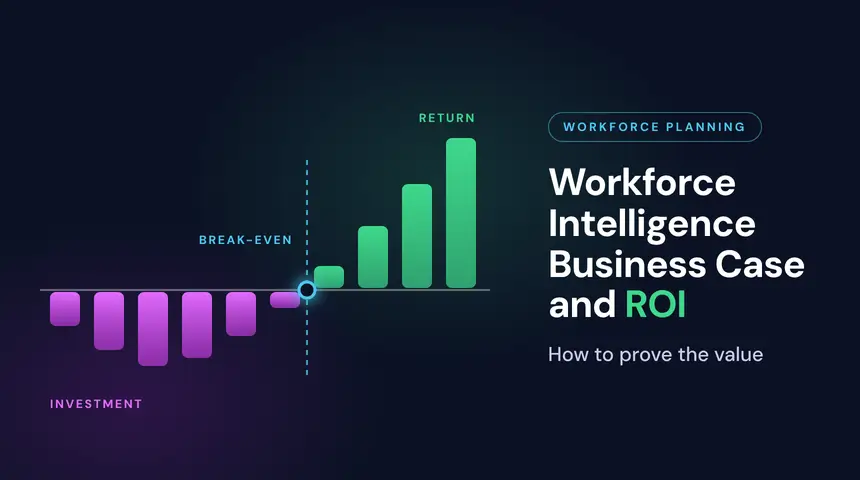
Every workforce decision has a price: which skills to build, where to move people, what to pay, which tasks to automate and what happens if a gap stays open. Workforce intelligence brings strategy, finance, people, market and AI data together so leaders can make those decisions with evidence. The investment still has to earn its place in the budget. This guide shows how to build a workforce intelligence business case and ROI model a CFO will trust: where the value comes from, how to count the full cost, how to stay conservative and how to present the result to the board.
What Is Workforce Intelligence?
Workforce intelligence connects internal workforce data with financial, strategic and external market data to answer decision questions: do we have the capabilities to execute our strategy, where are the gaps, what do they cost and what is the best way to close each one? It differs from HR reporting, which describes what has happened, and from a single analytics tool, which answers one question in one domain.
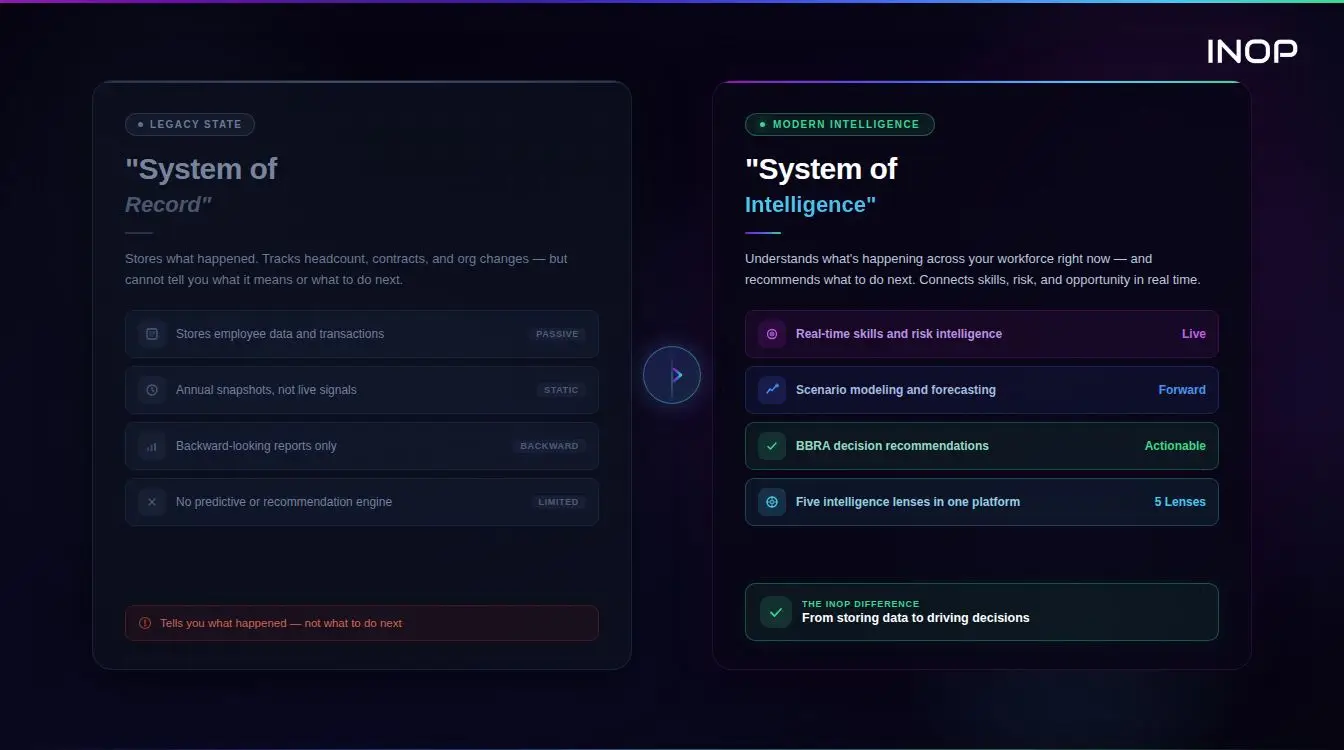
The shift is from a system of record to a system of intelligence: workforce data that informs decisions about capability, cost and risk.
Why Workforce Intelligence Needs a Business Case
Workforce costs are often the largest controllable expense in a business, yet the evidence behind workforce decisions is thin. The CIPD and Railpen’s review of FTSE 100 annual reports found that only 10% of firms disclosed total training costs, and only 13% referenced AI skills training for staff. If the largest companies cannot report what they spend on capability, few can show what it returns.
The gap between intent and progress is wide. Deloitte reports that, in its 2025 Human Capital Trends research, 82% of respondents say it is important to free up worker capacity, but only 8% are making great progress. AI programmes add pressure. BCG estimates that about 70% of the value from AI comes from the people side, with 20% from technology and 10% from algorithms. Organisations that invest in AI without workforce evidence are funding the smaller share of the value and guessing at the larger one.
A business case forces that evidence into the open. It names the decisions workforce intelligence will improve, puts a value on each one and sets the measures that will show whether the investment worked.
Where Workforce Intelligence Creates Value
The return comes from better decisions. Six levers account for most of it.
Better Gap-Closing Decisions
Every capability gap can be closed in more than one way: develop the skill, bring in external capability, move people who already have it or automate the work. Without a side-by-side comparison, organisations default to the option they used last time. Choosing the cheaper or faster route for even a share of gaps creates a direct, measurable saving.
Faster Reallocation of Capability
Moving people to the highest-value work is one of the strongest predictors of performance. In a McKinsey survey of 1,820 participants, fast talent reallocators were 2.2 times more likely to outperform competitors on total returns to shareholders. Workforce intelligence shows who sits closest to each priority role, which turns reallocation from a guess into a plan.
Sharper Pay Decisions
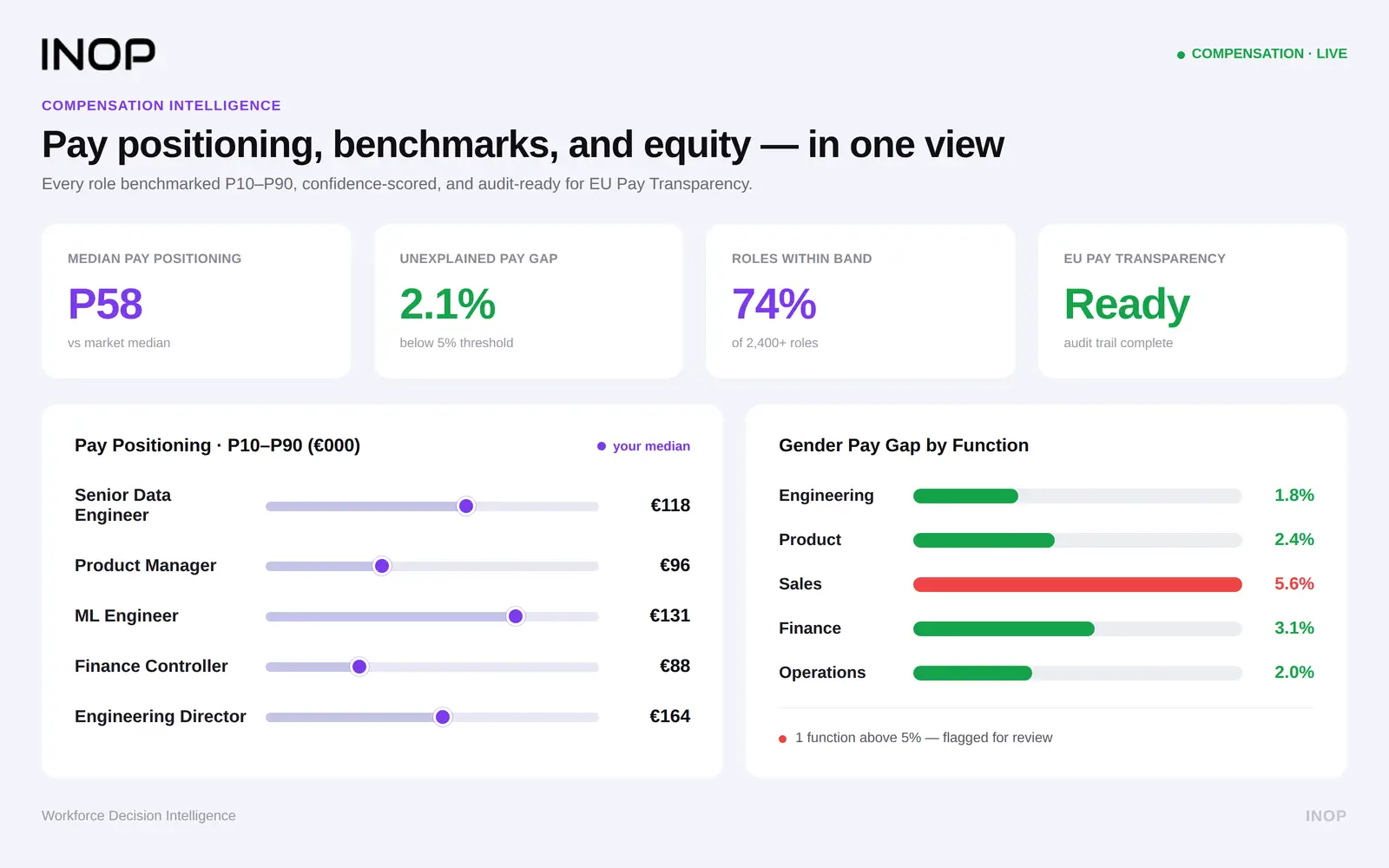
Skills that the market values are getting more expensive. Lightcast found that roles requiring AI skills offer 28% higher salaries, nearly $18,000 a year more. Market-based pay data lets you target adjustments at the roles and skills at risk, instead of spreading the budget evenly across everyone.
Smarter AI and Automation Sequencing
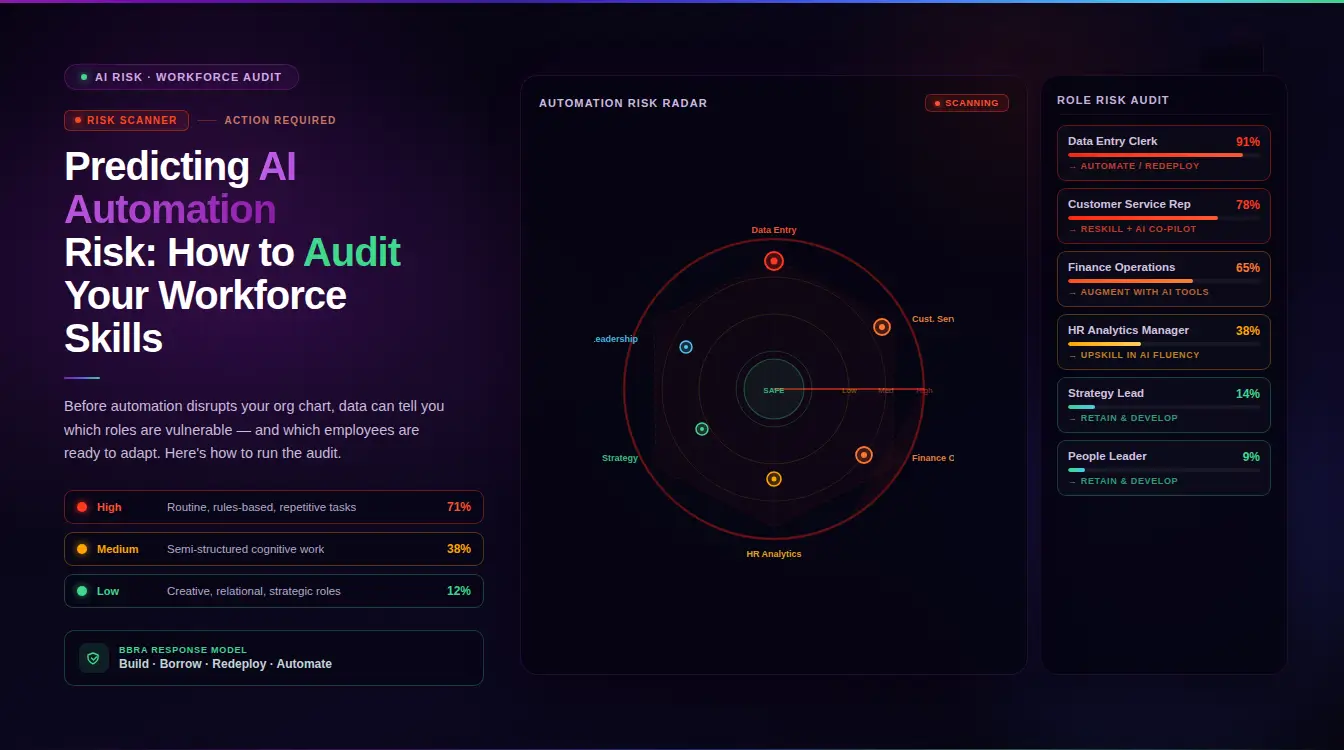
Task-level analysis shows which work AI will absorb, which roles will change and which skills the redesigned work will need. That prevents two common costs: training people in skills that are about to be automated, and automating work before anyone can oversee it. To set a target for each task, the levels of automation scale shows how far automation should go, from Level 0 manual work to Level 5 full automation, and what human oversight each level needs. That target is what turns task-level analysis into a cost and timing estimate for the business case.
Lower Workforce Risk
Losing people in critical roles costs productivity, knowledge and momentum on strategic initiatives. Early visibility of where capability is thin and where departures would hurt most lets leaders act before the gap opens.
Less Time Spent Assembling Data
HR, finance and strategy teams often spend weeks pulling workforce data from separate systems before any analysis starts. A single model cuts that time and lets the same people spend it on decisions.
How to Build a Workforce Intelligence Business Case and ROI Model
A credible business case is conservative, specific and tied to decisions the leadership team already has to make.
Start From the Decisions That Matter
List the workforce decisions on the agenda for the next one to three years: an AI programme, a restructuring, a new market, a pay review, an acquisition. Each decision is a place where better evidence creates value. A business case built on real decisions is easier to approve than one built on generic benefits.
Establish a Baseline
Record today’s numbers for each lever: external capability spend on roles that internal people could have filled, attrition in critical roles, training spend by skill, time spent preparing workforce reports and the size of recent pay adjustments. Where data is missing, use reasonable estimates and say so. The baseline is what the benefits are measured against.
Quantify Benefits by Lever
For each lever, estimate the change workforce intelligence will make and convert it to money. Keep the assumptions visible: number of gaps, cost difference per gap, share of decisions affected. Finance teams accept estimates they can trace and discount totals they cannot.
Count the Full Cost
Include the subscription or licence, implementation and data integration, internal time from HR, finance and IT, change management and training for users. Leaving out internal time is the fastest way to lose a CFO’s trust.
Apply a Realisation Factor
Not every benefit will land in year one. Multiply the gross benefit by a realisation factor, often 40% to 60% for the first year, to reflect adoption time and decisions that do not change. Showing a conservative case and an upside case gives the board a range instead of a single promise.
Calculate ROI, Payback and the Cost of Inaction
Use three measures:
- ROI = (realised benefit minus total cost) divided by total cost.
- Payback period = total cost divided by monthly realised benefit.
- Cost of inaction = the cost of the gaps and risks that stay open if nothing changes, such as delayed initiatives, lost capability and avoidable external spend.
The cost of inaction often carries the case. A board that hesitates over a new investment may move quickly once it sees what an unresolved capability gap is already costing.
Workforce Intelligence Business Case and ROI: A Worked Example
Consider an illustrative company with 5,000 employees preparing for an AI programme and a pay review. All figures are hypothetical.
| Value lever | Assumption | Annual gross benefit |
|---|---|---|
| Gap-closing and reallocation | 30 roles filled by moving existing people instead of external capability, saving €20,000 each | €600,000 |
| Critical-role retention | 12 fewer departures from critical roles, avoiding €45,000 of lost productivity and transition cost each | €540,000 |
| Training focus | Training budget moved away from skills that AI will automate | €250,000 |
| Pay decisions | Targeted adjustments for at-risk skills instead of a flat increase | €300,000 |
| Analysis time | 1,500 hours of HR and finance time saved at €65 an hour | €97,500 |
| Total gross benefit | €1,787,500 |
Applying a 50% realisation factor gives a year-one benefit of €893,750. Against an illustrative total year-one cost of €300,000, including implementation and internal time, the net benefit is €593,750. That is a year-one ROI of about 198% and a payback period of about four months. The figures are there to show the method. Your own baseline will produce different numbers.
How to Present the Business Case to the CFO and Board
- Lead with decisions. Open with the two or three decisions the investment will improve and what is at stake in each.
- Show the cost of inaction. Quantify what open gaps and slow decisions cost today.
- Give a range. Present a conservative case and an upside case, with the realisation factor visible.
- Make assumptions traceable. Every figure should link to a baseline number or a stated estimate.
- Commit to measures. Agree how and when you will report realised benefits, so the case becomes a performance commitment.
Common Mistakes in Workforce Intelligence Business Cases
- Selling features instead of decisions. Dashboards and integrations do not create value until they change a decision.
- Counting gross benefits as realised. A business case without a realisation factor looks inflated and gets discounted by finance anyway.
- Leaving out internal costs. Implementation and staff time are real costs, and the CFO will add them if you do not.
- Ignoring the cost of inaction. The status quo has a price, and it is often the strongest argument.
- No measurement plan. Without agreed measures, the next budget cycle starts from zero.
How INOP Delivers Workforce Intelligence ROI
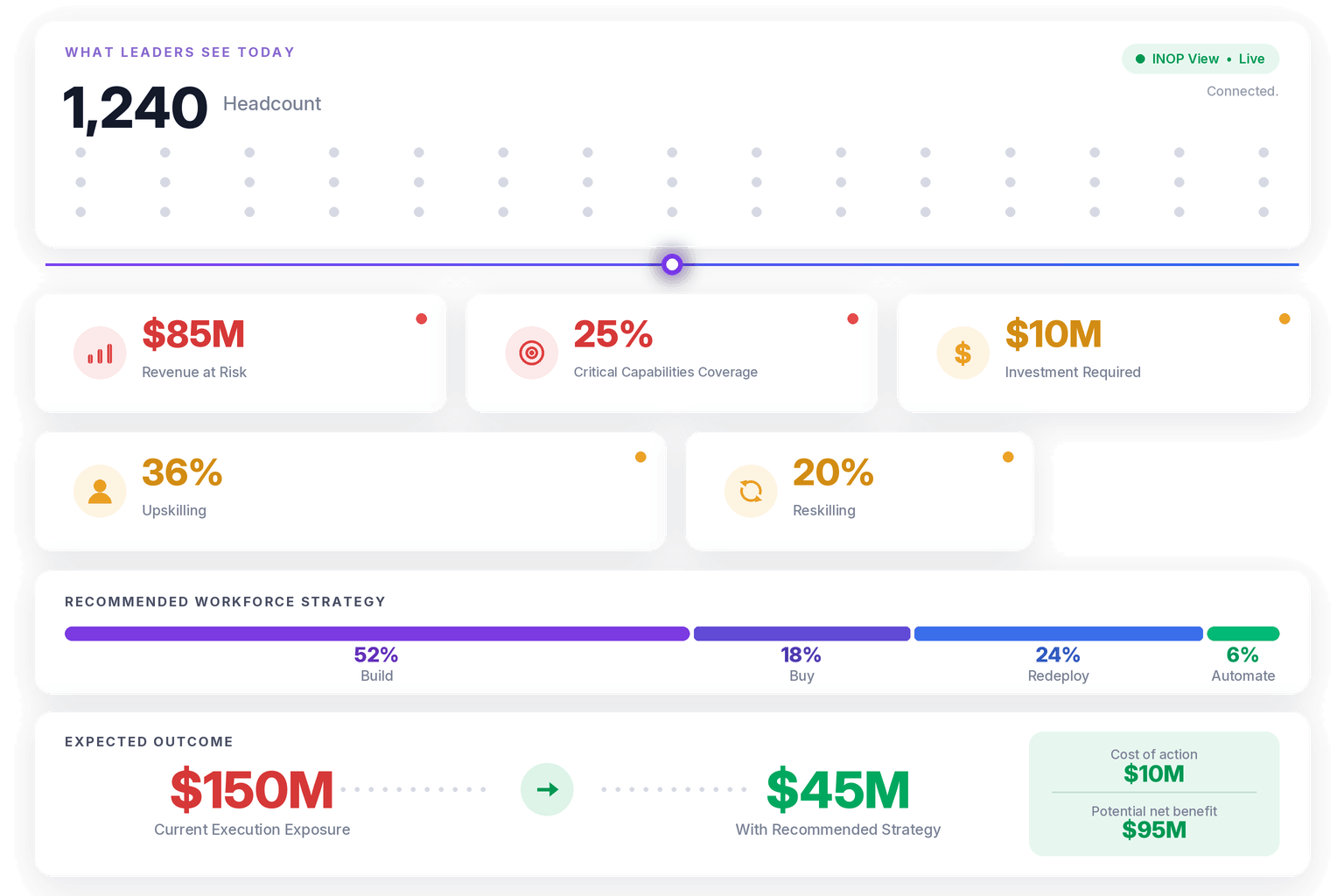
INOP starts from one question: does the organisation have the capabilities to execute its strategy today, and to stay ready as AI changes the work? It connects strategy, finance, people, market and AI data in one model to show which capabilities are in place, where the gaps and risks are, what those gaps cost if nothing changes and the best response to each one. Each lever in the business case above maps to something INOP measures.
INOP never assesses a workforce decision in isolation. Each one passes through five intelligence lenses: Strategy, Finance, People, Market, and AI and Automation. A gap only matters in relation to the strategy it affects, the budget involved, the people who could close it and the market the business competes in.
INOP’s proprietary BBRA decision architecture compares four pathways for every gap: Build, Buy, Redeploy and Automate. It models each pathway with its financial trade-offs across 30-day, 180-day, one-year and three-year horizons, which is the gap-closing lever in financial form. Execution Materiality, part of INOP’s layered risk model, quantifies the cost of leaving each gap open, so the cost of inaction rests on a calculation.
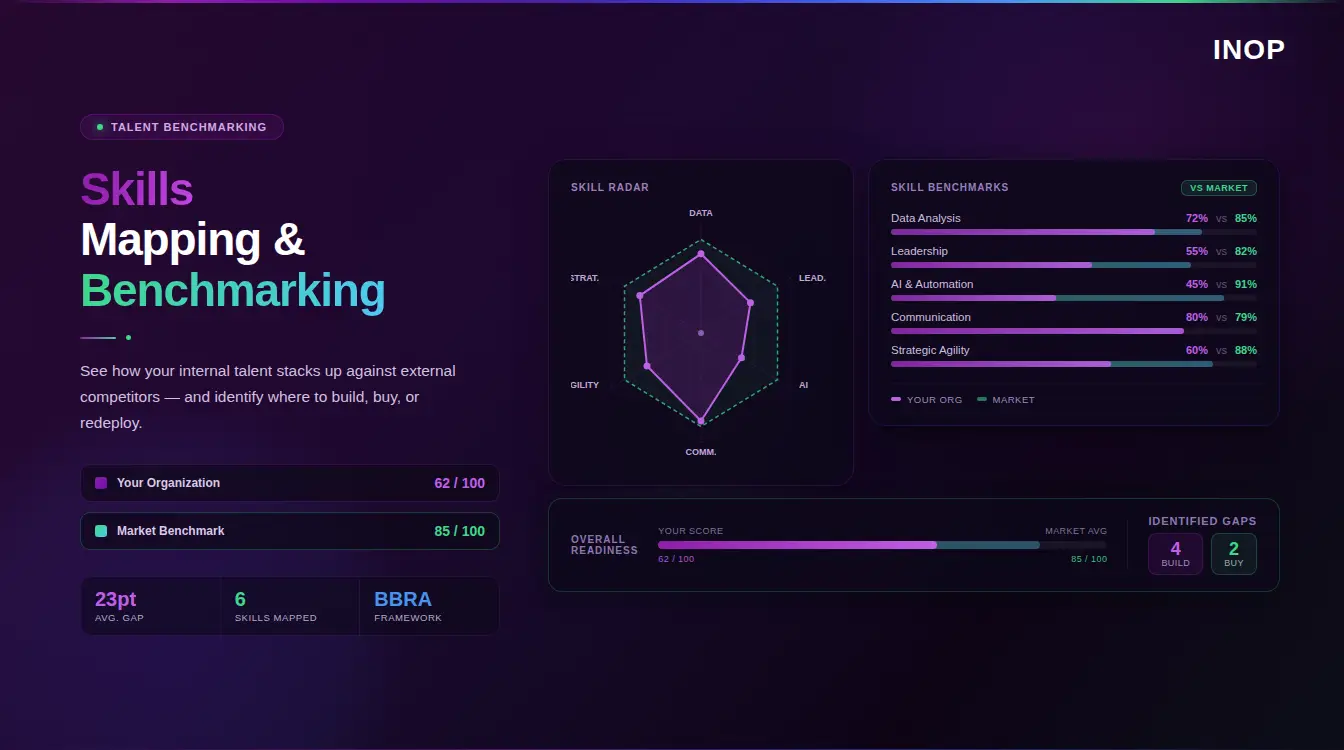
INOP’s strategic workforce planning platform scores readiness across five domains: Capability, Leadership, Role-Value, Mobility & Agility, and Cultural, with Strategic Execution Risk derived from those domains and the workforce plan. INOP’s skills intelligence classifies each skill as Emerging, In Demand, Stable or Declining, which shows where training budget will hold its value. INOP’s compensation analytics platform benchmarks pay from P25 to P90 across more than 2,400 role profiles, which supports the pay lever with current market data.
Results are available at organisation, business unit, department, country and individual level, and INOP works with role and task-level data where employee-level data is unavailable. That shortens the path to a first result and to the first realised benefit in the business case.
See what your open capability gaps cost today and what each response would return. Book a demo.
Workforce Intelligence ROI for PE Operating Partners
For operating partners, the business case for workforce intelligence sits inside the value creation plan. Workforce assumptions drive many of the plan’s numbers: synergies after an add-on, savings from AI, margin from a new operating model. Workforce intelligence tests those assumptions during diligence and tracks them through the holding period.
The return shows up in three places: fewer surprises after the deal, faster delivery of the capabilities the plan depends on, and a clearer workforce story at exit. Ask each portfolio company:
- Which workforce assumptions in the value creation plan are backed by evidence, and which are estimates?
- What do the open capability gaps cost each quarter they stay open?
- Which gaps will Build, Buy, Redeploy or Automate close, and when do the savings arrive?
- How will workforce performance be reported to the board and, eventually, to buyers?
INOP’s workforce intelligence for private equity applies the same lenses and BBRA horizons across each company you assess, with an initial analysis delivered within 48 hours of complete data submission, so returns on workforce decisions can be compared across a portfolio on one basis.
See whether the workforce assumptions in your value creation plans hold up, and what closing the gaps would return. Book a demo.
Frequently Asked Questions
What is a workforce intelligence business case?
A workforce intelligence business case sets out the workforce decisions an organisation needs to make, the value better evidence would add to each one, the full cost of the investment and the measures that will show whether it worked. It turns workforce data into a financial argument the CFO and board can test.
How do you calculate workforce intelligence ROI?
Estimate the annual benefit from each value lever, such as better gap-closing decisions, retention of critical people, targeted pay and saved analysis time. Apply a realisation factor for year one, subtract the full cost and divide by that cost. Add the payback period and the cost of inaction to complete the picture.
What are the main value drivers of workforce intelligence?
The main drivers are better choices between building, buying, redeploying and automating, faster reallocation of people to priority work, targeted pay decisions, smarter sequencing of AI and automation, lower risk in critical roles and less time spent assembling data.
How long does it take to see a return on workforce intelligence?
It depends on the decisions on the agenda. Organisations facing an AI programme, restructuring or pay review can see value within the first year, because the first decision informed by better evidence starts the return. A conservative business case assumes partial realisation in year one.
How should PE operating partners assess the ROI of workforce intelligence?
Operating partners should measure it against the value creation plan: whether workforce assumptions are evidence-based, how fast capability gaps close, what open gaps cost each quarter and how clearly the workforce story can be told at exit. Using one method across the portfolio makes returns comparable company by company.