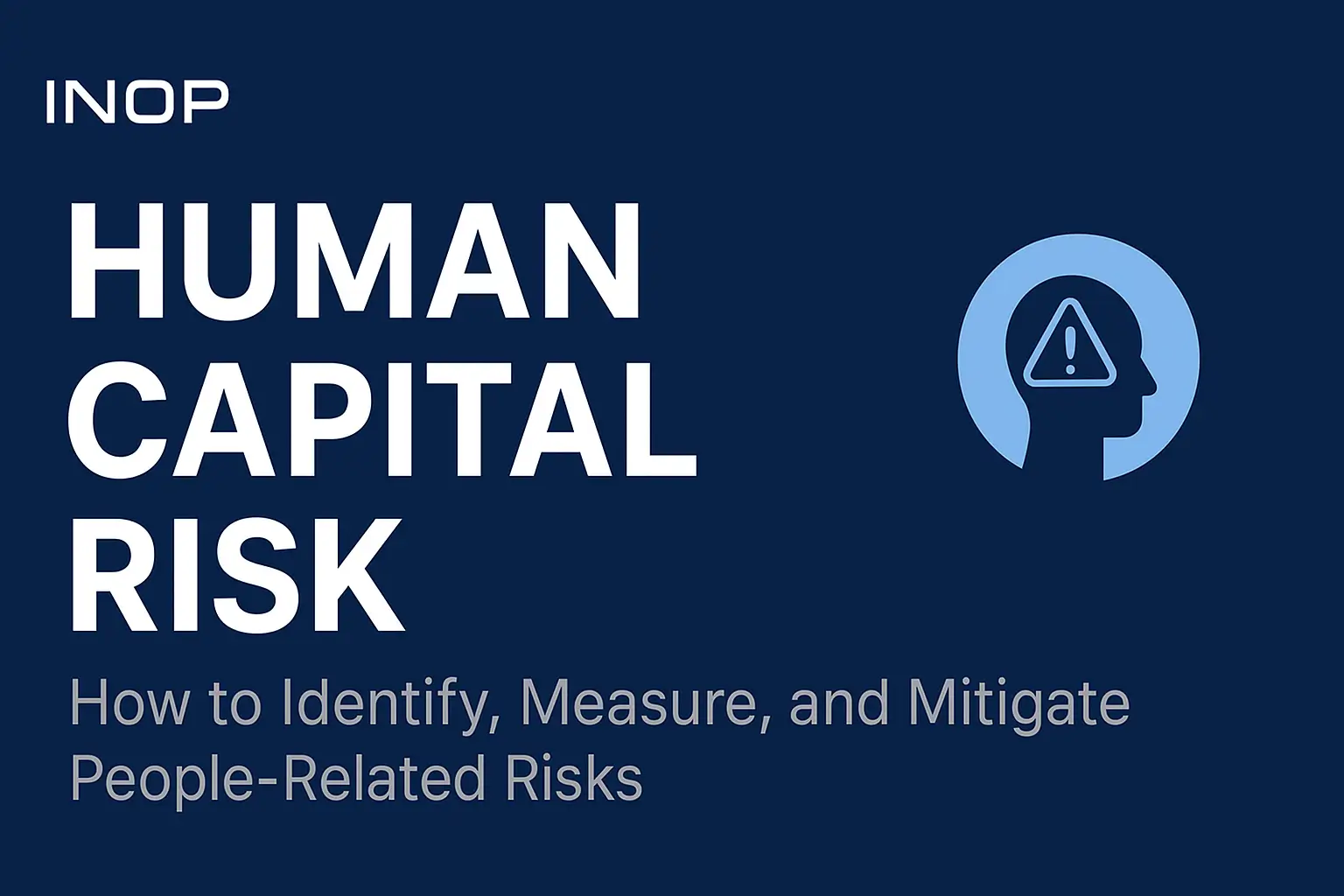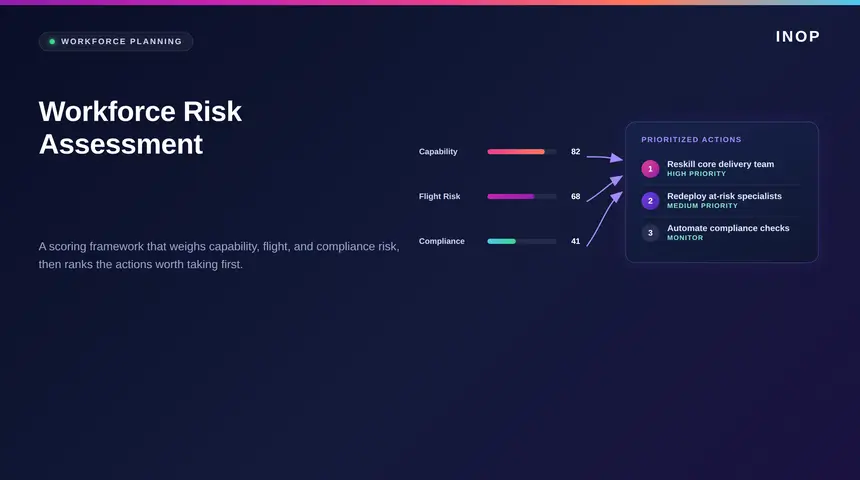
Workforce risk assessment is the structured process of identifying, scoring, and prioritizing the people-related threats that could keep an organization from executing its strategy, from a concentration of critical skills in one or two employees to a leadership pipeline too shallow to survive an unexpected departure. Most organizations can list their workforce risks without much trouble. Far fewer can tell you which of those risks actually deserves budget and executive attention this quarter, because listing risk and scoring risk are two very different exercises, and most workforce risk assessments stop at the list.
This guide covers the scoring methodology a credible workforce risk assessment actually requires, why so many assessments produce a report nobody acts on, and how to connect a risk score to a real response instead of a static document reviewed once a year.
What Workforce Risk Assessment Actually Measures
Workforce risk assessment is not the same as a risk inventory. An inventory names the risks: succession gaps, skill concentration, leadership depth, cultural erosion, execution capacity. Assessment goes further, scoring each of those risks so leadership can tell the difference between a risk worth monitoring and one that needs immediate action. Without scoring, every risk on the list looks equally urgent, which in practice means none of them get treated as urgent at all.
The Scoring Methodology Behind a Credible Assessment
A workforce risk assessment that actually drives decisions borrows its core logic from established risk management practice: score each risk on two dimensions, how likely it is to materialize and how severe the impact would be if it did, then multiply the two to produce a single, comparable risk score.
Likelihood and Impact, Not a Single Severity Score
A risk assessment matrix plots likelihood against impact on a grid, typically a five by five scale, ranking each risk from rare to almost certain on one axis and from negligible to catastrophic on the other. The resulting score, calculated as likelihood multiplied by impact, is what separates a workforce risk assessment from a gut-feel list of concerns, according to recent research on risk assessment matrix methodology. Anchoring likelihood scores in actual data, past incidents, industry benchmarks, historical turnover in a given role, rather than intuition is what makes the resulting score defensible when it needs to justify budget or executive attention. The same methodology recommends scoring impact across multiple dimensions, financial, operational, and reputational among them, since a risk that looks moderate on one dimension can be severe on another, and the highest single dimension should typically set the overall severity rating rather than an average across all of them.
On a typical five by five grid, the resulting scores generally sort into four bands: low risk, requiring monitoring but no immediate action, medium risk, warranting defined controls and periodic review, high risk, requiring active mitigation and senior leadership awareness, and critical risk, demanding immediate action and visibility at the board level. Sorting workforce risks into these same four bands, rather than treating every identified concern as equally deserving of executive time, is what makes the resulting assessment usable in a budget or planning conversation rather than just a compliance exercise.
Scoring the Six Domains of Workforce Risk
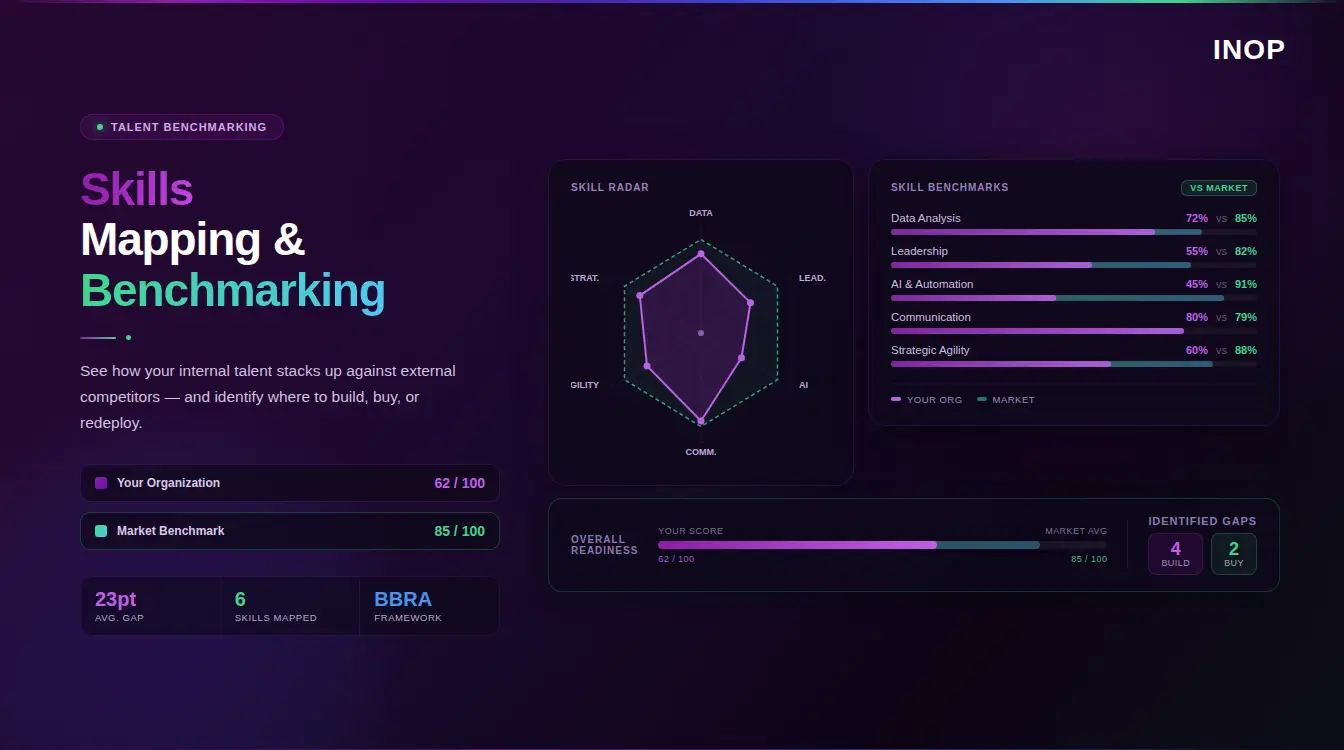
Applying this methodology to workforce risk specifically means scoring across a defined set of domains rather than an ad hoc list that varies by whoever ran the assessment. INOP’s Workforce Risk Engine evaluates exposure across six named domains: Capability Risk, the gap between required and available skills; Leadership Risk, the depth and readiness of succession pipelines; Mobility Risk, how easily talent can move to where it is needed; Role-Value Risk, whether roles are correctly weighted against the value they create; Culture Risk, engagement and retention signals that predict future disruption; and Strategic Execution Risk, whether the workforce as a whole can actually deliver on stated business priorities. Scoring likelihood and impact within each of these six domains, rather than treating workforce risk as one undifferentiated category, is what makes an assessment granular enough to act on.
Capability Risk in particular is difficult to score accurately using internal data alone, since an internal skills inventory only reflects what the organization believes it has, not whether that capability is becoming scarcer or more replaceable in the outside labor market. INOP’s skills intelligence platform supports this specific domain by mapping external demand signals, classified as emerging, in demand, stable, or declining, against your existing skills taxonomy, so a Capability Risk score reflects current market reality rather than an assumption about how hard a given skill would be to replace.
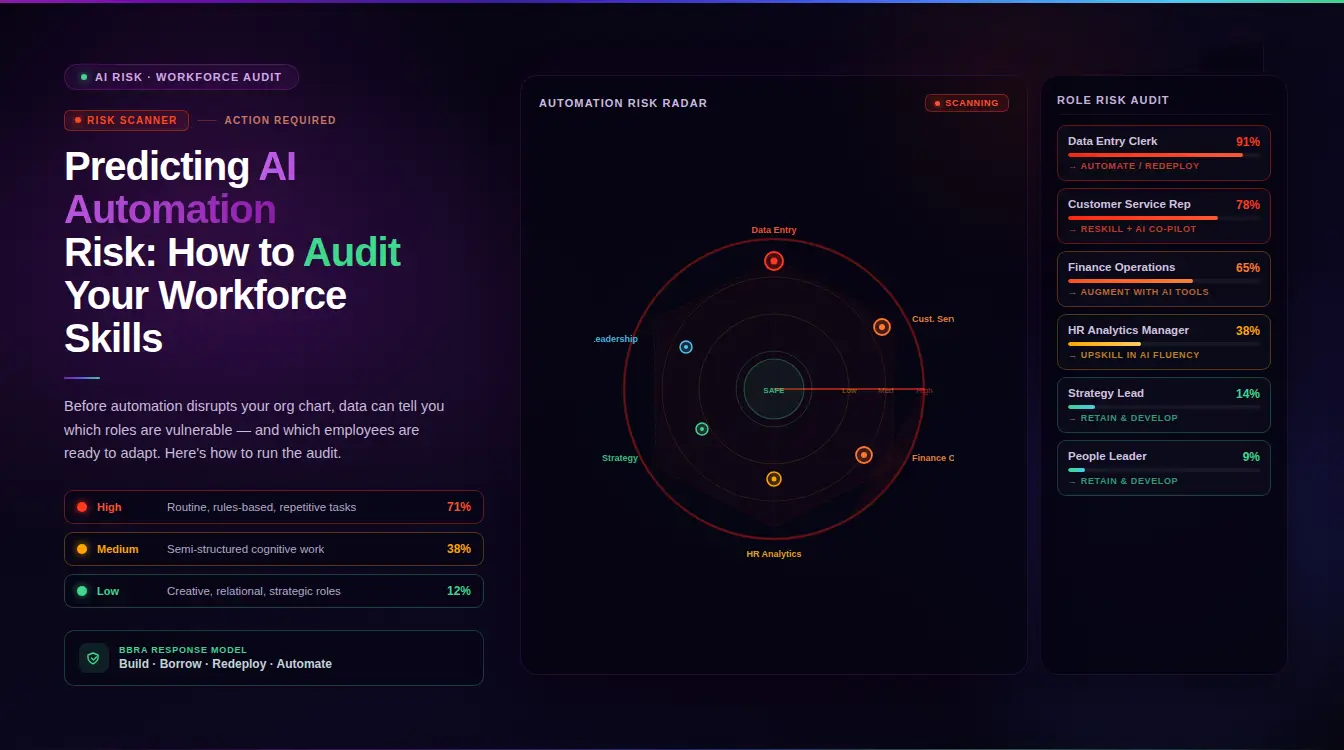
The AI and Automation lens in this scoring framework depends on a precise understanding of what automation risk actually measures at the task level. Automation risk is not a role-level percentage borrowed from industry reports. It is the exposure a specific task carries to AI or software substitution, scored by task composition within each role, which is what makes the resulting risk score actionable rather than illustrative.
See how INOP’s Workforce Risk Engine scores exposure across all six risk domains for your organization. Book a demo to walk through a live risk assessment.
Turning a Risk Score Into Ownership and Action
A scored risk with no owner stays scored. This is the step most workforce risk assessments skip, and it is the difference between a document and a working system. Every risk that scores in the medium range or above needs a named owner, a defined treatment approach, whether that means accepting the risk, mitigating it, transferring it, or actively avoiding it, and a review cadence that specifies when the score gets reassessed. Without this layer, even a well-scored assessment becomes what risk practitioners call a wall poster: accurate, well-organized, and completely disconnected from what the organization actually does next.
Ownership also needs to sit with someone who has the authority and budget to actually act on the risk, not simply the person most familiar with it. A Capability Risk finding tied to a scarce technical skill, for instance, might be best understood by a team lead, but the authority to fund an upskilling program, redeploy talent from elsewhere, or approve an external hire usually sits higher up. Assigning ownership without matching authority is a common way a well-scored risk still ends up unaddressed, since the named owner has visibility into the problem but no real ability to fund a response to it.
Why Static Risk Assessments Fail Within a Quarter
A workforce risk assessment scored once and filed away loses its value almost immediately, because the underlying conditions driving each score keep moving. A leadership risk scored as moderate can shift sharply after a single unexpected departure. A capability risk scored as low can climb quickly if external demand for that skill spikes. Modern risk management practice increasingly treats review as continuous rather than tied to a fixed annual or quarterly calendar, with scores updated whenever a relevant incident occurs, a control changes, or new data shifts the underlying likelihood. Workforce risk deserves the same discipline. An assessment that only gets revisited once a year is, for at least part of that year, describing a workforce that no longer exists.
INOP’s Five Intelligence Lenses Applied to Workforce Risk Assessment
A risk score by itself tells you how urgent a threat is. It does not automatically tell you what to do about it, or whether the response is worth its cost. INOP evaluates every scored workforce risk through five intelligence lenses before it becomes a funded initiative.
- Strategy: Does this risk threaten a specific business priority, which would justify moving it up the response queue ahead of a similarly scored risk elsewhere?
- Finance: What does mitigating this risk actually cost, and does that cost make sense relative to the financial exposure if the risk materializes?
- People: Who is affected if this risk plays out, and does the organization have adjacent capability that could absorb the impact?
- Market: Does external labor market data change how urgent this risk actually is, for instance by showing a critical skill is becoming harder or easier to source externally?
- AI and Automation: Could automation reduce exposure to this risk directly, changing the calculus on how much to invest in a workforce-based mitigation?
Running a risk score through all five lenses is what prevents an organization from over-investing in a well-scored but strategically minor risk while under-resourcing a lower-scored risk that happens to sit directly in the path of a critical initiative.
BBRA: From Risk Score to Modeled Response
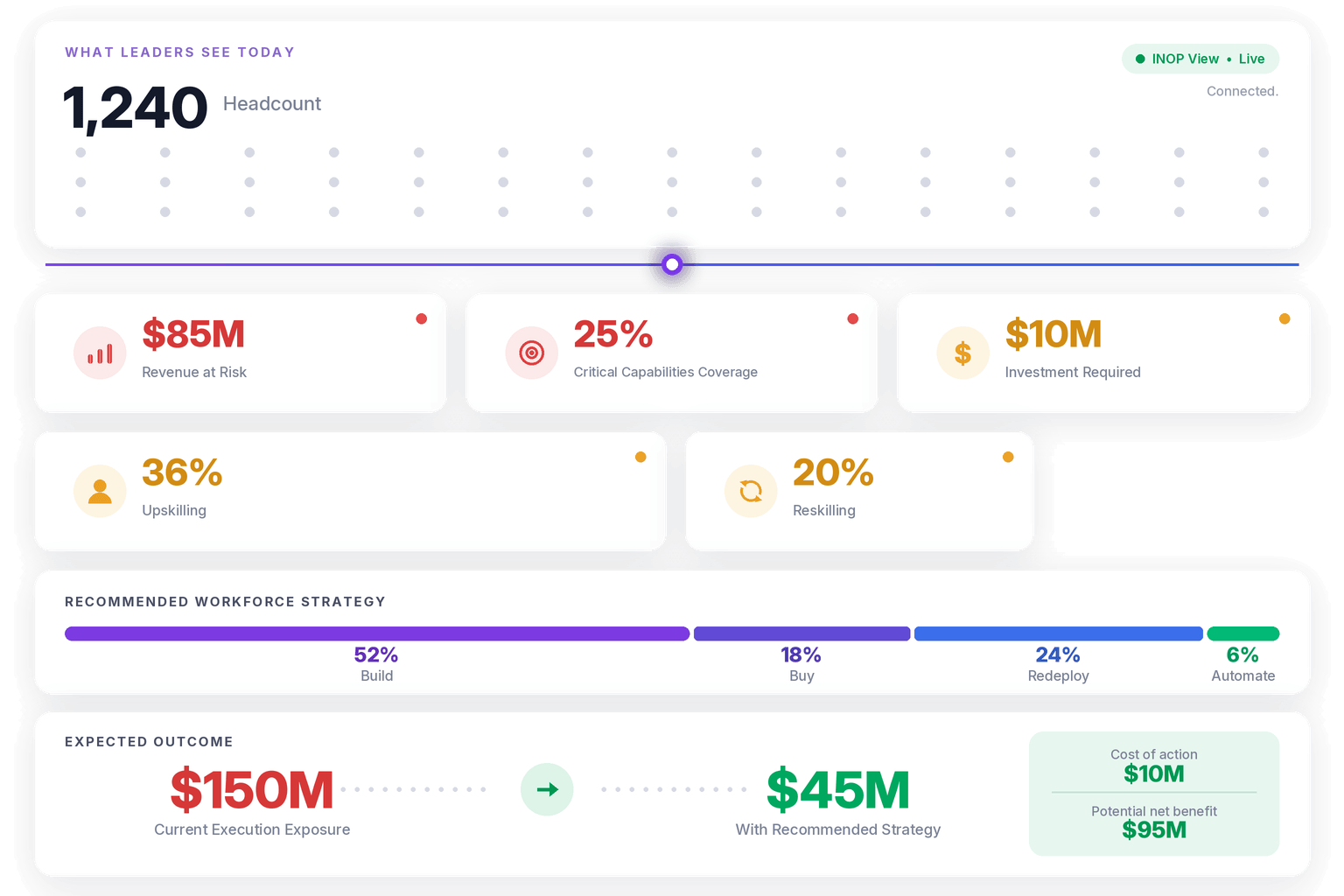
Once a workforce risk is scored and assigned an owner, the actual mitigation still needs a structure, and this is where INOP’s proprietary BBRA framework comes in. BBRA, Build, Buy, Redeploy, and Automate, models four intervention pathways against financial tradeoffs across four time horizons: thirty days, one hundred eighty days, one year, and three years.
Applied to a scored risk, this means a critical Capability Risk finding, a skill concentrated in one or two people, does not default automatically to a training plan or an external hiring search. It gets modeled: would cross-training a second person close the concentration fastest, would redeploying someone with adjacent skills reduce exposure sooner, does the risk justify external hiring given current market scarcity for that skill, or does the underlying task make more sense to automate, removing the concentration risk entirely rather than mitigating it. This is the step that turns a risk score from a number on a dashboard into an actual funded response with a defined timeline.
What that modeling needs to account for is the substantial gap between an AI agent working in a pilot and one running reliably in production. AI workforce automation at scale requires governance architecture that most organizations have not built before the pilot ends, and a deployment cost structure that changes the economics compared to what the pilot suggested.
Workforce Risk Assessment for Private Equity Operating Partners
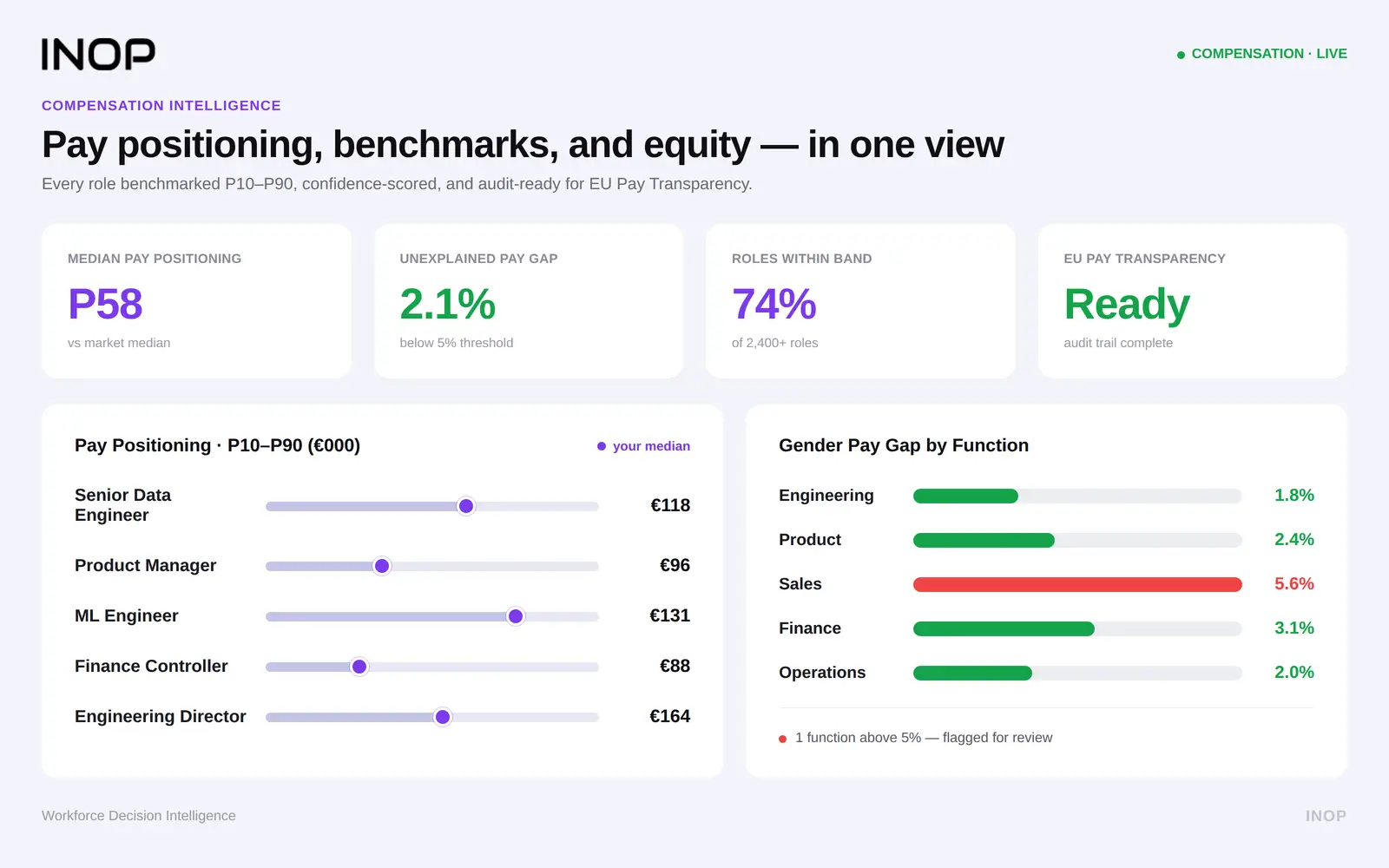
Inside a diligence process or a hundred-day plan, an unscored workforce risk inventory is close to useless. A portfolio company that can list its risks but cannot rank them by likelihood and impact is handing an operating partner a document that looks thorough and provides no basis for prioritization. Standardizing workforce risk assessment across a portfolio through INOP’s strategic workforce planning platform gives operating partners a consistent scoring methodology to compare exposure across assets, rather than reconciling each portfolio company’s own ad hoc risk list against the next. Where a scored risk touches roles carrying scarce, high-demand capability, INOP’s compensation analytics platform connects that finding directly into pay benchmarking, since a high-scoring capability or leadership risk often has a retention and compensation dimension that a pure risk score alone will not surface.
Common Mistakes in Workforce Risk Assessment
Listing risks without scoring them. A risk inventory with no likelihood and impact scores gives leadership no way to distinguish an urgent threat from a minor one, which in practice means everything gets treated with equal, and usually insufficient, urgency.
Score inflation. When every risk gets rated high or critical to ensure it gets attention, the scoring loses its purpose entirely. A credible assessment requires discipline about what genuinely qualifies as high likelihood or high impact, not a rating inflated to compete for budget.
Relying on a single rater. One person’s view of how likely a workforce risk is to materialize is incomplete. Involving multiple perspectives, HR, finance, and the business unit affected, produces scoring that reflects more than one vantage point on the same risk.
Treating the assessment as an annual event. A workforce risk assessment scored once a year is already stale for at least part of that cycle. INOP’s guidance on using data and analytics to predict human capital risks covers how continuous, data-driven monitoring catches shifts an annual review would miss entirely.
Scoring risk without assigning ownership or a treatment plan. A risk score with no named owner and no defined response, whether that response is to accept, mitigate, transfer, or avoid the risk, stays a number on a page. Turning a scored risk into a working response is exactly the gap INOP’s guidance on building a human capital risk playbook is built to close, connecting a scored risk to a defined mitigation plan rather than leaving it documented and unaddressed.
Never visualizing the scored portfolio for leadership. A spreadsheet of scored risks buried in a compliance folder rarely drives the executive attention a critical score deserves. INOP’s approach to building a human capital risk dashboard turns a scored assessment into something leadership actually looks at regularly, rather than a document reviewed once and forgotten.
Averaging severity across dimensions instead of taking the highest. A risk that scores low on financial impact but severe on strategic execution impact is a severe risk overall, not a moderate one. Averaging across dimensions understates exactly the risks that deserve the most attention, since a single catastrophic dimension gets diluted by several milder ones.
Frequently Asked Questions
What is the difference between a workforce risk inventory and a workforce risk assessment?
An inventory lists the risks. An assessment scores each one by likelihood and impact, producing a ranked view that shows which risks need immediate attention and which can be monitored, rather than treating every listed risk as equally urgent.
How is workforce risk assessment scored?
Most credible methodologies score each risk on two dimensions, likelihood and impact, typically on a five-point scale, then multiply the two to produce a single risk score. Applied to workforce risk specifically, this scoring happens across defined domains such as capability, leadership, mobility, role-value, culture, and strategic execution risk.
How often should a workforce risk assessment be updated?
Continuously is the ideal, with scores revisited whenever a relevant incident occurs, a mitigation is implemented, or new data changes the underlying likelihood. At minimum, a quarterly review cadence keeps the assessment from going stale between planning cycles.
What should happen after a workforce risk is scored as high or critical?
The risk needs a named owner and a defined treatment approach, then a response modeled against real alternatives, comparing build, buy, redeploy, and automate pathways before committing budget, rather than defaulting to whichever response is easiest to assign.
How should private equity operating partners evaluate a portfolio company’s workforce risk assessment?
By checking whether risks are actually scored by likelihood and impact, with named owners and defined treatment plans, rather than accepting an unscored list of concerns. A scored, owned risk portfolio is a far more reliable basis for prioritizing a hundred-day plan than a general narrative about workforce challenges.
Ready to see your workforce risk scored across all six domains instead of listed in a spreadsheet? Book a demo and INOP will walk through a live risk assessment, run every high-scoring risk through BBRA, and show you exactly where to act first.