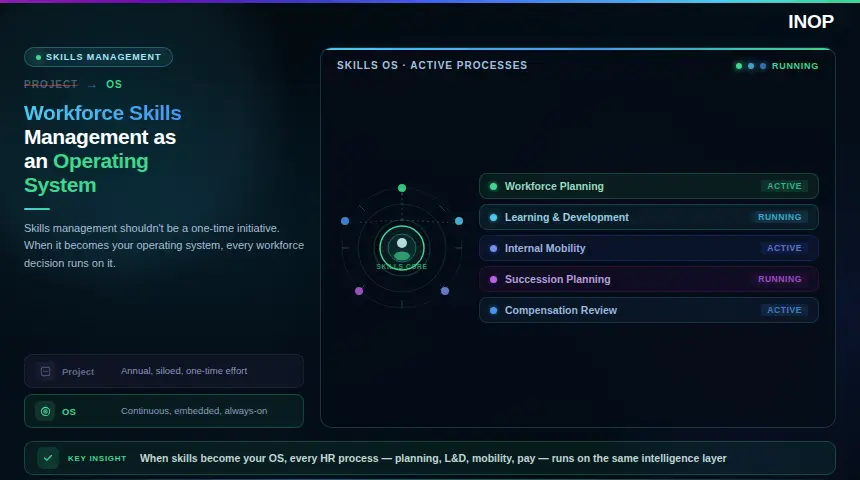
Workforce skills management is the ongoing practice of identifying, developing, deploying, and governing the skills across an organization so the right capability is available where and when the business needs it. It is not a single initiative with a start and end date. Most organizations still run it that way, treating skills work as a project that gets kicked off, staffed for a quarter, and then quietly shelved once the initial taxonomy is built. That approach is why so many skills programs stall well short of the outcome they were meant to deliver.
This guide covers what workforce skills management actually requires as an ongoing system, the four pillars that hold it together, where most organizations get stuck between building the foundation and actually deploying skills where they are needed, and how to structure the governance layer that keeps the whole thing from going stale.
What Workforce Skills Management Actually Means
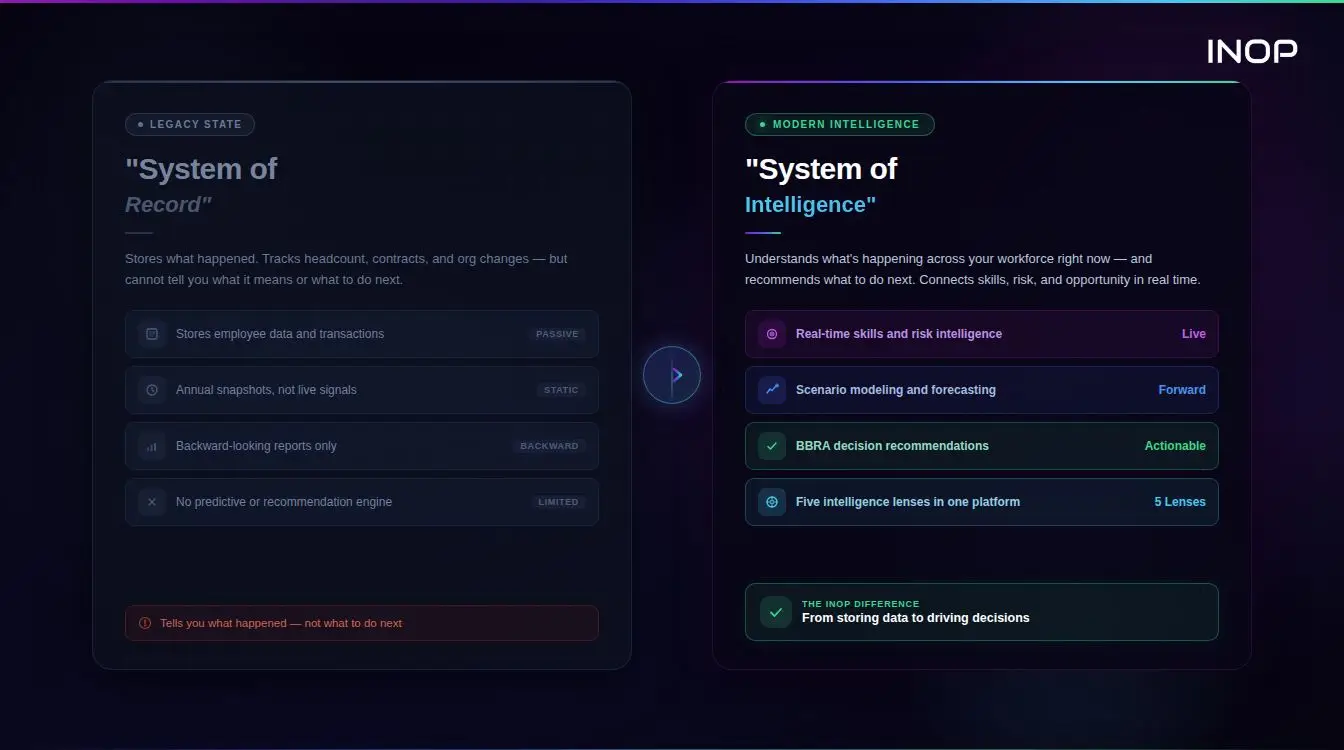
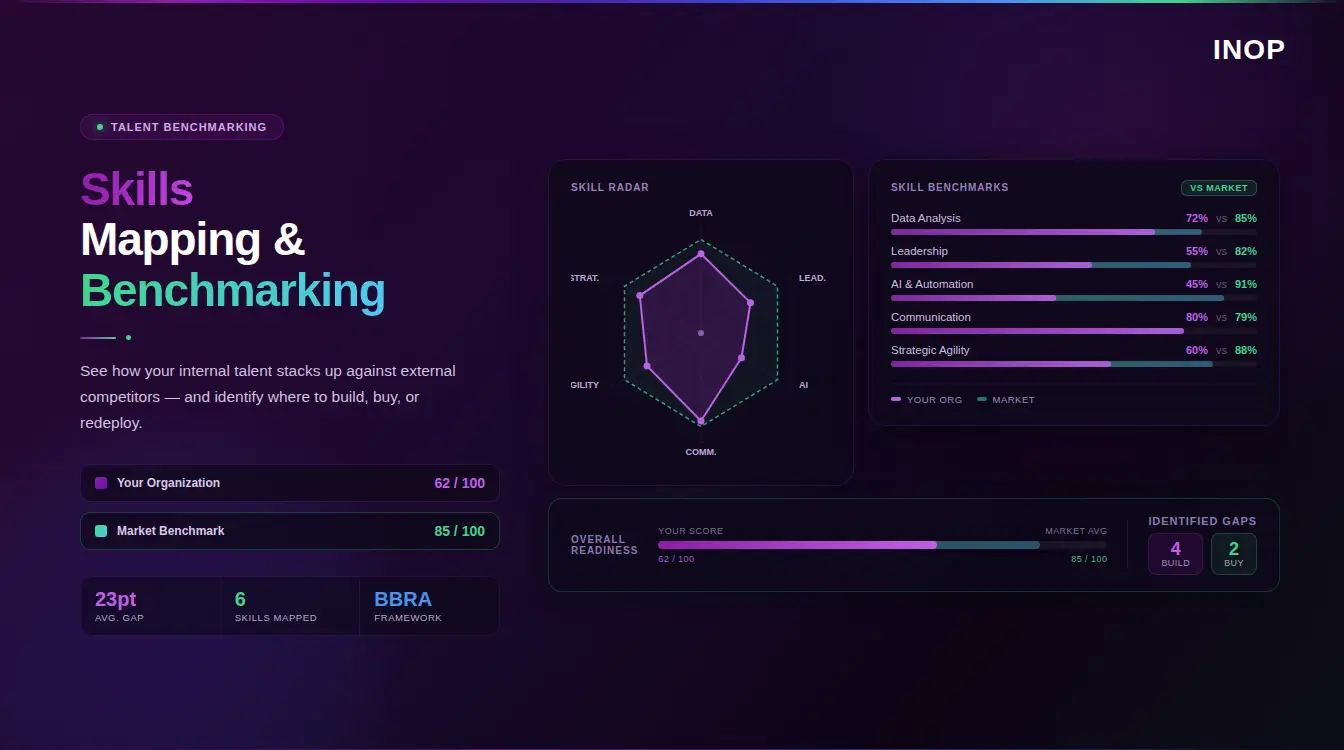
Workforce skills management is broader than a skills taxonomy, and it is broader than skill gap analysis. A taxonomy is one input. Gap analysis is one diagnostic step. Skills management is the full operating system that connects those pieces to actual workforce decisions: who gets trained, who gets redeployed, who gets hired, and who gets assigned to which project, all informed by a current, verified view of what skills the organization actually has.
It is also worth distinguishing skills management from talent management more broadly, since the two get used almost interchangeably in practice. Talent management is the wider discipline covering recruitment, performance, succession, and career development as an integrated whole. Workforce skills management is the specific layer inside that discipline focused on capability itself, the actual, verified skills an organization has, needs, and can move around. A company can run a mature talent management function, complete with performance reviews and succession plans, while still lacking any real skills management system underneath it, because none of those talent processes require a verified, current picture of what people can actually do at the skill level. That gap is usually invisible until a project stalls waiting for a capability nobody can locate quickly, even though the organization is confident, on paper, that the capability exists somewhere.
The organizations getting real value from this shift are not the ones that ran a one-time skills mapping exercise. They are the ones treating skills as ongoing infrastructure. According to Mercer’s 2025/2026 Skills Snapshot Survey, 91 percent of companies now see AI transforming their workforce and are actively planning how to respond to it, and the underlying skills infrastructure organizations have built to support that response has grown steadily: 38 percent now maintain a single, enterprise-wide skills library, up from 30 percent just two years earlier, 55 percent map skills directly to jobs rather than relying on job titles alone, up from 47 percent, and the average share of jobs with skills actually mapped has climbed to 72 percent, according to Mercer’s research on skills-powered organizations. That same research frames the discipline in almost exactly these terms: organizations that identify, develop, and deploy talent based on skills rather than roles alone are the ones achieving real workforce agility, which is the definition this guide builds on.
The Four Pillars of Workforce Skills Management
A durable skills management system rests on four connected pillars. Weakness in any one of them limits what the other three can actually deliver.
Identify: Building a Skills Foundation
Everything downstream depends on having a shared, current picture of what skills exist across the organization and how they map to roles. This means more than a static taxonomy document. It means a living reference that gets revisited on a defined schedule, since a skills foundation that goes two or three years without an update stops reflecting what the business actually looks like. Identification also needs to combine internal signals, self-assessment, manager validation, demonstrated work output, with external labor market data, since an internal-only view cannot tell you whether a skill your organization values is gaining or losing relevance outside your walls.
Develop: Closing Gaps With the Right Pathway
Once a gap between required and current skills is identified, development is the response most organizations reach for automatically, and it is not always the fastest or most cost-effective one. A mature skills management system treats development as one available pathway among several, weighed against redeployment, external hiring, and automation, rather than the default answer to every gap regardless of its size or urgency.
Deploy: Moving Skills to Where They Are Needed
This is the pillar most organizations underbuild. Identifying and developing skills does no good if there is no mechanism for actually moving people to the roles, teams, or projects where those skills are needed most. Deployment requires real-time visibility into who has which verified capability right now, not a snapshot from the last annual review, and a process for matching that capability to demand as it shifts, rather than relying on managers to happen to know who on their team could help elsewhere.
In practice, this pillar covers a wider set of decisions than most organizations initially account for: staffing a new project team based on verified skill match rather than availability alone, identifying internal candidates for an open role before posting it externally, and flagging when a team’s collective skill mix has drifted out of alignment with what its current workload actually demands. Each of these is a deployment decision, and each one depends on the same underlying requirement, a current, trustworthy view of capability that updates faster than an annual cycle allows.
Govern: Keeping the System Current
The fourth pillar is the one most commonly missing entirely, and its absence is what causes the other three to decay. Governance means a defined, recurring process for reviewing the skills taxonomy, checking whether proficiency benchmarks still reflect what roles actually require, and confirming that the deployment mechanism is still connecting people to opportunities accurately. Without it, a skills management system that looked strong at launch quietly reverts to the static, one-time project it was meant to replace.
See how INOP runs all four pillars of workforce skills management as one connected system. Book a demo to walk through a live view for your organization.
Why Most Organizations Stall Between Identify and Deploy
The pattern is consistent across organizations at very different levels of maturity. Building the skills foundation, the identify pillar, gets real investment and executive attention, because it produces a visible deliverable: a taxonomy, a dashboard, a mapping exercise with a clear before-and-after. Deployment gets far less investment, because it requires an ongoing operational capability rather than a one-time project, and it touches sensitive territory like internal mobility, manager control over headcount, and cross-functional politics that a taxonomy project never has to navigate.
The result is an organization that can tell you, with real precision, what skills it has, and still cannot move a person with the right skill to the project that needs them without weeks of informal networking and manager-to-manager favors. A skills foundation without a working deployment mechanism is an expensive reference document, not a management system.
INOP’s Five Intelligence Lenses Applied to Workforce Skills Management
A skills decision, whether it is about development, deployment, or governance, rarely stays contained to a single dimension. INOP evaluates every workforce skills management decision through five intelligence lenses so a choice that looks right from one angle does not create a problem from another.
- Strategy: Does this skills decision support a specific business priority, or is it being made because it was the easiest option available?
- Finance: What does the chosen pathway, whether development, redeployment, hiring, or automation, actually cost against the alternatives?
- People: Who else already holds this skill, and where does concentration or succession risk sit if this particular gap goes unaddressed?
- Market: Does external labor market data confirm this skill is worth the investment, or is demand for it already shifting elsewhere?
- AI and Automation: Could the underlying task be automated, which would change whether a skills-based response is even the right call?
Running every skills decision through these five lenses is what keeps a skills management system from optimizing one pillar, usually identification, at the expense of the deployment and governance work that actually determines whether the system delivers value.
BBRA: The Decision Engine Behind Deployment Decisions
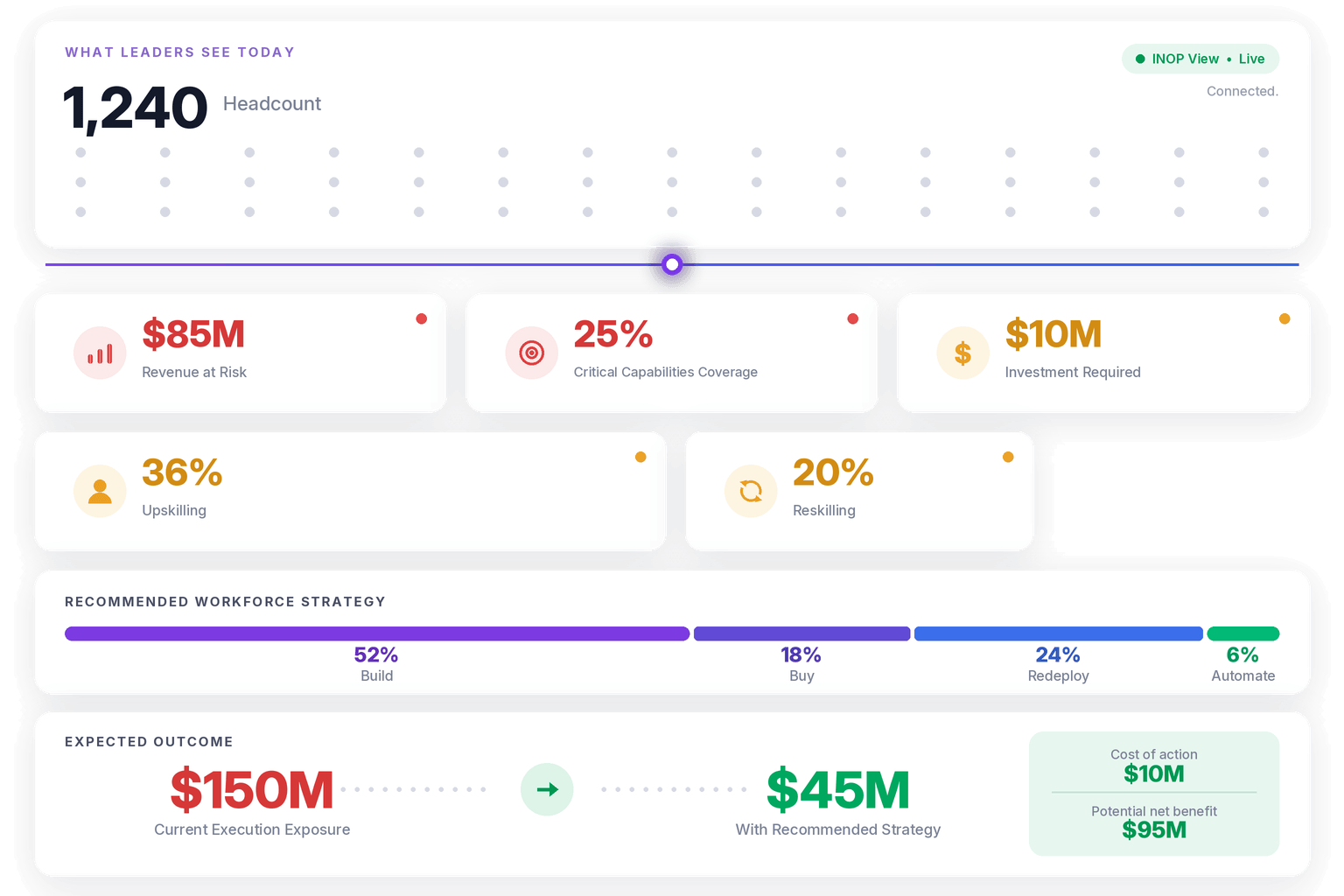
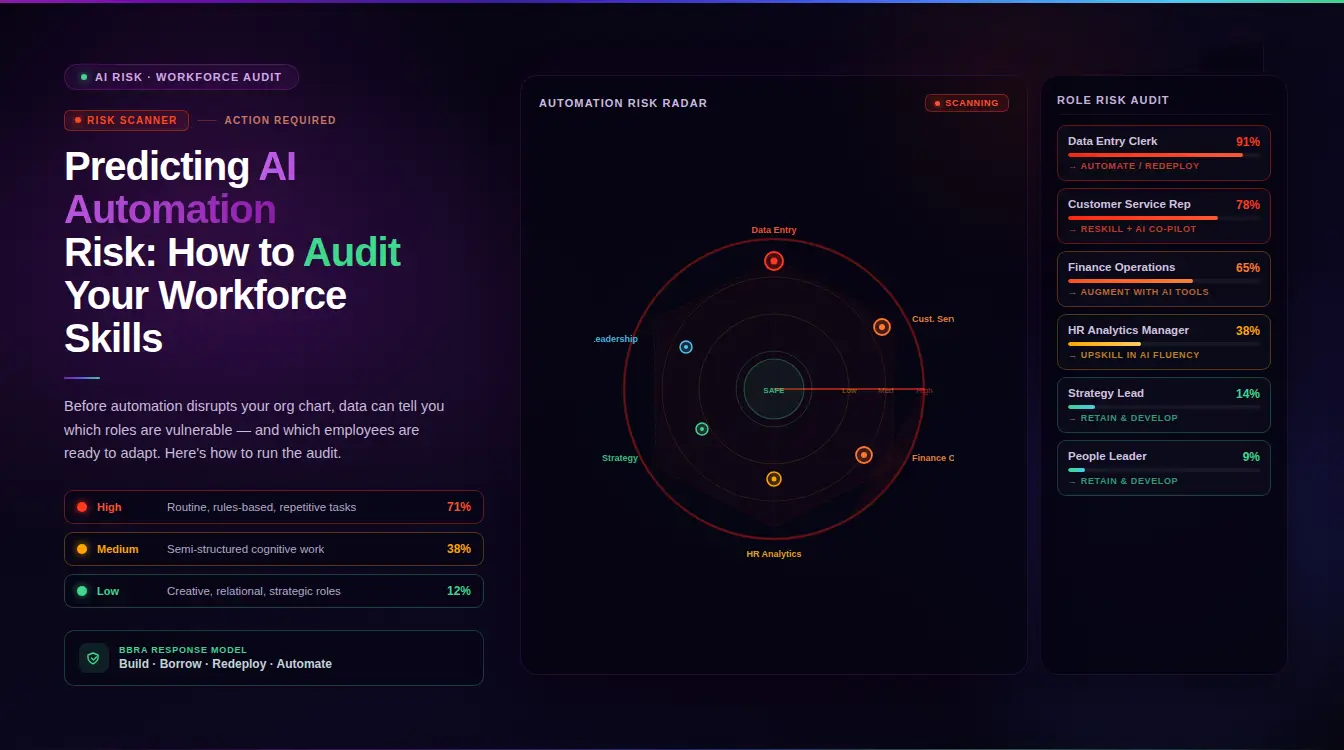
Once a skill gap or a deployment opportunity is identified, INOP’s proprietary BBRA framework, Build, Buy, Redeploy, and Automate, gives the decide pillar of skills management an actual structure instead of a default answer. BBRA models all four intervention pathways against financial tradeoffs across four time horizons: thirty days, one hundred eighty days, one year, and three years.
Applied to a deployment decision specifically, this means a project needing a scarce skill does not automatically trigger an external hiring search. It gets compared: would redeploying someone already carrying that skill elsewhere in the organization close the need fastest, would upskilling an adjacent employee be more cost-effective over a longer horizon, does the scale of the need justify external hiring given current market scarcity, or does the underlying task make more sense to automate. Reskilling an existing employee to close a skill gap internally is estimated to be roughly 23 percent more cost-effective than hiring externally, a comparison detailed in INOP’s research on the business case for an AI skills engine, which is exactly the kind of tradeoff BBRA is built to surface before a deployment decision gets made by default rather than by comparison.
Workforce Skills Management for Private Equity Operating Partners
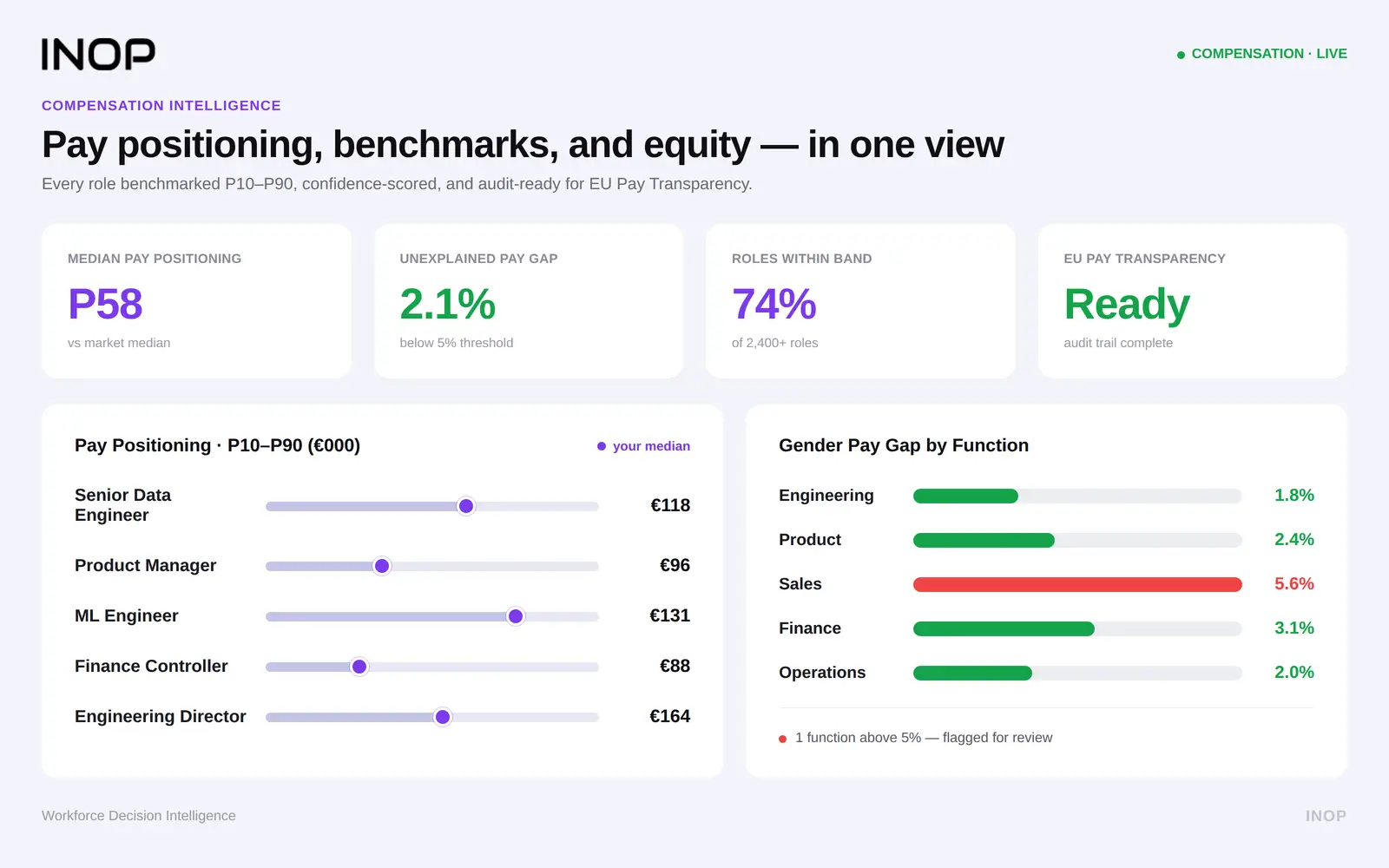
Across a portfolio, the maturity of a company’s workforce skills management system is a strong proxy for how efficiently that company can actually execute a transformation plan. A portfolio company with a well-built skills foundation but no working deployment mechanism looks capable on paper and struggles in practice, since the gap between knowing what skills exist and actually moving people to where they are needed is exactly where hundred-day plans lose momentum. Standardizing this evaluation across a portfolio through INOP’s strategic workforce planning platform gives operating partners a consistent way to assess not just whether a skills program exists, but whether it functions as an operating system across all four pillars. Where skills management surfaces roles carrying scarce, high-demand capability, INOP’s compensation analytics platform connects that finding directly into pay benchmarking, since the employees holding those skills often carry retention risk that a skills inventory alone will not flag.
Common Mistakes in Workforce Skills Management
Treating skills management as a one-time project. A taxonomy and gap analysis completed once, with no governance cadence behind them, decays into an outdated reference document within a year or two, regardless of how much effort went into building it initially.
Overinvesting in identification and underinvesting in deployment. A precise, well-maintained skills inventory that never connects to an actual mechanism for moving people to where skills are needed delivers visibility without the operational value that visibility is supposed to unlock.
Defaulting to development for every identified gap. Not every gap is best closed through training. Comparing development against redeployment, hiring, and automation for each specific gap, rather than assuming development by default, is what keeps a skills management system cost-disciplined.
Relying entirely on internal, self-reported data. An internal skills inventory only reflects what the organization believes it has. INOP’s skills intelligence platform closes this gap by mapping external demand signals, classified as emerging, in demand, stable, or declining, against your existing skills taxonomy, so internal data gets checked against what is actually happening in the labor market outside your organization.
Skipping governance because it produces no visible deliverable. Unlike a taxonomy launch or a new dashboard, governance work rarely generates a milestone worth presenting to leadership, which is exactly why it gets deprioritized even though it is what keeps the other three pillars functional. The same discipline that applies to building a living skills taxonomy as ongoing infrastructure rather than a static document applies to the full skills management system, not just the taxonomy layer of it.
Ignoring how skills management connects to broader workforce risk. A weak deployment mechanism does not just slow down projects. It compounds succession and concentration risk, since an organization that cannot move skills to where they are needed also struggles to backfill a critical role quickly, a pattern worth evaluating alongside the wider set of human capital risks CHROs are already tracking rather than treating skills management as an isolated HR initiative.
Frequently Asked Questions
What is the difference between workforce skills management and a skills taxonomy?
A skills taxonomy is one input into workforce skills management, the shared vocabulary that defines and categorizes skills. Skills management is the full operating system built on top of that taxonomy, covering identification, development, deployment, and governance as an ongoing practice rather than a single deliverable.
Why do most workforce skills management programs stall after the initial rollout?
Because the identification pillar gets most of the initial investment and produces a visible deliverable, while deployment and governance require ongoing operational capability that rarely gets the same attention. A skills foundation without working deployment and governance mechanisms decays into a reference document rather than a functioning system.
Should every skill gap be closed through training?
No. Training is one of several available pathways, alongside redeployment, external hiring, and automation. Comparing all four against cost and time tradeoffs for each specific gap consistently produces better outcomes than defaulting to training automatically.
How often should a workforce skills management system be reviewed?
The governance pillar should specify a recurring cadence, often quarterly for fast-moving technical skills and semiannually for more stable roles, rather than leaving review timing to chance. Without a defined cadence, even a well-built system drifts out of date.
How should private equity operating partners evaluate workforce skills management at a portfolio company?
By checking whether all four pillars, identify, develop, deploy, and govern, are actually functioning, not just whether a skills taxonomy exists. A strong foundation with no working deployment mechanism signals a company that will struggle to execute quickly on a transformation plan, regardless of how complete its skills inventory looks on paper.
Ready to see workforce skills management working as one connected system instead of four disconnected projects? Book a demo and INOP will walk through how identification, development, deployment, and governance work together, with every decision run through BBRA.
Make confident workforce decisions that support strategy and value creation.