Workforce transformation consulting, also called HR transformation consulting, helps an organization diagnose its current workforce, design the roles and skills its strategy needs, and support the change. Engagements usually take months, and the strategy phase at a mid-size enterprise commonly costs in the low hundreds of thousands of dollars. This guide covers what you get, what it costs, why engagements fall short, and how to weigh a consultant against continuous planning with INOP.
Consulting and continuous planning do different jobs. Consultants bring strategic judgment and change leadership. INOP keeps the underlying data on roles, skills, cost and risk current between engagements, so the answers do not go stale the week the final report is delivered.
What Does Workforce Transformation Consulting Involve?
Most engagements run in three phases.
| Phase | Focus | Typical output |
|---|---|---|
| Diagnostic | Current structure, roles, skills and cost | Baseline view of the workforce and its gaps |
| Design | Future-state model aligned to business and technology strategy | Target roles, skills and organization design |
| Transition support | Reskilling plans, role redesign and change management | Roadmap, governance and measurement plan |
Firms differ in how much of each phase they deliver. Some hand off after design. Others run implementation, governance and post-project measurement. Confirm which phases are in the quote before you compare prices. Strategy design phases are usually shorter than implementation and change management.
Workforce Transformation Consulting vs HR Transformation Consulting
The two terms overlap, and many providers use them interchangeably. HR transformation consulting usually centers on the HR operating model: processes, systems, service delivery and the structure of the HR function itself. Workforce transformation consulting centers on the workforce the business needs to execute its strategy: which roles, which skills, at what cost, and how people move from the current state to the future one. Ask any provider which of the two their team leads with, because the deliverables differ.
Workforce Transformation Consulting vs Change Management Consulting
Change management consulting helps people adopt a change through communication, sponsorship, training and reinforcement. Workforce transformation consulting decides what the change should be, then includes change management as one workstream. Strong engagements treat change management as a core workstream from day one, not an add-on after the design is finished.
How Much Does Workforce Transformation Consulting Cost?
For a mid-size enterprise, the strategy phase of workforce transformation consulting commonly costs in the low hundreds of thousands of dollars. Implementation support is usually priced as a share of the total transformation budget, and add-ons are billed on top.
Three components shape the total:
- Strategy design phase. The diagnostic and design work. This is the number most quotes lead with.
- Implementation support. Usually a percentage of the overall transformation budget, not a separate flat fee.
- Add-ons. Change leadership coaching, skills gap analysis and training delivery are often billed separately, so total program cost can far exceed the first quote.
Ask for pricing by phase and a written list of scope assumptions. A quote for the strategy phase is not the cost of the program.
A consulting engagement’s sticker price and its true three-year cost are rarely the same number. INOP’s Finance lens prices each path across 30-day, 180-day, one-year and three-year horizons, so the full cost is visible before a contract is signed.
Why Do Workforce Transformation Consulting Engagements Fall Short?
McKinsey research finds that transformation efforts fail about 70 percent of the time. It names four common pitfalls:
- Targets set by consensus instead of facts, so ambition is too low.
- No compelling reason for people to change how they work.
- Execution that tracks activity instead of outcomes, with difficult people decisions delayed.
- Impact that fades once the program ends, because incentives and budgets are not aligned to the new objectives.
Weak change management sits behind several of these. The strategy is often sound, and the failure happens in implementation.
What Separates Workforce Transformation Consulting Engagements That Work From Ones That Do Not?
Prosci’s research on change management and project success is direct on this point. In its Best Practices study of more than 2,600 change practitioners, 88 percent of projects with excellent change management met or exceeded their objectives, against 13 percent of projects with poor change management. That is roughly seven times more likely.
Engagements that work share four habits:
- Change management is a core workstream from day one.
- Measurable objectives are defined early, with outcomes rather than deliverables as the test.
- Results are reviewed at fixed checkpoints, not only at the end.
- Governance and measurement continue after the project closes.
A diagnostic describes the workforce on the day it was run. Conditions then keep moving. Unmanaged workforce exposure grows after go-live, which is why human capital risk belongs in the measurement plan, and why workforce risk management works best as a continuous practice.
How Does Workforce Transformation Consulting Compare to Continuous Planning With INOP?
| Factor | Workforce transformation consulting | Continuous planning with INOP |
|---|---|---|
| Timing | Project-based, typically months per engagement | Ongoing, updated as conditions change |
| Best suited for | Strategic judgment, stakeholder alignment, complex change leadership | Continuous role, skills and cost modeling between engagements |
| Data currency | Reflects conditions at the time of the diagnostic | Reflects current data on an ongoing basis |
| Typical cost structure | Project fee plus implementation support | Subscription-based platform access |
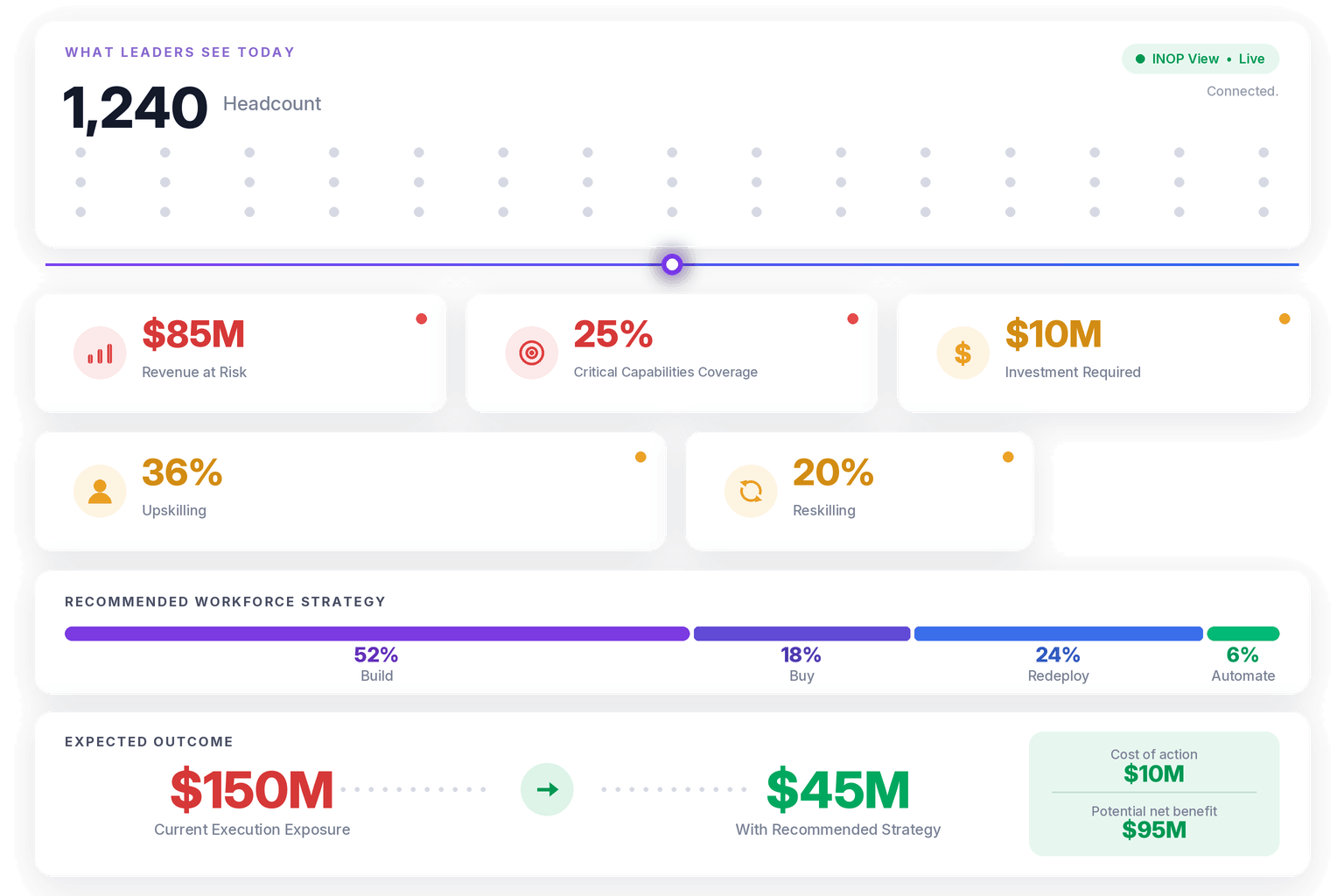
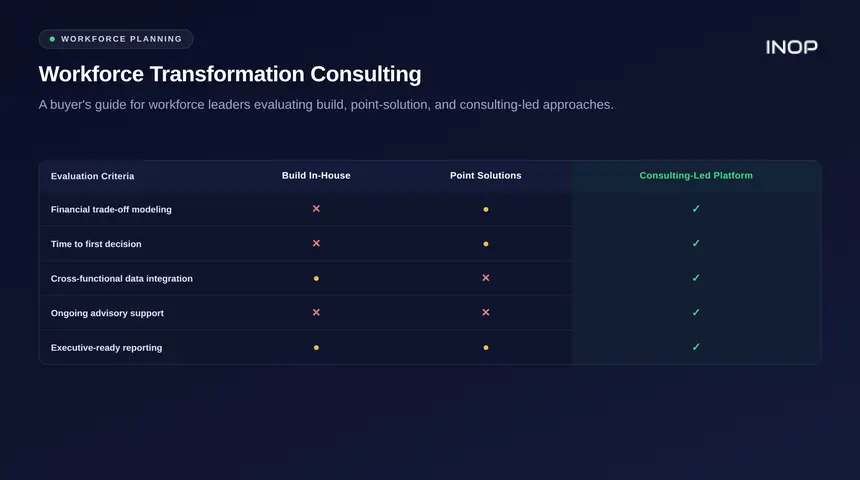
The two are complementary. INOP’s strategic workforce planning platform connects strategy, finance, people, market and AI data in one model. It shows which capabilities are in place, where the gaps and risks are, what the gaps cost if nothing changes, and the best response to each. A consulting team that starts from that model spends less time collecting baseline data and more time on judgment, sequencing and change leadership. INOP complements existing data and technology assessments. It does not replace them.
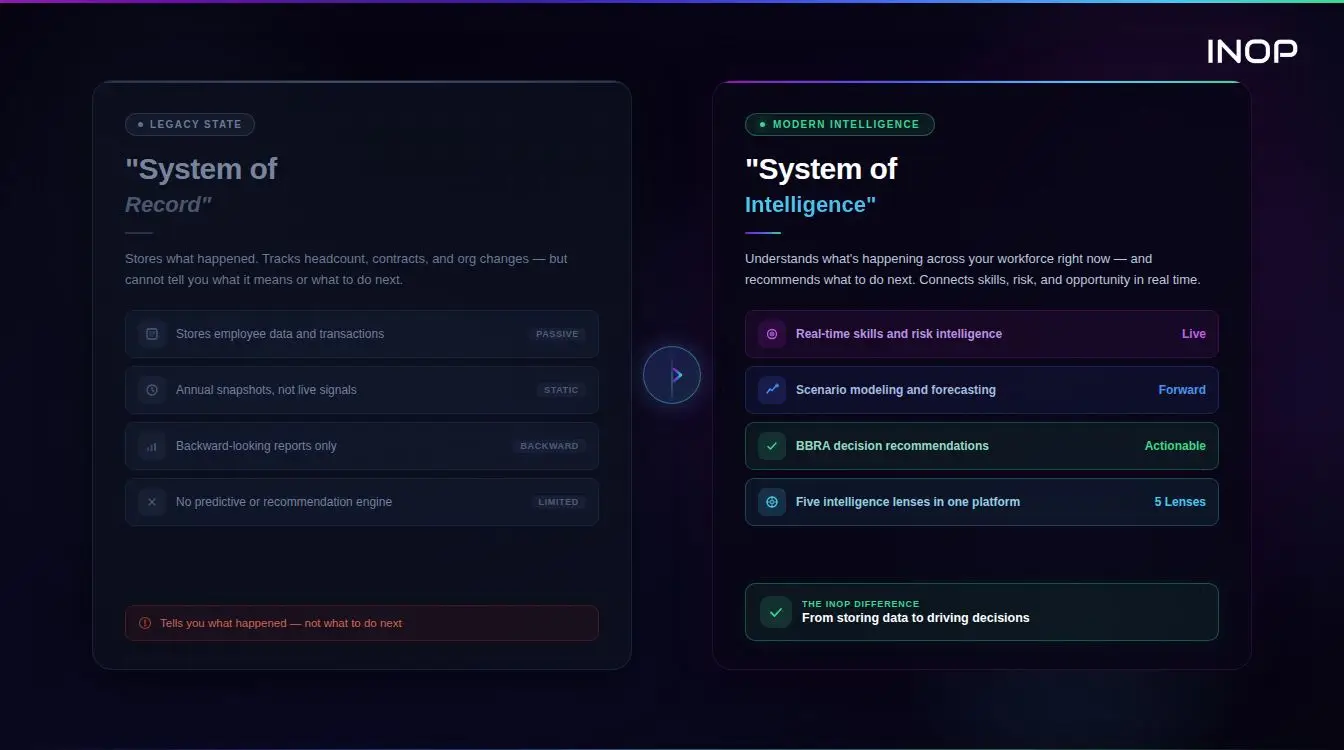
This is also the shift described in moving from a system of record to a system of intelligence: payroll and HR records are solved, and the missing piece is the intelligence that turns them into decisions.
How Should You Evaluate a Workforce Transformation Consulting Provider?
Use the same four questions with every provider, and with INOP.
| Criterion | Question to ask | Why it matters |
|---|---|---|
| Judgment vs data fit | Does this work need strategic judgment and negotiation, or continuously updated data? | Avoids paying consulting rates for work suited to a platform, and the reverse |
| Time-horizon cost | What does this cost at 30 days, 180 days, one year and three years? | The sticker price and the true three-year cost are rarely the same |
| Data ownership | Who owns the workforce data and models after the engagement or contract ends? | Decides whether the next transformation starts from scratch or from existing data |
| Success metric | What outcome, not activity, defines success? | Keeps evaluation on results instead of deliverables checked off a list |
Types of Workforce Transformation Consulting Firms
| Category | Best for | What to confirm |
|---|---|---|
| Large advisory firms | Programs that span technology, operations and workforce | How much of the team works on workforce design specifically |
| Strategy consultancies | Board-level strategy and operating model questions | How role-level and skills data will be gathered |
| HR and organization design specialists | HR operating model and organization design | How cost, market and risk are brought into the design |
| Continuous planning with INOP | Ongoing modeling of roles, skills, cost and risk across time horizons | How findings feed the advisory team’s design and change work |
AI Workforce Transformation Consulting: What to Ask For
AI changes the mix of tasks inside a role, which changes the value of the role and the skills it needs. AI workforce transformation consulting should therefore answer questions that a standard design phase does not.
Ask any provider:
- How do you separate tasks that are ready to automate from tasks that still need human ownership?
- How do you sequence AI rollouts against the organization’s capacity to absorb change?
- How do you price the cost and payoff of each path?
- How will role definitions and pay positions be updated as automation moves?
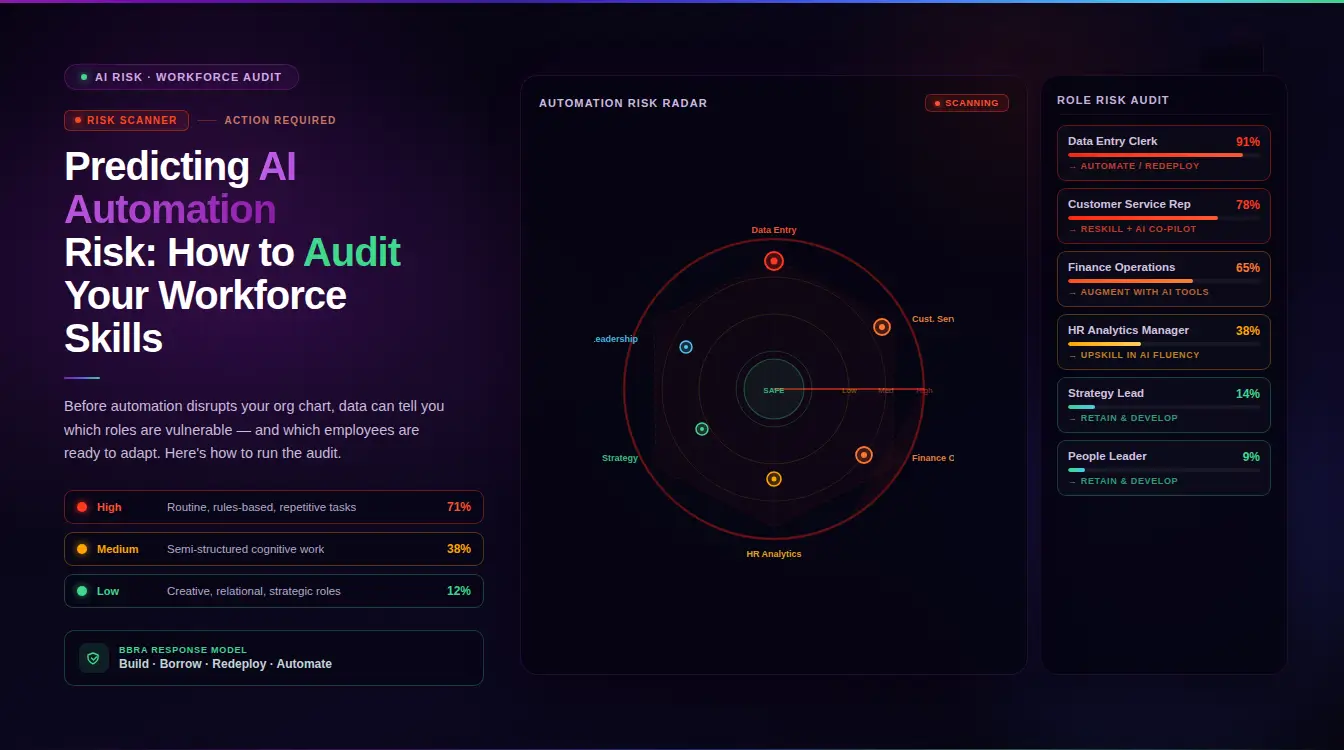
INOP never assesses AI in isolation. It tests automation against the strategy it serves, the budget it affects, the people who do the work and the market the business competes in. The AI and Automation lens shows how automation is changing the value of a role. For a method you can run before an engagement starts, see predicting AI automation risk.
What Does INOP’s BBRA Framework Add to a Workforce Transformation Decision?
BBRA is INOP’s proprietary decision architecture: Build, Buy, Redeploy, Automate. For any role or capability gap, it models all four pathways on the same basis, so options are compared like for like instead of argued case by case.
- Build: develop the capability inside the current workforce.
- Buy: bring the capability in from outside the organization.
- Redeploy: move existing people and skills to where the strategy needs them.
- Automate: shift the work to technology where it is ready.
Each pathway carries financial trade-offs across four horizons: 30 days, 180 days, one year and three years. A path that looks cheapest at 30 days often costs more at three years, and the reverse is also common.
BBRA runs through INOP’s five intelligence lenses:
- Strategy shows which roles and skills the business plan depends on.
- Finance prices the cost of each path, including the true cost of an engagement over time.
- People shows who is affected, and how ready they are to move or change.
- Market benchmarks each position against external data.
- AI and Automation shows whether work is ready to automate or still needs human ownership.
See BBRA applied to your own workforce decisions. INOP models Build, Buy, Redeploy and Automate for your roles and capabilities across four time horizons. Book a demo
How Does Workforce Transformation Affect Compensation and Skills Planning?
Transformation changes role value and skill requirements faster than annual pay cycles or training budgets track. Plan for both before the design phase ends.
How Should Pay Structures Change During Workforce Transformation?
Redesigned roles often carry different responsibilities than their old job descriptions. Salary bands built for the previous organization chart become outdated quickly, and even roles whose titles stay the same may need re-evaluation. Revisit compensation benchmarks alongside the new role architecture, not after it.
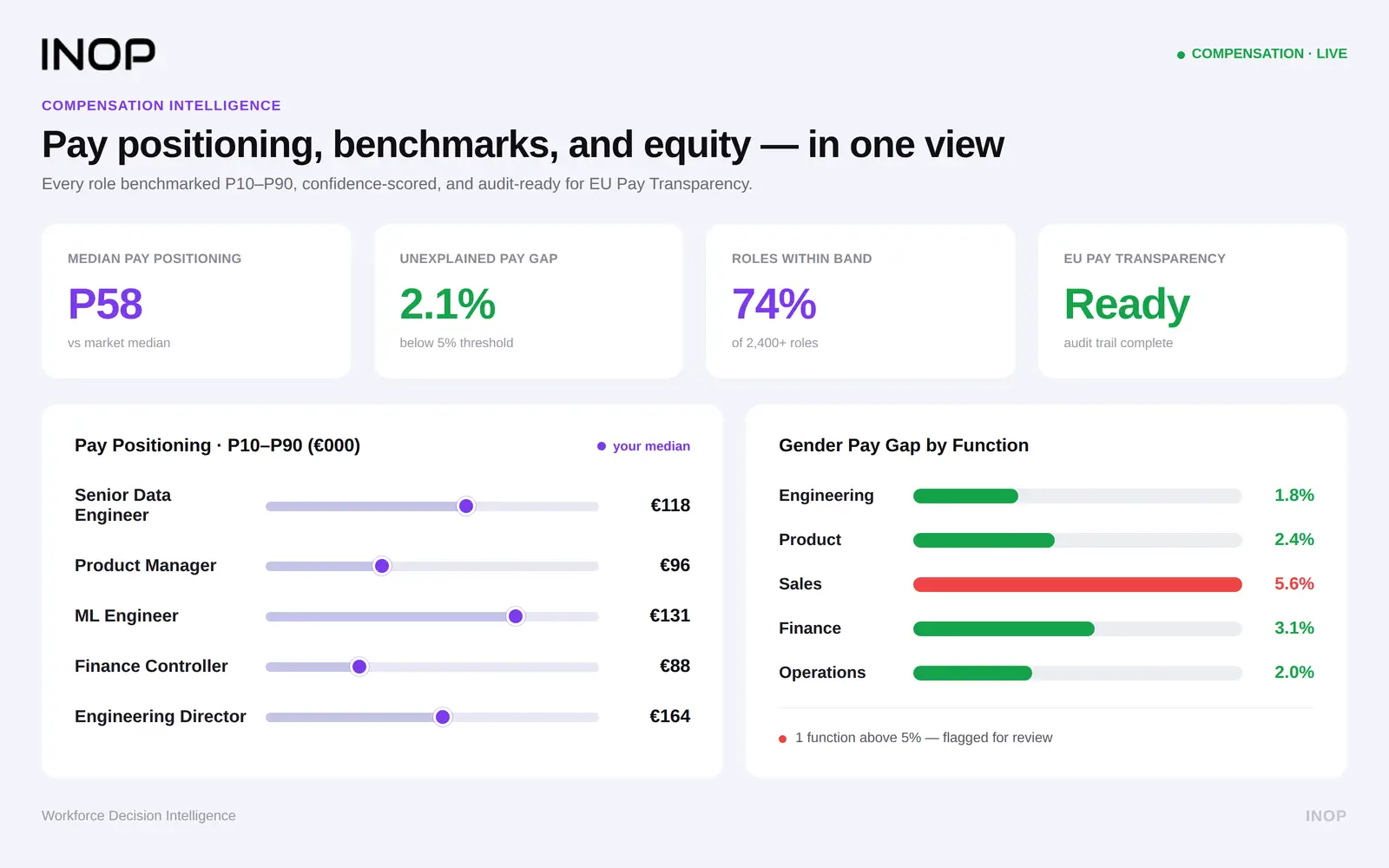
INOP’s compensation analytics platform benchmarks pay against real-time market data and flags equity risks as roles change. Two related guides help with design choices: skills-based pay vs job-based pay and pay parity, which covers the EU Pay Transparency Directive.
What Skills Data Do You Need Before Starting Workforce Transformation Consulting?
Starting the diagnostic from existing skills data makes an engagement faster and cheaper. Useful data answers four questions: which skills are emerging, which are in demand, which are stable and which are declining. That gives the team a starting point instead of a blank page.
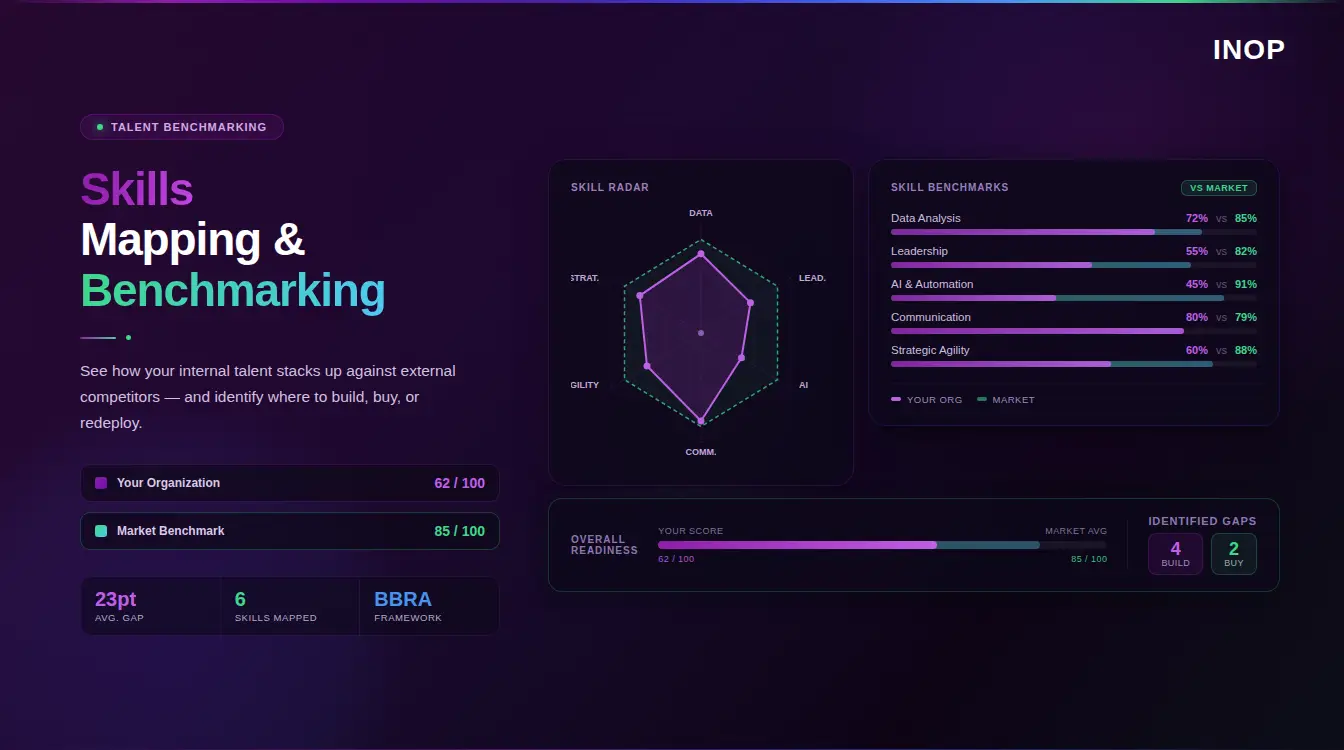
INOP’s skills intelligence classifies skills into those four signal states, so design work begins from what the market is doing. If you are unsure where your gaps are, start with what a skill gap is and compare skills assessment tools for measuring current capability.
Workforce Transformation Consulting by Industry
The diagnostic, design and transition sequence applies across sectors. The role families, regulation and pace of change differ.
Retail Workforce Transformation Consulting
Retail workforces combine large frontline populations, seasonal peaks and a fast shift in store and fulfillment tasks. Transformation work in retail usually focuses on three questions. Which store and fulfillment tasks are ready to automate? Which frontline skills can be redeployed into new roles such as digital fulfillment or customer service? How do scheduling and pay structures change when roles change? Ask providers to show how they model these trade-offs by role family, and at what cost across time horizons. The same sequence applies in financial services and manufacturing, with different role families and regulatory constraints.
What Should PE Operating Partners Ask Before Engaging Workforce Transformation Consulting Firms Across a Portfolio?
For private equity operating partners, workforce transformation consulting is a portfolio spending decision. The same scope may suit one portfolio company and be unnecessary for another, depending on data readiness and process maturity. Apply a consistent evaluation framework company by company instead of one engagement structure across the fund.
Five questions keep the decision comparable:
- Does this company have the data readiness and process maturity for the scope being proposed?
- What does the engagement cost at 30 days, 180 days, one year and three years?
- Who owns the workforce data and models when the engagement ends?
- What outcome, tied to the value creation plan, defines success?
- Could a lighter, data-led approach deliver the same result here?
INOP’s Finance lens compares options across time horizons against the exit timeline, which shows where consulting is worth the spend and where a lighter approach is enough. The same view supports due diligence, because it shows what workforce liabilities an acquisition carries.
Conclusion: Pair Advisory Judgment With Continuous Workforce Data
Workforce transformation consulting is worth the spend when the decision needs strategic judgment, stakeholder alignment and change leadership. It pays back faster when it starts from current data and keeps measuring after the project closes. Define the outcome first, price the full three years, settle who owns the data, and treat change management as a workstream from the first week.
Start your next workforce decision from current data. INOP connects strategy, finance, people, market and AI in one model, so every option is priced before you commit. Book a demo
Workforce Transformation Consulting FAQs
What is workforce transformation consulting?
Workforce transformation consulting is advisory work that diagnoses the current workforce, designs a future-state model of roles and skills, and supports the transition. It is also called HR transformation consulting, though the two differ in emphasis. The workforce version centers on the roles, skills and cost the strategy needs.
How much does workforce transformation consulting cost?
For a mid-size enterprise, the strategy phase commonly costs in the low hundreds of thousands of dollars. Implementation support is usually a percentage of the total transformation budget, and add-ons such as change coaching, skills gap analysis and training are billed separately. Ask for pricing by phase and compare the full cost over three years.
How long does a workforce transformation consulting engagement take?
Scope sets the length. A focused diagnostic can take weeks. A full redesign and rollout takes many months. Strategy design phases are typically shorter than implementation and change management, so confirm which phases a quote covers.
Do we need a consulting firm, or can workforce planning software replace it?
They do different work. INOP models role, skills and cost trade-offs continuously and keeps the data current between engagements. Strategic judgment, stakeholder alignment and change leadership still benefit from advisory support. Most organizations get the best result by using both.
How should PE operating partners approach workforce transformation consulting across a portfolio?
Apply one evaluation framework to each portfolio company, because readiness differs. Compare options across 30-day, 180-day, one-year and three-year horizons using INOP’s Finance lens, and match the scope to each company’s data readiness and exit timeline. A lighter, data-led approach is often enough where processes are mature.