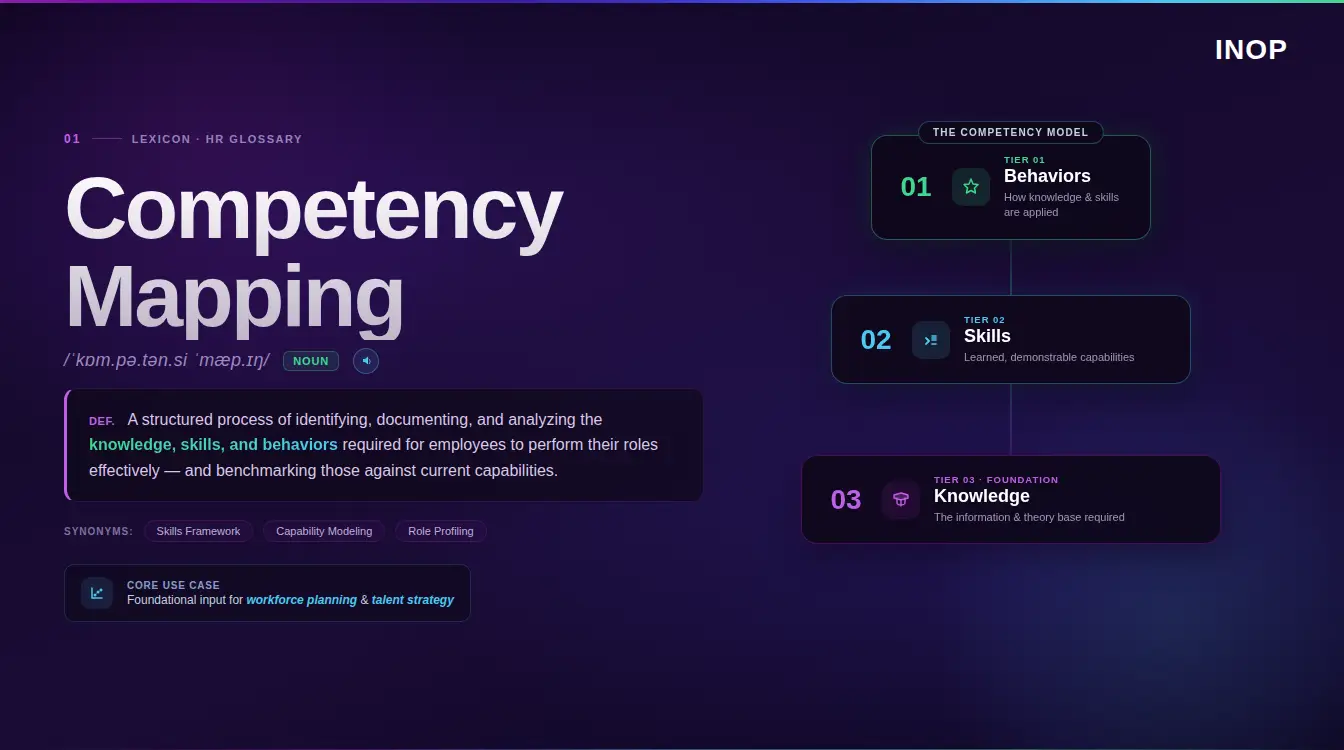
Competency mapping is the process of identifying the skills, knowledge, and behaviors each role needs to perform well, then assessing how closely each employee matches them. The result is a map of where capability is strong, where it falls short, and which gaps matter most to the strategy. This guide covers the meaning of competency mapping, the four types of competencies, role examples, a six-step process, and a template you can use.
Competency mapping meaning is one of those HR terms that gets used constantly but rarely defined with enough precision to be actionable. Ask five people what competency mapping means, and you will likely get five different answers, ranging from “it is basically a skills inventory” to “it is how we define what good looks like in a role.” Both of those answers contain truth. Neither is complete.
This article sets out to define competency mapping meaning clearly, explain what it actually involves in practice, and make the case for why it matters to the C-suite, not just to HR teams. If you are a CHRO, a people analytics leader, or a PE operating partner trying to understand whether a portfolio company’s workforce can execute on its strategy, understanding competency mapping at depth is not optional. It is foundational.
What Is Competency Mapping? A Precise Definition
At its core, competency mapping is the process of identifying and documenting the specific skills, knowledge, and behaviors that employees need to perform effectively in their roles and contribute to organizational goals. It is systematic. It is structured. And when done well, it produces a living framework that connects individual capability to business outcomes.
The key word in that definition is “behaviors.” Competency mapping is not just a list of skills. A skill is something you can measure in isolation. A competency is broader. It captures how a person applies knowledge and skill in context, how they communicate under pressure, how they lead a team through ambiguity, how they translate data into a recommendation that moves a decision forward. A skill gap might be the absence of Excel proficiency. A competency gap is the absence of the entire financial analysis capability, which includes Excel, financial judgment, analytical thinking, and the ability to communicate findings to non-finance stakeholders.
That distinction matters enormously when you are making workforce decisions at scale.
Competency Mapping vs Skills Mapping
The terms competency mapping and skills mapping are often used interchangeably. They are related but not the same, and conflating them leads to frameworks that measure activity without producing insight.
Skills mapping asks: what can this person do? It is task-oriented and transferable. It is useful for hiring decisions and short-term capability assessments. see our guide to see our guide to skills mapping.
Competency mapping asks: how effectively does this person perform in the context of this role, and what behaviors produce that performance? It is role-linked, behavioral, and designed to inform decisions about development, performance management, succession, and strategic workforce planning.
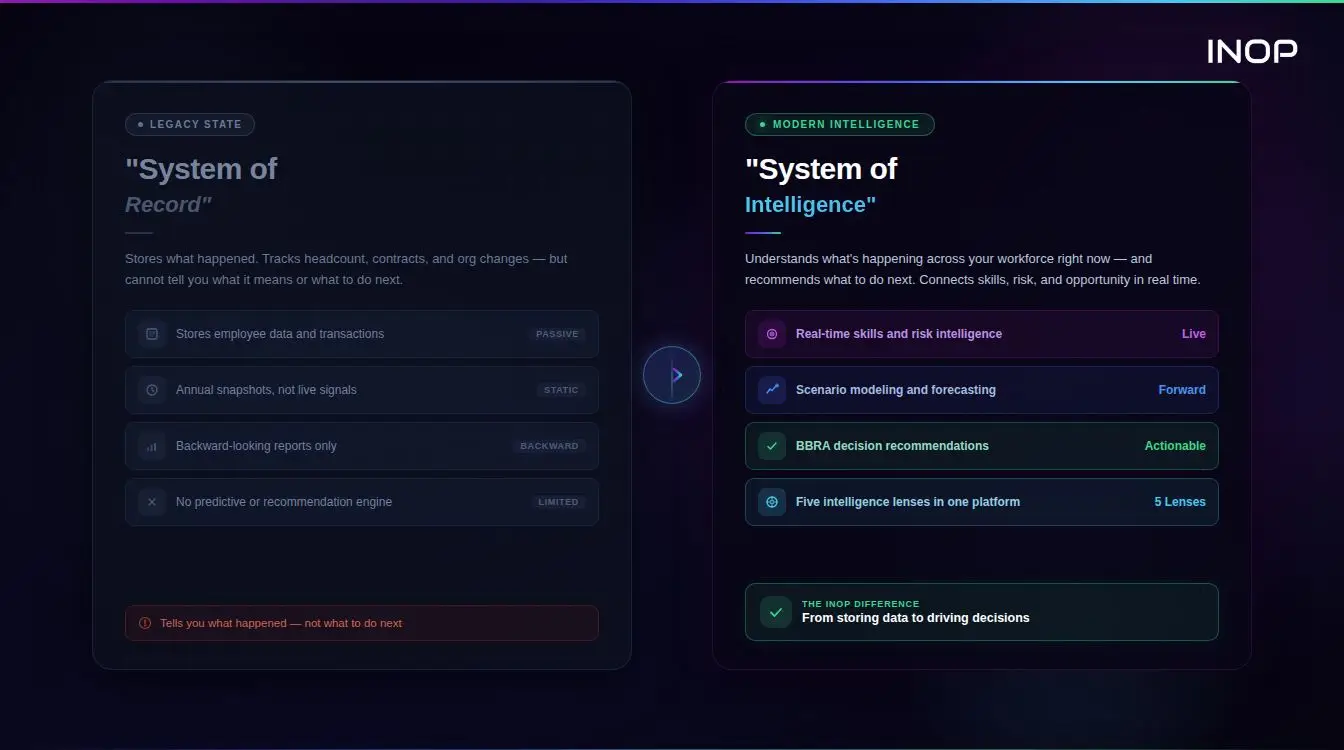
Most tools on the market today stop at skills mapping. They can show you where a skill is absent. What they cannot do is connect that absence to a financial exposure, an execution risk, or a strategic consequence. That connection, from competency gap to business impact, is where the real value lies, and it is where INOP’s approach to workforce intelligence separates itself from point solutions.
Benefits of Competency Mapping: What Organizations Actually Gain
The value of competency mapping is not in the framework document itself. It is in the talent decisions that become more accurate, more defensible, and more strategically grounded when the framework exists and is used consistently. Six specific benefits recur across organizations that implement competency mapping rigorously.
More precise hiring decisions. When job requirements are expressed as behavioral competency profiles with defined proficiency levels rather than credential lists, hiring panels assess candidates against the same criteria using the same rubric. This removes the interview-to-interview variability that causes inconsistent hiring outcomes, reduces the influence of candidate presentation on decisions that should be capability-based, and produces a documented rationale for every hire and every rejection that is far more defensible than general impression.
Targeted rather than generic learning and development. Without competency data, L&D budgets are allocated to programmes that feel relevant rather than programmes that close specific, documented gaps in the capabilities most critical to strategy execution. When competency mapping produces a prioritized gap analysis, development investment is directed to the competencies that most affect performance in the roles that most affect business outcomes. The training ROI is measurable because the target outcome is defined before the programme starts, not inferred from attendance records after it ends.
Evidence-based performance management. Competency frameworks give performance conversations a shared vocabulary and a shared standard. Instead of a manager’s general impression of whether someone is performing well, the conversation is anchored to specific behavioral levels: what advanced stakeholder management looks like in this organization, how intermediate strategic thinking manifests in actual decisions, and what the gap between current and required means in terms of specific development actions. That specificity makes performance management fairer, more developmental, and less emotionally charged for both parties.
Succession planning based on readiness rather than relationship. Competency mapping supports better succession planning by making the capabilities required for every role explicit and making current employees’ proximity to those capabilities visible. When leadership competency profiles are defined and employees are assessed against them, the succession pool is determined by evidence of capability proximity rather than seniority, visibility, or manager advocacy. The result is a more diverse and more accurate succession bench, with fewer post-promotion failures caused by advancing people whose technical performance was strong but whose leadership competency profile did not match the target role’s requirements.
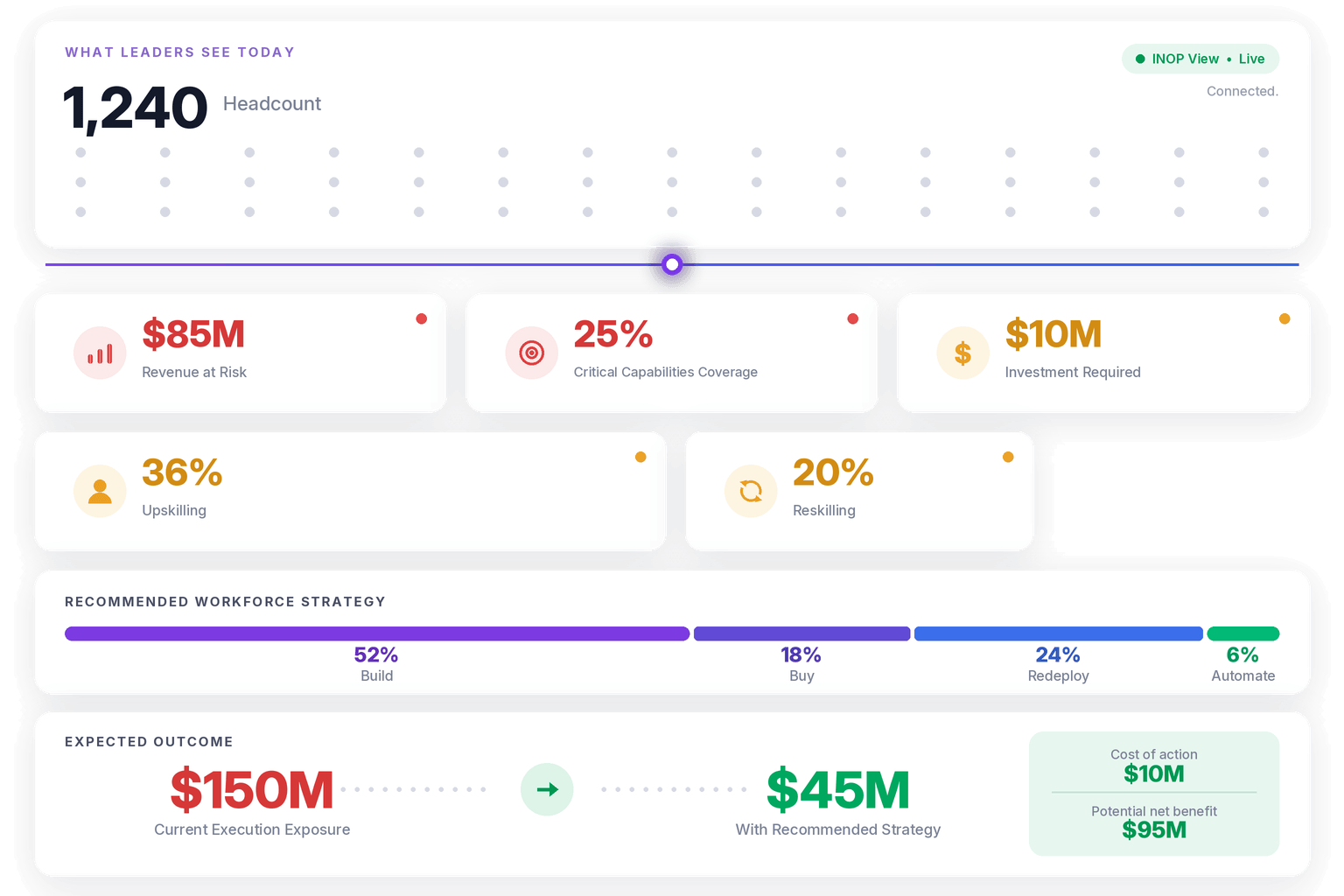
Workforce planning grounded in capability evidence. At the strategic level, competency mapping provides the data layer that answers the question boards and CEOs ask but rarely receive a rigorous answer to: do we have the people we need to execute this plan? When competency coverage against strategy-critical roles is visible and current, that question gets an evidence-based answer rather than an optimistic assumption. The gaps it reveals become the input to workforce investment decisions about where to develop, hire, redeploy, or automate, decisions that are currently being made from incomplete information in most organizations.
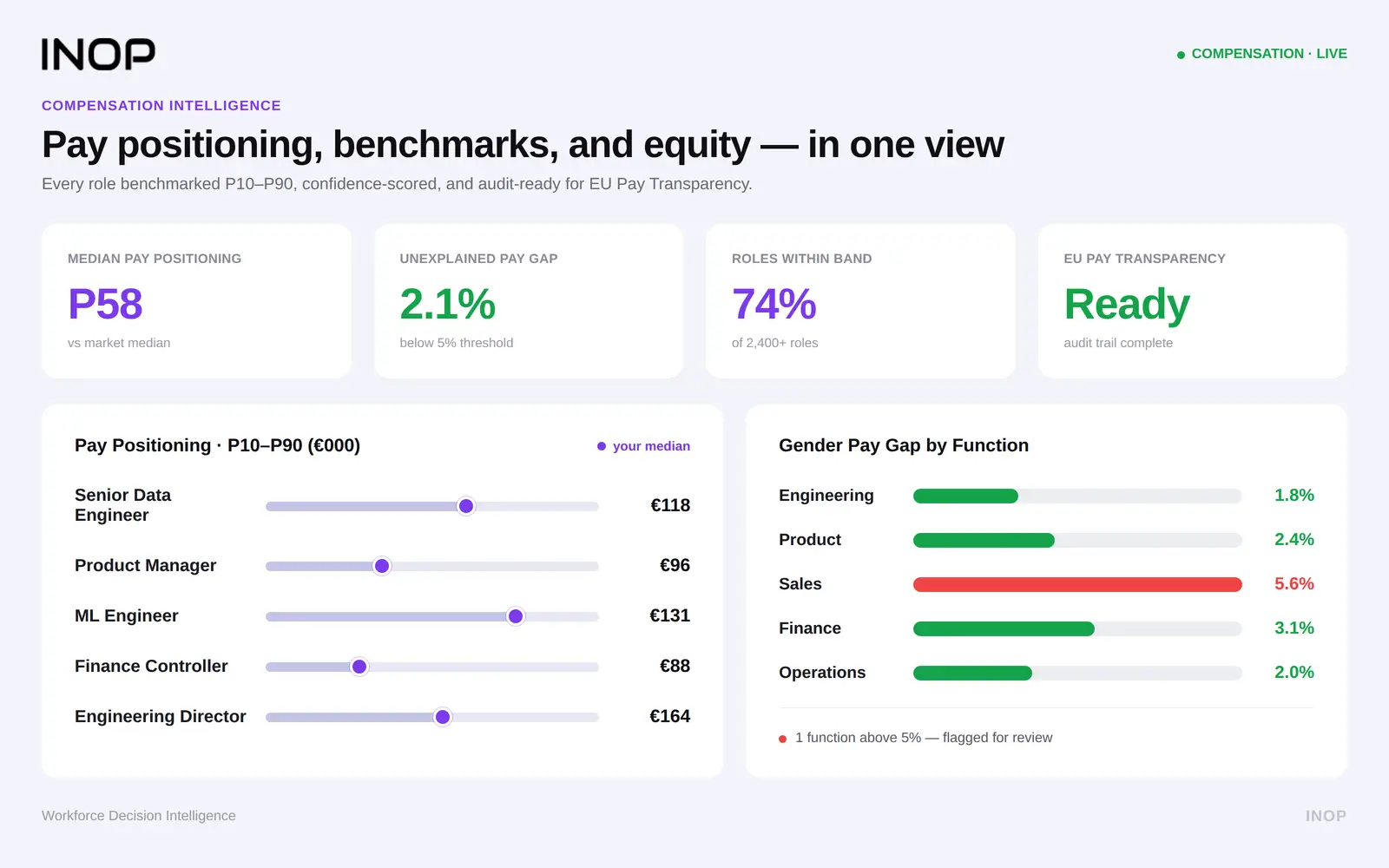
Legal and compliance defensibility. As pay transparency laws expand across US states, the UK, and the EU, organizations need to explain why individuals in similar roles earn different amounts. Competency frameworks provide that explanation when compensation is connected to verified proficiency levels rather than negotiation outcomes or manager discretion. The EU Pay Transparency Directive’s requirement that pay criteria be objective and gender-neutral is satisfied most cleanly when compensation differences are traceable to documented, consistently-applied competency assessments rather than to decisions that vary by manager and lack an audit trail.
The Four Types of Competencies
Any competency mapping framework, regardless of organizational size or industry, organizes competencies into three broad categories.
Core Competencies
Core competencies are the behaviors and attributes expected of every person in the organization, regardless of role or seniority level. They reflect the organization’s culture, values, and operating principles. Examples include communication, adaptability, accountability, and collaboration. A professional services firm might define client orientation as a core competency. A technology company might prioritize curiosity and experimentation.
Core competencies provide the behavioral baseline against which everyone is assessed. They also anchor culture in something observable and measurable, rather than leaving values as abstract aspirations on a wall.
Functional Competencies
Functional competencies are role-specific. They define what effective performance looks like in a particular job family or discipline. A financial analyst and a product manager will share the same core competencies but hold very different functional ones. For the analyst, that means financial modeling, scenario planning, and data interpretation. For the product manager, it means user research, roadmap prioritization, and cross-functional alignment.
Functional competencies are where most of the strategic value in competency mapping lives, because they are the ones that determine whether your organization can execute specific pieces of work.
Leadership Competencies
Leadership competencies apply to people in managerial and senior roles. They cover the behaviors that distinguish effective leaders from technically capable individual contributors: strategic thinking, people development, decision-making under uncertainty, and change management. Leadership competency mapping is particularly critical for succession planning, because it surfaces which employees are developing the profile needed for future senior roles and which have a gap between technical performance and leadership readiness.
Technical Competencies: The Fourth Category Worth Distinguishing
Many competency mapping frameworks treat technical skills as a subcategory of functional competencies, and for most professional services roles that conflation is workable. For roles where the technical dimension is both highly specific and central to performance quality, engineering, IT security, clinical healthcare, financial risk modeling, data science, advanced manufacturing, the conflation produces frameworks that underspecify the most critical capability dimension and make assessment unreliable.
Technical competencies are the specialized, domain-specific skills and knowledge required for a particular technical role. They differ from broader functional competencies in their specificity and verifiability. A functional competency like analytical thinking can be observed across a wide range of behaviors and assessed through structured conversation. A technical competency like Kubernetes cluster configuration at intermediate level is either present at that proficiency or it is not, and can be assessed through a structured technical exercise rather than behavioral observation alone. The assessment method is different, the evidence required is different, and the precision of the gap finding is different.
The practical reason to keep technical competencies distinct from functional ones is that they require different assessment instruments, different validators, and different development pathways. A manager can assess whether a direct report demonstrates strategic thinking through observation of their decision-making over time. That same manager frequently cannot assess whether a machine learning engineer’s proficiency in transformer architecture is foundational or advanced, because they do not personally hold the skill at the required depth. Technical competencies need technical assessors or external certification as their validation mechanism, which is a design decision that belongs in the framework architecture rather than being improvised during assessment.
For organizations in engineering, IT, healthcare, or manufacturing, a four-type competency framework produces a more accurate and more useful map than a three-type one. The functional layer captures how the role interacts with the broader organization. The technical layer captures the specific domain expertise that makes the role possible. Keeping these layers distinct prevents the technical assessment from being diluted by softer functional criteria and ensures that the validation method matches the type of competency being assessed.
Competency Mapping Examples: What a Completed Map Looks Like by Role
Abstract definitions of competency mapping are easier to apply when accompanied by a concrete example. The following three worked examples show how core, functional, and leadership competencies combine to define effective performance across different role types and seniority levels. Each example illustrates the level of specificity required to make a competency map useful for actual talent decisions rather than aspirational documentation.
Data Analyst Competency Map (Individual Contributor)
For a mid-level data analyst role, a competency map typically includes two core competencies and four functional ones. In the core dimension, communication at intermediate level means the analyst can explain technical findings to non-technical stakeholders clearly in both written and verbal formats — not just produce the analysis, but make it legible to a finance director or product lead who does not speak SQL. Accountability at intermediate level means proactively flagging data quality issues before they affect downstream outputs, rather than waiting to be asked.
On the functional side, SQL proficiency at advanced level means writing complex multi-table joins, optimizing query performance, and building reusable functions without guidance. Statistical analysis at intermediate means applying descriptive statistics, identifying distribution patterns, and designing basic A/B tests independently. Data visualization at intermediate means building production-standard dashboards without oversight. Business acumen at foundational level means understanding why the analysis was requested and what decision it is meant to inform.
A data analyst at intermediate proficiency in statistical analysis but foundational in business acumen has a completely different development priority from one who is the inverse. The competency map makes that difference visible in a way that a job description never could, because job descriptions capture what the role does, not how well or in what context.
Product Manager Competency Map (Mid-Level)
For a mid-level product manager, the competency map shifts the balance toward functional capabilities that involve coordination and judgment rather than technical execution. Core competencies include adaptability at advanced level, meaning the ability to adjust priorities and approach without loss of effectiveness when strategy changes, and collaboration at advanced level, meaning the ability to build productive working relationships across engineering, design, sales, and customer success simultaneously and under delivery pressure.
Functional competencies include user research at intermediate, where the manager designs and conducts qualitative and quantitative research independently. Roadmap prioritization at advanced means applying a documented framework such as RICE or ICE to prioritize across competing demands with explicit rationale rather than gut feel. Cross-functional alignment at advanced means achieving stakeholder consensus on scope and sequencing without direct authority over any of the stakeholders involved. Market and competitive intelligence at intermediate means monitoring market signals and incorporating them into product strategy updates on a regular cadence.
What makes this map useful is the combination of competency and proficiency level. A product manager who is advanced on roadmap prioritization but foundational on cross-functional alignment will consistently produce well-reasoned roadmaps that get blocked in execution because they cannot move stakeholders. Identifying that specific gap through a competency map produces a targeted development intervention, not a generic course recommendation.
Engineering Director Competency Map (Leadership)
At the leadership level, the competency map adds a fourth dimension — leadership competencies — alongside core and functional ones. Core competencies for an engineering director include strategic thinking at advanced level, meaning the ability to connect engineering decisions to business outcomes and articulate the logic clearly to non-technical leaders, and accountability at expert level, meaning the ability to establish team-wide accountability norms through behavior and process design rather than through individual oversight.
Functional competencies include technical architecture at advanced, meaning sound architecture decisions across complex multi-system environments, and engineering excellence at advanced, meaning the establishment and maintenance of quality standards and delivery practices across the full team rather than just within one project.
Leadership competencies include people development at advanced, meaning developing individual engineers and engineering managers through consistent coaching rather than task assignment, and change management at advanced, meaning leading the team through ambiguity and organizational change with minimal disruption to delivery timelines.
The engineering director example illustrates why leadership competency mapping is distinct from functional mapping. A director who has expert-level technical architecture but foundational people development will build technically sound systems while losing their best engineers to organizations that invest in them more deliberately. No functional competency map captures that risk. A leadership competency map does.
A competency map is only as good as the assessment behind it. Book a demo to see how INOP maps verified capability against what each role and your strategy require.
How Competency Mapping Works in Practice: A Six-Step Process
Understanding competency mapping meaning in theory is one thing. Executing it is another. The following process reflects how organizations that move from framework to impact actually do it.
Step One: Define the Strategic Context
Competency mapping that is not anchored to business strategy produces frameworks that feel comprehensive but deliver little. Before defining a single competency, the question to answer is: what does the organization need to be able to do over the next one to three years, and what behaviors and capabilities make that possible?
This step requires input from senior leadership, not just HR. It is a strategy exercise as much as a talent exercise.
Step Two: Conduct Role Analysis
For each role family in scope, analyze what effective performance actually looks like. This means talking to high performers in those roles, interviewing their managers, reviewing performance data, and examining how the role connects to the outputs that matter most to the business. The goal is to move beyond job descriptions, which describe tasks, and toward behavioral profiles, which describe performance.
Step Three: Define and Structure the Competency Framework
Group the identified competencies into the three categories described above: core, functional, and leadership. For each competency, write a clear definition and establish proficiency levels, typically four to five levels ranging from foundational to expert. Each proficiency level should have observable behavioral anchors so that assessments are grounded in evidence rather than subjective impression.
A well-built framework for a given role will typically include five to eight competencies in total. More than that and the framework becomes unwieldy. Fewer than that and it may not capture the full range of what effective performance requires.
Step Four: Assess Current Competency Levels
With the framework defined, assess where employees currently sit against each competency and proficiency level. Assessment methods include manager evaluations, self-assessments, 360-degree feedback, structured interviews, and behavioral observation. The most reliable results combine multiple inputs, since single-source assessments are vulnerable to bias.
This is the step where data quality matters most. Organizations that rely on incomplete profiles, or that assess only a subset of the workforce, produce gap analyses that misrepresent actual capability coverage. Before surfacing competency data to leadership, it is worth auditing completeness and setting transparency standards about confidence levels in the data.
Step Five: Identify Gaps and Prioritize by Business Impact
Once current competency levels are assessed, compare them against the required proficiency for each role. The resulting gap analysis should not treat all gaps as equal. A gap in a competency that is peripheral to strategic execution is less urgent than a gap in a capability that is central to the organization’s next 12 months of priorities.
Prioritization here should be driven by two variables: the size of the gap and the business consequence of leaving it unaddressed. The combination of those two factors tells you where to direct development investment first.
Step Six: Connect Gaps to Decisions Using a Response Framework
This is the step that most competency mapping exercises skip, and it is the most valuable one. Identifying a gap is not a decision. It is a starting point. The decision is what to do about it.
INOP’s BBRA framework provides the structure for that decision. Build: can the gap be closed through internal development, upskilling, skill assessment or structured learning programs? Buy: does closing the gap require external hiring or acquisition of talent? Redeploy: does the capability exist elsewhere in the organization and could it be moved to where it is most needed? Automate: can the underlying work be partially or fully handled by technology, freeing human capacity for higher-value tasks?
Embedding BBRA into the competency gap analysis turns a diagnostic into a workforce investment strategy. That is the shift that earns HR a seat at the strategy table.
Competency Mapping Template: The Structure You Need
The most common reason competency mapping exercises produce frameworks that sit unused is not poor intent, it is poor structure. A competency map that captures the right information in the right format becomes a working tool that managers and employees return to. One that captures too much, too little, or information in a format that does not support decisions becomes a document that nobody opens after the first review cycle.
The following template structure covers what a complete competency map needs to contain to be useful for talent decisions across hiring, development, succession, and workforce planning.
The Role Profile Header
Every competency map begins with a role profile header that anchors the framework to a specific organizational context. This includes the role title and job family, the organizational level, the business unit and reporting line, and the date of the last framework review. The review date is not administrative, it is the governance mechanism that prevents the framework from becoming stale. A competency map that has not been reviewed in 18 months may no longer reflect what the business actually needs from that role.
The Competency Matrix
The core of the template is the competency matrix itself. For each competency in scope, the framework should capture the competency name as a short and unambiguous label, the competency type indicating whether it is core, functional, technical, or leadership, a definition of one to two sentences describing the competency in observable behavioral terms rather than abstract qualities, and the reason this competency matters expressed as a connection to a specific business outcome.
Proficiency levels are the element most frequently underspecified. Each level should have behavioral anchors that describe what the competency looks like in practice at that stage. Foundational means understanding the concept and applying it with guidance. Intermediate means applying it independently in standard situations. Advanced means applying it in complex or novel situations and coaching others. Expert means defining organizational standards and driving innovation in this area. These anchors need to be specific to your context, not generic labels.
The template should also capture the assessment method for each competency, specifying how proficiency is evaluated. Technical competencies require technical assessment, peer review, or certification verification. Behavioral competencies require structured behavioral interviews or documented observation. This specificity prevents the common failure of assessing all competencies through the same instrument regardless of whether that instrument is appropriate for the competency type.
The Individual Assessment Record
For each employee assessed against the framework, the template should capture their current assessed proficiency for each competency, the required proficiency for their current role and their target next role if applicable, and the gap score calculated as the difference between required and current. The date of assessment and the assessors involved should be documented alongside the scores, because a self-assessment from 18 months ago carries very different evidential weight than a manager-validated technical assessment from last quarter.
Each identified gap should carry a priority designation based on the business criticality of the competency rather than just the size of the gap. A two-level gap in a peripheral competency is less urgent than a one-level gap in a capability that is central to a strategic initiative launching next quarter. The recommended action for each gap (Build, Buy, Redeploy, or Automate) closes the loop between the assessment and the decision.
The Team and Organizational Summary View
Individual assessment records aggregate into the view that HR leaders and business heads actually need for planning purposes. The summary should show average competency coverage by team and function, the percentage of employees at required proficiency for each competency, and the critical gaps where fewer than 60% of the relevant population meets the required standard. Trend data comparing the current assessment against the previous one is the element most organizations skip and most need: without it, you cannot tell whether the competency programme is working or whether gaps are widening faster than development is closing them.
Where Competency Mapping Plugs Into HR Processes
Competency mapping meaning only becomes organizational value when the framework is embedded into the processes that drive day-to-day people decisions.
Hiring: Competency frameworks give recruiting teams behavioral interview questions and structured rubrics tied to the specific proficiency levels required for each role. This raises the quality of hiring decisions and reduces the subjectivity that makes hiring outcomes inconsistent.
Performance management: Instead of annual reviews built on vague ratings, competency-based performance conversations give managers and employees a shared vocabulary for what effective performance looks like and a clear picture of where development is needed.
Learning and development: L&D programs that are not connected to specific competency gaps rarely move the needle on performance. Competency data tells L&D teams exactly which capabilities to build, for which populations, and at which proficiency level. That targeting is the difference between development that changes performance and development that fills a training calendar.
Succession planning: Leadership competency mapping makes succession planning evidence-based rather than relationship-driven. It surfaces which employees are genuinely developing the behaviors needed for senior roles and which have gaps that would need to be addressed before a promotion is viable.
Strategic workforce planning platform: At the broadest level, competency mapping informs the most consequential workforce question a leadership team can ask: do we have the capability to execute our strategy? When competency coverage data is connected to the business plan, that question gets a real answer instead of an assumption.
Competency Mapping and Workforce Intelligence: The Connection That Changes Everything
Most organizations that invest in competency mapping stop at the framework. They build it, run assessments, identify gaps, and produce a report. The report sits in a shared folder. The gaps remain.
The reason this happens is that competency data, in isolation, is not connected to the decisions it should be informing. It exists in an HR system while financial decisions are made in a finance system and strategic decisions are made in leadership off-sites. The gap between the data and the decision is where value leaks.
INOP’s five intelligence lenses, Strategy, Finance, People, Market, and AI/Automation, provide the architecture for closing that gap. Competency mapping feeds the People lens directly. But when that data is connected to the Finance lens (what is the cost of the gap?), the Strategy lens (which capabilities are critical to the operating plan?), the Market lens (what does external talent supply look like for the skills we need?), and the AI/Automation lens (which competencies are most exposed to automation-driven demand shifts?), competency data stops being an HR artifact and becomes a decision instrument.
That is the distinction between a competency mapping exercise and workforce intelligence. The exercise produces a snapshot. Workforce intelligence produces a continuously updated view of capability risk and opportunity, connected to the financial and strategic context that makes it actionable.
Common Mistakes in Competency Mapping
Even well-resourced HR teams make predictable errors when building competency frameworks. Awareness of these patterns helps avoid them.
Building without strategic input. A competency framework built by HR alone reflects what HR thinks matters. A framework built with input from the CEO, CFO, and business unit heads reflects what the organization actually needs to execute. The difference in credibility and adoption is significant.
Defining too many competencies. A framework with 20 competencies per role is not more rigorous than one with six. It is less usable. Prioritization is a feature, not a compromise.
Treating the framework as finished. Competency requirements evolve as business strategy shifts. A framework built in 2022 may not capture what the organization needs in 2026. Annual reviews, at minimum, are required to keep the framework relevant.
Leaving gaps unconnected to cost. Most competency mapping exercises tell you where gaps exist. They rarely tell you what those gaps are costing the business in lost productivity, elevated attrition risk, or delayed execution. Connecting competency gaps to financial exposure is what transforms a gap report into a business case.
Relying on self-assessment alone. Self-reported competency data is a starting point, not a conclusion. People consistently over- or underestimate their own proficiency depending on role, tenure, and organizational culture. Multi-source assessment, including manager input and behavioral observation, produces more reliable data.
Competency Mapping Tools and Software: How to Choose
A competency framework built in a spreadsheet can serve small organizations well. At scale, maintaining accuracy, tracking assessment history, and connecting competency data to talent decisions requires dedicated tooling. The market for competency mapping software splits into three distinct categories based on what problem they primarily solve.
Assessment and Data Collection Tools
The starting point for most competency mapping implementations is a structured way to collect and store assessment data across the workforce. For organizations under 100 employees or running a first pilot, structured survey tools such as Microsoft Forms or Google Forms provide a low-cost starting point for basic self and manager assessment data collection. The limitation is scale: version control across multiple managers, aggregation across departments, and update frequency all become manual bottlenecks quickly.
Dedicated skills assessment platforms provide a significant step up in capability. iMocha provides workforce-wide competency and skills assessment with HRIS integration, enabling verified proficiency data to be collected at scale rather than relying on self-reporting alone. TalentGuard specializes in competency framework design and succession readiness, providing the taxonomy infrastructure that other assessment tools require as a foundation. Degreed connects competency gap data directly to learning content, creating a closed loop between measurement and development that standalone assessment tools cannot provide.
HRIS Platforms With Built-In Competency Modules
Organizations already running Workday, SAP SuccessFactors, or Oracle HCM have access to built-in competency and skills modules within their existing infrastructure. The advantage is integration: competency data automatically informs succession planning, compensation decisions, and performance management within the same system. The limitation is depth: skills fields in an HRIS track whether a skill is present but typically do not assess proficiency levels, do not infer skills from work activity, and do not produce the market-benchmarked gap analysis that strategic workforce planning requires.
For most organizations, HRIS competency modules are a useful record-keeping layer but an insufficient intelligence layer. The organizations that extract the most value from competency mapping use their HRIS to store the data and a dedicated intelligence platform to analyze and act on it.
Competency Mapping in Strategic Workforce Intelligence Platforms
The highest-value category for competency mapping is platforms that connect verified competency data to strategic business decisions rather than treating it as an HR record. INOP’s skills intelligence sits in this category. Rather than producing a competency database that HR queries during review season, INOP connects competency coverage data to INOP’s Five Intelligence Lenses, Strategy, Finance, People, Market, and AI/Automation, so that the gap between current competency coverage and strategic requirements is expressed in financial terms and connected to BBRA decision options with cost modeling across four time horizons.
That connection is the difference between a competency mapping exercise that produces a report and a competency mapping programme that produces decisions. When a CHRO can show the CFO that a specific competency gap represents a quantified execution risk, with the cost of closing it through Build versus Buy versus Redeploy versus Automate modeled across 30-day, 180-day, one-year, and three-year horizons, competency data stops being an HR artifact and becomes a capital allocation input.
What Competency Mapping Means for PE Operating Partners
For private equity operating partners, the question underlying competency mapping meaning is usually a sharper one: can this management team execute the value creation plan, and where are the capability risks that could derail it?
The competency mapping process described here scales to portfolio company diligence and post-acquisition workforce assessment. The financial framing maps directly: which competency gaps represent material execution risk, how much would closing them cost through Build versus Buy, and which gaps are concentrated in individuals whose departure would represent a single point of failure?
INOP’s workforce intelligence platform applies this lens consistently across portfolio companies, giving operating partners a structured view of capability risk that complements the financial and operational data they already track. When competency coverage against the value creation roadmap is visible in the same decision framework as labor cost, attrition risk, and market talent supply, workforce becomes a factor in investment thesis management rather than a periodic HR report.
Conclusion
Competency mapping meaning, at its clearest, is the practice of defining what effective performance looks like in behavioral terms, assessing where your workforce stands against that standard, and connecting the resulting gap data to the decisions that determine whether your organization can execute on its strategy.
Done properly, it is not an HR activity. It is a strategic intelligence function. And when it is embedded in the kind of connected workforce intelligence platform that INOP provides, it becomes part of how the most capable CHROs, people analytics leaders, and operating partners make decisions that move the business forward.
The frameworks described in this article are a starting point. The real value comes when competency data stops living in a report and starts informing decisions in real time.
See which competency gaps put your strategy at risk, and what closing them costs. Book a demo to see INOP price build, buy, redeploy, and automate for every gap.
Frequently Asked Questions
What is competency mapping meaning in simple terms?
Competency mapping is the process of defining what effective performance looks like in a role, in terms of specific skills, knowledge, and behaviors, and then assessing where employees currently stand against that standard. The output is a structured view of where capability gaps exist and how they connect to business outcomes.
How is competency mapping different from a job description?
A job description describes what a person is responsible for. Competency mapping describes how they need to perform to do it well. Job descriptions capture tasks. Competency frameworks capture behaviors, and behaviors are what actually drive performance quality.
What are the four main types of competencies?
Core competencies are expected of everyone in the organization regardless of role. Functional competencies are specific to a job family or discipline. Leadership competencies apply to people in managerial and senior positions and cover the behaviors that effective leaders demonstrate.
How does competency mapping connect to strategic workforce planning?
Strategic workforce planning asks whether the organization has the capability to execute on its strategy. Competency mapping provides the data layer that answers that question: what capabilities does the strategy require, what does the current workforce actually have, and where are the gaps? Without competency data, workforce planning relies on assumptions rather than evidence.
What is INOP’s BBRA framework and how does it relate to competency mapping?
INOP’s BBRA framework provides the decision structure for responding to competency gaps: Build the capability through internal development, Buy it through external hiring, Redeploy existing talent from lower-priority areas, or Automate the underlying work. Embedding BBRA into a competency gap analysis turns a diagnostic exercise into a workforce investment strategy, with clear options and cost implications for each.
How often should a competency framework be updated?
At minimum, annually, aligned with budget planning and strategy cycles. Organizations going through significant change, whether a new market entry, a technology transformation, or a post-acquisition integration, should review competency requirements as part of that change process rather than waiting for the next annual cycle.
How does competency mapping apply in a private equity context?
PE operating partners use competency mapping to assess whether a portfolio company’s management team and workforce have the capabilities to execute the value creation plan. Gaps in critical competencies represent execution risk. INOP’s platform applies a consistent competency intelligence framework across portfolio companies, making workforce capability visible in the same decision context as financial and operational data.
Book a Demo
Make confident workforce decisions that support strategy and value creation.




One reply on “What Is Competency Mapping? Meaning, Process and Examples”
[…] role requirements evolve. For a complete guide to building this foundation, INOP’s article on competency mapping covers the full […]