AI driven upskilling is the practice of using verified skill data and AI-generated signals to target training at the specific gaps that are actually blocking business outcomes, rather than assigning generic courses company-wide and hoping they land. Most organizations already run some form of AI training. Far fewer can say with confidence which employees closed a real gap versus which employees simply completed a module.
This guide covers what separates this model from a standard learning and development catalog, why so much current training spend is not converting into measurable capability, and how to structure a program that ties directly back to verified workforce data.
What AI Driven Upskilling Actually Means
AI driven upskilling is not the same as offering AI courses. It is the process of using continuously updated skill signals, both internal performance data and external labor market demand, to decide who needs which capability, how urgently, and through which delivery method. The distinction matters because most training programs still run on the opposite model: a catalog gets built once, assigned broadly, and measured by completion rather than by whether the underlying gap closed.
Why AI Driven Upskilling Requires Verified Data, Not Course Completion
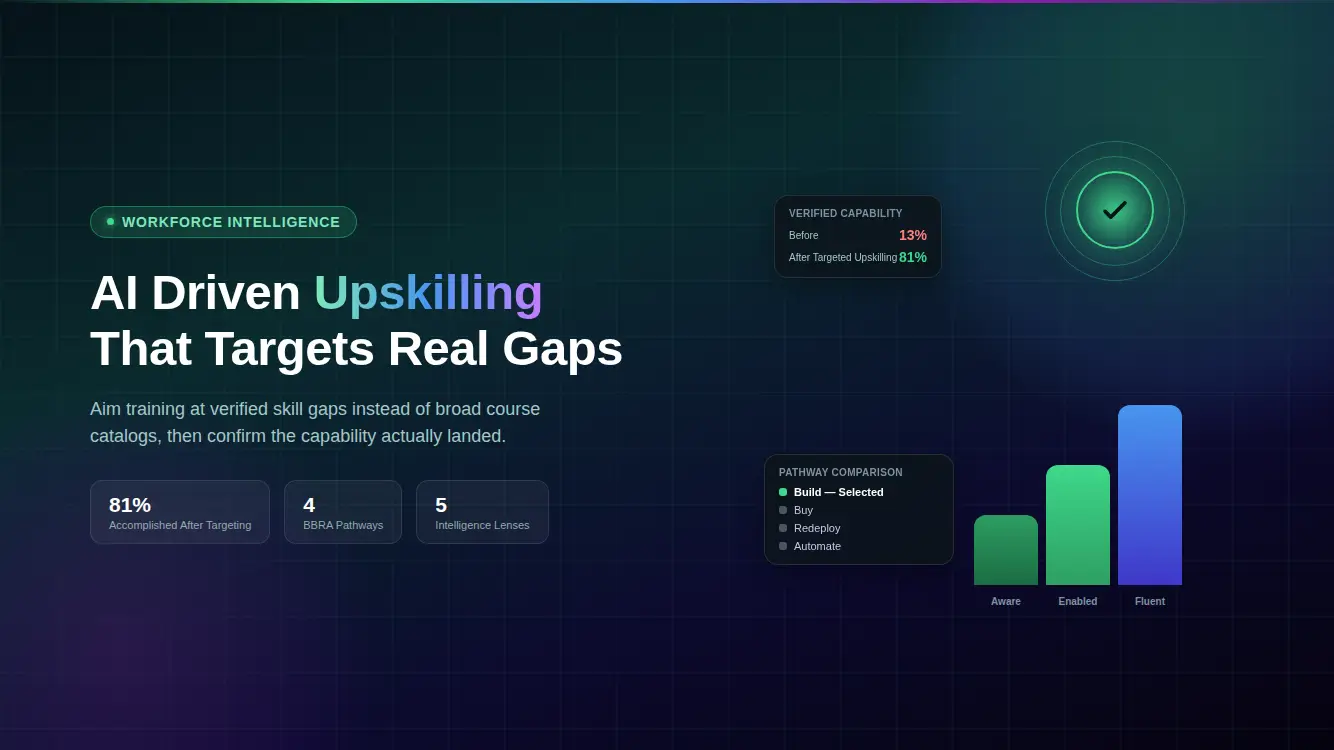
Completion rates tell you almost nothing about capability. Workera’s 2026 AI Skills Enterprise Benchmark Report, drawn from more than 88,000 assessments, found that only 13 percent of employees were rated Accomplished in Agentic AI before any upskilling, the lowest score across the 14 capabilities measured. After targeted upskilling, 81 percent of employees reached Accomplished level in Responsible AI, up from a starting point of just 25 percent, a before-and-after gap documented in Workera’s 2026 enterprise AI skills benchmark. That kind of before-and-after verification is what separates targeted, verified training from a catalog that simply gets pushed out and tracked by attendance.
Why Generic Upskilling Programs Keep Failing
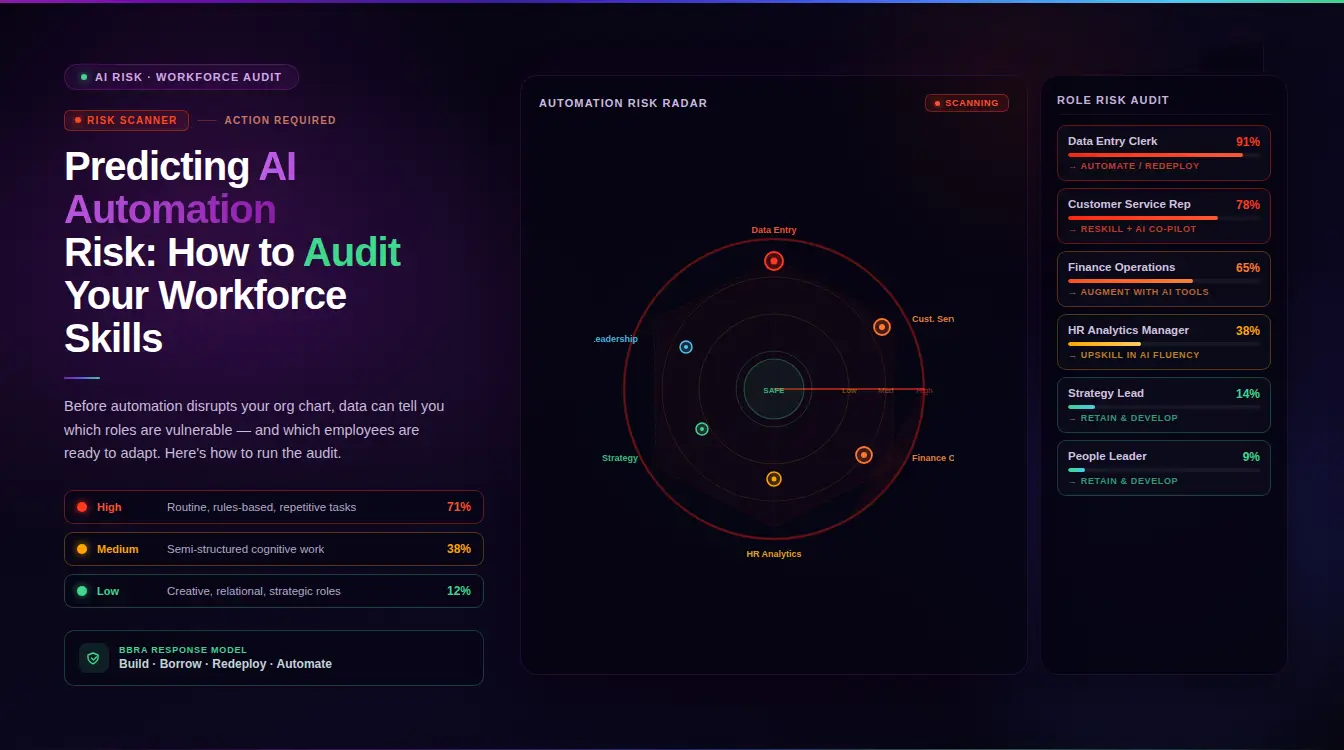
Targeting upskilling correctly requires knowing which tasks within each role carry real automation risk, not which job titles appear on a watch list. A role whose automation-exposed tasks make up 20% of the working week presents a very different upskilling priority from one where 70% of tasks are already substitutable. The distinction is what separates a targeted reskilling investment from a broad training calendar that misses the roles that most need intervention. The data on generic, untargeted training is not encouraging, and it explains why so many AI investments underperform even when the underlying tools work fine.
The structural reason so many upskilling programs underdeliver is that they address one dimension of workforce transformation while leaving the other three unchanged. People and skills is the most visible dimension, but reskilling without corresponding changes to roles and structure, to the technology that reshapes what those roles require day to day, and to the culture that determines whether employees actually adopt the change, produces trained people returning to jobs that have not changed around them.
Untargeted Training Wastes Budget on the Wrong Skills
Research on enterprise AI investment suggests that only about 1 in 50 enterprise AI investments, roughly 2 percent, produce meaningful ROI, and the reason is rarely the technology itself. The same research puts the scale of the challenge at roughly 80 percent of the workforce needing new AI-related skills by 2027. Organizations invest heavily in AI tools without ever mapping which specific roles need which specific capability, so the training budget spreads thin across everyone instead of landing where it would actually change output.
The deeper structural reason upskilling programs stall even when they run well is that they address one of the five pillars an AI enabled workforce requires while leaving the others unchanged. Building AI skills in individual employees does not build the governance framework that creates trust in AI outputs, redesign the roles that embed AI into actual workflows, or shift the culture that determines whether employees feel safe flagging when an AI recommendation is wrong. Without all five pillars moving together, trained employees return to an organization that has not changed around them.
Annual Training Cycles Cannot Keep Pace with Skill Decay
Employees who have not received structured AI training are six times more likely to say AI is making them less productive rather than more, a signal that untrained use of AI tools can actively work against an organization rather than simply underdeliver, based on findings from recent enterprise AI and data skills research. The same research found that only 23 percent of organizations now say their workforce is ready for AI, down from 29 percent the year before, even as 57 percent of those same organizations have broadly deployed AI in core processes, a strong signal that the training model itself, not the amount of training, is the problem.
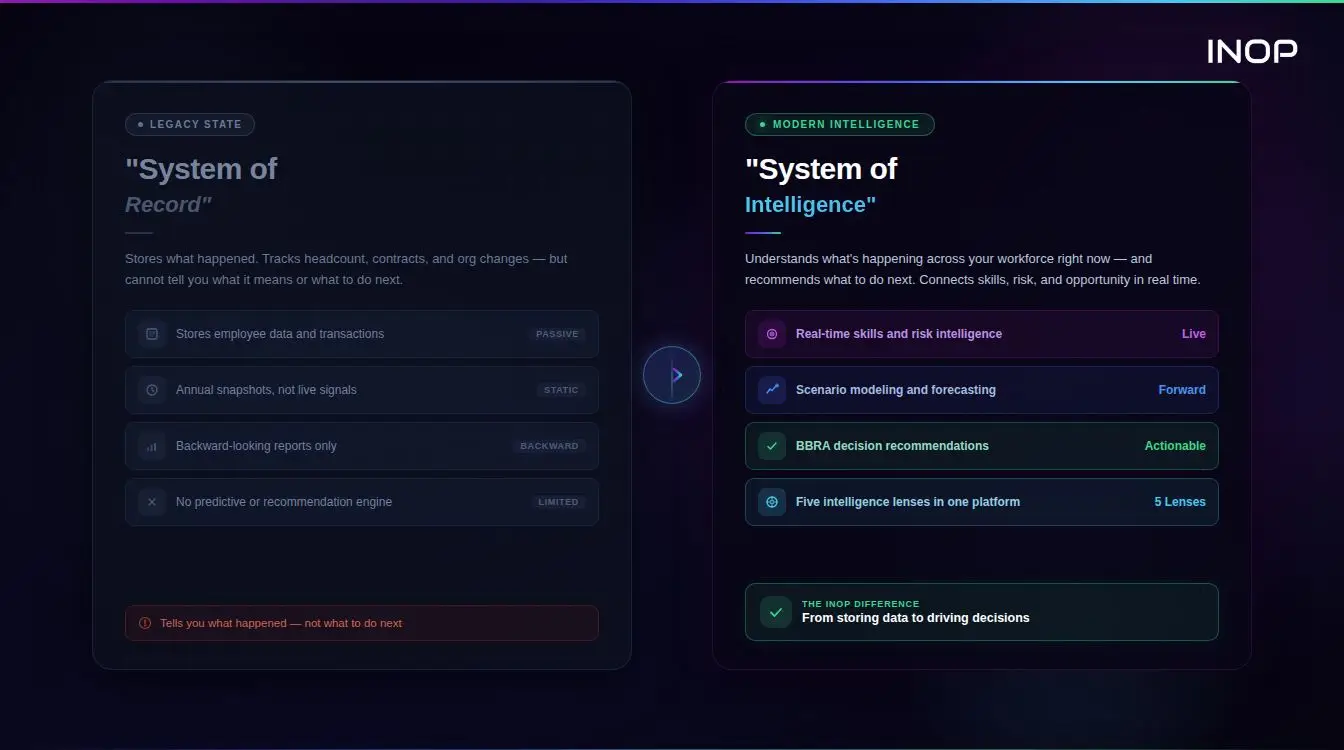
The root cause is structural. Organizations running upskilling on a system of record have accurate data about who completed training. They do not have the verified capability signals, external market benchmarks, or financial modelling that would tell them whether the training closed the right gap at the right time. That distinction, between a system of record and a system of intelligence, is what separates upskilling programs that produce completion certificates from ones that produce measurable capability improvement.
See how INOP identifies which roles need targeted upskilling before you spend the budget. Book a demo to walk through a live capability map for your workforce.
How the Process Actually Works
A working program like this follows a sequence that most learning and development functions have never had the data to support until recently.
Map the Gap Before Assigning a Course
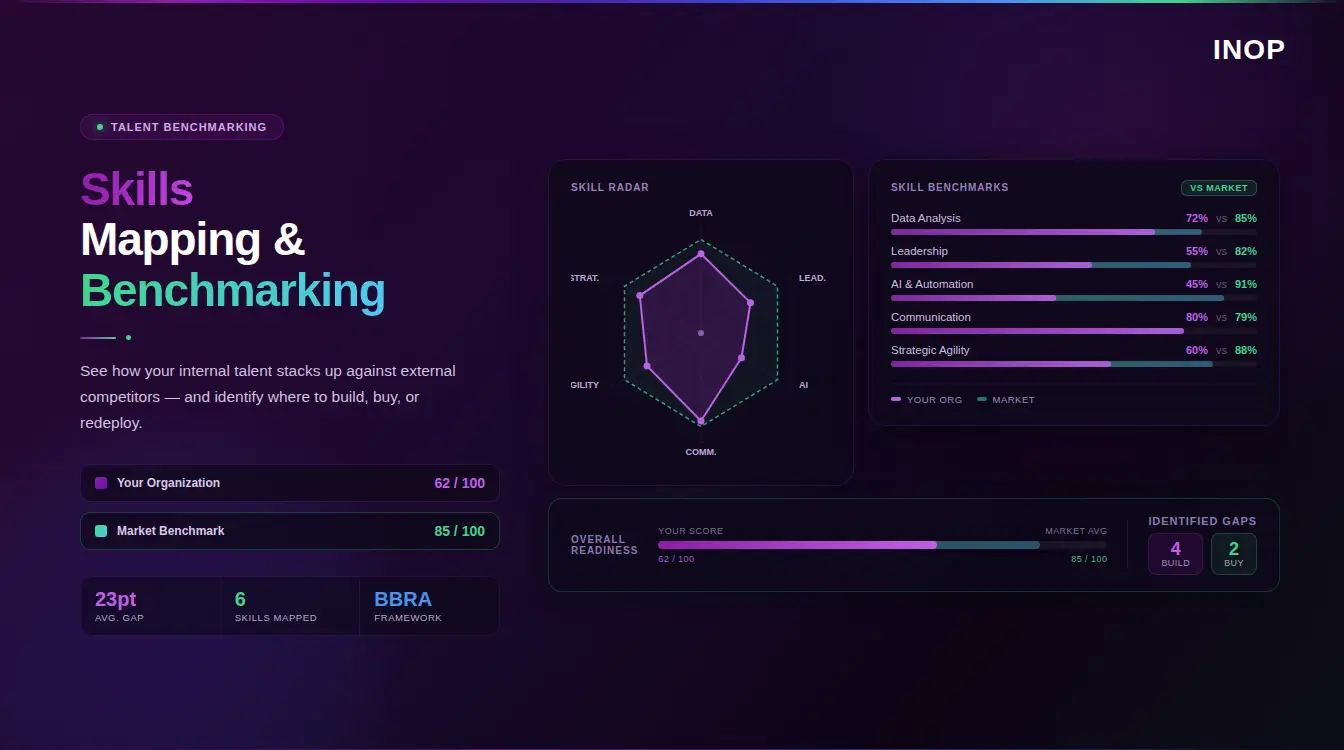
Every upskilling decision should start from a verified gap, not a course catalog. This means comparing what a role currently demonstrates against what the role requires now and over the next few quarters, using data pulled from actual work output and external labor market signals rather than a self-assessment survey. INOP’s skills intelligence platform supports this stage directly by mapping external demand signals, classified as emerging, in demand, stable, or declining, against your existing skills taxonomy, so the gap that training is meant to close is defined before anyone gets assigned to a module.
Model the Fastest Path Before Committing Budget
Once a gap is confirmed, building internal capability is only one of several options, and it is not always the fastest or cheapest one. Modeling build against redeploying someone with adjacent skills, buying the capability externally, or automating the underlying task gives a clearer picture of whether upskilling is even the right call for a given gap.
Verify the Skill Gain, Not Just the Completion
A program only qualifies as truly data driven if it closes the loop with verification. That means checking demonstrated capability after training against the same benchmark used to identify the gap in the first place, rather than counting a completed course as a closed gap.
Applying INOP’s Five Intelligence Lenses to Upskilling Decisions
Upskilling decisions rarely stay contained to a training budget line. INOP evaluates every upskilling investment through five intelligence lenses so the decision reflects the full picture, not just a learning and development view of it.
- Strategy: Does closing this gap unblock a specific initiative, or is the training being assigned because it is available rather than because it is urgent?
- Finance: What does the training path cost against the alternative pathways, and over what time horizon does it pay back?
- People: Who is closest to the required capability already, and where does attrition risk concentrate if the gap stays open?
- Market: Is the skill being trained toward one the external labor market is actively rewarding, or one that is already losing relevance?
- AI and Automation: Could the underlying task be automated instead of trained for, changing whether upskilling is the right investment at all?
The BBRA Framework and the Build Pathway
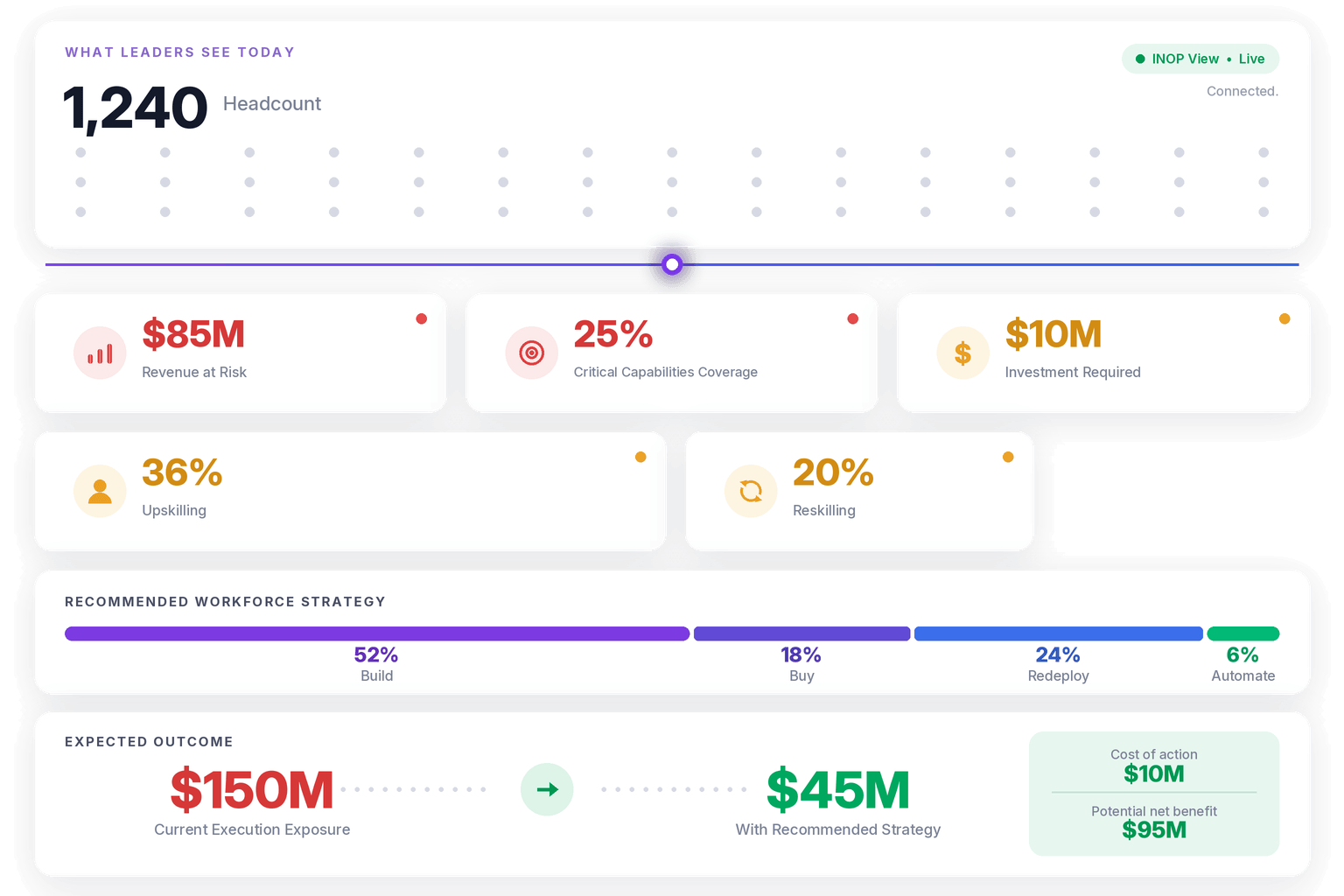
This model maps directly onto the Build pathway inside INOP’s proprietary BBRA framework, which models Build, Buy, Redeploy, and Automate against financial tradeoffs across four time horizons: thirty days, one hundred eighty days, one year, and three years. Treating Build as one of four modeled pathways, rather than the automatic default, is what keeps upskilling investment disciplined. If Redeploy would close the same gap in thirty days at a fraction of the cost of an eighteen month training path, BBRA surfaces that comparison before the training budget gets committed.
This matters because organizations that treat upskilling with real rigor are already seeing it pay off. Companies with strong training infrastructure report 3.5 times faster digital transformation and a 40 percent improvement in employee productivity compared with organizations that lack one, according to recent corporate AI training research, but that gain depends on the training being targeted rather than generic.
The Automate pathway is the most misunderstood of the four, not because organizations overlook it, but because they consistently underestimate what reaching production with an AI agent actually requires. AI workforce automation covers the specific gap between a pilot that impresses a steering committee and a deployment that runs without human correction at every step, which is where most Automate decisions currently stall.
AI Driven Upskilling for Private Equity Operating Partners
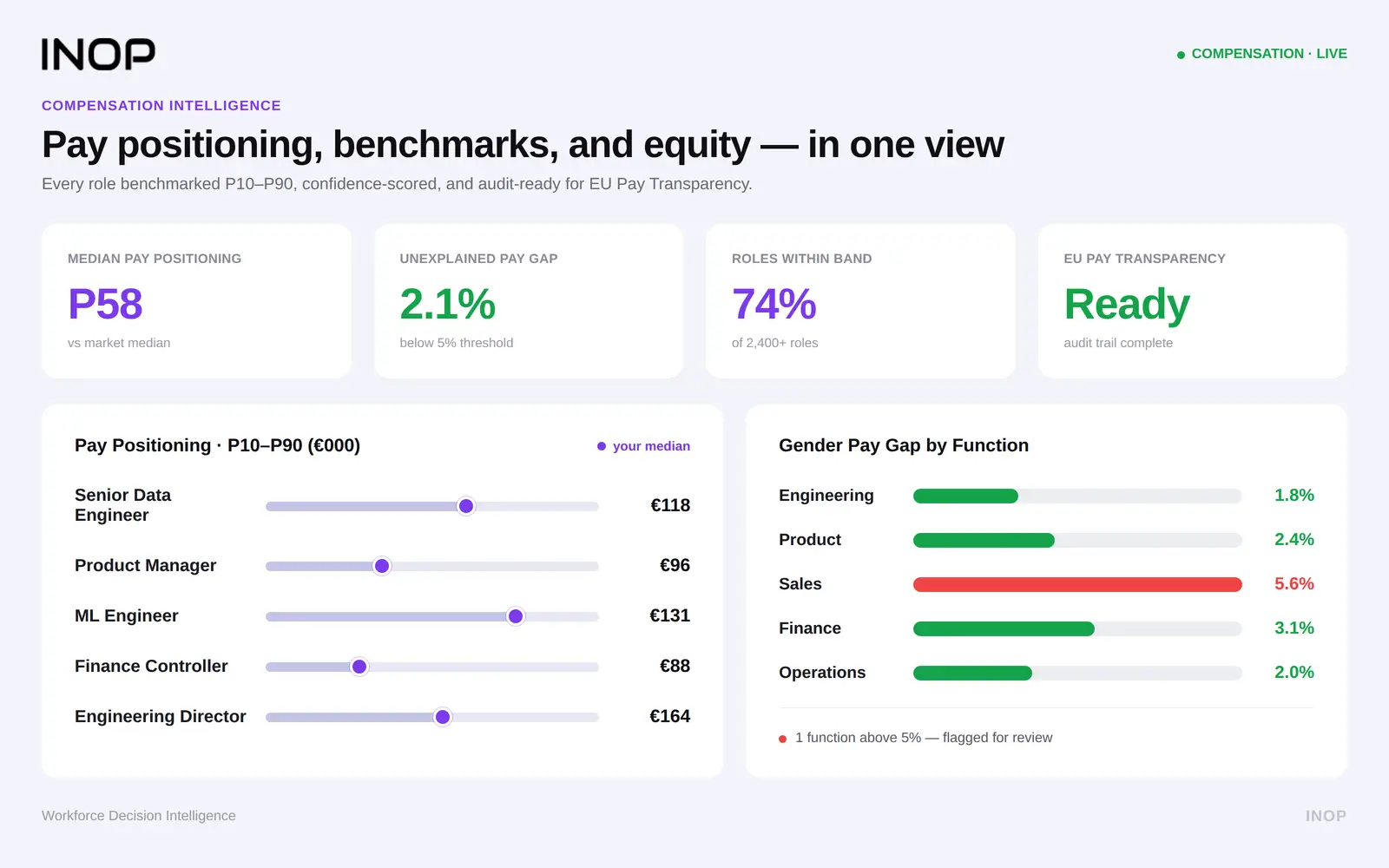
Inside a portfolio company, an upskilling line item is either a real capability investment or a sunk training cost, and the difference usually is not visible until well after the budget is spent. Operating partners evaluating a hundred-day plan benefit from seeing which portfolio companies are running targeted, verified upskilling against which are running generic training with no gap mapping behind it, since the second pattern is a strong predictor that the training spend will not show up in performance later. Standardizing this view across a portfolio through INOP’s strategic workforce planning platform gives operating partners a consistent way to compare upskilling effectiveness across assets rather than taking each portfolio company’s training report at face value. Where the upskilling gap connects to a pay equity or retention risk, INOP’s compensation analytics platform ties the same skill data back into benchmarking, since employees who close a high-demand skill gap often need to be repriced to retain them.
Common Mistakes in AI Driven Upskilling Programs
Measuring completion instead of capability. A finished course proves attendance, not competence. Without a post-training verification step, there is no way to know whether the gap actually closed.
Assigning training company-wide instead of role by role. Broad, undifferentiated rollouts waste budget on employees who did not have the gap in the first place and under-serve the roles where the gap is most costly.
Treating upskilling as the default fix for every gap. Some gaps close faster and cheaper through redeployment or automation. Assuming training is always the answer is what turns a targeted program into an expensive default.
Ignoring how fast the target skill is moving. A training program built around a skill that is already declining in external demand is solving yesterday’s gap. Boston Consulting Group’s own research is direct on this point: across the hundreds of companies in its case work, only about 10 percent of AI value comes from the algorithms themselves and another 20 percent from the underlying technology, while the remaining 70 percent comes from the workforce changes built around it, a finding detailed in BCG’s research on AI transformation as workforce transformation. That same research found that future-built companies plan to upskill more than half of their employees on AI, compared with roughly a fifth at laggard organizations, a gap that only closes if the upskilling effort is aimed at the right skill in the first place.
Frequently Asked Questions
What is the difference between AI driven upskilling and generic AI training?
Generic AI training assigns the same courses broadly and measures success by completion. AI driven upskilling starts from a verified gap specific to a role, models whether training is even the fastest path to closing it, and verifies the skill gain afterward rather than just tracking attendance.
How is AI driven upskilling different from reskilling?
Upskilling deepens capability within a current role. Reskilling prepares someone for a different role entirely. Both can be data driven, and both should run through the same gap mapping and verification process rather than being assigned on assumption.
Can AI driven upskilling replace hiring for AI capability gaps?
It can close a meaningful share of gaps, particularly where an employee already holds adjacent skills, but it should be modeled against hiring and redeployment rather than assumed as the default. Given how scarce specialized AI talent currently is, targeted internal upskilling is often faster than an external search regardless of cost.
How should private equity operating partners evaluate upskilling programs across a portfolio?
By checking whether each portfolio company’s training spend is tied to a verified gap and a post-training capability check, not just a completion report. A high completion rate with no verification step is a weak signal of actual readiness.
How often should an AI driven upskilling program be re-evaluated?
At minimum quarterly, since the underlying skill demand this training targets shifts faster than most annual learning and development calendars can track. A program built once and left unchanged for a year is likely training toward a gap that has already moved.
Ready to see where your training budget is actually working and where it isn’t? Book a demo and INOP will map verified skill gaps against your workforce, model Build against Redeploy, Buy, and Automate for a role of your choice, and show you exactly where targeted upskilling will move the needle first.
Make confident workforce decisions that support strategy and value creation.