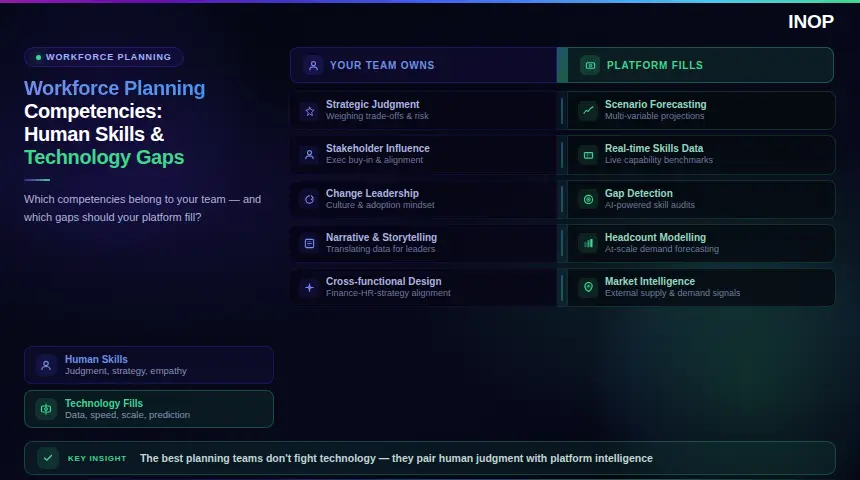
Workforce planning competencies are the specific skills a workforce planning function needs to do the job well: forecasting, financial modeling, data analysis, stakeholder influence, and increasingly, AI fluency. This is a different question from what skills the broader workforce needs. It is about whether the people responsible for planning that workforce actually have the capability to do it credibly, and for most organizations, that answer is no.
This guide covers the core competencies a modern workforce planning function needs, why most teams are short on them, and how to close the gap without trying to hire an entire data science team from scratch.
What Workforce Planning Competencies Actually Cover
Workforce planning has changed faster than most job descriptions for the role have. It has moved from a back-office administrative function, tracking headcount and budget against historical trends, into a strategic discipline that sits at the intersection of HR, finance, and business strategy, according to recent research on workforce planning careers and required competencies. The competencies that role demands have shifted just as fast, and most teams are still staffed and trained for the version of the job that existed five years ago.The Core Competencies Every Workforce Planning Function Needs
Four competency areas consistently show up across current research on what separates a credible workforce planning function from a spreadsheet-and-headcount operation.Data Analysis and Forecasting
Strong spreadsheet skills are treated as a baseline requirement, not a differentiator: pivot tables and lookup functions are considered non-negotiable, SQL is increasingly expected, and familiarity with Python or R is what separates a competitive candidate from an average one, according to the same research on workforce planning careers. Forecasting itself has moved beyond simple trend lines toward a three-tier approach, combining baseline, conservative, and aggressive scenarios built on documented assumptions.Financial and Business Acumen
A workforce plan that cannot translate into a cost model and a return on investment case will not survive a budget conversation. This is why the highest-paid roles in this space blend workforce expertise with financial modeling directly, with Head of People Analytics roles commanding annual salaries in the range of 247,000 to 261,000 dollars, reflecting how much weight financial fluency now carries in the role.Stakeholder Communication and Influence
Technical skill alone does not move a workforce plan into action. Executive communication, the ability to translate analytical findings into strategic recommendations for non-technical audiences, along with the political savvy to navigate competing priorities across business units, is consistently named as a core requirement rather than a soft add-on, according to the same workforce planning careers research. A workforce planning function that can build the model but cannot sell the recommendation produces analysis nobody acts on.AI and Technology Fluency
The newest competency on this list is also becoming one of the most consequential. HR leaders now pay a premium for staff with specialized skills including data analytics and strategic workforce planning, with 86 percent of HR leaders reporting they offer higher compensation for these capabilities, according to recent research on essential HR skills. Workforce planning professionals are now expected to interpret AI outputs critically, govern how AI is used in planning decisions, and apply analytics strategically rather than treating a model’s output as automatically correct.See how INOP fills the competency gaps most workforce planning teams are carrying today. Book a demo to walk through a live capability view for your organization.
Why Most Teams Have a Competency Gap, Not a Data Gap
Most organizations already collect enough workforce data to plan well. What they lack is the combination of competencies required to turn that data into a credible plan: someone who can build the forecast, cost it correctly, and get a business leader to act on it. Hiring a full team to cover data science, financial modeling, and stakeholder management from scratch is slow and expensive, and it is also usually unnecessary. The faster, more common path is augmenting the competencies a workforce planning function is missing with a platform built to cover exactly that gap, rather than treating every missing skill as a headcount problem. INOP’s skills intelligence platform is one part of that augmentation, since it removes the need for a workforce planning team to build and maintain external labor market benchmarking capability internally, mapping demand signals directly against your existing skills taxonomy instead.INOP’s Five Intelligence Lenses as a Competency Multiplier
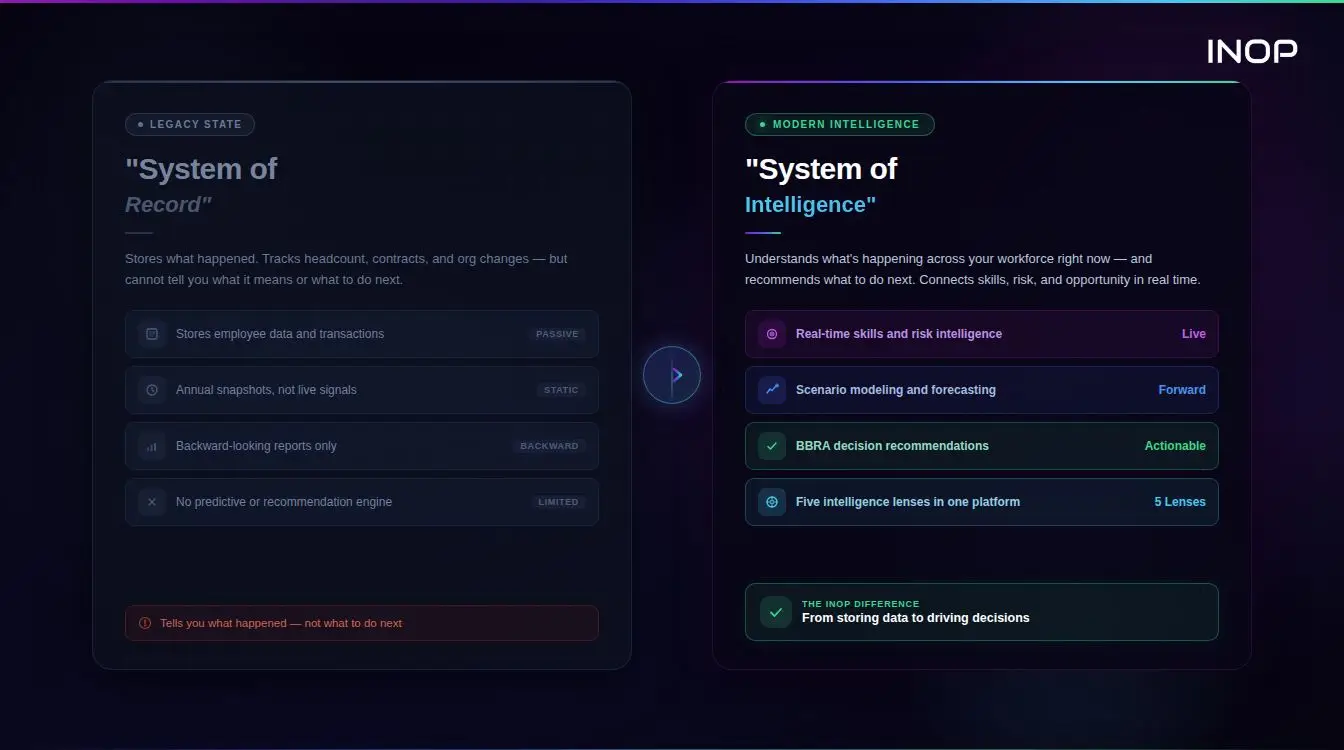
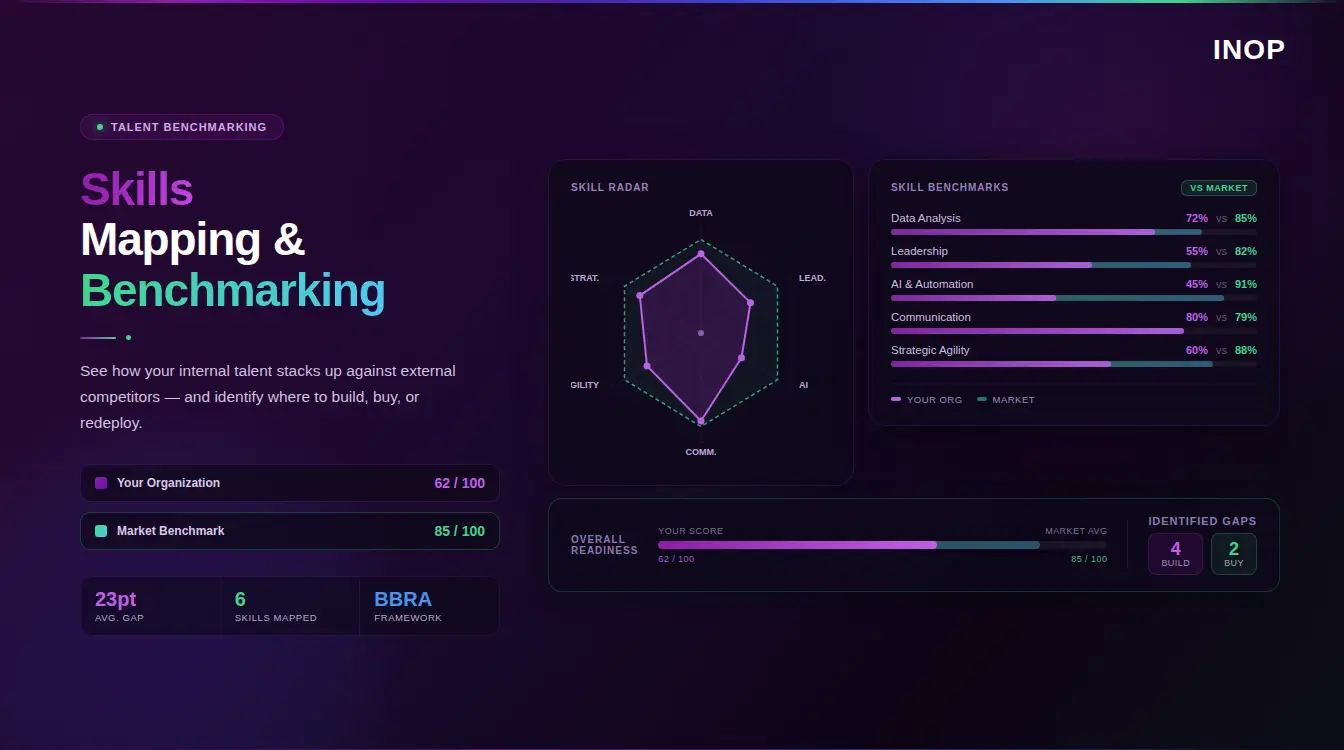
INOP’s Decision Intelligence Layer is built around the same competency areas a strong workforce planning function needs, structured as five lenses so a team missing depth in one area does not lose the full picture.- Strategy: Covers execution readiness, leadership capacity, and succession risk, the strategic judgment layer a workforce planning function needs but rarely has time to build in-house.
- Finance: Covers workforce cost modeling, return on talent investment, and scenario-based financial impact, the exact competency gap that keeps workforce plans from surviving budget review.
- People: Covers real-time skills mapping, role intelligence, mobility capacity, and reskilling pathways, replacing manual data analysis work most teams do not have the staffing to sustain.
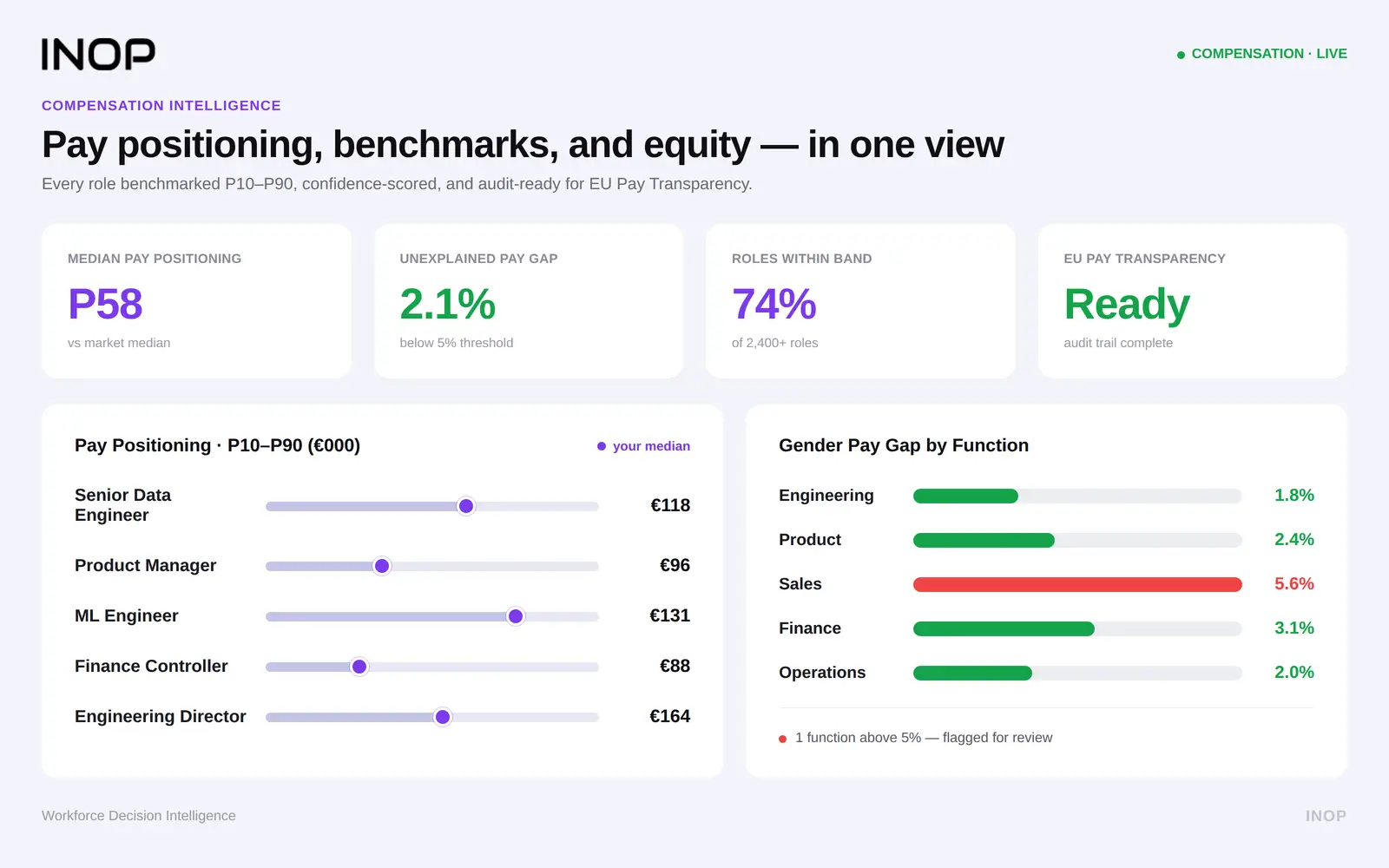
- Market: Covers sector dynamics, competitor hiring activity, compensation benchmarking, and technology disruption, an external research competency few internal teams maintain on their own.
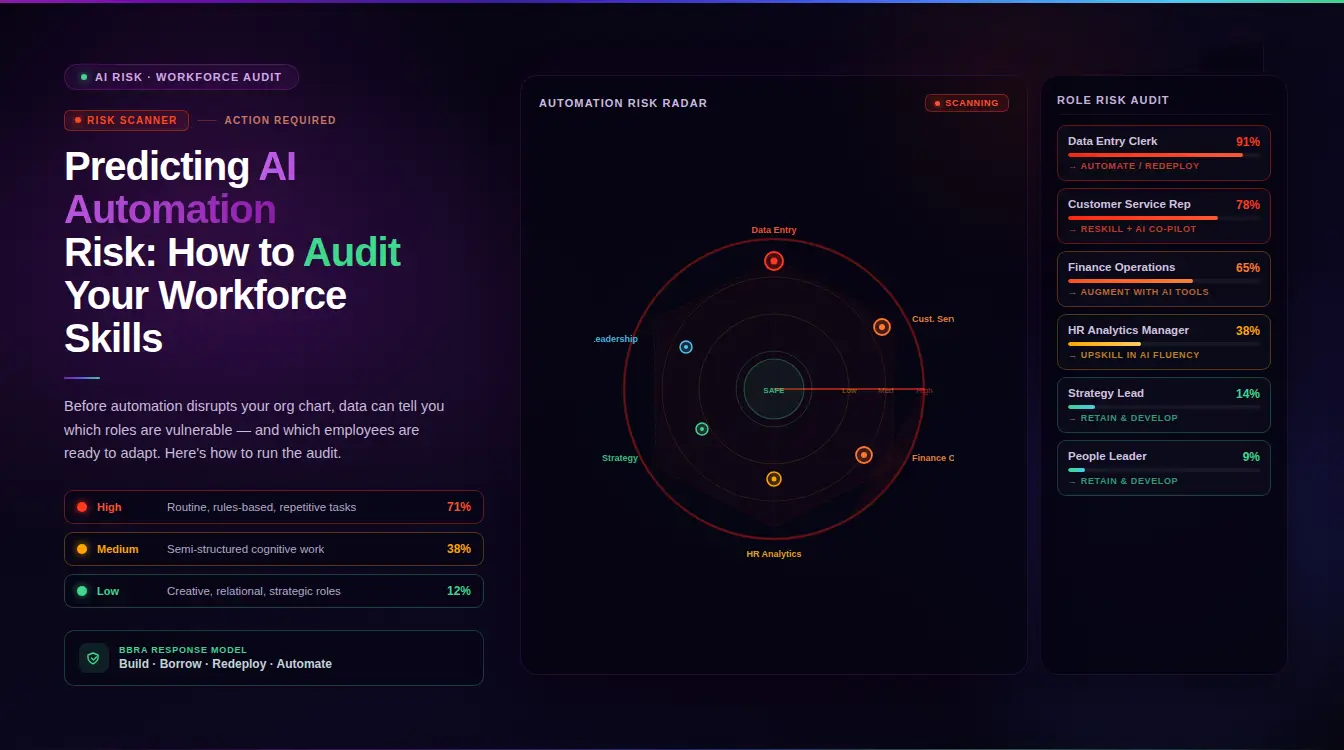
- AI and Automation: Covers role-level automation exposure and workforce impact modeling, the newest and least developed competency inside most workforce planning functions today.
BBRA: Closing Competency Gaps Without Overbuilding the Team
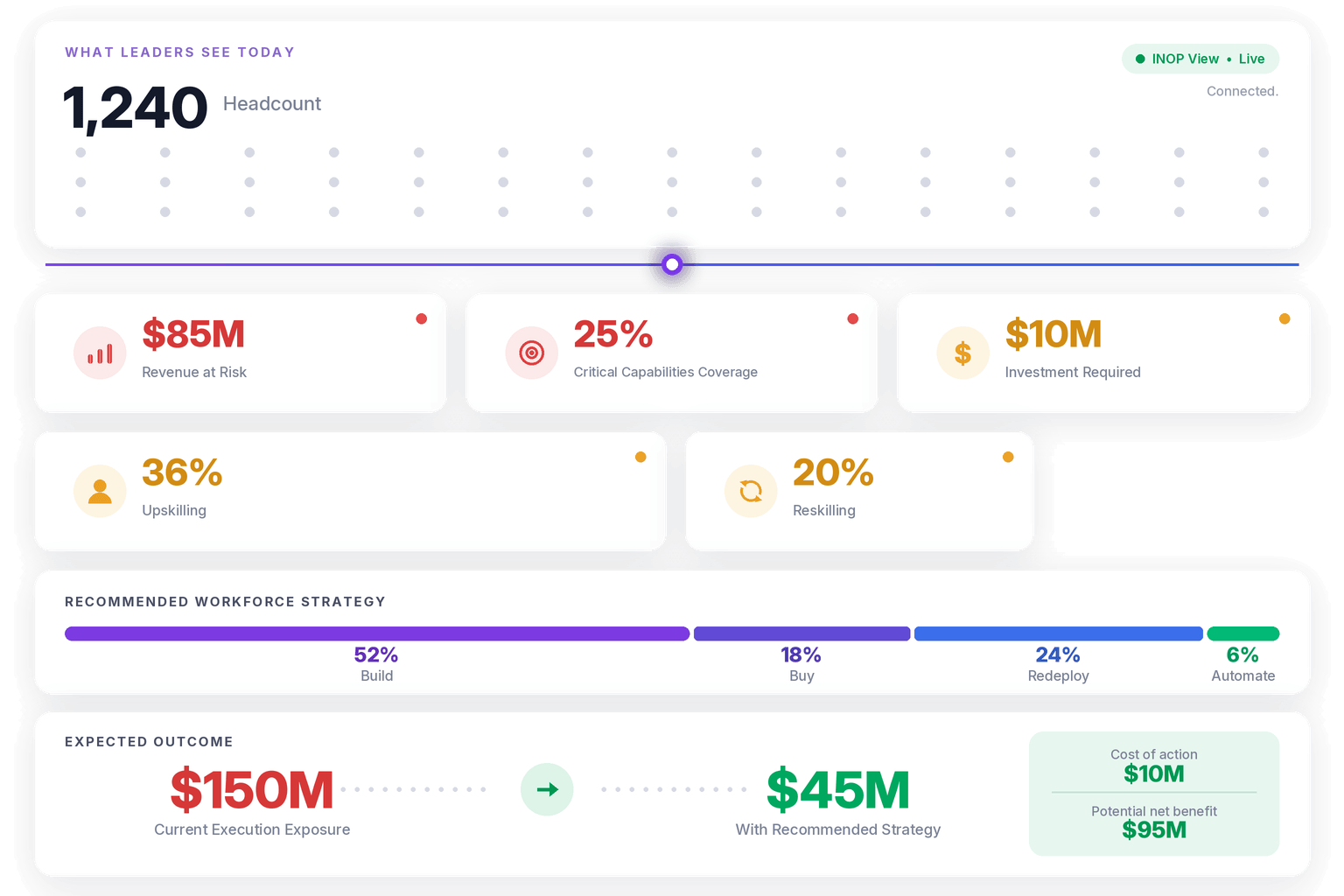
Once a competency gap inside the workforce planning function itself is identified, the same discipline that applies to any workforce gap applies here too. INOP’s proprietary BBRA framework, Build, Buy, Redeploy, and Automate, models four intervention pathways against financial tradeoffs across four time horizons: thirty days, one hundred eighty days, one year, and three years. Applied to a team missing financial modeling depth, for example, this means the choice is not automatically “hire a financial analyst.” It gets modeled against training an existing team member in cost modeling, redeploying someone from finance with adjacent skills, or automating the modeling work through a platform that already covers that competency. Given that Head of People Analytics compensation now runs well into the mid-200,000 dollar range, comparing the cost of building that capability internally against automating it is not optional due diligence, it is the difference between a workforce planning function that scales and one that stays bottlenecked on a single hire.Workforce Planning Competencies for Private Equity Operating Partners
Inside a portfolio company, the competency level of the workforce planning function is a direct predictor of how reliable its workforce data and recommendations actually are. A team strong on spreadsheets and headcount tracking but missing financial modeling, external market benchmarking, or AI fluency is producing plans that look complete and are missing exactly the analysis an operating partner would need to trust them during a hundred-day plan. Standardizing this evaluation across a portfolio through INOP’s strategic workforce planning platform gives operating partners a consistent way to assess workforce planning competency across assets, rather than assuming a function is credible simply because it exists. Where a competency gap connects to retention risk on a workforce planning team itself, since these roles now carry a real market premium, INOP’s compensation analytics platform ties that finding directly into pay benchmarking.Common Mistakes in Building Workforce Planning Competency
Treating workforce planning as an administrative function. Teams staffed and trained for headcount tracking rather than strategic analysis will keep producing headcount reports rather than plans a business leader can actually act on. Hiring for one competency and assuming the rest follow. A team with strong data skills but no financial modeling or stakeholder communication capability still cannot turn a forecast into an approved budget. Ignoring AI fluency as a required competency. Interpreting and governing AI-generated workforce insights is now a distinct skill, not an assumed byproduct of general data literacy, and a team without it is exposed to the same automation bias risk that shows up anywhere an AI output goes unquestioned. Assuming every competency gap requires a new hire. Given how specialized and expensive roles like Head of People Analytics have become, comparing build against augment for each specific gap, rather than defaulting to headcount, is what keeps a workforce planning function scalable. INOP’s guidance on building a living skills taxonomy as planning infrastructure covers the same principle applied to the broader organization, not just the planning function itself. Leaving leadership and succession competency out of the picture. Workforce planning competency is not only about data and forecasting. It also includes judgment about leadership depth and succession readiness, risks worth evaluating alongside the broader set of human capital risks CHROs are already tracking, rather than treating workforce planning as a purely technical exercise.Frequently Asked Questions
What are the most important workforce planning competencies to hire for first?
Data analysis and forecasting typically come first, since they form the foundation everything else builds on, but financial modeling and stakeholder communication are close behind. A team strong in one and missing the others will still struggle to get its plans approved and acted on.Do workforce planning competencies require a technical background?
Increasingly yes, at least at a working level. Spreadsheet fluency is treated as a baseline, SQL is increasingly expected, and familiarity with AI tools and outputs is becoming a standard expectation rather than a specialized add-on.How is AI fluency different from general data literacy in workforce planning?
General data literacy covers reading and interpreting data. AI fluency specifically means knowing how to evaluate, question, and govern AI-generated outputs, since an ungoverned AI recommendation can be wrong in ways general data skills alone will not catch.Should organizations hire for every workforce planning competency gap?
Not necessarily. Given how expensive specialized roles like financial modeling or market research analysts have become, modeling build against augmenting the gap with a platform, or redeploying existing talent, is usually more cost-effective than hiring for every missing competency individually.How should private equity operating partners evaluate workforce planning competency at a portfolio company?
By checking whether the function covers data analysis, financial modeling, stakeholder influence, and AI fluency, not just whether a workforce planning team exists. A team strong in one area and missing the others is producing incomplete plans that may look more credible than they are.Ready to see where your workforce planning function has real competency and where it has a gap? Book a demo and INOP will map your team’s capability against the five lenses, run every gap through BBRA, and show you where augmentation beats another hire.
Book a Demo
Make confident workforce decisions that support strategy and value creation.