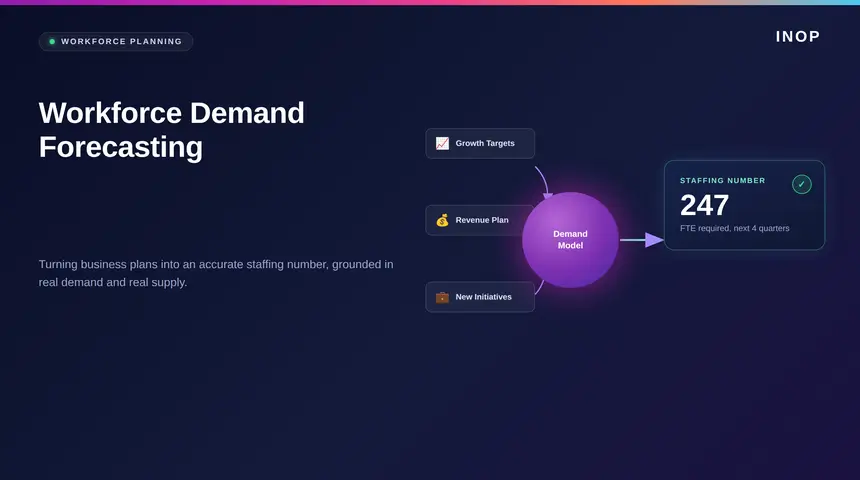
Workforce demand forecasting is the process of predicting how many people, with which skills, an organization will need to hit a specific business target, whether that target is projected revenue growth, a product launch, or a market expansion. It is one half of workforce planning, the half driven entirely by business outputs rather than by who currently sits on the payroll. Get the demand side wrong and every downstream decision, hiring plans, training budgets, redeployment strategy, inherits that error.
This guide covers what a credible workforce demand forecast actually requires, the methods available and when each one applies, and why a forecast that produces an accurate number still fails if it never connects to an actual staffing decision.
What Workforce Demand Forecasting Actually Predicts
Demand forecasting starts from the business, not from the org chart. If a company plans to grow revenue by a defined percentage, launch a new product line, or expand into a new region, workforce demand forecasting translates that plan into a specific headcount and skills requirement: how many people, in which roles, with which capabilities, by when. This is distinct from workforce supply forecasting, which looks internally at retirements, turnover, and internal mobility to predict what talent will actually be available. Demand forecasting answers what the business needs. Supply forecasting answers what the organization will have. The gap between the two is where workforce planning decisions actually get made.
The Data Foundation Behind an Accurate Forecast
A demand forecast is only as reliable as the data feeding it, and most organizations underinvest in this step relative to how much weight they put on the model itself. A comprehensive forecast draws on internal HR data, timesheets, overtime records, absenteeism, and turnover, to establish a baseline of current workforce utilization, combined with recruitment metrics like time-to-hire and offer acceptance rates that reveal how quickly new capacity can actually be added. External labor market indicators, unemployment rates, industry staffing benchmarks, and regional talent supply, provide context that internal data alone cannot, since a forecast built only on internal history has no way to account for a tightening or loosening labor market outside the organization. Seasonal and business-cycle trends round out the picture, capturing recurring patterns tied to product launches, budget cycles, or historical demand peaks, according to recent research on workforce demand forecasting methodology. Skipping any one of these four categories does not make the forecast faster to build. It makes it less reliable in exactly the conditions where an accurate forecast matters most.
The most common failure point is not a missing data category but poor data quality within the categories an organization does track. Timesheets with inconsistent formatting across business units, turnover logs that lag actual departures by weeks, or recruitment metrics that mix contractor and full-time hiring without distinction all quietly degrade forecast accuracy long before the modeling step even begins. Establishing clear data ownership, standardized formats, and a regular audit cadence is unglamorous work compared to selecting a forecasting method, but it is usually the higher-leverage investment, since even the most sophisticated model cannot compensate for inputs that are inconsistent or stale.
Choosing the Right Forecasting Method
No single forecasting technique works for every situation. The right choice depends on how stable the environment is, how much historical data exists, and how much interpretability matters to the stakeholders who need to trust the output.
Time Series and Regression for Stable Environments
Time series analysis examines historical staffing and workload data to identify recurring patterns and cycles, and it works well precisely because it is easy to implement and interpret. Its limitation is equally clear: it struggles to account for external shocks or structural changes that break historical patterns. Regression models go a step further, quantifying the relationship between staffing levels and specific demand drivers like sales volume or service requests, which supports a more direct hypothesis about what is actually driving the need for more people, though the approach assumes those relationships are linear and can be thrown off by variables that move together.
Machine Learning for Complex, Shifting Demand
Where multiple demand drivers interact in nonlinear ways, machine learning models can detect patterns that time series and regression approaches miss entirely, adapting automatically as new data comes in. The tradeoff is real: these models require substantial historical data to train well, and their internal logic is far less transparent to the finance and business leaders who need to trust a forecast before acting on it. A highly accurate model nobody trusts enough to act on delivers less value than a simpler model stakeholders actually believe.
Scenario Planning for Volatile or High Growth Conditions
Scenario planning complements the quantitative methods above by building multiple forecast versions based on different assumptions, an economic downturn, an accelerated launch timeline, a slower hiring market, so leaders can evaluate risk and prepare contingencies rather than betting the entire workforce plan on a single projected number. It is more time-consuming to build and entirely dependent on the quality of the assumptions behind each scenario, but for organizations operating in volatile or high-growth conditions, a single-point forecast is often more dangerous than no forecast at all, since it creates false confidence in a number that was unlikely to hold from the start.
See how INOP turns a demand forecast into a modeled staffing decision, not just a number. Book a demo to walk through a live forecast for your organization.
Why Demand Forecasts Break Down Without a Decision Layer
An accurate demand number is not, by itself, a plan. Most organizations invest heavily in getting the forecasting method right and comparatively little in what happens after the forecast is produced. A forecast that says a business expansion will require forty additional engineers by a certain quarter is useful only if it connects to an actual decision process: should those forty people be hired externally, developed internally from adjacent roles, redeployed from a lower-priority initiative, or is some portion of that projected need better addressed through automation. Without that connection, an accurate forecast sits in a report while the organization defaults to the same response it always uses, usually external hiring, regardless of whether that is actually the fastest or most cost-effective path for the specific gap the forecast identified.
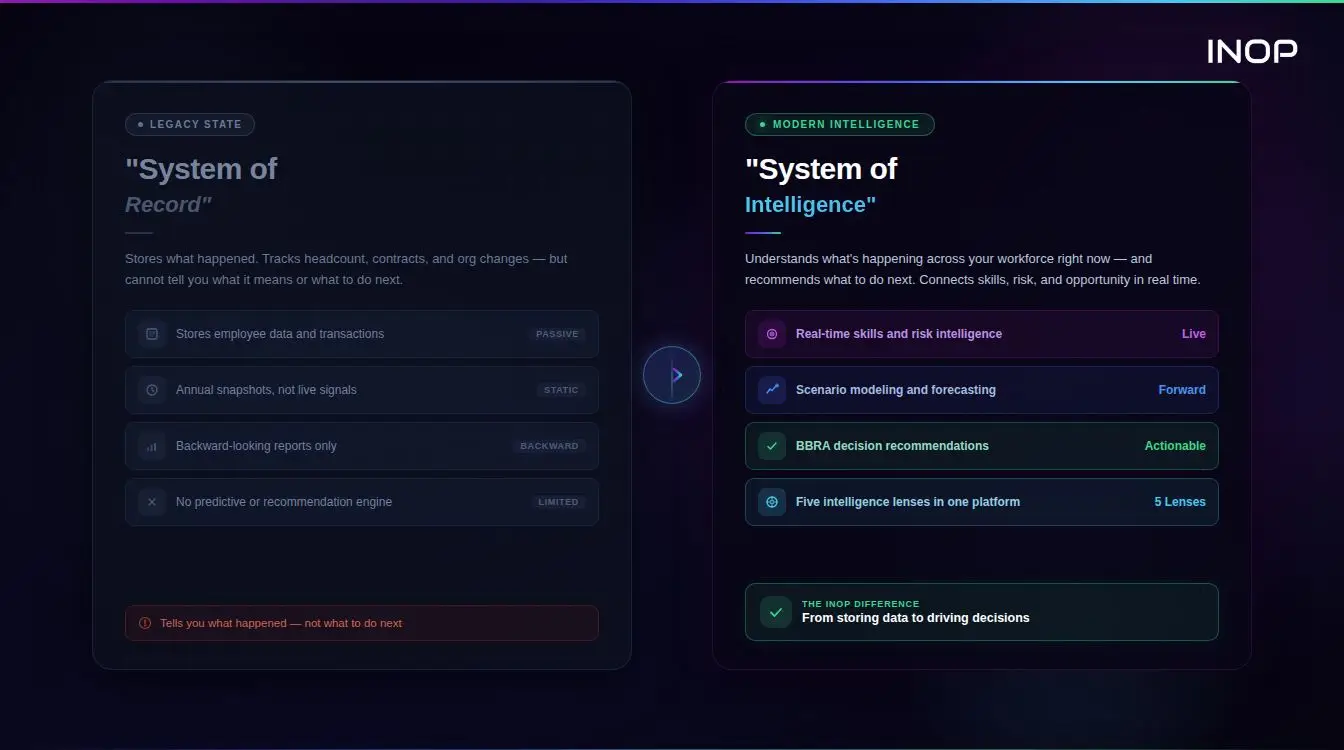
This is also where the distinction between predictive and prescriptive forecasting matters in practice. A predictive forecast tells you what is likely to happen, the projected headcount and skills gap. A prescriptive layer on top of it tells you what to actually do about it, comparing the available response pathways against cost, speed, and risk. Most organizations have invested in the predictive half and stopped there, which produces confident, well-modeled numbers that never quite translate into faster or cheaper staffing outcomes, because nothing in the process forces a comparison between the response options once the number is in hand.
INOP’s Five Intelligence Lenses Applied to Workforce Demand Forecasting
A demand number in isolation tells you how many people and what skills a business plan requires. It does not tell you whether that plan is achievable, what it will cost, or what the smartest path to closing the gap actually is. INOP evaluates every demand forecast through five intelligence lenses before it becomes a staffing decision.
- Strategy: Does the forecasted demand align with a business priority significant enough to justify the investment required to meet it?
- Finance: What does closing the forecasted gap actually cost across different pathways, and does the projected business outcome justify that cost?
- People: Who inside the organization already holds adjacent capability that could close part of the forecasted gap faster than external hiring?
- Market: Is the talent the forecast calls for actually available externally at the volume and timeline the business plan assumes, given current labor market conditions?
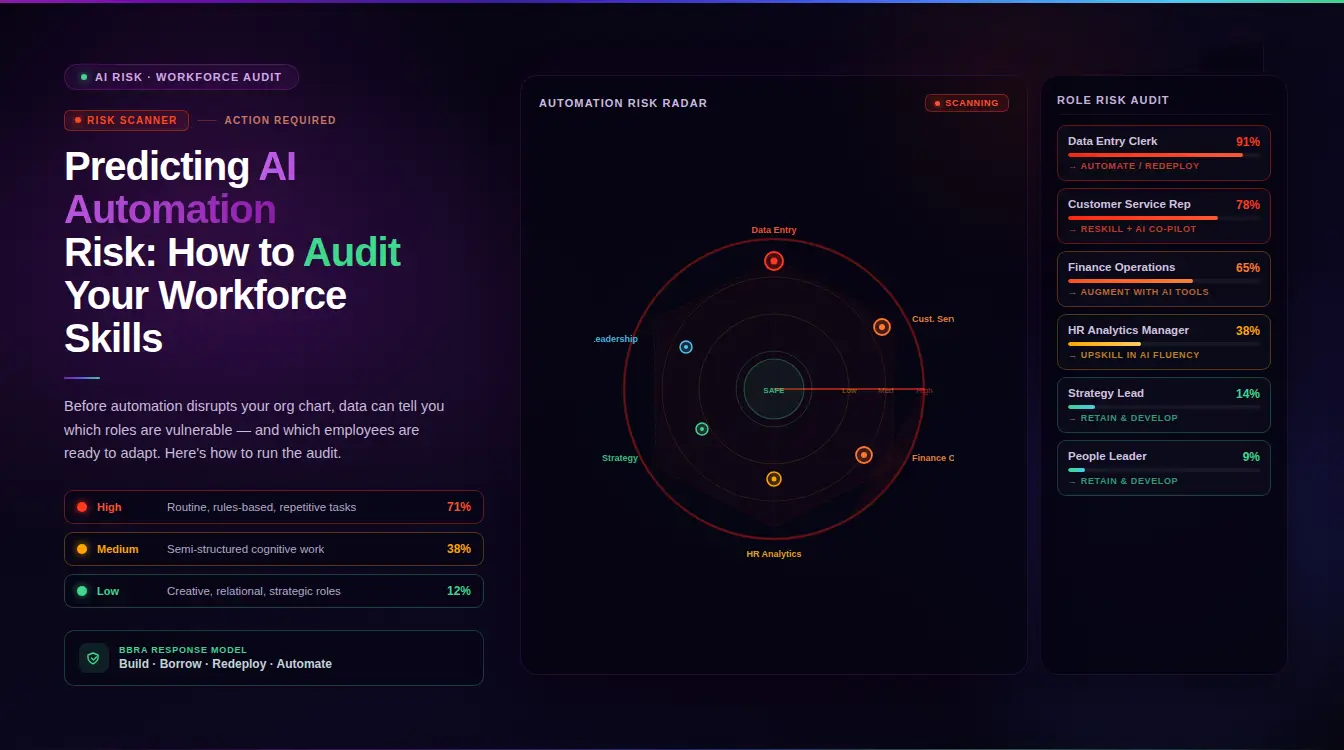
- AI and Automation: Could some portion of the forecasted demand be met through automation rather than headcount, changing the actual staffing number required?
Running a forecasted number through all five lenses is what separates a workforce plan grounded in reality from one built on an assumption that hiring, at whatever volume the model produces, is automatically achievable and automatically the right response.
BBRA: Turning a Forecasted Gap Into a Modeled Response
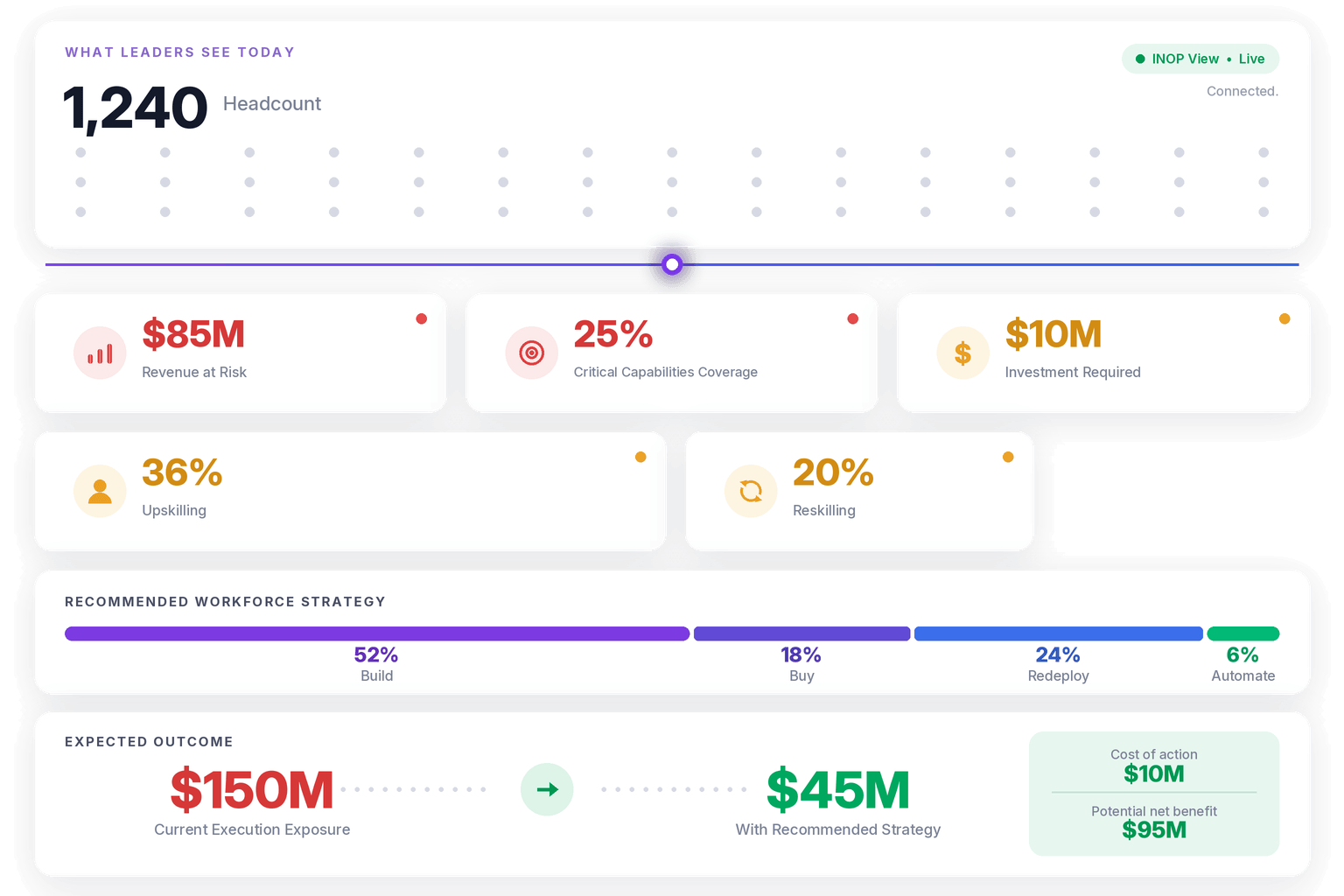
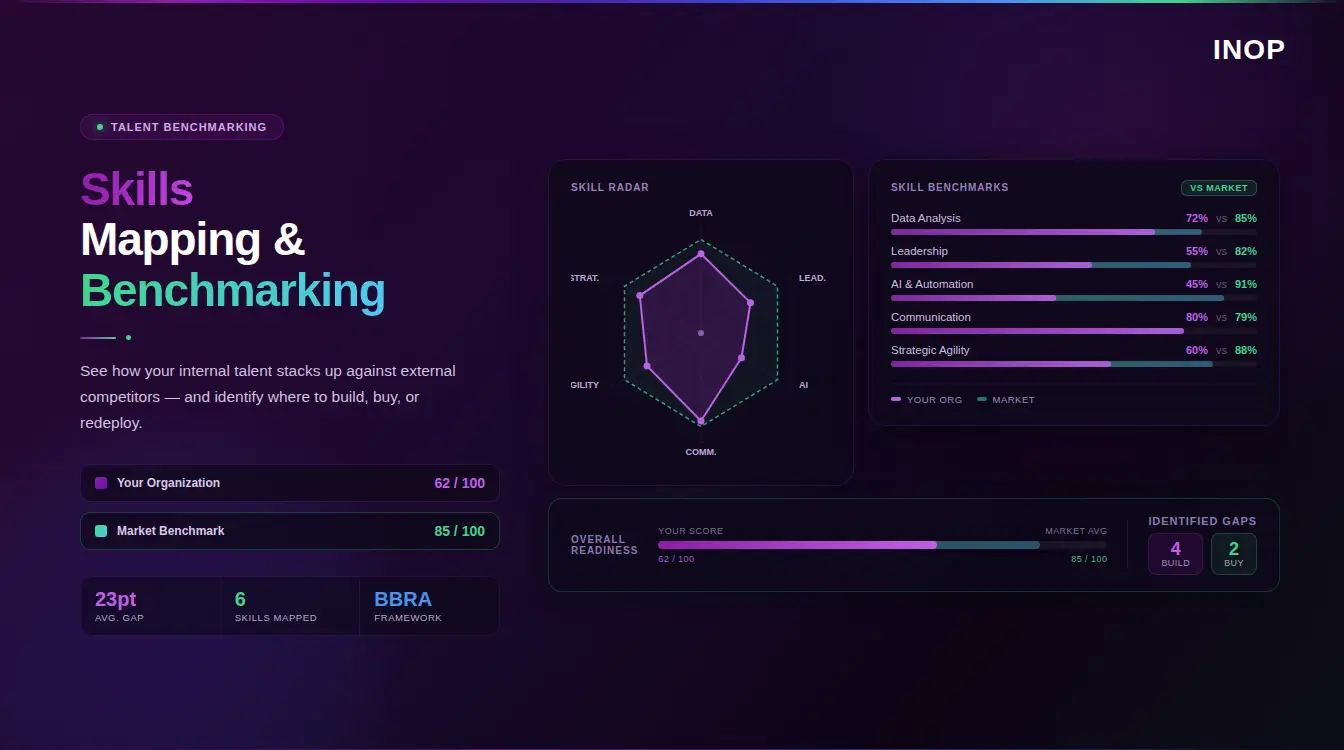
Once a demand forecast identifies a gap, INOP’s proprietary BBRA framework, Build, Buy, Redeploy, and Automate, gives that gap an actual decision structure instead of a default response. BBRA models all four intervention pathways against financial tradeoffs across four time horizons: thirty days, one hundred eighty days, one year, and three years.
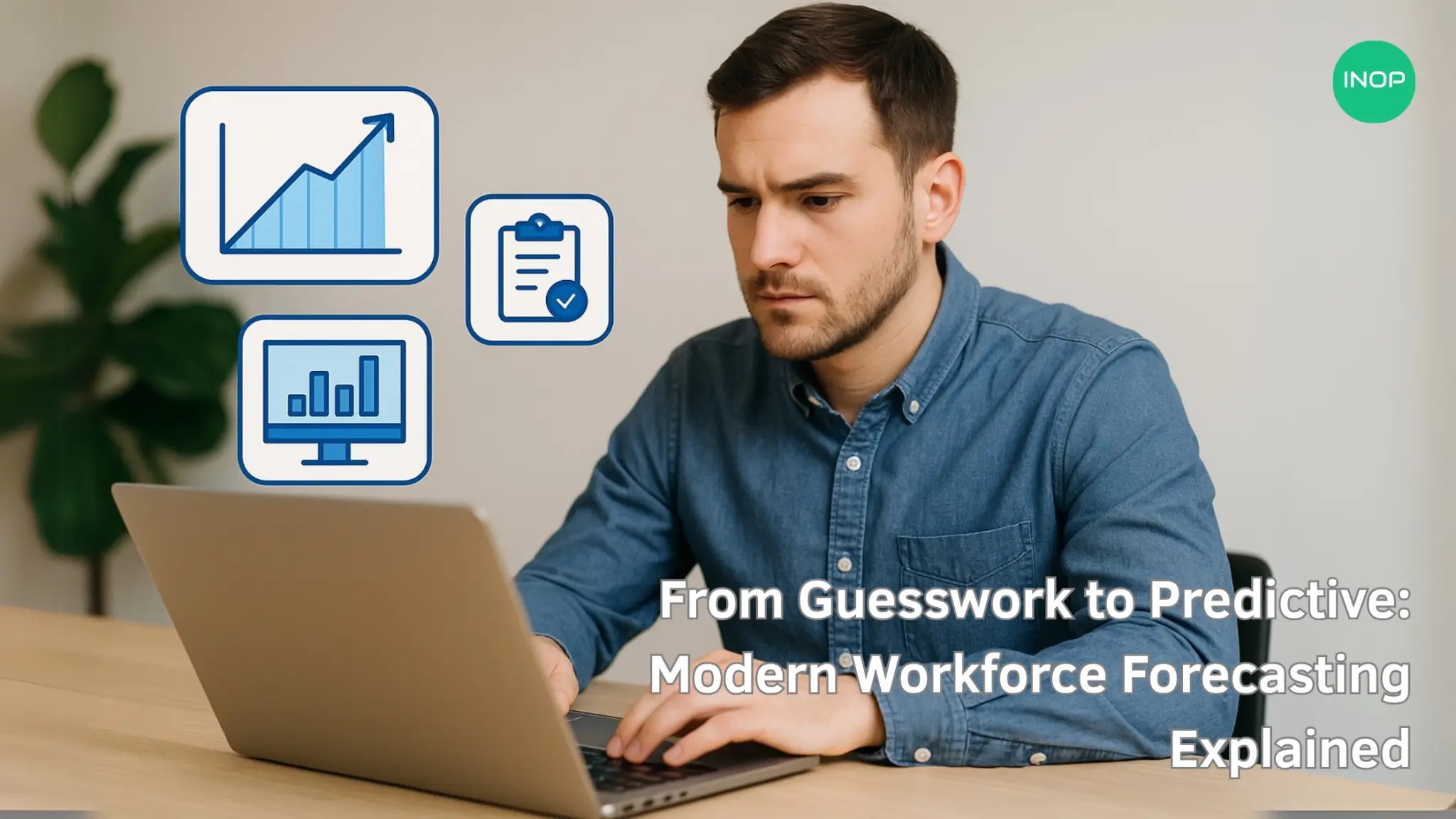
Applied to a forecasted demand gap, this means a projected need for forty additional engineers does not automatically trigger forty external hiring searches. It gets modeled against redeploying engineers from lower-priority projects, upskilling adjacent talent already inside the organization, and automating a portion of the underlying workload, compared side by side against the cost and timeline of external hiring at that scale. This is the layer most demand forecasting stops short of, producing an accurate number without ever comparing the paths available to actually reach it. For a deeper look at how demand and supply forecasting connect to this decision layer, INOP’s guide on moving from guesswork to predictive, modern workforce forecasting covers how the two sides of forecasting work together across the platform, and how predictive forecasting outputs connect into prescriptive, decision-ready recommendations once BBRA and the five-lens model are applied.
Workforce Demand Forecasting for Private Equity Operating Partners
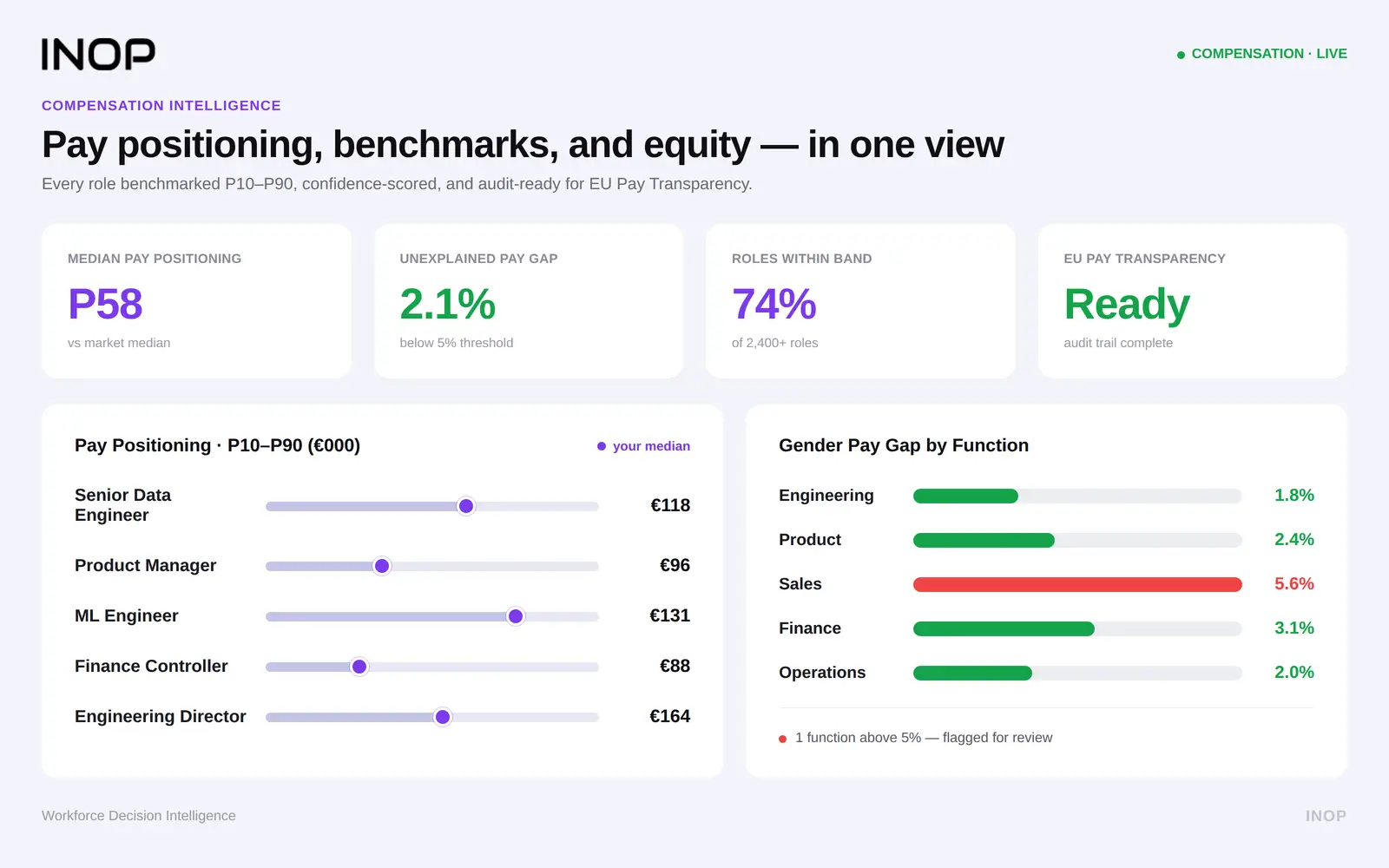
Inside a hundred-day plan, an inaccurate or disconnected demand forecast is one of the more common ways a growth plan quietly fails to translate into staffing reality. A portfolio company that projects aggressive revenue growth without a corresponding, credible demand forecast behind it is planning to scale a business it does not yet know how to staff. This gap rarely shows up in the numbers presented during diligence, since a growth projection and a staffing plan can both look complete on paper while having no real connection to each other underneath. Standardizing demand forecasting across a portfolio through INOP’s strategic workforce planning platform gives operating partners a consistent way to stress-test whether a portfolio company’s growth assumptions actually connect to a realistic staffing plan, rather than taking a projected headcount number at face value. Where a forecast identifies roles carrying scarce, high-demand skills, INOP’s compensation analytics platform connects that finding directly into pay benchmarking, since a forecasted hiring surge into a tight talent market usually comes with a compensation premium that a headcount number alone will not surface, and that premium can materially change the economics of a growth plan built on optimistic hiring assumptions.
Common Mistakes in Workforce Demand Forecasting
Forecasting headcount without forecasting skills. A number that says “forty additional engineers” without specifying which capabilities those engineers need is not specific enough to act on. Demand forecasting has to operate at the skill level, not just the headcount level, to actually inform hiring, development, or redeployment decisions.
Choosing a forecasting method based on sophistication rather than fit. A machine learning model is not automatically the right choice simply because it is more advanced. In a stable, well-understood environment, a simpler time series or regression model that stakeholders actually trust often outperforms a more complex model nobody wants to act on.
Treating the forecast as static once it is built. Business assumptions shift faster than most forecasting cycles account for. A forecast built once at the start of a planning cycle and never revisited is describing a business plan that may no longer be accurate by the time the projected hiring is supposed to happen.
Skipping external labor market data. A demand forecast built entirely on internal data has no way to account for whether the talent it calls for is actually available externally at the volume and timeline assumed. INOP’s skills intelligence platform closes this gap by mapping external demand signals directly against your existing skills taxonomy, so a forecast reflects labor market reality rather than an internal assumption about availability.
Never connecting the forecast to a modeled response. An accurate number that does not feed into a build, buy, redeploy, or automate comparison is a projection, not a plan. This is the single most common reason an otherwise well-built demand forecast fails to change what the organization actually does.
Letting forecast ownership sit entirely with HR. A demand forecast built without direct input from finance and the business units generating the demand tends to reflect HR’s best guess at business plans rather than the plans themselves. Cross-functional ownership, with finance validating cost assumptions and business leaders validating the underlying growth or launch timeline, produces a forecast the organization actually trusts enough to act on.
Frequently Asked Questions
What is the difference between workforce demand forecasting and supply forecasting?
Demand forecasting predicts what the business will need based on projected outputs like revenue growth or product launches. Supply forecasting looks internally at retirements, turnover, and internal mobility to predict what talent the organization will actually have available. Workforce planning compares the two to identify the gap.
Which forecasting method is most accurate for workforce demand forecasting?
No single method is universally most accurate. Time series and regression models work well in stable environments with clear historical patterns, machine learning handles complex, shifting demand with enough historical data, and scenario planning is often more valuable than any single-point forecast in volatile or high-growth conditions.
How often should a workforce demand forecast be updated?
Monthly updates typically align with operational planning, while quarterly reviews should incorporate larger strategic shifts such as mergers, product launches, or significant market changes. A forecast should also be revisited after any unexpected event that would materially change the underlying business assumptions.
Why does an accurate demand forecast sometimes fail to change staffing decisions?
Because the forecast never connects to a decision process. An accurate number that identifies a gap still needs to be compared against build, buy, redeploy, and automate pathways before it translates into an actual staffing plan, and most organizations stop at the number itself.
How should private equity operating partners evaluate a portfolio company’s workforce demand forecast?
By checking whether projected growth assumptions connect to a specific, skill-level staffing plan, not just a headcount projection. A growth plan without a credible demand forecast behind it is a strong signal that execution risk is higher than the plan on paper suggests.
Ready to see your demand forecast connected to an actual staffing decision, not just a projected number? Book a demo and INOP will walk through a live forecast, run every gap through BBRA, and show you the fastest path to closing it.