Predictive HR analytics is the discipline that moves HR from reporting what happened to forecasting what will happen next, and, crucially, giving leadership enough lead time to do something about it. Your analytics platform flags that 11 employees in a critical delivery function are likely to resign within 90 days. The forecast is accurate, the confidence interval is tight, and the data is clean. Now what?
For most HR teams, that question is where the value of the analytics investment quietly evaporates. It turns into a meeting, a spreadsheet, and a gut call. This guide covers everything HR leaders need to know about predictive HR analytics in 2026: what it is, how it works technically, the use cases that generate the most measurable value, the data and tools required to build it, how it connects to the prescriptive analytics layer where decisions actually live, and what separates the organizations extracting real ROI from those producing impressive charts that change nothing.
Ready to see predictive HR analytics in action for your organization? Book a 20-minute demo with INOP.
What Is Predictive HR Analytics?
Predictive HR analytics uses historical HR data, statistical modeling, and machine learning algorithms to forecast future workforce outcomes. Where traditional HR reporting describes what has already occurred, turnover spiked last quarter, engagement scores dropped after the restructure, predictive analytics identifies patterns in existing data and uses them to signal what is likely to happen next.
The emphasis is on probability rather than certainty. A predictive model does not tell you with certainty that an employee will leave. It tells you that based on their compensation percentile relative to market, their tenure bracket, their engagement trajectory, their manager change recency, and their skill-to-role alignment score, there is a 74% probability of departure within 90 days. That probability, applied across 500 employees simultaneously, converts an individual HR instinct into an organizational early warning system.
According to a Deloitte survey, 70% of companies reported using data analytics to support HR decision-making in 2022. By 2026, adoption is projected to exceed 80%, making predictive analytics a standard operational capability for progressive organizations rather than a competitive differentiator available only to large enterprises. The organizations that moved early are now extracting compounding returns. Those adopting now are closing the gap. Those waiting are absorbing the cost of decisions made without foresight.
Predictive HR Analytics vs. Traditional HR Reporting
The distinction between predictive analytics and traditional HR reporting is not one of sophistication, it is one of time orientation. Traditional HR reporting is retrospective. It answers: what happened? Headcount this quarter, attrition last month, engagement scores from the last survey. The information is accurate and useful for accountability. It is not useful for prevention, because by the time the data is available the event has already occurred.
Predictive HR analytics is prospective. It answers: what is about to happen? It uses the patterns in historical data to project forward rather than backward. The same attrition data that confirms last month’s departures, combined with current compensation positioning, development trajectory, and engagement signal data, can identify next quarter’s likely departures while there is still time to intervene.
The Analytics Maturity Ladder: Where Predictive Fits
HR analytics sits within a four-stage maturity model. Understanding where your organization is on this ladder is the first step toward a realistic deployment roadmap.
Descriptive analytics answers: what happened? It summarizes historical workforce data: headcount trends, turnover rates, time-to-fill, absenteeism, engagement scores. Most organizations have this capability. According to AIHR’s research on HR analytics maturity, fewer than one in three organizations has progressed beyond this stage to genuine forecasting capabilities.
Diagnostic analytics answers: why did it happen? It isolates root causes. When turnover spikes in a specific business unit, diagnostic tools reveal whether the driver was compensation positioning, management quality, workload concentration, or skill-to-role mismatch.
Predictive analytics asks: what is likely to happen next? It uses statistical models and machine learning to forecast future events, from flight risk scores to hiring demand projections, skills shortage timelines, and succession readiness gaps.
Prescriptive analytics asks: what should we do about it? It evaluates multiple possible interventions, models the likely effect of each, and recommends the optimal course of action, often with financial implications attached to each pathway. This is where INOP’s BBRA framework becomes the decision architecture that makes prescriptive outputs actionable rather than advisory.
According to Gartner’s 2025 CHRO survey findings, strategic workforce planning entered the top three CHRO priorities for the first time, reflecting a broader C-suite expectation that HR will deliver forward-looking capability intelligence connecting talent decisions to financial outcomes, not just backward-looking headcount reports.
How Predictive HR Analytics Works: The Technical Foundation
Data Sources and Inputs Required
Predictive HR analytics is only as reliable as the data that feeds it. The most common reason predictive models produce unreliable outputs is not algorithmic weakness, it is insufficient or inconsistent data inputs. Understanding what data is required, at what quality standard, is the prerequisite to realistic model deployment.
The primary data sources for predictive HR analytics include: HRIS data covering employee demographics, tenure, role history, organizational structure, and compensation history; payroll data providing salary, bonus, and benefits information at the individual level; performance management data including ratings, goal completion records, and manager assessments over multiple cycles; engagement survey data and pulse check results mapped to individual employees rather than only to aggregate team levels; learning management system data showing training completions, certification records, and development investment per employee; time and attendance data capturing absenteeism patterns, overtime trends, and schedule adherence; and ATS and recruiting data providing time-to-fill, source effectiveness, and early tenure outcome data for each cohort of hires.
The higher the consistency and coverage of these data sources, the more reliable the predictive models built on top of them. An organization with five years of clean HRIS data, individual-level performance records, and current compensation benchmarks can build attrition models with meaningful predictive accuracy within 90 days of starting. An organization with fragmented data spread across five disconnected systems will spend the first six months on data engineering before the first model is viable.
Statistical Methods Used in Predictive HR Modeling
Several statistical frameworks underpin predictive HR analytics, each suited to different types of prediction problems.
Logistic regression is the most widely used method for binary outcome prediction in HR, including attrition (will this employee leave or stay?) and offer acceptance (will this candidate accept or decline?). It produces interpretable probability scores that non-technical stakeholders can understand and act on, which is a significant practical advantage over more complex methods whose outputs are harder to explain.
Decision trees and random forests identify the combination of variables that most strongly predict an outcome and organize them into a hierarchy of decision nodes. They are particularly effective for complex predictions where multiple variables interact, for example, identifying that tenure combined with manager change recency combined with a compensation percentile below 40 produces a significantly elevated attrition probability, even though no single variable alone would flag the risk.
Survival analysis models time-to-event outcomes rather than simple binary predictions. Rather than asking “will this employee leave?”, survival analysis asks “how long before this employee is likely to leave?” This time dimension is particularly valuable for workforce planning, where knowing that a departure is likely in 60 days versus 18 months requires completely different interventions.
Neural networks and deep learning are increasingly applied to large-scale pattern recognition in HR data, particularly for talent acquisition use cases where large volumes of historical hiring and performance data are available. Their limitation for HR applications is interpretability: neural network outputs are difficult to explain to employees, managers, or regulators, which creates governance risk in an era of increasing pay transparency and algorithmic accountability requirements.
Natural language processing (NLP) enables predictive modeling from unstructured data sources including engagement survey free-text responses, performance review comments, and pulse check responses. NLP can identify sentiment trajectories and disengagement signals that structured numerical data misses, adding a qualitative dimension to predictive models that rely only on quantitative inputs.
How a Competency Framework Powers Predictive Models
A competency framework is not background context for predictive HR analytics, it is the structural input that determines whether models produce meaningful capability forecasts or sophisticated pattern-matching on proxy variables.
When competency data is clean, consistently measured, and embedded in the HR data ecosystem, predictive tools can forecast which employees are developing at the rate required to reach next-level competency thresholds, identify roles where skill decay or market-relative capability erosion is generating execution risk, score candidates against defined competency profiles and model their likely performance trajectory, and detect early attrition signals linked to unmet development expectations or skill-to-role misalignment.
Title and tenure produce coarse predictions. Competency data, when clean and consistently defined, produces precise ones. According to Deloitte’s Global Human Capital Trends research, organizations using data-driven workforce practices are significantly more likely to report improved talent outcomes and faster execution on strategic initiatives. The quality of those outcomes depends directly on what the models are measuring.
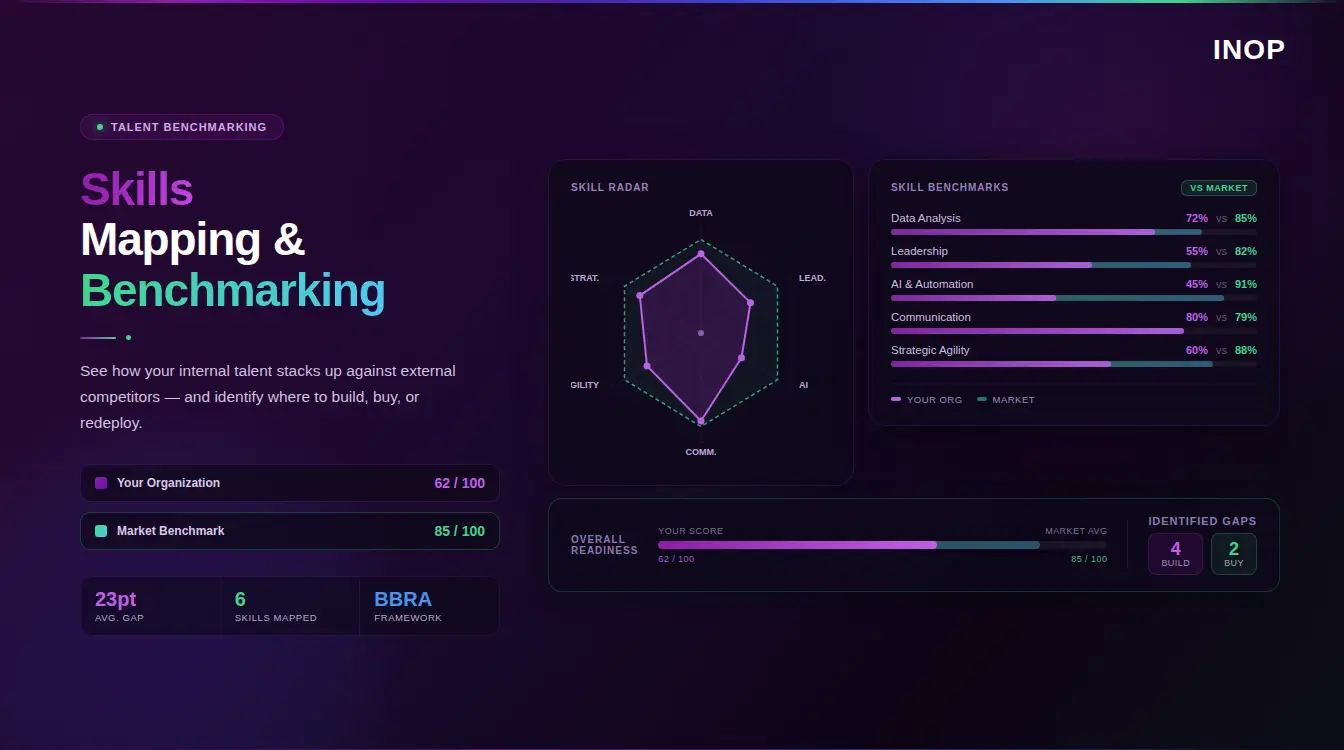
INOP’s skills intelligence platform maps internal competency frameworks against external market demand signals at the proficiency, role, and sector level, and models AI/automation impact on each skill. The result is a continuously updated view of where workforce capability sits relative to where the market is moving, not just where it was last year.
Key Use Cases for Predictive HR Analytics
Employee Attrition and Flight Risk Prediction
Attrition prediction is the most widely deployed and most immediately valuable application of predictive HR analytics. Rather than discovering that a high-performer has accepted an external offer, a well-deployed attrition model gives HR and managers a 60 to 90 day window before departure intent becomes departure action.
The variables most predictive of voluntary attrition include compensation percentile relative to external market benchmarks for the specific skill profile (not the generic title), tenure within current role versus career stage expectations, engagement score trajectory over the last three survey periods rather than point-in-time score, manager change recency, promotion wait time relative to comparable cohorts, and skill-to-role alignment score. The interaction of these variables produces significantly more accurate predictions than any single variable alone.
The financial case for attrition prediction is direct: SHRM’s research on the cost of workforce gaps shows that the fully loaded cost of a senior-level departure, including productivity loss, knowledge transfer, and replacement, can reach 150% to 200% of annual salary. For a team of ten senior professionals where the model identifies three at elevated risk, the financial exposure is $750,000 to $1,000,000 on replacement costs alone. An intervention costing $50,000 in compensation adjustments and development investment that retains two of the three represents an ROI of 1,400% to 1,900% on the analytics-driven intervention.
Skills Gap Forecasting and Workforce Capability Planning
Skills gap prediction answers one of the most strategically important questions workforce planning can ask: which capabilities will the organization need in 12 to 36 months that it does not currently have at sufficient scale, and how long does it have to close the gap through internal development before external hiring becomes the only option?
Predictive models for skills forecasting combine internal capability assessment data with external labor market demand signals. When an organization’s data scientists are assessed at foundational to intermediate on generative AI frameworks, and external market data shows that GenAI capability is appearing as a core requirement in 67% of new data science postings, the model can project how many months before the internal capability gap becomes a competitive disadvantage, and compare that timeline to the development velocity of the current workforce. Deloitte projects that 90% of companies will face skills shortages by 2027, making early planning through predictive analytics the primary lever for avoiding emergency hiring at premium rates.
For organizations building skills gap forecasting capabilities, INOP’s skills intelligence platform provides both the internal assessment layer and the external market demand signals required for meaningful capability prediction. For a worked example of how skills gap analysis connects to strategic planning, INOP’s guide on skill gap analysis examples for HR teams covers the methodology in detail.
Succession Planning and Leadership Readiness Prediction
Succession planning without predictive analytics defaults to two failure modes: recency bias, where the most recent high-visibility performance determines succession candidacy, and manager advocacy, where the most senior voice in the room determines the successor pool. Predictive analytics addresses both by scoring current employees against the competency profile of target succession roles and modeling their development trajectory toward readiness.
A readiness score for each succession candidate is calculated from the current competency gap between assessed proficiency and role-required proficiency, the rate at which the candidate is closing gaps over time based on assessment history, performance evidence of the leadership behaviors the target role demands, and organizational context factors including manager quality in the development role and access to relevant stretch assignments.
The output is not a binary “ready or not ready”, it is a time-to-readiness estimate with a development pathway attached. An organization that knows Candidate A is 12 months from readiness with a specific development investment, while Candidate B is 24 months away and Candidate C requires external hiring for the target role, can make a substantially better succession decision than one choosing between three names on a list.
Workforce Demand Forecasting and Headcount Planning
Predictive HR analytics transforms headcount planning from an annual exercise based on historical trends and manager estimates into a continuous, driver-based forecasting process. Rather than asking managers “how many people do you need next year?”, predictive demand models connect business driver assumptions directly to workforce requirements.
If the organization has historically needed 2.3 additional operations staff per $1M in new revenue, a 12% revenue growth plan produces a predicted demand for 28 additional operations FTEs within a defined period. When this demand projection is compared against the predicted internal supply, accounting for attrition probability, development velocity, and internal mobility potential, the model produces a specific net hiring requirement rather than a headcount guess.
This approach is the foundation of modern workforce forecasting, moving organizations from reactive to proactive planning. The organizations that implement driver-based predictive demand modeling consistently report 20 to 35% improvement in headcount planning accuracy and significantly lower reactive hiring premium costs.
Candidate Quality and Performance Prediction
Predictive analytics in talent acquisition models the probability that a candidate will reach expected performance benchmarks within a defined timeframe, given their assessed competency profile, prior experience pattern, and behavioral assessment results. When trained on historical hiring data connecting pre-hire assessment results to 12-month performance outcomes, these models produce significantly more accurate candidate quality predictions than unstructured interviews or credential review alone.
The practical application: rather than making hiring decisions based on which candidate presented most compellingly in an unstructured interview, organizations using predictive selection models can identify which candidates are most likely to perform at the required level six months post-hire. This is particularly valuable for roles where the interview-to-performance correlation of conventional assessment methods is poor, which, according to research from the Journal of Applied Psychology, includes most knowledge-work roles where unstructured interviews have a validity coefficient of only 0.38.
Engagement and Absenteeism Risk Prediction
Predictive engagement modeling uses survey response patterns, absenteeism trends, collaboration data, and performance trajectories to identify employees at risk of disengagement before that disengagement registers in standard metrics. An employee whose engagement scores have declined in three consecutive surveys, who has requested three sick days in the past month after a period of zero absenteeism, and whose performance rating has dropped one level is displaying a pattern that predictive models reliably associate with departure within 60 to 90 days, even when their current score is still above the threshold that would flag them manually.
The value of early engagement prediction is the intervention window it creates: addressing the root cause of disengagement 60 days before a resignation decision is made is far cheaper than replacing the employee 90 days after the resignation is submitted.
Benefits of Predictive HR Analytics
The benefits of predictive HR analytics are most clearly understood in financial terms, because that is the language in which organizational investment decisions are made.
Reduced workforce risk costs. Predictive models identify attrition risk, skills gaps, and succession failures before they materialize as operational problems. The cost of a proactive retention intervention is consistently lower than the cost of the replacement cycle it prevents. For organizations with 500 employees where the model identifies 30 at elevated attrition risk and proactive intervention retains 20, the saving is 20 avoided replacement cycles at an average cost of $80,000 each, representing $1.6 million in avoided cost from a single predictive analytics application.
Lower external hiring premium costs. Organizations that can forecast workforce demand 12 to 18 months in advance build proactive hiring pipelines that fill roles at market rates rather than reactive emergency rates. Apollo Technical’s 2026 research shows that reactive hiring runs 19% to 30% more expensive per hire than proactive pipeline-based hiring. For organizations making 200 professional hires annually, this premium represents $400,000 to $600,000 in avoidable annual spend.
More accurate strategic workforce planning. Predictive analytics replaces assumption-based planning with evidence-based planning. Organizations that use predictive demand modeling and skills gap forecasting report 20 to 35% improvement in headcount planning accuracy over baseline historical trend analysis. This accuracy improvement directly reduces both over-hiring cost and under-hiring delay.
Improved talent acquisition quality. Predictive selection models trained on historical hire-to-performance data reduce first-year attrition rates for externally hired talent, reduce time-to-full-productivity, and improve retention rates among new hires. When candidates are assessed against competency profiles predictively validated against performance outcomes, the quality of selection decisions improves measurably.
Board-level human capital intelligence. As SEC human capital disclosure requirements and EU CSRD obligations expand, organizations need to demonstrate structured, evidence-based workforce governance to investors and regulators. Predictive analytics provides the forward-looking workforce risk identification that satisfies the expectation that HR leadership can anticipate and address workforce challenges rather than only reporting on them after the fact.
Predictive HR Analytics vs. Prescriptive Analytics: The Full Picture
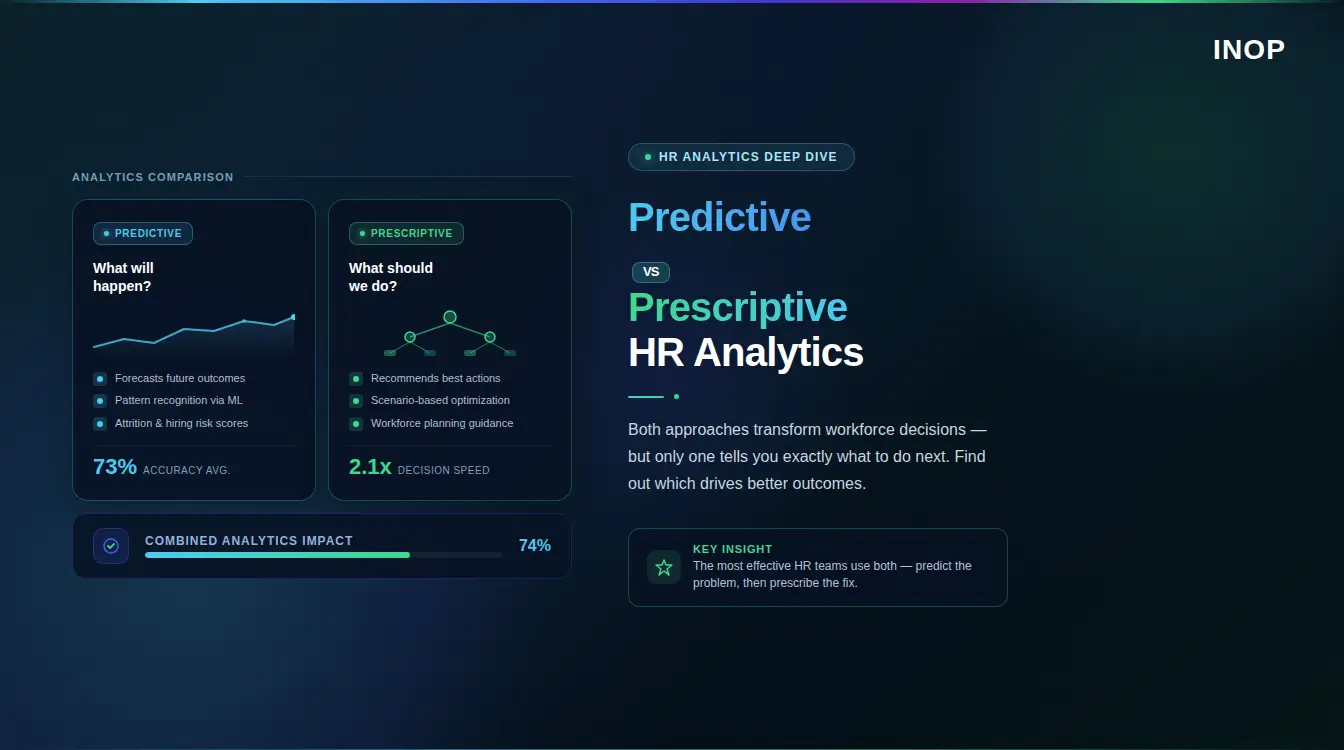
The most important limitation of predictive analytics is the one that is most often overlooked: predictive analytics generates forecasts, not decisions. It tells a CHRO that 11 employees are likely to leave. It does not tell the CHRO whether to adjust compensation, accelerate promotions, reassign workloads, or redesign roles. That is the domain of prescriptive analytics.
Understanding both layers, and how they sequence, is what separates organizations that extract strategic value from people analytics from those that produce accurate forecasts that nobody acts on efficiently.
The Comparison Table: Predictive vs. Prescriptive
| Dimension | Predictive Analytics | Prescriptive Analytics |
|---|---|---|
| Core Question | What is likely to happen? | What should we do about it? |
| Output | Probability scores, forecasts, risk flags | Recommended actions with modeled outcomes and financial impact |
| Competency Framework | Input variable for forecasting accuracy | Defines the optimization target and success criteria |
| Decision Authority | Informs human decision-making | Guides and partially automates decision pathways |
| Financial Visibility | Flags cost risk (projected attrition cost) | Quantifies ROI across intervention options; models execution risk in revenue terms |
| Maturity Required | Moderate | High: requires solid predictive foundation and clean competency data |
| Example Output | “11 employees likely to leave in Q2” | “Redeploy 3 internally, upskill 5, adjust comp for 2. Cost: X. Retention probability: 78%” |
Prescriptive HR Analytics: From Forecast to Structured Decision
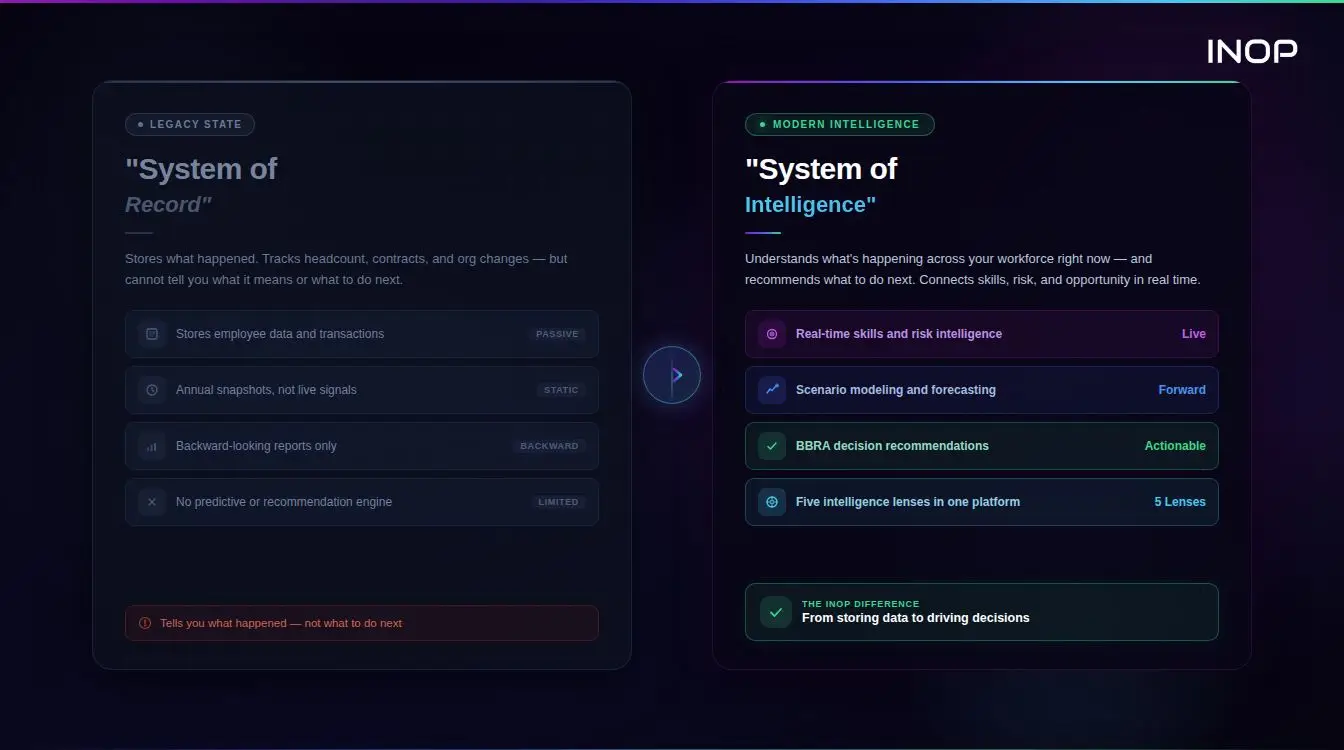
Prescriptive analytics is the highest tier of the analytics maturity model. It does not merely forecast an outcome. It evaluates multiple possible interventions, models the likely effect of each one against defined constraints, and recommends the optimal course of action. The distinction is the difference between a weather forecast and a navigation system that reroutes you around the storm.
For CHROs, this means the system no longer stops at identifying that 11 people are likely to leave. It evaluates whether adjusting compensation, accelerating development, offering lateral mobility, or restructuring the team is the most effective response, given cost constraints, time horizons, and organizational capability needs. Each recommendation carries a modeled outcome and an expected financial impact.
BBRA: The Decision Architecture That Makes Prescriptive Analytics Actionable
One of the clearest examples of prescriptive analytics applied to workforce strategy is INOP’s Build, Buy, Redeploy, Automate (BBRA) framework. BBRA is INOP’s proprietary decision architecture for responding to identified capability gaps, and it is precisely the kind of structured logic that prescriptive systems are built to support.
Build develops capability internally through targeted upskilling and competency-aligned learning programs. Prescriptive analytics models time-to-competency and total development cost, enabling leaders to evaluate whether internal development is viable within the required strategic window.
Buy acquires capability externally through hiring. Prescriptive tools evaluate market availability, time-to-hire benchmarks, total acquisition cost, and the probability that an external hire reaches full competency within the business-required timeframe.
Redeploy moves internal talent from lower-priority functions to roles where the capability gap is most critical. This requires rich competency mapping to identify skill adjacency, and predictive modeling to estimate performance trajectory in the new role.
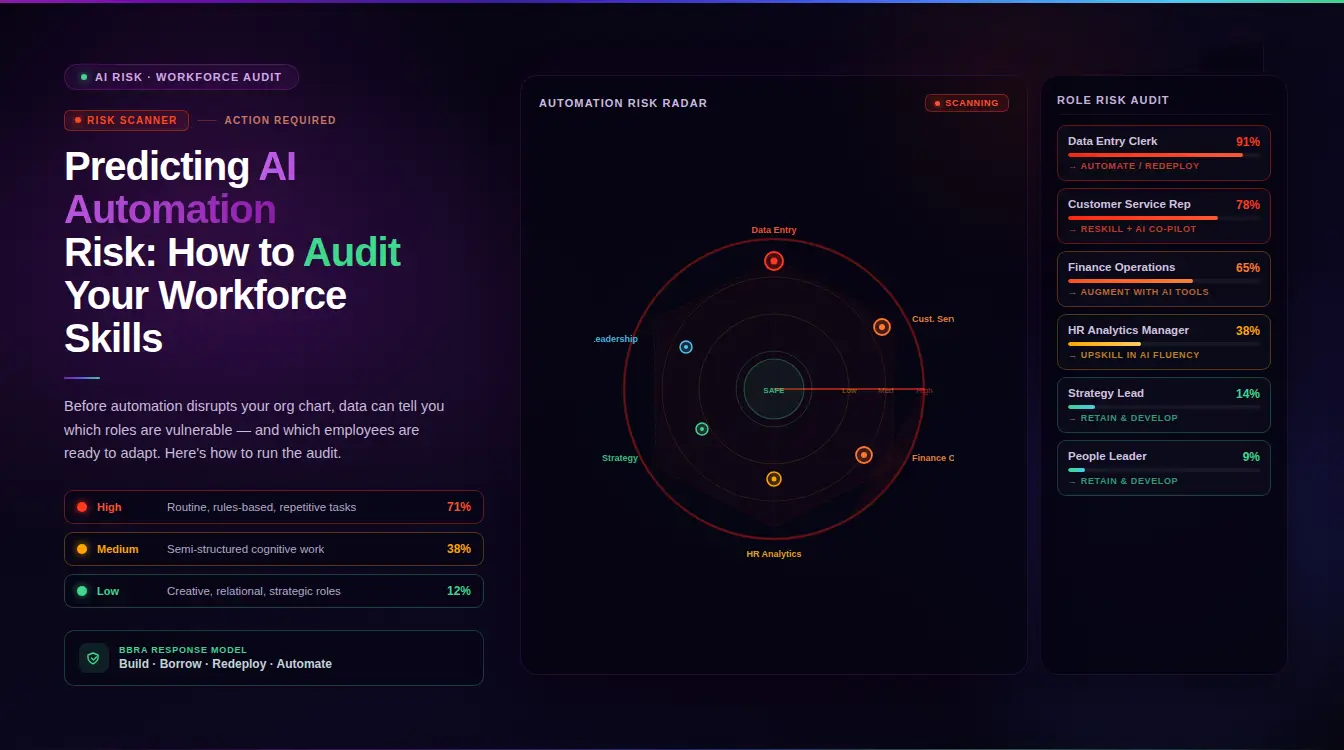
Automate assesses whether the capability gap can be partially or fully addressed through AI or process automation, removing the human capacity requirement altogether. This pathway is increasingly relevant as AI and automation impact modeling becomes a core input to workforce planning.
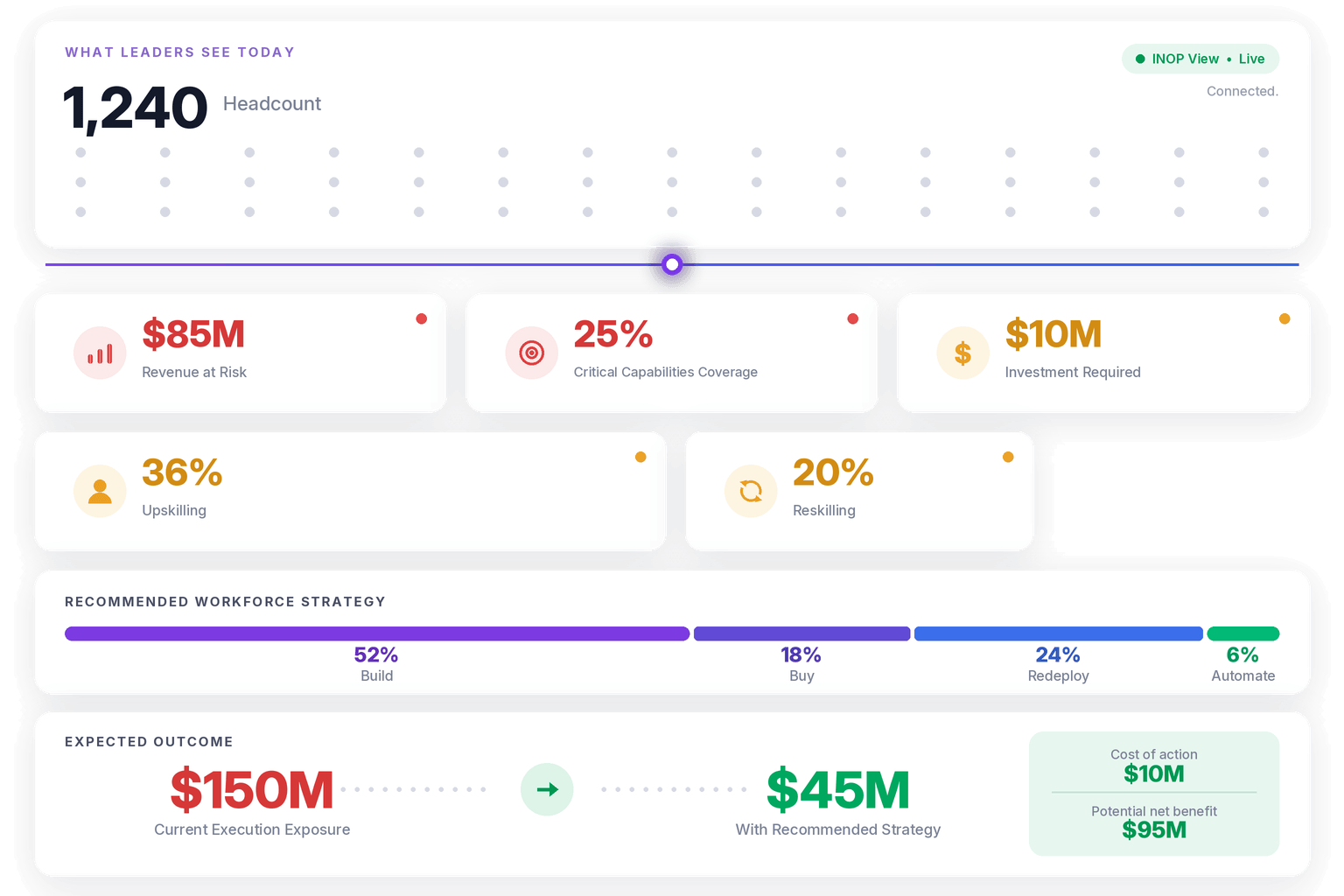
BBRA is not just a strategic framework. It is a financial decision tool. For a CHRO presenting workforce investment options to a CFO or a PE operating partner, BBRA transforms a capability gap from an HR problem into a structured set of options, each with a cost, a timeline, a risk profile, and an expected return.
The Five Intelligence Lenses
Prescriptive analytics is only as good as the breadth of data it synthesizes. INOP’s platform connects workforce decisions across five intelligence lenses: Strategy, Finance, People, Market, and AI/Automation impact. This five-lens model is what separates genuine workforce decision intelligence from analytics that only looks inward.
A prescriptive system that only sees internal people data will recommend retaining an employee in a role that external market signals show is being automated within 18 months. A system that only sees market data will recommend hiring for skills that your internal competency mapping shows already exist in a different business unit. The five-lens model provides the unified view that makes prescriptive recommendations both precise and strategically defensible.
Predictive HR Analytics Tools: What to Look For
The Tool Landscape in 2026
The market for predictive HR analytics platforms has matured into four distinct categories, each suited to different organizational contexts and maturity levels.
HRIS platforms with embedded analytics provide predictive capabilities within the core HR system, reducing data engineering complexity and embedding predictions directly in existing workflows. Workday, SAP SuccessFactors, and Oracle HCM all offer embedded analytics modules. Their advantage is integration. Their limitation is depth: embedded analytics typically covers standard use cases (attrition risk, engagement scoring) without the customization required for complex multi-variable models or organization-specific prediction requirements.
Specialist people analytics platforms provide deeper analytics capability and prebuilt use cases tailored specifically to HR. Visier is the market leader for people analytics depth, with strong attrition prediction, skills analytics, and workforce planning modeling. OneModel provides highly customizable analytics infrastructure. These platforms require more implementation investment but produce more sophisticated and more trustworthy outputs for organizations with complex workforce planning needs.
Business intelligence plus data science platforms such as Tableau, Power BI, or Python/R-based custom modeling environments offer maximum flexibility but require dedicated data science and data engineering capacity. They are appropriate for organizations with established people analytics teams and data science capability. They are not appropriate for organizations looking for rapid deployment of standard HR prediction use cases.
Workforce decision intelligence platforms represent the emerging category that connects predictive analytics to prescriptive decision support. INOP’s strategic workforce planning platform is positioned in this category, connecting skills intelligence, financial scenario modeling, and the BBRA decision architecture in a single layer that serves HR, Finance, and executive leadership simultaneously.
Evaluation Criteria for Predictive HR Analytics Platforms
When evaluating platforms for predictive HR analytics, the following criteria determine whether a system will produce decisions or produce dashboards.
Data connectivity and integration depth. The platform is only as reliable as the data feeding it. Confirm it integrates natively with your HRIS, performance management system, compensation system, and LMS, not through CSV imports that require manual intervention but through API connections that update continuously.
Explainability of model outputs. Predictive recommendations that cannot be explained to employees, managers, or regulators create governance risk. Look for platforms that show which variables drove each prediction and allow decision-makers to understand why a specific employee was flagged as high attrition risk. SHAP (SHapley Additive exPlanations) and LIME (Local Interpretable Model-agnostic Explanations) are the standard explainability frameworks in enterprise analytics. Ask vendors whether these are available out of the box.
Bias audit capability. As NYC Local Law 144 and other AI employment regulations expand, platforms used in employment decisions must be auditable for demographic bias. The platform should produce adverse impact ratio analysis across protected groups for any prediction use case, and should support bias correction in model training.
Competency and skills integration. Platforms that model only on job title and tenure produce coarse predictions. Platforms that integrate competency assessment data produce meaningfully more accurate forecasts. Confirm whether the platform can ingest your competency framework data as a modeling input.
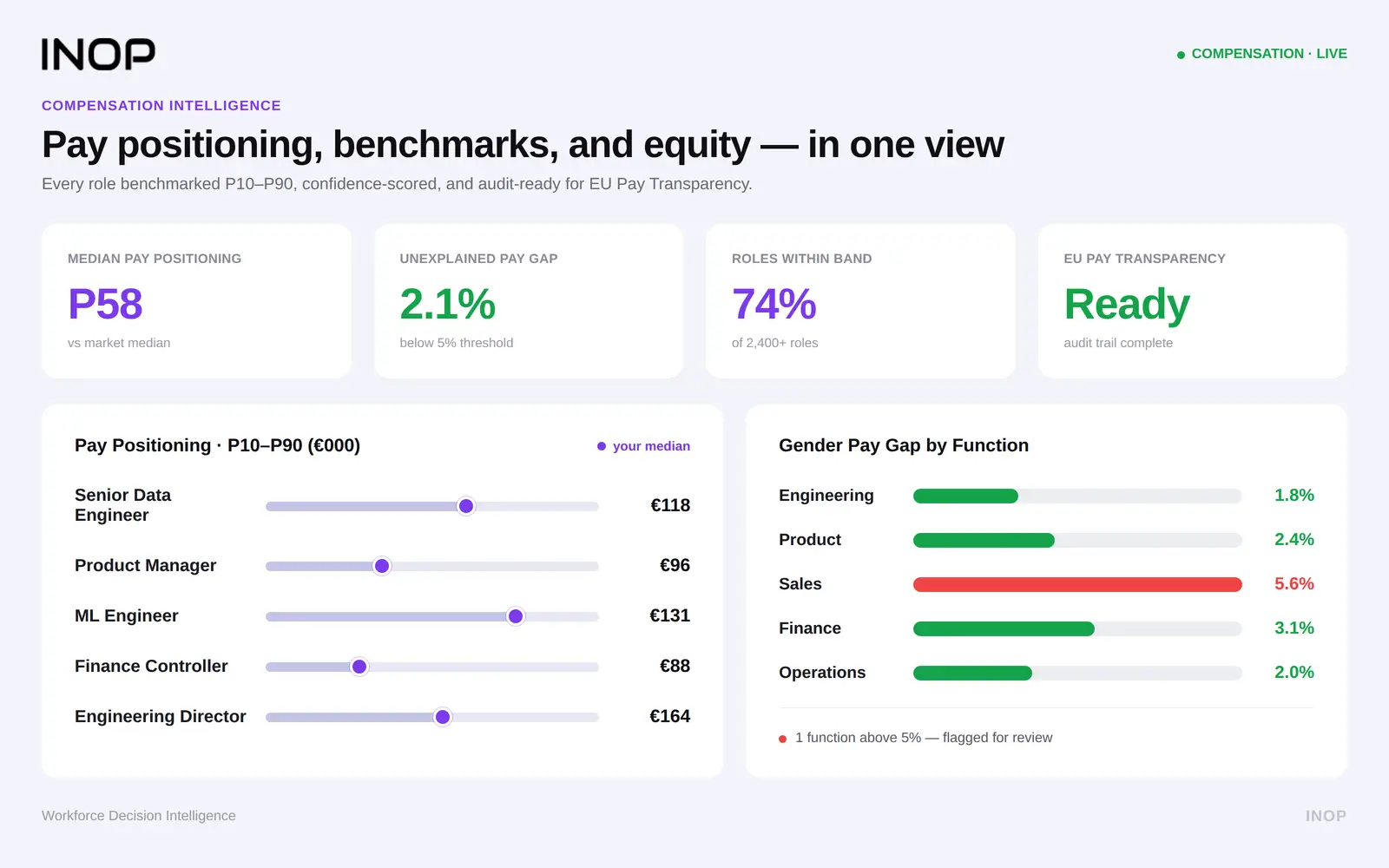
Financial modeling integration. The predictive outputs that matter most to CFOs and boards are those expressed in financial terms. Platforms that translate attrition risk, skills gaps, and succession failures into expected financial impact produce analytics that influence capital allocation decisions. Those that produce only probability scores and risk flags produce reports that stay in the HR inbox.
Real-World Predictive HR Analytics Examples
Google: Project Oxygen and Manager Quality Prediction
Google’s Project Oxygen is one of the most documented applications of predictive analytics in talent management. The company used machine learning to identify which management behaviors were most strongly associated with team performance, retention, and employee engagement. Rather than asking managers to be generally better, Google identified eight specific, observable behaviors that predicted positive team outcomes and built both hiring criteria and development programs around those behaviors.
The project demonstrated a principle that applies broadly to predictive HR analytics: the value is not in knowing that performance correlates with good management, which is obvious, but in identifying exactly which management behaviors are most predictive of which outcomes in your specific organizational context. Generic industry research is a starting point. Predictive models trained on your own historical data produce insights specific to your organization that generic benchmarks cannot provide.
IBM: Attrition Prediction and Proactive Retention
IBM built a retention prediction model that the company calls its “predictive attrition program.” The system analyzes multiple data points per employee, compensation positioning, career trajectory, engagement signals, and external market conditions, to generate flight risk scores. IBM’s CHRO reported that the system enabled proactive conversations and interventions with at-risk employees, saving the company approximately $300 million in avoided turnover costs over a multi-year deployment. IBM’s case demonstrates the financial scale of the ROI available from attrition prediction when deployed at enterprise scale and connected to systematic intervention workflows.
Unilever: Predictive Selection in Talent Acquisition
Unilever deployed predictive selection models for entry-level hiring, using AI to analyze video interview responses and connect them to competency profiles predictively associated with performance in specific role types. The company reported a 16% increase in hiring diversity and a significant reduction in time-to-hire. The case is also instructive about governance: Unilever’s design required human reviewers to make final decisions using the predictive model as one input rather than as the sole determinant, and the company has been transparent about the audit processes in place to monitor for bias. This human-in-the-loop design is increasingly the standard for defensible predictive selection systems.
Implementation: How to Build Predictive HR Analytics Capability
Step 1: Audit Your Data Foundation
Before selecting any platform or building any model, conduct a data quality audit across the sources required for your intended use cases. For attrition prediction, assess whether you have individual-level compensation data with market benchmarking, performance ratings at the individual level over at least three review cycles, engagement survey data mapped to individuals rather than only to teams, and complete organizational structure data with manager-employee relationships.
Identify and document the gaps. Data that does not exist cannot be collected retroactively. Data that exists but is inconsistently structured requires cleaning investment before modeling. Data that is complete and clean can begin supporting models within weeks. The audit output is a realistic timeline: organizations with clean data can deploy initial models in 60 to 90 days. Organizations with significant data gaps should plan for three to six months of data infrastructure work before the first reliable model is viable.
Step 2: Define Your Competency Framework
Predictive models that incorporate competency data consistently outperform those that rely on job title and tenure as capability proxies. If your organization does not have a consistently measured competency framework, building one is the highest-return investment you can make before deploying predictive analytics.
A minimum viable competency framework for analytics purposes requires defined skill categories for each major role family, behavioral anchors at each proficiency level that make assessment consistent across different managers and assessors, an assessment process that produces individual-level data rather than only aggregate team ratings, and a governance cadence that keeps the framework current as role requirements evolve. For a complete guide to building this foundation, INOP’s article on competency mapping covers the full process.
Step 3: Start With One High-Value Use Case
The organizations that build lasting analytics capability almost universally start with a single, high-value, well-scoped use case rather than attempting to build comprehensive people analytics across all workforce dimensions simultaneously. Attrition prediction for a critical talent population is the most common and most successful starting point because it has a clear business case (replacement cost avoided), measurable success criteria (retention rate in the flagged population), and a defined data requirement set.
Run the pilot for 90 days. Measure the model’s predictive accuracy against actual outcomes. Present the financial impact to leadership. Use that demonstrated value to secure investment in expanded deployment.
Step 4: Build the Intervention Workflow
A predictive model that produces flight risk scores without a defined intervention workflow produces lists, not outcomes. For each use case, define before deployment: who receives the model output, what actions are available in response, who approves each action type, and how outcomes are tracked. An attrition risk model that surfaces 30 employees as high-risk needs a corresponding manager notification process, a defined menu of retention interventions at different cost tiers, a timeline for implementing interventions before the predicted departure window, and a review process at 30, 60, and 90 days to assess whether interventions are affecting the predicted outcomes.
Step 5: Layer Prescriptive Capabilities on Top
Once predictive models are generating trusted, consistent outputs that HR and business leaders act on, the foundation is in place to add prescriptive capabilities. This is where INOP’s BBRA decision architecture becomes relevant: the prescriptive layer takes the predictive output (“this capability gap is likely to widen significantly within six months”) and produces structured recommendations (“the Build pathway through targeted upskilling costs $X and closes the gap in Y months; the Buy pathway through external hiring costs $Z and produces deployment in W months; the financial risk of doing nothing is $V in execution exposure”). That quantified, scenario-modeled output is what transforms predictive analytics from an HR intelligence tool into a board-level capital allocation instrument.
Common Challenges and How to Address Them
Data Quality and Consistency
The most frequently cited barrier to analytics maturity is not technology. It is data quality. Inconsistent job classifications, missing competency assessments, or gaps in historical performance data will degrade forecast accuracy at every subsequent stage of the maturity model. The practical approach is not to wait for perfect data. Prioritize the domains that matter most for your intended use case, clean them systematically, and build models incrementally. Platforms that integrate across HR, finance, and operational systems reduce the data consolidation burden significantly and accelerate the path to reliable forecasting.
Organizational Readiness to Act
Prescriptive analytics only delivers value if the organization acts on its outputs. In practice, many HR teams receive algorithmic recommendations and default to intuition or organizational politics when making final decisions. Building trust in analytics outputs requires demonstrated accuracy over time and full transparency about how recommendations are generated. Start with lower-stakes decisions where recommendations can be tested and outcomes measured. As the system builds a track record, organizational confidence grows and recommendations begin to carry real decision weight.
Ethics, Bias, and Governance
AI-powered analytics systems can encode bias if the underlying data reflects historical inequities. Predictive models trained on data from organizations with systemic promotion or compensation disparities will reproduce those disparities in their outputs unless explicitly corrected. Prescriptive recommendations must be regularly audited to ensure they do not disadvantage protected groups or compound existing organizational inequities.
CHROs have both the authority and responsibility to establish ethics governance frameworks for analytics. Every inference should be traceable, supporting governance requirements under ESG, CSRD, and DEI compliance frameworks. The Society for Industrial and Organizational Psychology publishes analytics ethics guidance that provides a practical baseline for CHROs designing internal governance structures. For a comprehensive treatment of how AI bias affects workforce decisions and how to govern against it, INOP’s guide on AI automation bias and workforce decisions covers the regulatory and governance landscape in depth.
Predictive HR Analytics for PE Portfolio Companies
For private equity operating partners, predictive HR analytics serves a specific and time-compressed purpose that differs from the steady-state enterprise application. The operating partner needs predictive intelligence about workforce capability and risk within 90 days of acquisition, not a 12-month analytics implementation programme.
The three highest-value predictive analytics applications in PE portfolio contexts are attrition risk modeling for the management team and critical individual contributors (where departure during the integration period creates disproportionate execution risk), capability gap prediction against the value creation plan (which capabilities will be insufficient to deliver the plan within the required timeframe?), and compensation competitiveness monitoring (which roles are currently below market in ways that predict attrition before the next benchmarking cycle surfaces the gap?).
The financial quantification of predictive HR analytics value is particularly important in PE contexts because every workforce investment decision is evaluated against return expectations across a defined hold period. A predictive model that identifies three management-level flight risks carrying an average replacement cost of $250,000 each, with an intervention cost of $120,000 in compensation adjustments and retention incentives, produces a documented ROI of 525% on the retention investment, the kind of calculation that belongs in a quarterly business review alongside operational KPIs, not in an HR report that Finance reviews annually.
INOP’s strategic workforce planning platform provides PE operating partners with the predictive intelligence and BBRA-backed prescriptive recommendations needed to connect workforce decisions to value creation plan execution. Book a demo to see how INOP approaches predictive HR analytics in PE portfolio environments.
Ready to move from workforce reporting to workforce decision intelligence? Book a consultation with the INOP team to see how BBRA, the five-lens model, and predictive HR analytics work together in a live demonstration tailored to your organization’s specific challenges.
How INOP Connects Predictive and Prescriptive into Workforce Decision Intelligence
INOP is built on a specific conviction: workforce analytics should produce decisions, not just insights. The platform is positioned as a workforce decision intelligence system, not simply an analytics or reporting tool. That distinction matters for CHROs who have invested in analytics infrastructure that generates impressive charts but stops short of telling leadership what to do next.
INOP connects capabilities, roles, skills, and workforce investments across five intelligence lenses: Strategy, Finance, People, Market, and AI/Automation impact. Where most platforms focus on planning outputs, INOP starts with the decisions that CEOs, CHROs, CFOs, and boards need to make: Are we capable of executing our strategy? Where are the execution risks? Where should we invest in workforce capability, and what return can we expect?
The BBRA framework is embedded in INOP’s decision architecture. CHROs can model Build, Buy, Redeploy, and Automate scenarios with financial impact attached to each pathway. The compensation analytics module connects pay decisions directly to retention risk and market benchmarks, ensuring that the Buy pathway in any BBRA analysis is grounded in real cost data rather than assumptions.
INOP’s skills intelligence capability provides the external validation layer that makes internal competency frameworks market-relevant: skills mapped against external demand signals, automation risk by competency, and competitive capability dynamics. For CHROs who want a full picture of how these capabilities connect to strategic execution, INOP’s guide on predictive workforce forecasting shows how the platform turns forecasting outputs into structured workforce investment decisions aligned to business strategy.
Conclusion: The Question Is Not Whether to Use Predictive HR Analytics. It Is How to Sequence It.
Predictive HR analytics is no longer a competitive differentiator available only to large enterprises with dedicated data science teams. By 2026, adoption is projected to exceed 80% across organizations using data analytics for HR decisions. The organizations that built this capability early are compounding the advantage. Those building it now are closing the gap. Those waiting are absorbing the cost of decisions made without foresight in a talent market where foresight is increasingly the primary differentiator.
The path forward is clear. Build the data foundation, with consistent HRIS data, individual-level performance records, and a validated competency framework. Deploy predictive analytics at the use cases with the clearest financial cases: attrition prediction, skills gap forecasting, and workforce demand modeling. Measure and demonstrate value rigorously. Then layer BBRA-backed prescriptive capabilities on top to translate foresight into quantifiable, boardroom-ready workforce investment decisions that speak the language of the CFO and the board.
The organizations winning the talent capability race are not those with the largest analytics budgets. They are those with the clearest definitions of capability, the most consistent data discipline, and the analytical architecture to turn workforce intelligence into decisive, financially grounded action.
Frequently Asked Questions About Predictive HR Analytics
What is predictive HR analytics?
Predictive HR analytics uses historical HR data, statistical modeling, and machine learning algorithms to forecast future workforce outcomes. Rather than reporting on what has already happened, predictive analytics identifies patterns in existing data to project what is likely to happen next: which employees are likely to leave, which roles will face capability shortages, which candidates are likely to perform at the required level, and where workforce demand will exceed current supply. The output is probability-based intelligence that gives HR leaders and business decision-makers sufficient lead time to intervene before risks materialize.
What is the key difference between predictive and prescriptive HR analytics?
Predictive analytics forecasts future workforce outcomes, it tells you what is likely to happen. Prescriptive analytics goes one step further: it recommends specific actions in response to those forecasts, evaluates multiple intervention options, models the likely effect of each, and recommends the optimal course of action with financial implications attached. Predictive analytics answers “11 employees are likely to leave in Q2.” Prescriptive analytics answers “redeploy 3 internally, adjust compensation for 5, and accelerate the development plan for 3 more. Estimated cost: $X. Probability of retaining 9 of 11: 78%.” The two approaches work in sequence, with predictive as the foundation for prescriptive.
What data does predictive HR analytics require?
The core data requirements are HRIS data including employee demographics, tenure, role history, and compensation history; performance management data including individual ratings over multiple cycles; engagement survey data at the individual level; LMS data showing training completions and certification records; and time and attendance data for absenteeism modeling. For skills-based prediction, competency assessment data at the individual and proficiency level is essential. The more complete, consistent, and current these data sources are, the more accurate the predictive models built on top of them will be. Organizations with clean data across these sources can deploy initial models within 60 to 90 days.
What are the most valuable use cases for predictive HR analytics?
The six use cases that consistently produce the highest and most measurable ROI are: employee attrition and flight risk prediction, which enables proactive retention interventions before departure decisions are made; skills gap forecasting, which identifies capability shortfalls before they affect strategic execution; succession planning and leadership readiness prediction, which replaces manager nomination with evidence-based candidate assessment; workforce demand forecasting connected to business drivers; candidate quality and performance prediction in talent acquisition; and engagement and absenteeism risk prediction. Attrition prediction typically delivers the fastest measurable ROI because the financial case, replacement cost avoided, is directly calculable and the intervention cost is reliably lower than the cost it prevents.
What statistical methods are used in predictive HR analytics?
The most commonly used methods are logistic regression for binary outcome prediction including attrition and offer acceptance, decision trees and random forests for identifying which combinations of variables most strongly predict outcomes, survival analysis for time-to-event modeling such as how long before a departure is likely, and natural language processing for predictive modeling from unstructured data sources including engagement survey free-text responses. Neural networks are increasingly used for large-scale pattern recognition but carry interpretability challenges that create governance risk in employment decision contexts. The optimal method for each use case depends on the outcome type, data volume, and interpretability requirements.
What is the BBRA framework and how does it connect to predictive HR analytics?
BBRA is INOP’s proprietary decision architecture for responding to capability gaps identified through predictive analytics. Build develops capability internally, Buy acquires it externally through hiring, Redeploy moves internal talent with adjacent skills to where the gap is most critical, and Automate addresses the gap through technology rather than human capability. BBRA connects predictive analytics to prescriptive decision-making by providing a structured set of comparable options for each identified gap, each with a modeled cost, timeline, risk profile, and expected return. This is the framework that converts a predictive output from an HR risk flag into a boardroom-ready capital allocation decision.
How long does it take to implement predictive HR analytics?
Organizations with clean data and a defined competency framework can deploy reliable predictive models for standard use cases within 60 to 90 days. Organizations with significant data gaps should plan for three to six months of data infrastructure work before the first reliable model is viable. Building prescriptive capabilities on top of a proven predictive foundation typically requires an additional 12 to 18 months of model validation, governance development, and organizational change management. The timeline compresses significantly when working with a platform that integrates HR, finance, and operational data natively from day one.
What are the governance requirements for predictive HR analytics?
The primary governance requirements are bias auditing of all predictive models to ensure outputs do not systematically disadvantage protected groups, explainability of model recommendations so that decisions can be traced to their inputs and audited by regulators or employees, compliance with employment AI regulations including NYC Local Law 144 for organizations with New York-based employees, and alignment with ESG and CSRD human capital disclosure requirements for organizations subject to those frameworks. Every predictive model used in employment decisions should be tested for adverse impact ratios across protected classes before deployment and audited at minimum annually thereafter.
Can smaller organizations benefit from predictive HR analytics?
Yes, and increasingly so. AIHR’s analytics maturity research shows that cloud-based platforms have significantly lowered the entry point, making predictive analytics accessible well below the enterprise tier. The key is starting with a focused use case, a clean data set, and a clear definition of what good looks like in your specific organizational context. For organizations under 200 employees, a well-structured approach to attrition risk monitoring and skills gap identification using a combination of structured assessment and HRIS data can produce meaningful foresight without enterprise-level data infrastructure investment. The principle that applies at all scales is the same: predictive analytics is only as valuable as the intervention workflow it informs. Start with the use case where the intervention is clearest and the ROI is most directly calculable.
What does INOP mean by workforce decision intelligence?
Workforce decision intelligence is INOP’s positioning for a platform capability that goes beyond analytics and reporting to actively support the decisions that leaders need to make: where to invest in capability, which BBRA pathway to take for a given gap, how workforce decisions affect financial outcomes, and where execution risk is emerging before it hits delivery. It is distinct from talent acquisition as a primary descriptor and reflects INOP’s focus on connecting workforce data directly to business strategy, financial performance, and organizational resilience. For a full explanation, INOP’s complete guide to workforce decision intelligence is the recommended starting point.