Organizational network analysis, often shortened to ONA, is a method for mapping the informal relationships, communication patterns, and collaboration flows inside a company to reveal influence, knowledge flow, and capability that a formal org chart never captures. Where a reporting line tells you who is supposed to have authority, a network map tells you who people actually go to when something needs to get done. For workforce planning teams trying to spot hidden talent and manage leadership risk before it becomes a crisis, that distinction is the entire value of the method.
This article explains what organizational network analysis measures, how the data behind it is collected, and how workforce planning teams should act on what it reveals.
What Is Organizational Network Analysis
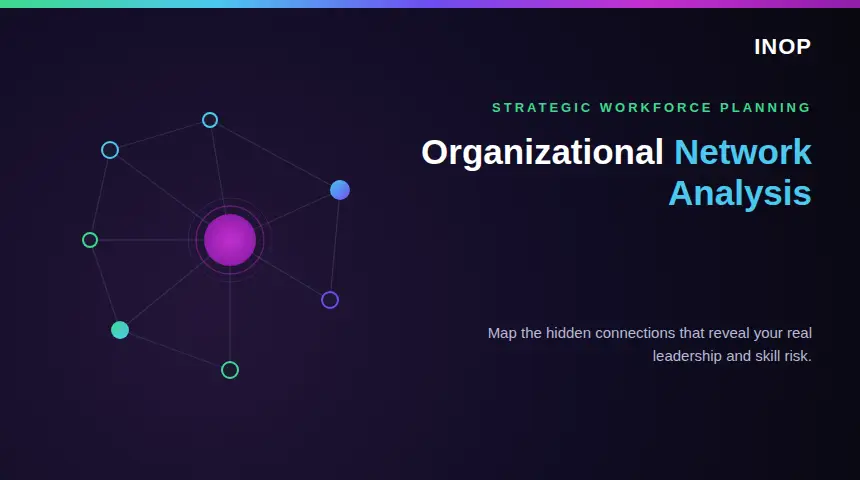
Organizational network analysis treats a company as a network graph rather than a hierarchy. Each employee is a node, and each meaningful interaction, a shared project, a recurring meeting, a message thread, becomes a connection between nodes. Once that graph exists, standard network analysis techniques can identify who sits at the center of the most connections, who bridges otherwise disconnected parts of the business, and who would leave the biggest structural hole if they left the company tomorrow.
None of this shows up on an org chart, because an org chart encodes reporting relationships, not working relationships. A mid-level employee with an unremarkable title can be the single person holding two departments together, quietly resolving handoffs that would otherwise stall, and a network map is the only tool that reliably surfaces that.
Organizational Network Analysis vs the Traditional Org Chart
The org chart and the network map answer different questions, and workforce planning teams that rely on only one of them are missing half the picture.
The org chart answers “who reports to whom.” It is designed for accountability, budget ownership, and formal decision rights, and it is genuinely necessary for those purposes. But it says nothing about how work actually flows. Two employees on opposite sides of the org chart, in different departments with no reporting relationship at all, might be the two people who actually make a critical cross-functional process work.
Organizational network analysis answers “who is actually connected to whom, and how much does the business depend on that connection.” It surfaces informal leaders who have never been promoted into a title that reflects their real influence, identifies employees who are quietly overloaded because they have become an unofficial single point of contact for too many teams, and shows where the loss of one person would fracture communication between groups that otherwise barely interact. Used together, the org chart shows where authority formally sits and the network map shows where the work actually happens, and the gap between the two is frequently where an organization’s biggest hidden risks and its most underrecognized talent both live.
How Organizational Network Analysis Works
A typical organizational network analysis starts with data collection, either through a short employee survey asking who people go to for specific kinds of help, or through passive analysis of existing collaboration data with appropriate privacy governance in place. The raw interaction data is then converted into a network graph, and standard graph metrics are applied: degree centrality to find who has the most direct connections, betweenness centrality to find who bridges otherwise separate clusters, and eigenvector centrality to find who is connected to other highly connected people, which is often a better signal of real influence than raw connection count alone.
The output is usually a visual map of the organization’s actual collaboration structure, color coded by team or function, with certain nodes visibly larger or more central based on their calculated importance to the network. From there, the analysis moves from description to action: which central nodes represent single points of failure that need a succession plan, which informally influential employees have never been given formal development opportunities, and which parts of the organization are structurally isolated from each other in ways that are quietly slowing the business down.
Data Sources Behind Organizational Network Analysis
Survey-based organizational network analysis asks employees directly who they collaborate with, who they go to for advice, and who they consider a mentor, which produces high-quality, intentional data but only captures a snapshot at the moment the survey runs. Passive, systems-based organizational network analysis instead draws on collaboration data already generated by email, chat, calendar, and project management platforms, which produces a continuously updating picture but requires careful governance, since this data touches communication metadata that employees have a reasonable expectation of privacy around. Platforms like Microsoft Viva Insights and Worklytics offer this kind of passive collection in enterprise environments, typically aggregating and anonymizing data at the team level rather than exposing individual message content.
The most defensible implementations combine both approaches: passive data to identify structural patterns at scale, and a lightweight survey to validate and add context to what the passive data suggests, since network position alone does not tell you why someone is central, only that they are.
What Organizational Network Analysis Reveals About Hidden Capability
The business case for organizational network analysis has become sharper as hybrid and distributed work have removed the informal visibility that used to surface talent naturally. Research summarized by Teamspective’s 2025 guide to organizational network analysis, drawing on Gartner’s HR priorities survey, found that three in four HR leaders report their managers are overwhelmed and not equipped to actively lead culture, development, and engagement, a management capacity problem that directly limits how much hidden talent gets surfaced through informal manager observation alone.
That gap is exactly what organizational network analysis is positioned to close. It does not depend on a manager noticing a pattern during a busy quarter. It surfaces informal leadership, knowledge brokering, and collaboration capacity directly from the data, regardless of whether any single manager was paying attention.
Book a demo to see how INOP connects network and skills signals to workforce risk, so hidden influence shows up in your planning before it shows up as a departure. Book a demo.
Five Intelligence Lenses Applied to Organizational Network Analysis
INOP evaluates every organizational network analysis finding through five intelligence lenses: Strategy, Finance, People, Market, and AI and Automation. The Strategy lens asks whether a structurally critical employee’s role actually maps to a strategic priority, or whether the organization has simply allowed process debt to accumulate around one person. The Finance lens quantifies the replacement and disruption cost if a highly central node were to leave unexpectedly, which is almost always higher than the cost implied by that person’s title and salary alone. The People lens looks at whether structurally influential employees are being developed and recognized in proportion to their actual organizational impact, since informal influence with no formal recognition is a well documented flight risk. The Market lens checks whether the skills a central node holds are becoming scarcer or more available externally, which changes the urgency of any succession plan. The AI and Automation lens asks whether the coordination work a bridge employee is doing manually could be partially automated, freeing that person for higher value work rather than simply working around them being a bottleneck.
Using the BBRA Framework to Act on Organizational Network Analysis Findings
Identifying a structurally critical employee through organizational network analysis is only useful if it leads to a decision, and INOP’s proprietary BBRA framework is the decision architecture applied to that finding. BBRA evaluates every workforce response across four pathways: Build, Buy, Redeploy, and Automate, each modeled with its financial trade-offs across four time horizons, an immediate thirty day view, a hundred and eighty day view, a one year view, and a three year view.
For a network-critical employee specifically, Build usually means deliberately documenting and distributing the knowledge that currently only lives in that one person’s head, and developing a second employee into a similar bridging role over the hundred and eighty day and one year horizons. Buy is rarely the right first move here, since an external hire cannot inherit an existing relationship network on arrival, though it can be part of a longer three year succession plan. Redeploy applies when the analysis reveals the central employee is overloaded precisely because they have absorbed responsibilities that should belong to someone else, in which case the fix is redistributing that load rather than replacing the person. Automate applies to the coordination and information-relay work itself, where structured tools and clearer process ownership can reduce how much a business genuinely depends on one person’s informal network position.
Governance and Privacy Considerations in Organizational Network Analysis
Organizational network analysis touches sensitive ground, since it is fundamentally an analysis of who talks to whom, and that data requires deliberate governance from the outset. Best practice is to aggregate and report findings at the team or role level rather than exposing individual communication patterns broadly, to be transparent with employees about what data is collected and why, and to use the analysis to inform development and succession decisions rather than performance evaluation, since employees who suspect network data will be used against them will quickly change their behavior in ways that make the data useless. Organizations that skip this step tend to get one round of accurate data and then lose it permanently once employees stop trusting the system.
Organizational Network Analysis for PE Operating Partners
For private equity operating partners, organizational network analysis is one of the fastest ways to de-risk a newly acquired company. In the first hundred days after close, an operating partner rarely has the relationship history to know which employees are quietly holding the business together versus which ones simply carry senior titles. A network analysis run early in the integration period surfaces that distinction directly from collaboration data rather than from asking the outgoing leadership team, which is a materially more objective source given the incentives at play during a transition. It also gives an operating partner a concrete way to answer the investment committee’s question about key person risk with data rather than impression.
See how INOP’s strategic workforce planning platform surfaces key person and leadership risk across a newly acquired business from day one. Book a demo to see it applied to your next deal.
Frequently Asked Questions
What is organizational network analysis in simple terms?
Organizational network analysis is a method for mapping who actually collaborates with whom inside a company, revealing informal influence, knowledge flow, and hidden dependencies that a formal org chart does not show.
How is organizational network analysis different from an employee engagement survey?
An engagement survey measures how employees feel about their work and the organization. Organizational network analysis measures the actual structure of who they work with and depend on, which is a different and complementary data source.
What data is used to run an organizational network analysis?
It typically combines employee survey responses about who they collaborate with and go to for help, along with aggregated collaboration data from email, chat, and project management platforms, collected and reported with clear privacy governance.
Can organizational network analysis help identify hidden talent?
Yes. It frequently surfaces employees who function as informal leaders, mentors, or knowledge brokers without holding a title that reflects that role, which is exactly the kind of hidden capability that traditional performance reviews miss.
Why would a private equity operating partner use organizational network analysis?
It gives an operating partner an objective, data-based view of key person and leadership risk in a newly acquired company within the first hundred days, rather than relying on impressions from outgoing leadership during a transition.