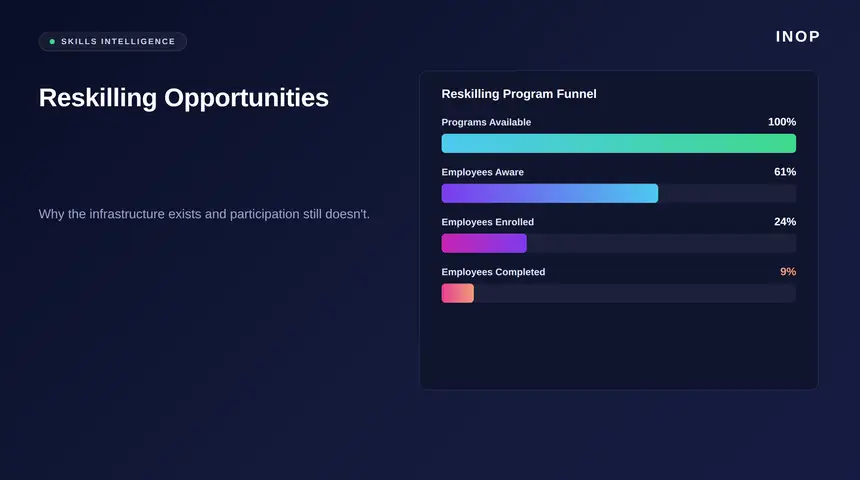
Reskilling opportunities are the actual, visible pathways an organization gives employees to move into a different role using skills they can build now, not just the training content that theoretically makes that move possible. Most organizations have spent real money on the second part. Far fewer have built the first, which is why so many well-funded reskilling programs sit mostly unused while leadership keeps asking why participation never climbs past a fraction of the workforce.
This guide covers what separates a genuine reskilling opportunity from a course catalog, why the gap between built infrastructure and actual participation has become one of the more expensive blind spots in workforce planning, and how to close it.
What Real Reskilling Opportunities Actually Require
A reskilling opportunity is not a course assignment. It is a visible, credible path from where an employee currently sits to a specific different role, backed by a defined way to close the capability gap between the two. Without that visible destination, reskilling content is just more training, and employees increasingly treat it that way. The distinction matters because organizations have overwhelmingly solved the infrastructure half of this problem and are still struggling badly with the half that actually drives participation.
The Participation Gap Nobody Talks About
The infrastructure investment has genuinely happened. Ninety percent of organizations now use skills data in HR decisions in some form, and 93 percent track outcomes on skills-based practices, according to recent research compiling upskilling and reskilling statistics. What the same research finds is a sharp drop-off once you look past the infrastructure numbers to actual participation: only 34 percent of organizations see more than half their employees actively engaging with the upskilling programs they pay for, and 31 percent see fewer than one in four employees participating at all. The infrastructure exists. Most employees are not using it.
The same research offers a useful diagnosis for why this happens: most organizations design reskilling as a learning program rather than a career system. A learning program serves the people who already know where they want to go and mostly shows up as activity on a dashboard, completions logged, courses assigned, licenses purchased. A career system reaches everyone, because it answers the question an employee is actually asking before they decide whether to engage: what am I learning this for, and what changes for me if I do. Most reskilling infrastructure was never built to answer that question, which is precisely why the participation numbers stay flat even as the infrastructure spend keeps climbing.
Why Reskilling Opportunities Go Unused Even When They Exist
The reason is not a lack of employee interest. It is that most organizations are offering training when employees are looking for a credible next move.
Development That Doesn’t Connect to a Visible Next Move
Employees no longer separate learning programs from career opportunity, and treating the two as distinct is where participation quietly collapses. Development that doesn’t connect to a visible next role reads as effort without payoff, and employees who try it once, see no return, and stop engaging, according to the same research. This is not a marketing or communication problem, which is how many learning and development functions initially diagnose it. It is a structural gap between what is being offered and what employees are actually evaluating it against. Fifty-three percent of candidates say they would forgo a 10 percent pay increase for more skill growth opportunity, and employees stay 41 percent longer at companies with high internal mobility rates compared with those that have low rates, which makes clear that the demand for real reskilling opportunities is not the missing piece.
Managers Are the Activation Lever, Not the Training Catalog
The single strongest predictor of whether a reskilling opportunity actually gets used is not the quality of the content behind it. Employees adopt skills systems three to five times faster when they see their manager actively using the system rather than simply endorsing it from a distance, and organizations with high internal mobility rates are consistently the ones where managers actively support career movement rather than quietly discouraging it to protect their own headcount. A reskilling opportunity that depends entirely on an employee discovering and pursuing it alone, with no manager actively pointing toward it, will underperform one where a manager treats internal movement as part of their own job.
See how INOP surfaces real, verified reskilling opportunities instead of a generic course catalog. Book a demo to walk through a live view for your organization.
Reskilling Opportunities vs Upskilling Opportunities
The two get used interchangeably, and the distinction matters when deciding which kind of opportunity to actually build for a given employee. A reskilling opportunity prepares someone for a different role than the one they currently hold, using existing adjacent capability as a foundation. An upskilling opportunity deepens capability within the role someone is already in. Both are valuable, and neither should default to being the only option offered. INOP’s guide on upskilling vs reskilling covers how to decide which one deserves investment for a specific gap, a decision that depends on how far an employee’s current role sits from where the business actually needs capability next.
INOP’s Five Intelligence Lenses Applied to Reskilling Opportunities
A reskilling opportunity that looks good on paper does not automatically make sense for the business. INOP evaluates every reskilling opportunity through five intelligence lenses before it gets surfaced to an employee.
| Lens | What It Evaluates in a Reskilling Opportunity |
|---|---|
| Strategy | Whether the destination role sits inside a business priority worth investing in, not just a role with an open headcount |
| Finance | What closing the gap between current and destination role actually costs against external hiring for the same position |
| People | Whether the employee’s current capability is genuinely adjacent enough to make the move realistic within a reasonable timeline |
| Market | Whether the destination role’s required skills are gaining or losing relevance externally, mapped through INOP’s skills intelligence platform against your existing skills taxonomy |
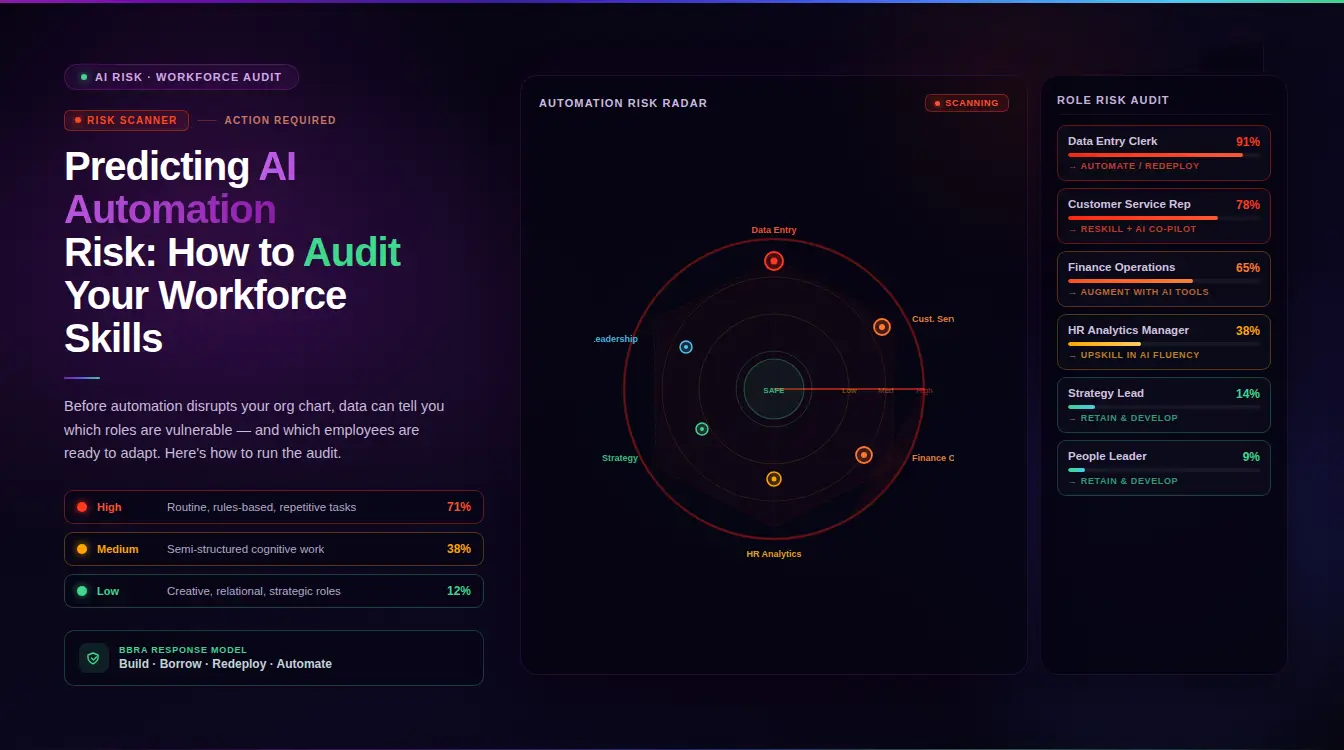
| AI and Automation | Whether the destination role itself is stable enough to justify the investment, or already a candidate for automation |
When reskilling decisions need to be made at scale, across many roles and functions simultaneously, the question of whether to structure that effort internally or through workforce transformation consulting is worth comparing explicitly. A consulting engagement brings external diagnostic rigor and change management infrastructure that can accelerate decisions that would otherwise stall in internal prioritization debates, but it also transfers data ownership and analytical capability out of the organization at the end of the engagement. Understanding that tradeoff before committing to an approach is part of what the reskilling investment decision actually involves.
BBRA: Turning a Reskilling Opportunity Into a Modeled Move
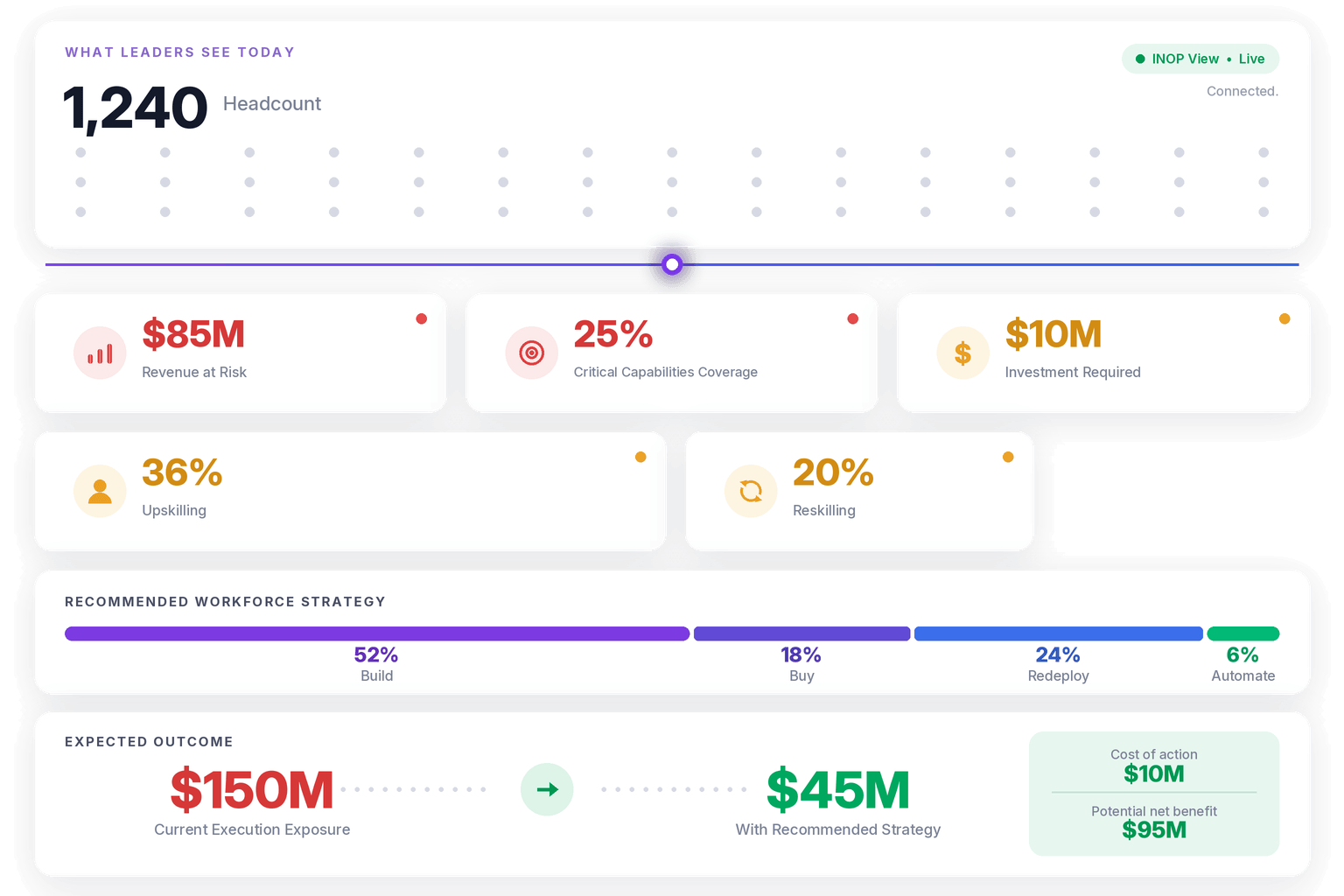
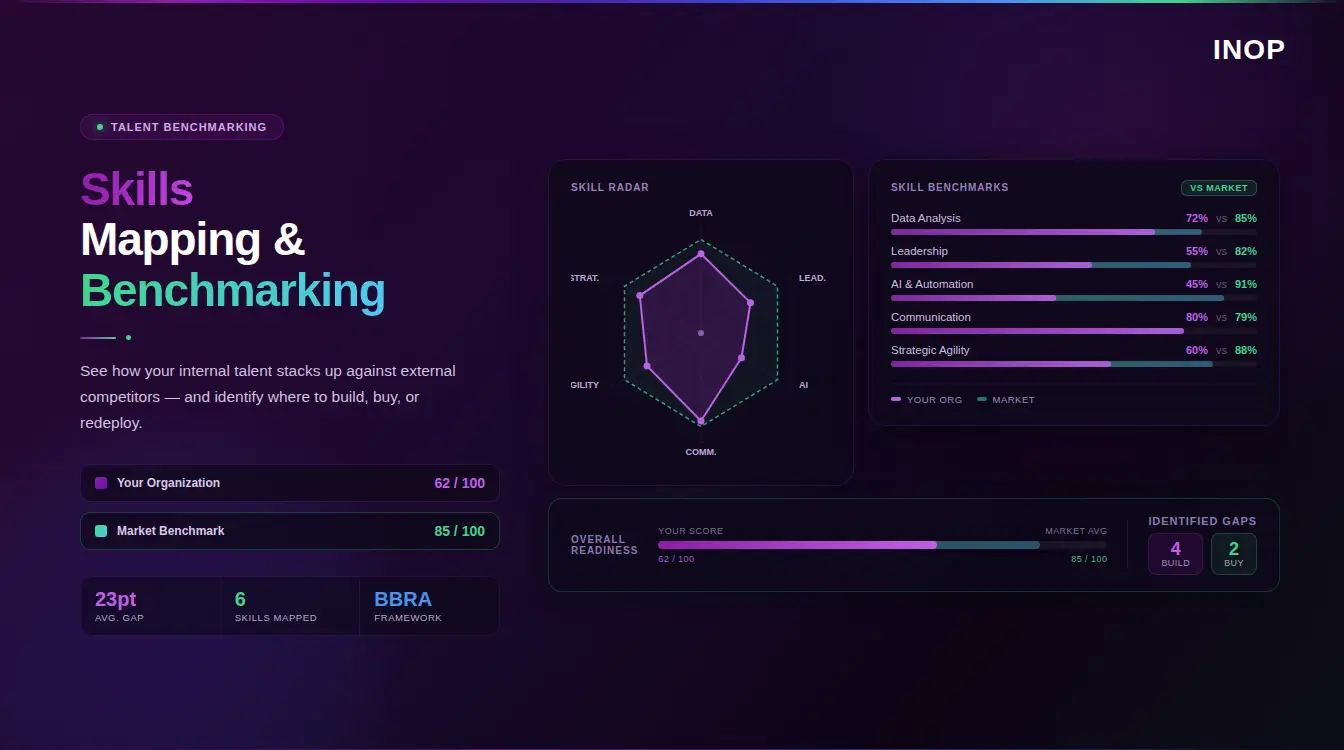
Once a reskilling opportunity is identified as viable, INOP’s proprietary BBRA framework, Build, Buy, Redeploy, and Automate, gives it an actual decision structure rather than treating reskilling as the automatic answer. BBRA models all four intervention pathways against financial tradeoffs across four time horizons: thirty days, one hundred eighty days, one year, and three years.
Applied to a specific opening, this means a role that needs filling does not default straight to either external hiring or an internal reskilling push without comparison. It gets modeled: does reskilling an internal employee close the gap faster and cheaper than external hiring given current market conditions, does redeploying someone already closer to the required skill set make more sense, or does the underlying task make more sense to automate rather than staff at all. Companies running this comparison consistently, rather than defaulting to whichever option is easiest, are the ones reporting the kind of results found in the same research, including a reported average 60 percent reduction in employee churn after implementing internal mobility and reskilling infrastructure that actually connects to real openings.
Reskilling Opportunities for Private Equity Operating Partners
Inside a portfolio company, a reskilling program with strong enrollment numbers can still be delivering almost no actual internal mobility, and the two get conflated constantly during diligence. A company can report robust training participation while showing almost no measurable movement of employees into new roles, which is precisely the participation-without-outcome pattern current research documents at scale. Standardizing this evaluation across a portfolio through INOP’s strategic workforce planning platform gives operating partners a consistent way to check whether reported reskilling activity is producing real internal mobility, rather than taking enrollment numbers as a proxy for outcome.
Common Mistakes in Offering Reskilling Opportunities
Building the training without building the pathway. A course catalog with no connected destination role is training, not a reskilling opportunity. Employees increasingly evaluate the two very differently, and the training-only version underperforms badly.
Leaving managers out of the activation process. A reskilling opportunity that depends entirely on individual employee discovery, with no manager actively pointing toward it, moves several times slower than one where managers treat internal mobility as part of their own role.
Measuring enrollment instead of movement. High enrollment in a reskilling program says little if it never translates into actual role changes. Internal mobility rate is the metric that reflects whether opportunities are real, not completion or sign-up numbers.
Treating every gap as a reskilling opportunity by default. Not every open role is best filled by internal reskilling. INOP’s case studies on companies leveraging skills intelligence for growth document how organizations like IBM identified employees with adjacent skills before defaulting to external hiring, a comparison that only works when it happens deliberately rather than automatically.
Ignoring how skill obsolescence timelines have compressed. With critical skills in many industries now becoming obsolete within three years or less, a reskilling opportunity built around a destination role’s current requirements can be solving for a version of that role that is already shifting. Reskilling programs connect directly to broader workforce risk, a pattern worth checking against the wider set of human capital risks organizations are already tracking rather than treating reskilling as an isolated learning and development initiative.
Rushing skills data accuracy before launch. Programs that reach strong skills data accuracy before going live consistently outperform those that rush the launch and spend the following year trying to rebuild the trust they failed to establish the first time. A reskilling opportunity built on unreliable underlying skills data undermines its own credibility before an employee has even engaged with it once.
Frequently Asked Questions
What makes something a genuine reskilling opportunity rather than just training?
A visible, credible path to a specific different role, backed by a defined way to close the capability gap. Training content without a connected destination role is development activity, not a reskilling opportunity, and employees increasingly treat the two very differently.
Why do reskilling opportunities go unused even when organizations build them?
Because most programs are built as learning infrastructure without a visible connection to an actual next role, and because managers, the strongest predictor of participation, are often left out of actively surfacing opportunities to their teams.
How is a reskilling opportunity different from an upskilling opportunity?
A reskilling opportunity prepares someone for a different role than the one they currently hold. An upskilling opportunity deepens capability within their current role. Both matter, and the right choice depends on how far an employee’s current skills sit from where the business needs capability next.
What metric actually shows whether reskilling opportunities are working?
Internal mobility rate, the share of employees actually moving into new roles, is a far stronger indicator than enrollment or completion rate. High participation in training with no corresponding movement into new roles signals a pathway problem, not a content problem.
How should private equity operating partners evaluate reskilling opportunities at a portfolio company?
By checking internal mobility rate and actual role changes, not training enrollment numbers alone. A portfolio company can report strong reskilling participation while producing almost no real movement of employees into new roles.
Ready to see reskilling opportunities that connect to real, verified openings instead of a course catalog? Book a demo and INOP will walk through how verified skill gaps connect to BBRA and real internal mobility, live.