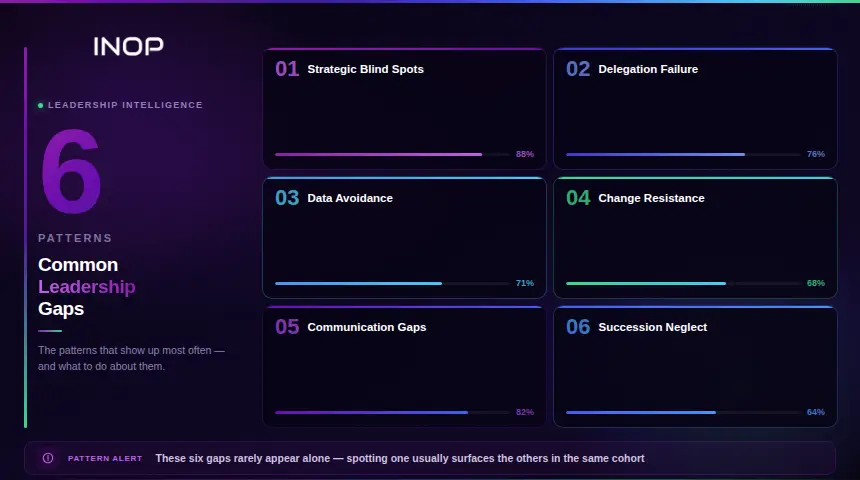
Common leadership gaps are the recurring patterns of missing capability, missing readiness, or missing process that show up across most organizations regardless of industry or size. They are common precisely because they stem from the same structural failures: promoting for performance in the current role rather than readiness for the next one, treating succession as a document rather than a discipline, and leaving new managers to figure out the job without preparation. Seventy-seven percent of organizations globally report experiencing a leadership gap, which makes this less an exception to watch for and more a default condition to plan around.
This guide breaks down the six leadership gaps that recur most often, the two additional patterns that 2026 research identifies as accelerating, why they keep showing up even at organizations that invest in leadership development, what each one costs, and how to close them with verified data rather than assumption.
Want to score leadership readiness across your organization instead of relying on manager instinct? Book a demo to walk through a live leadership risk view.
What Common Leadership Gaps Actually Mean
A leadership gap is the difference between the leadership capability an organization needs and the leadership capability it can verify it has. The word common matters here because these gaps are not unusual failures at poorly managed organizations. They are structural patterns that recur across companies with different cultures, sizes, and industries, which is why naming them as a defined set is more useful than treating each one as an isolated surprise.
An organization that has mapped which of the six patterns it currently carries can address each gap proactively, on its own timeline. One that has not mapped its exposure discovers these gaps during a leadership transition, which is the worst possible moment for the discovery. The gap that should have been identified and closed two years ago surfaces the day a critical leader departs unexpectedly and the honest answer to “who is next?” turns out to be nobody is sure.
What Common Leadership Gaps Actually Cost
The 77% prevalence figure establishes that leadership gaps are normal. It does not establish the cost of treating them as normal. The business consequences cascade in ways that most financial models attribute to the wrong cause.
Turnover concentrates around poor leaders. Employees leave managers, not companies, according to research replicated consistently by Gallup, Aden Leadership, and CCL. At 100 to 200% of annual salary per departing employee, a single underperforming manager in a six-person team can generate $400,000 to $800,000 in replacement costs over two years before anyone identifies the root cause as a leadership gap rather than a retention problem. The attrition shows up in the dashboard. The cause does not.
The succession gap carries a different cost profile. When a senior leader departs without a prepared internal successor, organizations typically face a 6 to 9 month external search at 25 to 30% of first-year compensation in executive search firm fees, followed by 6 to 12 months before the incoming leader reaches full operating effectiveness. For a Vice President role at $280,000 base salary, this sequence generates $70,000 to $84,000 in direct search costs plus 12 to 18 months of reduced leadership capacity in the function, compounding against the strategic priority that function was responsible for delivering during the transition. For a treatment of how to build the human capital risk playbook that catches this pattern before it becomes expensive, INOP’s guide on building a human capital risk playbook covers the full framework.
According to Deloitte research cited by the Taplow Group’s 2026 leadership analysis, 85% of business executives believe their organizations are not developing leaders at all levels, and they identify this directly as a risk to long-term organizational success. The gap between investing in leadership development and producing a reliable pipeline of ready leaders is where most organizations currently sit.
Projects miss deadlines despite competent teams when poor communication from an underprepared leader fails to bridge strategy and execution. Cross-functional initiatives stall when a mid-level leader lacks the influencing skills to secure buy-in outside their direct authority. Strategic opportunities pass when a senior team cannot adapt fast enough because nobody in the leadership layer was developed for decision-making under uncertainty.
The Eight Most Common Leadership Gaps
The following eight patterns account for the overwhelming majority of leadership gap findings across current research. Most organizations carry more than one simultaneously.
The First-Time Manager Transition Gap
Forty-two percent of first-time managers receive no training before assuming their role. The gap is not a skills problem in the traditional sense. New managers were rewarded for individual output, then promoted into a role where their job changes to making other people successful, and no one explains that the rules of the game have changed. Left unaddressed, this identity mismatch shows up as avoided difficult conversations, unclear expectations for direct reports, and a tendency to continue doing individual contributor work rather than managing the team doing it. Since managers account for a large share of team performance variance, the cost flows directly into team output and team retention.
The Succession Pipeline Gap
Only 11% of companies report having a strong leadership pipeline. Fifty-six percent of HR professionals say their organization has no succession plan at all. Even where a plan exists on paper, only 14% of organizations include onboarding and handoff procedures for an incoming leader, which exposes the distance between a completed succession document and an executable succession process.
The Baby Boomer retirement wave is accelerating this gap faster than most development pipelines can respond. The mass departure of experienced executives is draining institutional knowledge, technical expertise, and organizational relationship capital simultaneously across all three leadership levels, not just at the top. Aden Leadership’s 2026 analysis of leadership skills gaps identifies this as a structural force that no individual organization’s planning effort can fully offset, only outpace by building the pipeline earlier. For a deeper look at how skills-based approaches to succession planning differ from the traditional nine-box model, INOP’s guide on workforce risk management covers the talent pooling methodology that replaces single-successor planning with verified capability pools.
The Future-Readiness Gap
Seventy-one percent of leaders say they are not ready to lead their organizations into the future. This gap hides behind strong performance in the current role. The skills that made someone successful running today’s business are not automatically the skills needed to navigate the next one, and current performance reviews are not designed to surface this distinction. A leader who is excellent at managing a stable function can score highly on every performance metric while lacking the adaptive capability, strategic reframing ability, and comfort with ambiguity that the next role requires.
The Coaching and Mentoring Gap
Thirty percent of organizations cite inadequate coaching and mentoring as a key reason behind their leadership development shortfalls. This gap compounds the first-time manager transition gap directly: a new manager without structured coaching learns through trial and error, at direct cost to the team they are managing during that learning curve. The absence of coaching also prevents the identity shift that effective management requires. A manager who intellectually understands they should delegate, hold performance conversations, and develop their team but has never been coached through the discomfort of doing those things for the first time will avoid them long past the point where avoidance has become damaging.
The Assessment Gap
A succession plan built on manager instinct and performance reviews is making the organization’s most consequential people decisions on thin evidence. Performance in a current role is a weak predictor of success in a more complex one, particularly at director and VP-plus levels where the demands shift from functional excellence to cross-functional influence, strategic clarity, and change leadership. Harvard Business School research cited in Aden Leadership’s 2026 leadership guide identifies confidence, relationship-building, and strategic thinking as three of the most common leadership deficits at this level, none of which standard performance reviews reliably measure.
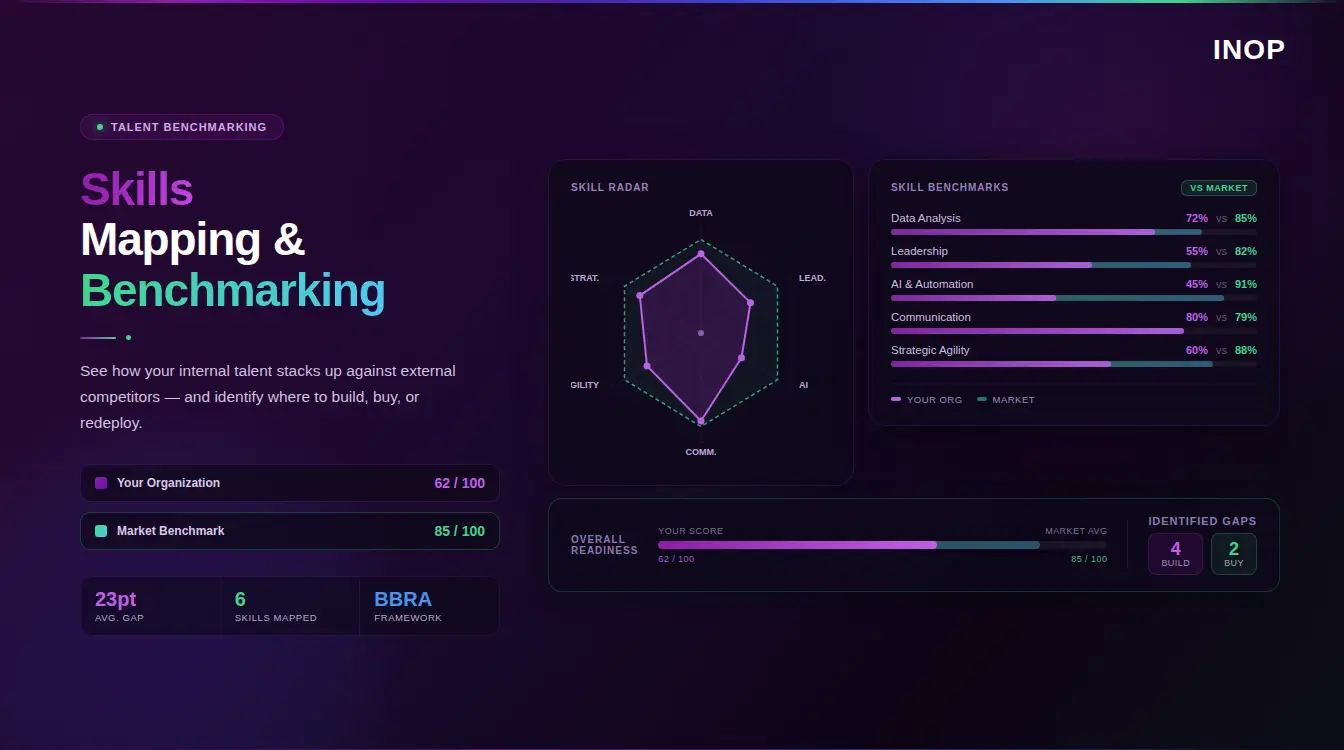
Organizations that skip structured assessment promote on tenure and familiarity rather than tested readiness. The gap only becomes visible at the moment of transition, when the cost of having missed it is already fully loaded. Building competency mapping into the leadership assessment process replaces manager instinct with behavioral evidence across the specific capabilities each leadership role requires.
The Digital and AI Literacy Gap
Adaptability and digital literacy appear consistently among the critical skills future leaders need, with 58% of organizations naming digital literacy as a growing requirement their current pipelines were not built around. BCG research cited in the Taplow Group’s 2026 analysis shows that 72% of the global workforce uses AI, while only 51% of frontline staff has adopted it, creating a specific management challenge: the leaders responsible for driving adoption are not equipped to lead teams through the resistance, anxiety, and behavioral change that AI integration requires at the team level.
This gap is the newest of the eight and the one most leadership development programs, designed before generative AI became a daily workplace tool, have not yet caught up to. INOP’s skills intelligence platform surfaces this specific gap by mapping how leadership-relevant digital and AI skills are trending in the external labor market, so a pipeline built around yesterday’s leadership competencies gets flagged before it becomes the reason a transition fails. For organizations that want to understand how skills intelligence specifically improves succession planning accuracy, INOP’s guide on how skills intelligence helps identify skill gaps covers the methodology in depth.
The Strategic Communication Gap
Strategic communication means translating organizational strategy into context a team can act from, creating alignment across stakeholders who do not share priorities, and sustaining directional clarity through periods when the strategy itself is evolving. Promark’s 2026 essential leadership skills analysis identifies unclear communication as generating losses at every level: projects missing deadlines despite competent teams, cross-functional initiatives stalling from misalignment rather than poor strategy, and efforts failing from insufficient understanding of the strategy at the execution layer.
This gap shows up as leaders who give status updates rather than strategic dialogue, who assume their teams understand the business context without making it explicit, and who never teach the people below them how their daily work connects to organizational priorities. The intervention requires leaders to open team discussions with business context before tactical execution, creating space for understanding rather than one-way direction.
The Change Leadership Gap
222 CEOs of large organizations departed in January 2025 alone, largely due to digital disruption, AI adoption pressure, and the inability to lead organizations through transformation at the pace the environment required, according to Taplow Group’s 2026 analysis. The change leadership gap is related to but distinct from the digital literacy gap. A leader can understand AI without being able to lead a team through the identity disruption of having their work meaningfully changed by it. The capability missing is the ability to hold steady in ambiguity, communicate a credible narrative before all the answers are available, and maintain team confidence during the period when the new way of working has not proven itself reliable.
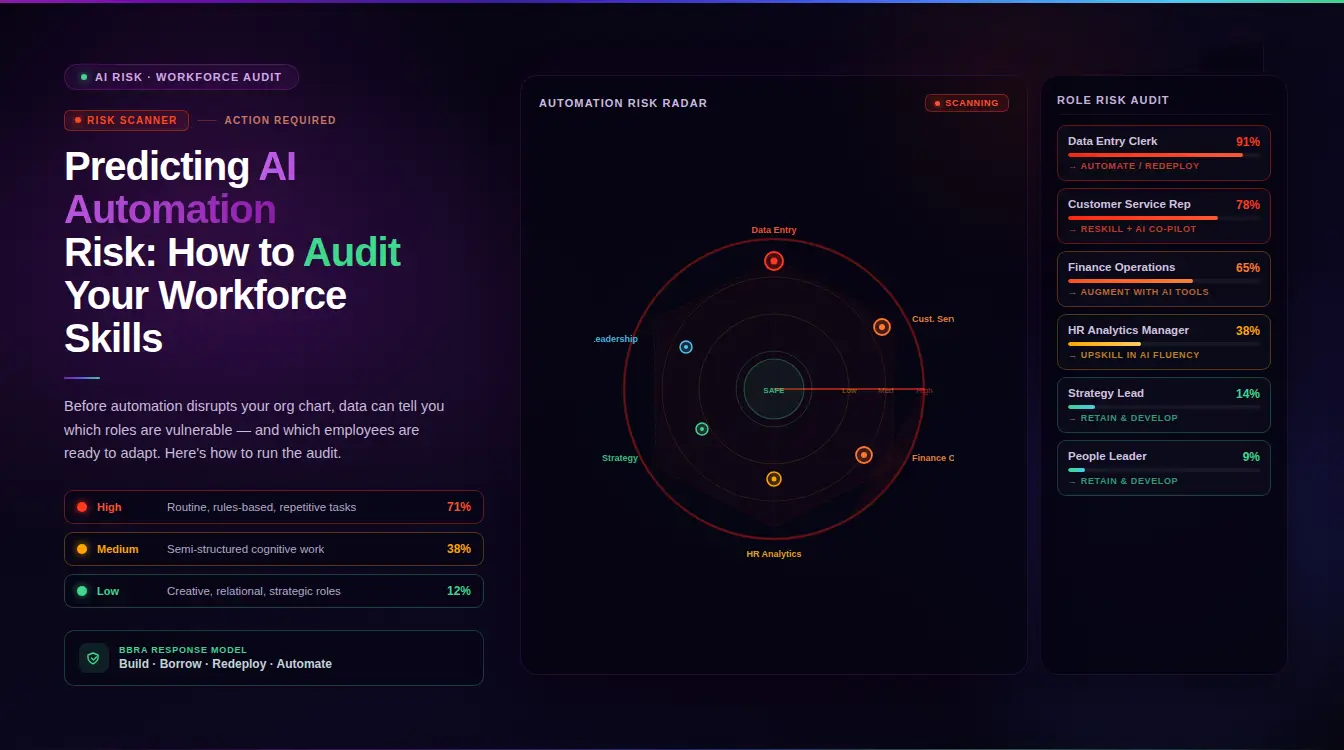
For organizations managing AI transformation as a workforce-level change, INOP’s guide on predicting AI automation risk covers how to audit which roles face the most immediate change pressure, giving change leaders specific, data-grounded context for the transitions they need to manage.
Leadership Gaps by Career Stage: Where Each Pattern Concentrates
The eight gaps affect every level of an organization’s leadership hierarchy but concentrate differently by career stage. Identifying where in your pipeline each gap sits determines both the right intervention and the urgency.
Frontline and First-Time Managers
The first-time manager transition gap concentrates here by definition, and the coaching and mentoring gap compounds it at the same level. This is the layer that most frequently receives neither upward coaching from senior leaders nor structured peer learning from other managers at the same level, because both groups assume the other is handling it. The strategic communication gap also surfaces early: managers who communicate well within a team context often struggle when their role requires communicating across organizational lines where they cannot rely on shared context or formal authority.
The operational consequence is teams that function adequately when the work is routine and break down when it becomes ambiguous, because the manager was never taught to create direction in the absence of certainty. The team absorbs that learning cost.
Mid-Level Leaders
The future-readiness gap concentrates at the mid-level. Leaders who were promoted because they performed well in technical or functional roles find that leading larger, more complex teams requires capabilities their current competency framework did not require or develop: stakeholder influence, cross-functional navigation, strategic framing, and change leadership. The change leadership gap intensifies here too, because mid-level leaders are frequently responsible for translating board-level strategic changes into team-level behavioral changes, a translation that requires specific facilitation and communication skills that most management development programs cover lightly.
Senior and Executive Leaders
At the senior level, CCL’s post-pandemic research identifies credibility and trust as the primary concerns. Before COVID, limited self-awareness was the most frequently cited issue among senior leaders. After it, overcoming credibility gaps, building and maintaining stakeholder trust in environments where executives operate more publicly and where workforce skepticism toward institutional leadership has increased, became the most pressing challenge. The assessment gap concentrates most expensively here. A first-time manager assessment failure costs the team. A VP assessment failure costs the function and the strategic initiative that function is responsible for delivering, for 18 months before the organization acknowledges and begins addressing the problem.
The Microsoft Illustration: What Systematic Gap Closure Produces
Satya Nadella’s transformation of Microsoft after taking the CEO role in 2014 is the most frequently cited example of systematic leadership gap closure at scale. Microsoft’s leadership had concentrated around a competitive, individual-performance culture that produced strong technical performers who struggled to lead in an environment where collaboration, psychological safety, and cross-functional partnership were needed for the cloud-first strategy the business required. Nadella targeted the leadership culture directly, requiring senior leaders to model growth mindset behaviors before those behaviors were expected of the broader organization, and building leadership assessment frameworks around these new requirements rather than leaving them as cultural aspirations.
Microsoft’s market capitalization increased approximately tenfold between 2014 and 2024. The point is not that a culture change alone produced that outcome. It is that the leadership capability gap was the identified constraint, the gap was addressed with a specific and sustained intervention, and the organization demonstrated measurably different capability on the other side. The gap closure preceded the financial outcome. That sequencing is the argument for treating leadership gaps as capital allocation decisions rather than HR programme requests.
How to Assess Leadership Gaps: What Structured Assessment Actually Involves
Structured assessment is the intervention that addresses the assessment gap. The term covers specific practices most organizations are not currently running, and naming them makes the difference between an instruction and a methodology.
360-Degree Feedback
360-degree feedback collects structured input from a leader’s direct reports, peers, and their own manager, all responding to the same behavioral criteria rather than providing general impressions. The 360 surfaces leadership capability that single-source assessment misses: a leader can perform adequately in the eyes of their manager while their direct reports experience them as unclear, inconsistent, or unavailable in ways that predict attrition before the attrition data shows it. The design requirement for 360 feedback that changes behavior is behavioral anchors at each proficiency level, not general rating scales, so the feedback is specific enough to drive a development action rather than a general impression that a leader already has to rationalize.
Team-Level Performance Data
A leader’s own performance rating measures their individual contribution. Their team’s performance trajectory, including retention, engagement scores, and output against targets, measures their leadership effectiveness. These two diverge: a high-performing individual contributor promoted to manager can maintain strong personal output metrics while their team’s performance quietly declines, which is exactly the pattern the first-time manager transition gap produces. Building team-level performance data into leadership assessment catches this divergence. Ignoring it lets the divergence grow until a talent review forces the conversation.
Structured Behavioral Interviews
Structured interviews against defined leadership competency criteria are more reliable than unstructured conversations for identifying capabilities that do not show up in performance data: strategic thinking under uncertainty, stakeholder influence across organizational lines, resilience under pressure, and change leadership all require a behaviorally anchored interview to assess validly. Unstructured conversations produce impressions. Structured interviews produce evidence that holds up when a promotion or succession decision is challenged.
CulturePartners’ May 2026 leadership development research identifies all three sources as components of a thorough needs assessment: current leadership capabilities through 360-degree feedback, performance data, and structured interviews; future leadership requirements through retirement projections, growth plans, and strategic initiative needs; and organizational challenges that determine where the pipeline exposure matters most. For organizations building this assessment infrastructure into a strategic planning discipline, INOP’s guide on using workforce planning tools for strategic decision-making covers how assessment data connects to the planning cycle.
Why These Gaps Keep Recurring
The pattern behind all eight gaps is the same regardless of which one surfaces first. Leadership readiness gets assumed rather than measured, and that assumption survives right up until a transition tests it. Confidence in leadership pipelines remains low even at organizations with significant investment in talent processes and data, because visibility into who theoretically exists in the pipeline is not the same as defensible evidence that they are actually ready.
A nine-box grid with names in every seat looks complete during diligence and still fails the first time it is tested by an unplanned departure. The grid shows who is there. It does not show what they can do, how quickly they can step into a more complex role, or whether the assumptions behind their readiness ratings have been tested against anything more rigorous than a manager’s comfortable familiarity with their current performance.
Compounding the structural failure is a framework problem. Many organizations are running leadership assessment against competency models built three to five years ago, calibrated to leadership requirements that have shifted significantly as remote work, AI adoption, and workforce generational change have reshaped what effective leadership requires. A pipeline that looks ready against yesterday’s criteria can carry a material readiness gap against today’s requirements. For a direct treatment of how outdated competency frameworks create leadership gaps, INOP’s guide on fixing an outdated competency framework covers the refresh process in detail.
INOP’s Five Intelligence Lenses Applied to Leadership Gaps
A leadership gap identified in isolation is an HR observation. INOP evaluates leadership risk through five intelligence lenses to turn that observation into something a board or leadership team can act on.
| Lens | What It Evaluates in a Leadership Gap |
|---|---|
| Strategy | Whether the exposed leadership layer sits directly in the path of a critical business priority |
| Finance | What closing the gap costs through internal development versus external hiring at that seniority level |
| People | Who is genuinely ready now versus who merely has tenure or visibility, based on assessed capability rather than instinct |
| Market | How the organization’s leadership bench compares to what is available externally for the same level of role |
| AI and Automation | Whether the leadership role requires new digital and AI fluency the current pipeline was never developed against |
BBRA: Closing a Leadership Gap Without Defaulting to External Hiring
Once a leadership gap is scored, INOP’s proprietary BBRA framework, Build, Buy, Redeploy, and Automate, gives it a modeled response rather than a default one. BBRA compares all four intervention pathways against financial tradeoffs across four time horizons: 30 days, 180 days, one year, and three years.
Applied to a leadership gap, a thin succession bench does not automatically trigger an external executive search. BBRA models all four options first. Would accelerating development for an internal candidate close the gap credibly within the needed timeline? Could redeploying a leader from an adjacent part of the business solve it faster and at lower total cost? Does the seniority and specificity of the role justify external hiring given current market conditions and search timelines? Is there a structural reason to reduce reliance on the role, or to redesign it so the capability requirement shifts?
Organizations with strong internal leadership development generate measurably higher shareholder returns and retention than organizations without it, which is exactly the kind of comparison BBRA surfaces before a search firm gets engaged by default. The BBRA framework converts a leadership gap from an HR concern into a capital allocation decision with financial modeling across scenarios, in a format that a CFO or operating partner can evaluate alongside other strategic investments. For a practical guide to connecting workforce risk decisions to the BBRA framework across the full talent system, INOP’s strategic workforce planning platform walks through the decision architecture in detail.
When the succession gap is deep enough that no internal pathway closes it within the required timeline, the organization is often already evaluating a broader transformation engagement alongside the executive search. Workforce transformation consulting becomes relevant at that point not as an alternative to the search, but as the structural response to the conditions that made the succession gap this deep: a pipeline that was never built, a succession process treated as a document rather than a discipline, and a leadership development system that has not kept pace with where the business now needs to go.
Common Leadership Gaps in PE Portfolio Companies
Inside a portfolio company, a leadership gap is one of the risks most likely to surface at the worst possible moment: mid-transaction or mid-transformation, precisely because readiness was assumed rather than verified before the deal closed. A nine-box grid with names in every seat can look complete during diligence and still fail the first time it is tested by an unplanned departure.
The three gaps that carry the most financial exposure in a PE context are the succession pipeline gap, the assessment gap, and the change leadership gap. A thin succession bench discovered post-close means an accelerated executive search at premium market rates during the integration period when leadership stability matters most. An assessment gap means the readiness ratings on the succession chart were based on manager familiarity rather than tested capability, which the first real transition pressure will expose. The change leadership gap matters specifically because most value creation plans require a workforce through significant operational or strategic change, and the leaders responsible for executing that change were often not selected or developed for it.
Standardizing leadership gap evaluation across a portfolio through INOP’s strategic workforce planning platform gives operating partners a consistent way to score leadership readiness across assets against real assessment data, rather than accepting a portfolio company’s own succession chart at face value. Where a gap forces an accelerated external search, INOP’s compensation analytics platform connects that finding directly into pay benchmarking, since executive-level hiring under time pressure carries a real market premium that a succession chart will not reveal.
Ready to score leadership readiness against verified data instead of a nine-box grid? Book a demo and INOP will walk through leadership risk scoring across all five lenses, live.
Common Mistakes When Addressing Leadership Gaps
Promoting on tenure instead of readiness. Defaulting to whoever has been in the role longest conflates comfort with capability. It is one of the most consistent ways a succession plan quietly sets up a failed transition without anyone noticing until the transition happens.
Treating a succession document as a finished plan. A nine-box grid with names filled in looks complete and says nothing about whether those names are actually ready, or whether anyone has verified that readiness against a real assessment rather than a performance review from a manager who promoted them.
Leaving first-time managers to figure it out alone. A new manager without coaching or structured onboarding into the role learns through trial and error, at direct cost to the team they are managing during that learning curve. The cost is rarely attributed to the management gap that caused it.
Assuming leadership competency frameworks stay current on their own. A leadership pipeline built against a static, outdated framework produces leaders calibrated to yesterday’s challenges. A framework that captured digital literacy requirements in 2021 may already be measuring the wrong capabilities against today’s AI-augmented leadership context. For a treatment of how to refresh an outdated framework, INOP’s guide on fixing an outdated competency framework covers the process in detail.
Skipping structured assessment entirely. Manager instinct and performance reviews are a thin basis for an organization’s most consequential people decisions. The gap between how someone performs today and how they would perform under the pressure of a bigger role only shows up under real assessment conditions, not in a performance rating that measures their effectiveness in the current role.
Treating leadership development as a program instead of a pipeline. A one-time leadership training cohort produces a burst of activity and no lasting change to the underlying pipeline. Closing these eight gaps requires an ongoing system, continuously identifying who is developing readiness and where the exposure sits, not a single course rolled out once and revisited only when a crisis forces the question.
Skipping the communication and change leadership gaps in favor of more familiar interventions. Organizations that focus their leadership development investment on visible gaps like succession and first-time manager readiness while ignoring the strategic communication and change leadership gaps are optimizing the org chart while leaving the execution capacity underdeveloped. Both gaps generate project failures and strategic misalignment that no succession plan prevents.
Frequently Asked Questions
What are the most common leadership gaps organizations face?
Eight patterns recur most consistently across current research: the first-time manager transition gap, the succession pipeline gap, the future-readiness gap, the coaching and mentoring gap, the assessment gap, the digital and AI literacy gap, the strategic communication gap, and the change leadership gap. Most organizations carry more than one simultaneously, and the patterns compound: a succession pipeline gap built on an assessment gap produces a list of names on a chart who have never been tested against the readiness criteria the role requires.
What does a common leadership gap actually cost?
The costs distribute across multiple budget lines and typically get attributed to the wrong cause. A first-time manager transition gap generates team attrition at 100 to 200% of annual salary per departing employee, attributed to retention issues rather than management failure. A succession pipeline gap generates external executive search fees at 25 to 30% of first-year compensation plus 12 to 18 months of reduced leadership effectiveness in the function, attributed to transition costs rather than pipeline failure. At VP level, a single unplanned succession gap costs $70,000 to $84,000 in search fees before the incoming leader starts. The leadership gap itself rarely appears on the financial statement that shows the damage it caused.
Why do common leadership gaps keep recurring even at well-resourced organizations?
Leadership readiness gets assumed rather than measured, and that assumption survives until a transition tests it. Visibility into who theoretically exists in the pipeline is not the same as verified evidence that they are actually ready, and most organizations do not run the structured assessment that produces that evidence. Compounding this is a framework problem: many organizations assess leadership capability against models built years before remote work, generative AI, and multi-generational workforce dynamics changed what effective leadership requires. A pipeline that looks strong against yesterday’s criteria can carry a material readiness gap against today’s requirements.
How is a leadership gap different from a general skill gap?
A leadership gap specifically concerns readiness to lead, decide, and develop others, capabilities that current-role performance does not reliably predict. A general skill gap can apply to any technical or functional capability regardless of whether it involves managing people. The distinction matters for assessment design: a technical skill gap can be identified through structured assessment, certification review, or work product evaluation. A leadership gap requires behavioral evidence, 360-degree feedback, and structured interviews against defined leadership criteria, because the relevant behaviors only show up under specific conditions that a technical assessment does not replicate.
What is the fastest way to start closing common leadership gaps?
Replace manager instinct with structured assessment for identifying succession candidates, and ensure first-time managers receive training and coaching before they take on the role, not after they have already started struggling with it. These two changes address the gaps most directly tied to failed transitions. The structured assessment change does not require a platform: a well-designed 360-degree feedback process and a behavioral interview framework against defined leadership competencies can be implemented without new technology. The coaching change does not require a formal program: a structured onboarding into the management role, with explicit conversations about the identity shift the job requires, closes the majority of the first-time manager transition gap before it costs the team.
What is the most expensive leadership gap for organizations to ignore?
The succession pipeline gap carries the highest direct cost when it surfaces unexpectedly. An unplanned departure from a senior role without a prepared internal successor generates 6 to 9 months of external search at 25 to 30% of first-year compensation, followed by 6 to 12 months before the incoming leader reaches full operating effectiveness. For a VP position at $280,000 base salary, this sequence costs $70,000 to $84,000 in direct search fees plus 12 to 18 months of reduced leadership capacity in the function. The first-time manager gap carries a less visible but equally significant cost: every high performer who leaves the team rather than continue under an underprepared manager generates replacement costs of 100 to 200% of their annual salary, attributed to attrition rather than leadership failure.
How should private equity operating partners evaluate leadership gaps at a portfolio company?
Check whether succession readiness is backed by structured assessment data, not just a completed org chart or nine-box grid. A leadership pipeline that looks strong on paper fails the first time it is tested by an unplanned departure, and the cost of that failure during the integration period or transformation phase is significantly higher than the cost of identifying the gap during diligence. The three gaps that carry the most financial exposure in PE contexts are the succession pipeline gap, the assessment gap, and the change leadership gap, because all three directly affect whether the value creation plan can be executed by the existing leadership team without an unplanned executive search mid-hold.
What does closing a leadership gap look like in practice?
Closing a leadership gap requires four connected elements rather than any one of them in isolation. A verified assessment of which gap exists and where it concentrates in the pipeline, using 360-degree feedback, performance data, and structured behavioral interviews rather than manager instinct. A development plan anchored to the specific gap rather than a general leadership development curriculum. A coaching or accountability structure that reviews progress against that plan rather than assuming development happens automatically once the plan is written. And a revised succession roster that connects development milestones to readiness timelines, so the organization knows not just who is on the list but when each person will actually be ready to step into the role. Running three of these four without the fourth consistently produces the same result: a plan that exists and a gap that persists.