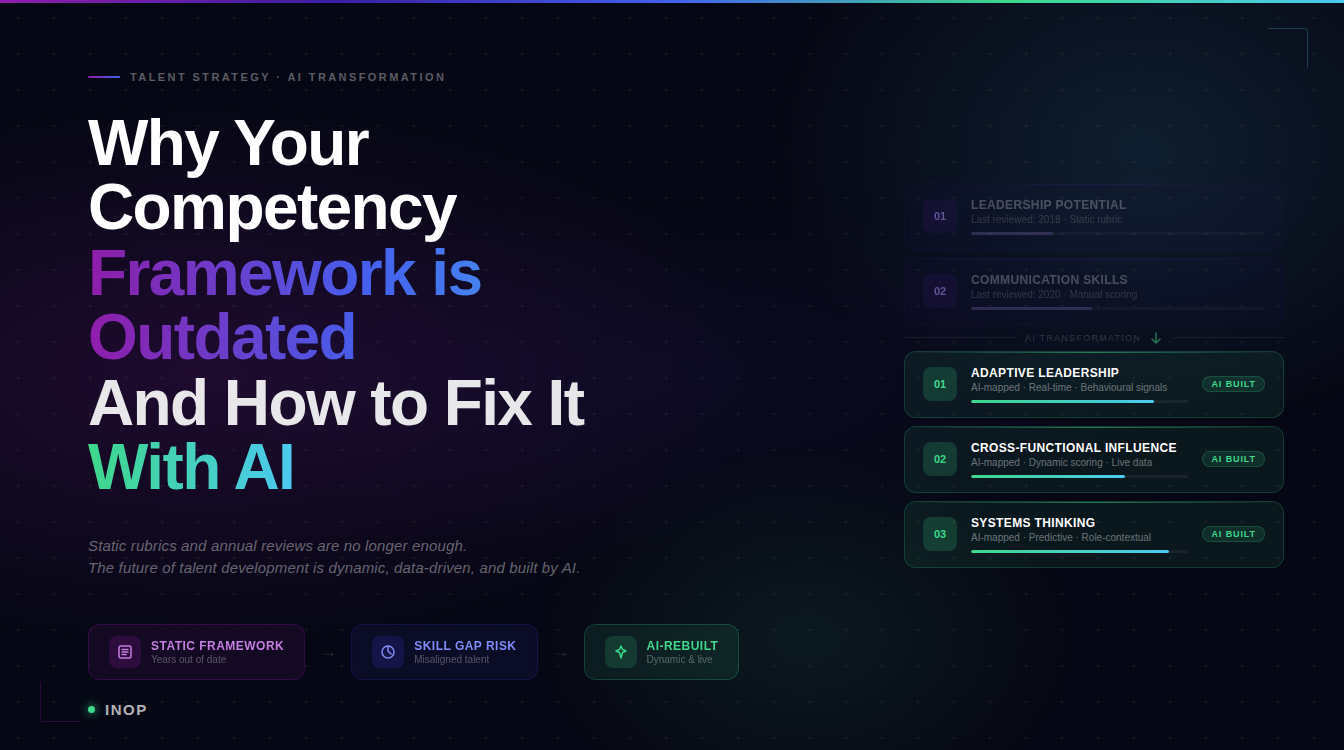
A competency framework — the structured model that defines the knowledge, skills, behaviors, and attributes required for effective performance, should be the backbone of every major people decision your organization makes. Hiring, performance management, learning and development, succession planning: all of it depends on the quality of that foundational model.
research from the Deloitte 2025 Gen Z and Millennial Survey and Global Human Capital Trends report found that only 14% of HR leaders believe their organizations are effective at developing talent for future needs.
When a competency framework is static, role-centric, and disconnected from real business strategy, it stops being a guide and starts being a bottleneck. This article examines why so many competency frameworks are already obsolete, what the cost of inaction looks like in measurable terms, and how artificial intelligence (specifically INOP’s skills intelligence architecture) is fundamentally transforming what a modern, living competency framework can do.
What a Competency Framework Is (And What It Was Built to Do)
A competency framework is a structured model that defines the knowledge, skills, behaviors, and attributes individuals need to perform effectively, across roles, functions, or an entire organization. It creates a shared language for talent decisions, from how you recruit and onboard to how you develop, reward, and promote.
At its best, a well-designed competency framework does three things well. It aligns individual capability to organizational goals. It gives managers a consistent, fair basis for evaluating performance. And it gives employees a clear picture of what excellence looks like and a defined path to grow toward it.
When competency frameworks became widespread in the 1970s and 1980s, the business environment moved slowly enough that a structured, role-based model made perfect sense. You could define what a high-performing project manager or a strong sales executive looked like, codify it into a competency framework, and rely on that definition for years.
That is no longer the world most organizations operate in.
Why Most Competency Frameworks Are Already Outdated
The Static Competency Framework Problem
The fundamental flaw in most competency frameworks is not that they were designed badly. It is that they were designed once. The typical competency framework review cycle runs every two to four years. In an environment where AI tools are reshaping job functions quarterly and entirely new roles emerge with little warning, a two-year-old competency framework is already navigating with yesterday’s map.
Consider what has changed in just the last three years. Roles across marketing, finance, and operations now routinely require AI literacy, data interpretation, and prompt engineering, skills that did not appear in competency framework dictionaries before 2022. Legal and compliance functions increasingly need working knowledge of algorithmic accountability. Customer success teams are expected to use predictive analytics tools that barely existed a few years ago.
A competency framework last revised before these shifts cannot accurately reflect what strong performance looks like today, let alone what it will require tomorrow.
Role-Centric Design vs. Skills-Based Reality
Traditional competency framework design organizes competencies around roles and job families. You define competencies for a Senior Finance Manager, a Product Director, or a Customer Service Representative, then evaluate people against those role-specific profiles.
This approach made sense when roles were stable. It creates serious problems when they are not.
The World Economic Forum’s Future of Jobs Report 2023 estimated that 44% of workers’ core skills will be disrupted within the next five years. When skills shift that rapidly, a role-centric competency framework becomes a straitjacket. It tells you whether someone fits a static job description. It cannot tell you which employees have adjacent capabilities that could be redeployed, which roles are at risk of obsolescence, or where capability gaps are forming before they become an execution problem.
The move toward skills-based organizations is not a trend. It is a structural response to skills volatility. And most competency frameworks are not built for it.
Disconnection from Business Strategy
One of the most significant, and underappreciated, failures of a traditional competency framework is its disconnect from live business strategy. Organizations build their competency framework in the context of a strategic plan that may have already shifted by the time the framework is deployed.
When workforce capabilities are defined in isolation from financial performance, operational goals, and market dynamics, you end up with a competency framework that feels administratively complete but is strategically irrelevant. Competency assessments happen. Ratings get entered into the HRIS. But no one can clearly answer whether the distribution of capabilities across the workforce actually supports the direction the business is moving.
This is one of the core problems INOP’s Strategic Workforce Planning module is designed to solve: connecting competency framework outputs to strategy in real time, not as an annual HR exercise.
The Data Quality Gap
Most competency framework assessments rely on manager ratings, self-assessments, and annual reviews. Each of these inputs carries significant bias and inconsistency. Research consistently shows that manager ratings of competency correlate more closely with the relationship between manager and employee than with actual skill level. Self-assessments suffer from both overconfidence in familiar areas and underestimation where someone lacks the vocabulary to name what they know.
The result is a data layer that looks structured but is deeply unreliable. Succession decisions, development investments, and talent mobility programs built on this data inherit its flaws.
The Real Cost of an Outdated Competency Framework
It is tempting to treat an outdated competency framework as an administrative inconvenience. The actual cost is measurable, material, and board-visible.
Misaligned hiring. When competency framework definitions no longer reflect what roles actually require, hiring managers default to gut feel, familiarity, or credentials rather than relevant capability. Research from McKinsey & Company found that companies using skills-based hiring are five times more likely to make successful hires than those relying on traditional job descriptions and static competency models. For an organization making 200 hires annually at an average total employment cost of £60,000, even a 10% improvement in hiring quality translates to millions in avoided cost and ramp time.
Wasted L&D investment. According to Statista and Training Industry data, organizations globally spend over $400 billion annually on employee learning and development. When that spend is directed by an outdated competency framework, it targets yesterday’s gaps — not tomorrow’s requirements. For a mid-sized organization spending £2M annually on L&D, even 20% misdirection represents £400,000 in value-destroying investment.
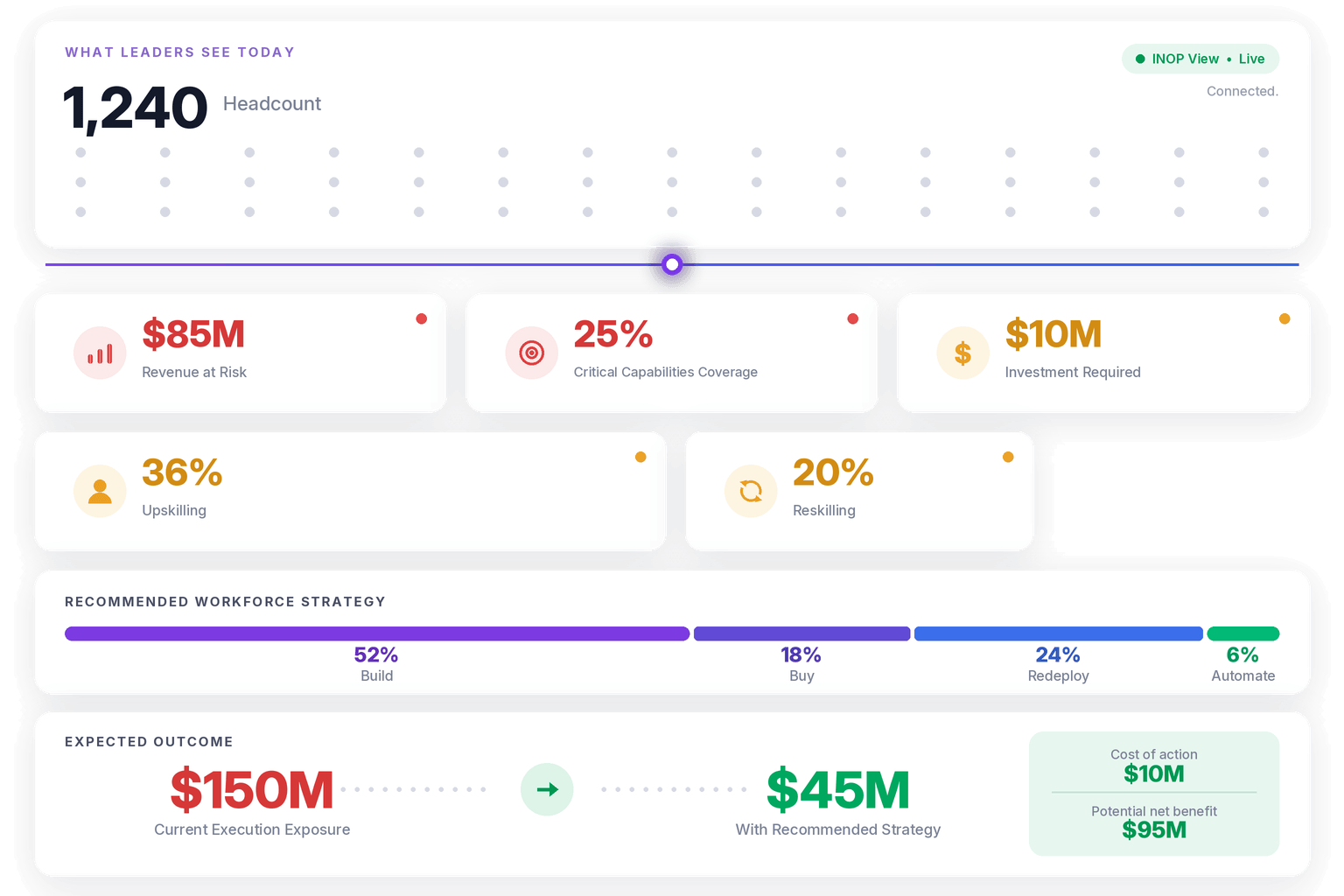
Invisible capability gaps and execution risk. When the competency framework does not map to current or emerging skill requirements, organizations cannot see where execution risk is forming. For private equity-backed businesses, this is an EBITDA risk: capability shortfalls in key value-creation functions routinely surface only at the point of delivery failure, by which point the cost to remediate is multiples of the cost to prevent.
Poor internal mobility and avoidable attrition. Employees with highly transferable skills get stuck in role-defined tracks because the competency framework has no mechanism for recognizing adjacent capabilities. This drives avoidable turnover. Replacing a mid-level knowledge worker typically costs 50–200% of annual salary. An organization losing 30 people per year to mobility frustration — at an average replacement cost of £50,000 — faces a £1.5M annual liability that a modern competency framework can materially reduce.
Succession failures. Succession pipelines built on a static competency framework profile often produce leaders calibrated to past challenges, not current ones. For PE operating partners conducting portfolio reviews, a succession bench built on stale competency data is an investment risk that does not appear on the balance sheet — until it does.
How INOP Quantifies Competency Risk
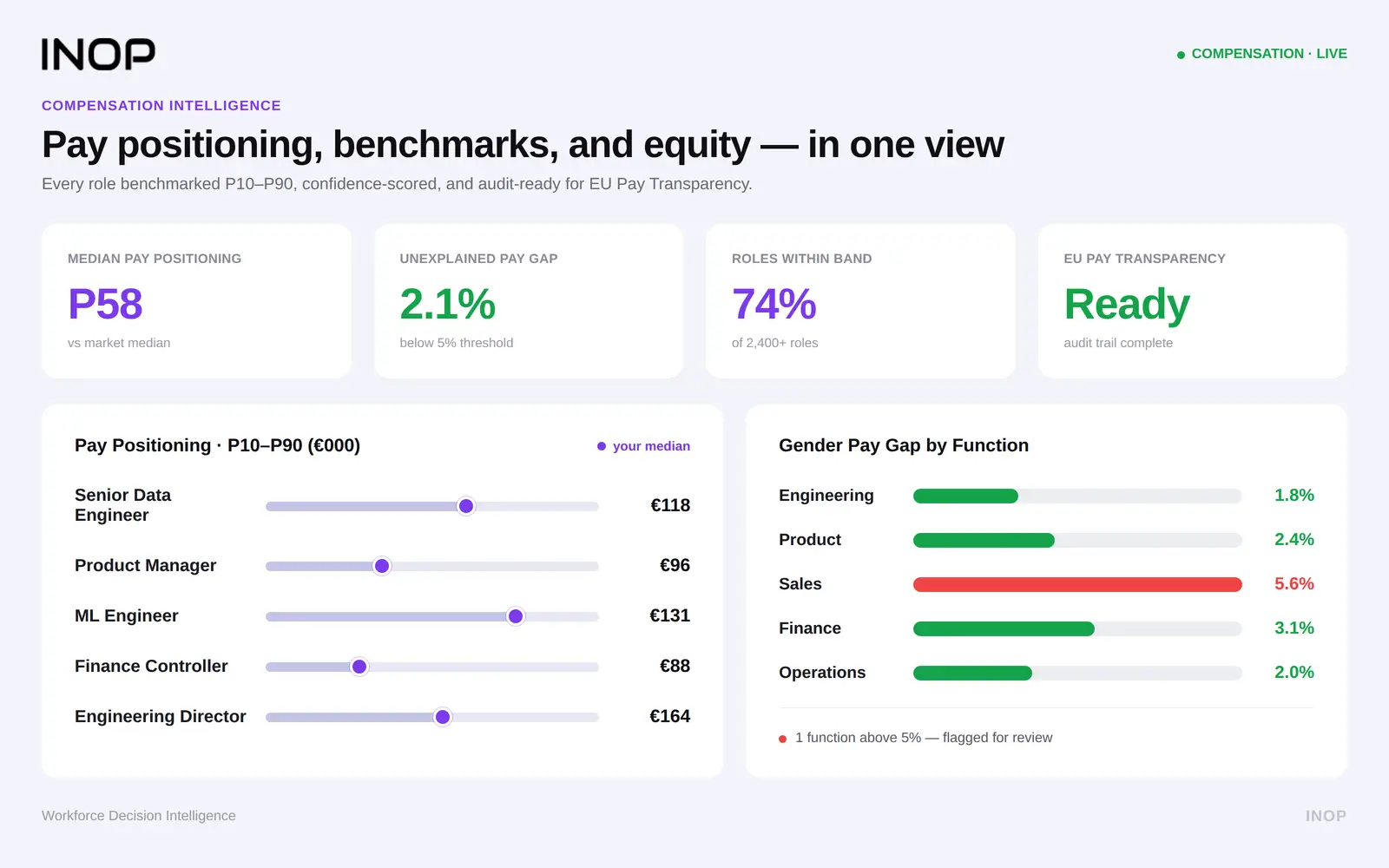
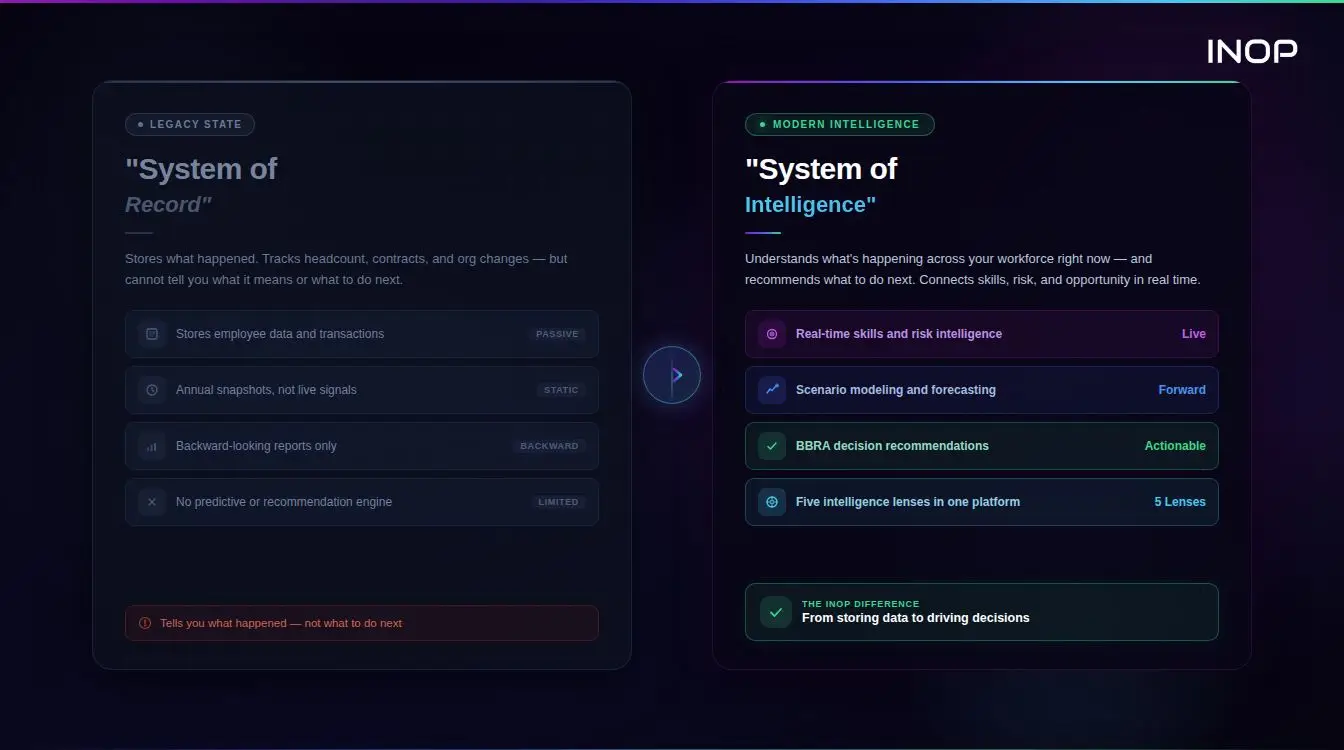
INOP’s platform applies five intelligence lenses, Talent Intelligence, Compensation Intelligence, Skills Intelligence, Workforce Planning Intelligence, and Performance Intelligence, to give CHROs, CFOs, and operating partners a unified, financially-grounded view of workforce capability. The BBRA (Build, Buy, Rent, Automate) decision framework connects competency gap data directly to capital allocation decisions, so that capability risk is expressed in the language boards and investors understand. See the INOP Platform overview for more detail.
What a Modern, AI-Powered Competency Framework Looks Like
AI does not simply make it faster to do what you were already doing with your competency framework. It makes fundamentally different things possible, transforming a static administrative model into a dynamic intelligence system.
Continuous Skills Mapping at Scale
One of the most immediate advantages AI brings to competency framework management is the ability to map skills continuously and at scale, rather than through periodic, resource-intensive review cycles.
INOP’s Skills Intelligence module analyzes job postings, project records, learning completion data, performance feedback, and external labor market signals to build — and continuously update — a rich picture of what skills exist across the organization, how they are evolving, and how they compare to what the market demands. Instead of a competency framework dictionary updated every two years by a small working group, you have a living skills taxonomy that reflects reality as it changes.
Inferring Skills From Behavioral and Work Data
A critical limitation of the traditional competency framework is its reliance on explicit inputs: what someone says they can do, or what a manager observes and rates. AI can go significantly further by inferring skills from the work people actually perform.
Natural language processing can analyze project documentation, communication patterns, and work outputs to surface evidence of capability that would otherwise remain invisible in a static competency framework. An employee who has been solving complex data interpretation problems across multiple projects has demonstrated data literacy, regardless of whether it appears in their formal competency profile. INOP’s Talent Intelligence lens identifies and surfaces that evidence systematically, giving human judgment a far richer and more reliable evidentiary foundation.
Dynamic Definitions That Evolve With the Market
Rather than maintaining a fixed competency framework dictionary, INOP pulls in external labor market signals to understand how role requirements are shifting across an industry. If data shows that AI fluency is becoming a baseline expectation in a previously non-technical function, the framework surfaces that shift and prompts a structured organizational response, before the gap becomes a performance problem.
This kind of outside-in intelligence is what separates a modern competency framework from its predecessors. It is not just introspective. It is connected to the world the organization actually competes in.
Connecting the Competency Framework to Strategy and Financial Outcomes
Perhaps the most significant transformation AI enables is connecting competency framework outputs directly to business outcomes. Instead of asking whether an employee demonstrates a leadership competency at level three, the question becomes: which capability configurations correlate with the strongest performance in this strategic priority area, and where do we have gaps?
INOP’s Workforce Planning Intelligence module makes this connection explicit. Capability gap data is modelled against strategic scenarios, so that decisions about where to develop, hire, redeploy, or automate are grounded in what actually drives business performance. For PE-backed businesses, this means competency framework outputs feed directly into value-creation plan tracking — not into a separate HR dashboard that no one on the investment team ever opens.
Personalized Development at Scale
AI makes it possible to move from standardized competency framework development programs to genuinely personalized learning pathways. By understanding each individual’s current skill profile, their career goals, and the capability requirements of target roles or future organizational needs, INOP can recommend development experiences that are specific, timely, and relevant, rather than assigning everyone at a given level the same program regardless of where they individually stand.
How to Modernize Your Competency Framework: A Practical Path Forward
Replacing an outdated competency framework is not simply a matter of updating definitions in your HRIS. It requires a different approach to how competency data is collected, interpreted, and connected to decisions.
1. Audit Your Existing Competency Framework
Before redesigning anything, conduct an honest audit. When was the competency framework last substantively updated? How were competencies defined, and by whom? What data sources feed your assessments, and how reliable are they? Are there areas of the business where the framework is obviously misaligned with what roles actually require?
This audit will often reveal that the competency framework is both more fragmented and more outdated than people assumed. INOP’s Diagnostic Assessment provides a structured starting point for this analysis, benchmarking your current framework against market and internal performance data.
2. Shift to a Skills-Based Architecture
Move away from organizing the competency framework exclusively around roles and job families. Instead, build a skills taxonomy that can be applied across roles, functions, and career paths. Skills should be defined at a level of granularity that makes them searchable, assessable, and comparable — not so broad as to be meaningless, not so narrow as to be unmanageable.
This transition is foundational. You cannot run meaningful skills gap analysis or build effective internal mobility programs on a role-centric competency framework.
3. Integrate Internal and External Data Sources
A modern competency framework should draw on multiple data sources — not just manager ratings and self-assessments. Internal sources include project records, LMS data, performance feedback, and work outputs. External sources include labor market data, industry skills taxonomies, and AI-generated signals about how role requirements are shifting across the sector.
Integrating these sources is where technology becomes essential. No human team can synthesize the volume of data required to maintain a dynamic, market-calibrated competency framework at scale.
4. Connect the Competency Framework to Business Strategy
Competency framework data becomes strategically valuable only when connected to where the business is going. This means mapping capability gaps against strategic priorities, modelling the workforce implications of different business scenarios, and understanding how current capability profiles translate to execution risk or competitive advantage.
This is where competency framework management connects to INOP’s Strategic Workforce Planning module, and where organizations that make that connection gain a decisive advantage over those treating the framework as a standalone HR process.
5. Use AI to Maintain and Evolve the Framework
Once the architecture is in place, AI should be the primary mechanism for keeping the competency framework current. Set up systems to continuously ingest and analyze internal work data, external market signals, and organizational performance data. Establish governance processes to review and validate AI-generated insights, and ensure human judgment remains central to significant decisions.
The goal is not to automate competency framework management out of human hands. It is to give HR and business leaders the intelligence they need to make faster, more confident decisions about capability.
Common Objections And Why They Don’t Hold Up
“Our competency framework was built with significant stakeholder input — we can’t just change it.” Stakeholder input is valuable for ensuring adoption. It is not a reason to preserve a competency framework that no longer reflects reality. Stakeholders can be engaged in the redesign process, and a well-communicated business case, expressed in financial and execution terms, not HR process terms — typically generates support rather than resistance.
“We don’t have the data infrastructure to support a modern competency framework.” Most organizations have more usable data than they realize. HRIS records, LMS completion data, performance reviews, and project management systems are starting points. INOP is designed to work with imperfect and incomplete data, building richer pictures over time as integration deepens.
“Overhauling the competency framework will be expensive and take years.” A phased approach can deliver measurable improvements within months. Starting with a skills taxonomy refresh and integrating one or two additional data sources produces value quickly. A full transformation does not need to happen all at once. INOP’s modular architecture means you can start with the Skills Intelligence lens and expand from there.
Competency Framework FAQs
What is a competency framework and what does it include?
A competency framework is a structured model that defines the knowledge, skills, behaviors, and attributes required for effective performance across roles or an entire organization. A well-designed competency framework typically includes behavioral indicators at different performance levels, organized by role, function, or career stage.
What is the difference between a competency framework and a skills taxonomy?
A competency framework defines behaviors, knowledge, and attributes required for effective performance, typically organized by role or level. A skills taxonomy is a structured catalogue of specific, granular skills across the organization. Modern approaches integrate both: using the skills taxonomy as the foundation and the competency framework to define how skills combine into performance expectations at different levels. INOP’s Skills Intelligence module operates at both levels simultaneously.
How often should a competency framework be updated?
Traditional guidance suggested every two to four years. In the current environment, meaningful elements of a competency framework should be reviewed continuously — at least annually for the overall architecture, and in real time for skills definitions — using technology to monitor market signals and internal data.
What are examples of a competency framework in practice?
Competency framework examples include behavioral frameworks that define leadership, collaboration, and problem-solving across levels; technical frameworks that catalog role-specific skills in areas like data analytics or software engineering; and hybrid frameworks that combine both. Modern AI-powered competency frameworks, like those built on INOP, go further by mapping these definitions against live market signals and organizational performance data.
Can small and mid-sized organizations benefit from an AI-powered competency framework?
AI-powered competency framework tools are increasingly accessible to organizations of all sizes. Many platforms offer modular entry points that do not require full enterprise implementation. The business case for smaller organizations is often stronger — not weaker — because they have less capacity for the manual review cycles that large teams can sustain.
What is the relationship between a competency framework and succession planning?
Succession planning depends entirely on the quality of the competency framework and capability data underpinning it. A static, role-centric framework produces a succession pipeline calibrated to past requirements. A dynamic, skills-based competency framework makes it possible to identify succession readiness against forward-looking capability requirements — a fundamentally more valuable output for boards and investors.
What is the risk of over-relying on AI in competency framework management?
AI should inform, not replace, human judgment in competency framework management. The primary risk of over-reliance is that algorithmic outputs reflect the quality and completeness of the underlying data. INOP’s governance layer ensures AI recommendations are reviewed, validated, and contextualized by people who understand the business.
How do we measure the ROI of modernizing our competency framework?
ROI can be measured across several dimensions: reduction in time-to-fill for critical roles through better internal mobility identification; improvement in hiring quality through more accurate role-skill matching; reduction in avoidable turnover; and improvement in project delivery through better capability-to-work matching. A baseline assessment before modernization provides the comparison point. INOP’s Performance Intelligence lens is designed to track these outcomes over time, connecting competency framework improvements to measurable business results.
The Window for Getting Your Competency Framework Right Is Narrowing
The gap between organizations building dynamic, AI-powered competency frameworks and those still managing static models is growing. The former are making faster, more confident decisions about where to develop, hire, and invest. The latter are operating with an increasingly unreliable map of their most important asset, while accumulating financial exposure that will eventually surface as an execution or valuation problem.
Modernizing your competency framework does not require a complete organizational overhaul. It requires a clear-eyed assessment of what is not working, a commitment to a skills-based architecture, and the right technology to keep the framework current and connected to business reality.
INOP brings together five intelligence lenses, Talent intelligence, Compensation Analytics, Skills, Workforce Planning, and Performance — into a single platform that connects competency framework outputs to financial and strategic outcomes. The BBRA decision framework translates capability gap data into concrete build, buy, rent, or automate decisions. The result is a competency framework that a CHRO, CFO, and PE operating partner can all act on.
Book a Demo
Make confident workforce decisions that support strategy and value creation.


One reply on “Why Your Competency Framework is Outdated (And How to Fix It With AI)”
[…] treatment of how outdated competency frameworks create leadership gaps, INOP’s guide on fixing an outdated competency framework covers the refresh process in […]