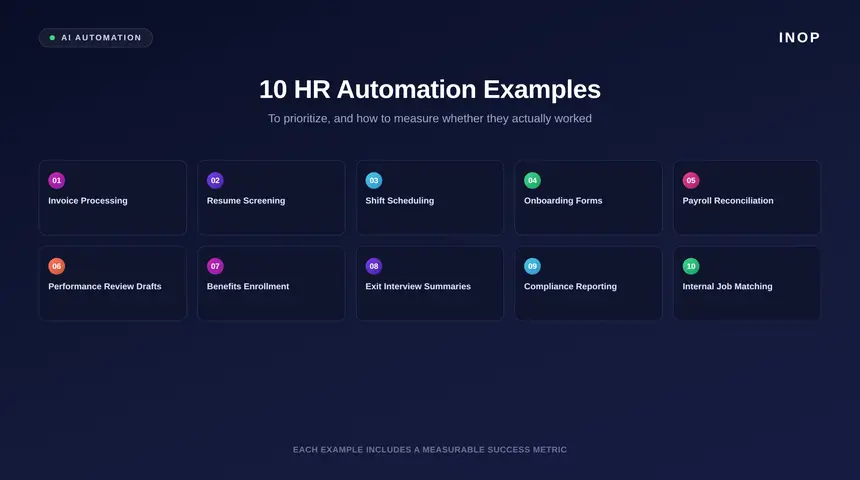
The most useful HR automation examples are not just a list of what technology can do. They are the ones tied to a measurable outcome, cost per hire, time to fill, compliance exposure, so an organization can actually tell whether the investment paid off. Most lists of HR automation examples stop at the feature description and skip the harder, more useful question: which of these examples are actually worth prioritizing, and how do you know afterward that they worked.
This guide covers ten HR automation examples worth prioritizing, ranked roughly by how fast and measurable the return tends to be, why so many HR automation initiatives never show up in a real ROI number, where automating an HR decision specifically carries bias and compliance risk, and what to do with the capacity automation frees up.
12 HR Automation Examples Worth Prioritizing
These twelve examples are ordered roughly from fastest and most measurable to slowest and most judgment-dependent, which is also a reasonable rough guide to sequencing investment. Each one covers a specific mechanism, not just a category, since the details are what actually determine whether an example is worth prioritizing for a given organization.
AI-Powered Candidate Sourcing and Screening
Modern applicant tracking systems parse incoming resumes, extract structured data on skills and experience, and score each candidate against the specific requirements of the open role before a recruiter opens a single file. Some tools go further, proactively sourcing passive candidates from professional networks based on the same criteria. This is consistently one of the fastest-paying-off examples on this list: AI-powered recruitment can reduce cost per hire by up to 30 percent and cut time to shortlist by 60 to 80 percent, largely because the tool eliminates the hours a recruiter would otherwise spend manually reading through applications that never had a real chance at the role.
Automated Interview Scheduling
Self-service scheduling tools sync a candidate’s availability directly against every interviewer’s calendar and confirm a slot automatically, removing the email back-and-forth that used to eat days out of a hiring timeline. More advanced versions also handle rescheduling, send automated reminders to both sides, and update the applicant tracking system the moment a slot is confirmed, so recruiters are not manually re-entering the same information across two or three separate tools.
Onboarding Workflow Automation
New hire paperwork, system access provisioning, equipment orders, and a structured task checklist all trigger automatically off a confirmed start date, rather than depending on a hiring manager remembering each step in sequence. A well-built onboarding automation also personalizes the sequence by role and department, so a sales hire and an engineering hire land on different first-week paths without anyone manually configuring it each time. The result is a new employee’s first week running on a defined, repeatable process instead of whatever a busy manager has time to assemble.
Payroll Processing and Tax Compliance
Automated payroll systems calculate withholding, apply jurisdiction-specific tax rules, handle overtime and shift differentials, and run payroll on schedule with minimal manual input. For organizations operating across multiple states or countries, this is one of the highest-value examples on the list, since manual payroll calculation across jurisdictions is both time-consuming and one of the more common sources of compliance error when handled by hand.
Benefits Enrollment and Life-Event Updates
Eligibility gets determined automatically based on employment status and tenure, enrollment reminders go out on a defined schedule during open enrollment, and life-event changes, a marriage, a new dependent, a change in employment status for a spouse, trigger the correct plan update without an employee having to track down a paper form or wait for HR to process a manual request.
Compliance and Certification Tracking
Automated systems flag expiring certifications and licenses before they lapse, track completion of mandatory policy acknowledgments, and monitor labor law requirements across the jurisdictions an organization operates in, surfacing a gap before it becomes an audit finding rather than after. This example matters disproportionately for regulated industries and multi-state employers, where the sheer number of tracked requirements makes manual monitoring genuinely unreliable at scale.
Performance Review Cycle Automation
Review scheduling, reminder cadences, and goal tracking run automatically across the organization, freeing managers and HR from the administrative overhead of chasing overdue reviews and consolidating scattered feedback documents. The substance of the review itself, the actual judgment about an employee’s performance, still requires a human manager, which is exactly why this example works best as an administrative automation rather than a decision automation.
Employee Self-Service and HR Chatbots
Routine policy and benefits questions, how many vacation days remain, when the next paycheck lands, how to update a direct deposit, get answered automatically through a chatbot or self-service portal, reducing the volume of repetitive inquiries that otherwise consume a meaningful share of an HR team’s week. The strongest implementations also escalate to a human the moment a question moves beyond a routine policy lookup, rather than trapping an employee in an unhelpful automated loop.
Attrition and Retention Risk Flagging
Automated systems surface early turnover risk patterns by combining tenure data, engagement survey results, manager change history, and other behavioral signals into a single risk score, giving HR and managers a heads-up before a resignation letter arrives rather than after. The value here depends heavily on what happens next: a flagged risk with no connected retention conversation or intervention plan is just an alert nobody acts on.
Offboarding and Exit Workflow Automation
The counterpart to onboarding automation deserves the same rigor and rarely gets it. Automated offboarding revokes system access on a precise schedule tied to the employee’s last day, triggers final pay and benefits processing, schedules an exit interview, and tracks return of company equipment, closing gaps that manual offboarding commonly misses, particularly around access revocation, which carries real security exposure when it lags behind an employee’s actual departure date.
Internal Mobility and Job Matching
Automated systems match open internal roles against employee skills profiles and surface qualified internal candidates before, or alongside, an external job posting goes live. This example is the one most HR automation lists skip entirely, and it is also one of the highest-leverage, since surfacing an internal candidate automatically, rather than relying on a manager happening to know who might be a fit elsewhere in the company, is what actually turns internal mobility from a stated value into an operating practice.
Skills and Workforce Data Mapping
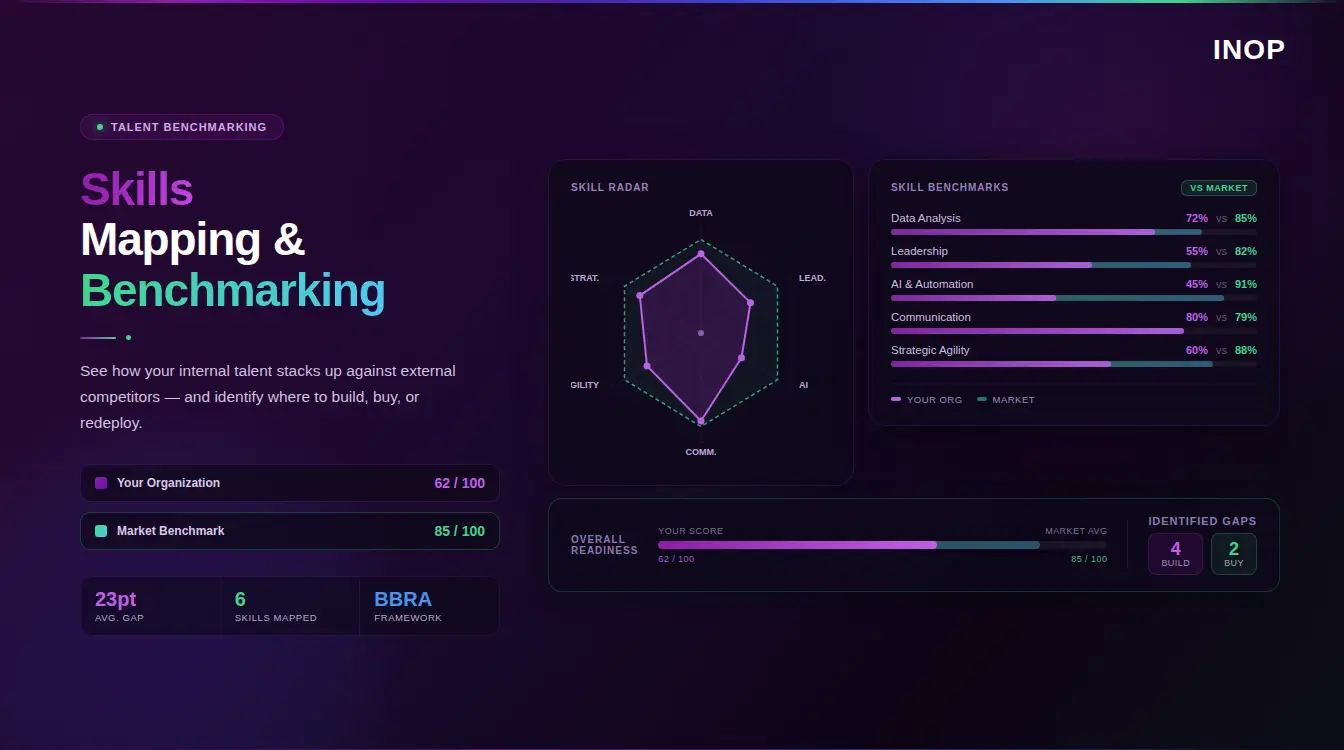
Automated systems map employee skills against external labor market signals continuously, classifying each skill as emerging, in demand, stable, or declining, rather than relying on a static job description that goes stale the moment it is written. This example connects automation back to actual workforce strategy rather than administrative efficiency alone, and it is the foundation the internal mobility and retention risk examples above both depend on to work accurately.
The pattern across all twelve examples is consistent: the closer an example sits to a repetitive, rules-based task, the faster and more measurable the payoff. The closer it sits to a judgment call about a specific person, screening, promotion, performance interpretation, the more scrutiny it deserves before automating it.
What HR Automation Actually Covers Beyond These Examples
HR automation spans a wide range of processes, and treating all of them as equally valuable to automate is one of the more common planning mistakes. Recruiting and sourcing, onboarding workflows, payroll processing, benefits administration, performance tracking, and compliance documentation are the categories most commonly automated. AI adoption in HR is fastest in recruiting and slowest in compensation and employee relations, according to recent research on AI in HR statistics, a pattern that reflects how much easier it is to automate high-volume, rules-based work compared to decisions that carry real judgment and legal exposure.
Why Most HR Automation Never Shows Up in the ROI Numbers
The gap between HR automation activity and HR automation return is wide, and it comes down to measurement discipline more than the quality of the tools themselves. High-impact AI HR programs deliver returns in the range of 200 to 500 percent in year one when measured properly, according to the same research, yet most organizations never set up the measurement structure required to actually confirm that return. Automation projects commonly fail to show ROI for three specific reasons: ownership of the initiative is weak, scaling stalls after an initial pilot, and the value never gets translated into a business metric finance actually accepts, according to recent research on automation ROI measurement. A program that saves individual employees time without ever being translated into a metric like cost per hire, time to fill, or reduced compliance exposure will struggle to justify its next round of investment, regardless of how much time it is genuinely saving day to day.
Why HR Automation ROI Needs a Defined Owner
The same research on automation ROI measurement points to a structural fix worth adopting before rollout rather than after: define one metric tree for the initiative up front, then track adoption, cycle time, and downstream business outcomes against that same tree consistently. Without a named owner accountable for that tracking, HR automation initiatives tend to drift the same way any unowned cross-functional project does, generating real activity that nobody translates into a business case anyone outside HR actually reads. This single structural change, assigning clear ownership of measurement before the tool is even selected, is one of the highest-leverage steps available to any HR automation program still treating ROI as something to figure out later.
How to Prioritize Which HR Processes to Automate First
Not every HR process deserves the same automation investment, and a prioritization method beats an arbitrary feature checklist every time.
Start With High-Volume, Low-Judgment Tasks
The clearest early wins sit in high-volume, rules-based work: candidate sourcing, interview scheduling, onboarding documentation, and routine compliance tracking. Twenty-nine percent of HR leaders specifically point to automating redundant tasks as generative AI’s most immediate value, with another 28 percent citing process improvement, according to recent research on HR automation statistics and trends. AI-powered recruitment specifically can reduce cost per hire by up to 30 percent and cut time to shortlist by 60 to 80 percent, concrete, measurable wins that make recruiting workflows a common starting point for HR automation investment.
Weigh Compliance and Bias Risk Before Automating Decisions
Automating a task is very different from automating a decision, and this distinction gets flattened in most HR automation guidance. Thirty percent of AI HR deployments have surfaced bias issues once in production, according to IBM data cited in the same research on AI in HR statistics, which is exactly why screening, shortlisting, and promotion recommendations deserve more scrutiny before automation than scheduling or document routing ever will. The upside of getting this right is real: bias-audited AI tools show more than 50 percent higher employee trust scores than unaudited ones. Automating a judgment call without building in verification is where HR automation stops saving time and starts creating legal and reputational exposure instead, a risk covered in more depth in INOP’s guide on AI automation bias and how over-trusting an automated recommendation distorts workforce decisions.
See how INOP helps you prioritize HR automation investment against real workforce risk. Book a demo to walk through a live view for your organization.
What to Do With the Capacity HR Automation Frees Up
This is the step most HR automation guidance skips entirely. Automating recruiting coordination, onboarding paperwork, or compliance tracking frees up real HR capacity, and what happens to that capacity determines whether the automation investment actually pays off strategically. Knowledge workers spend a significant share of their week on repetitive administrative tasks, and automation’s real value comes from shifting that reclaimed time toward higher-value work rather than simply reducing headcount, according to recent research on workflow automation statistics. For an HR function specifically, that higher-value work usually means strategic workforce planning, skills analysis, and succession work, the kind of analysis HR teams consistently say they do not have time for while they are still manually processing onboarding forms and scheduling interviews.
INOP’s Five Intelligence Lenses Applied to HR Automation
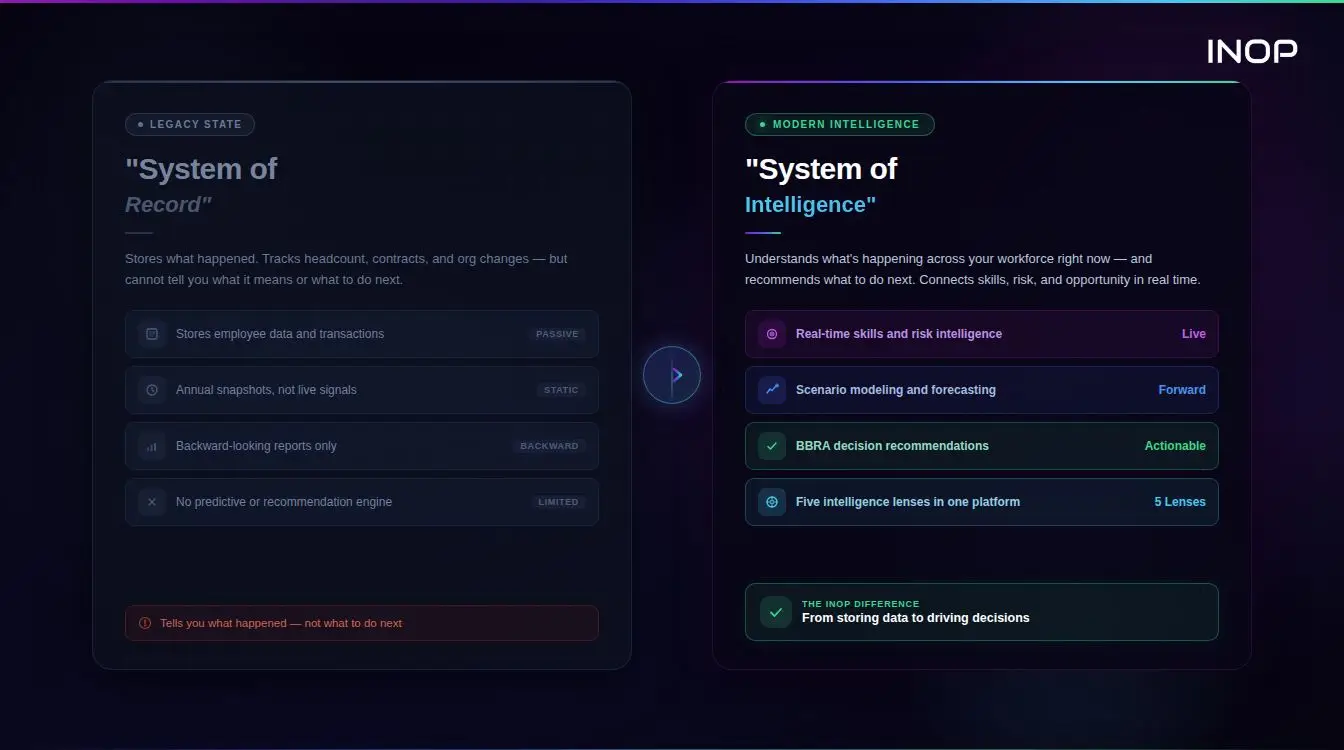
Deciding what to automate and what to do with the freed capacity is not purely an HR operations question. INOP evaluates HR automation decisions through five intelligence lenses to connect them to the broader workforce picture.
| Lens | What It Evaluates in an HR Automation Decision |
|---|---|
| Strategy | Whether the reclaimed HR capacity is being redirected toward a specific strategic priority, not just reabsorbed into more administrative work |
| Finance | Whether the automation investment is tied to a business metric finance recognizes, like cost per hire or compliance exposure, not just time saved |
| People | Whether automating a given HR decision, not just a task, introduces bias or compliance risk that needs verification before deployment |
| Market | How the organization’s HR automation maturity compares to peers, given how unevenly adoption is currently spread across HR functions |
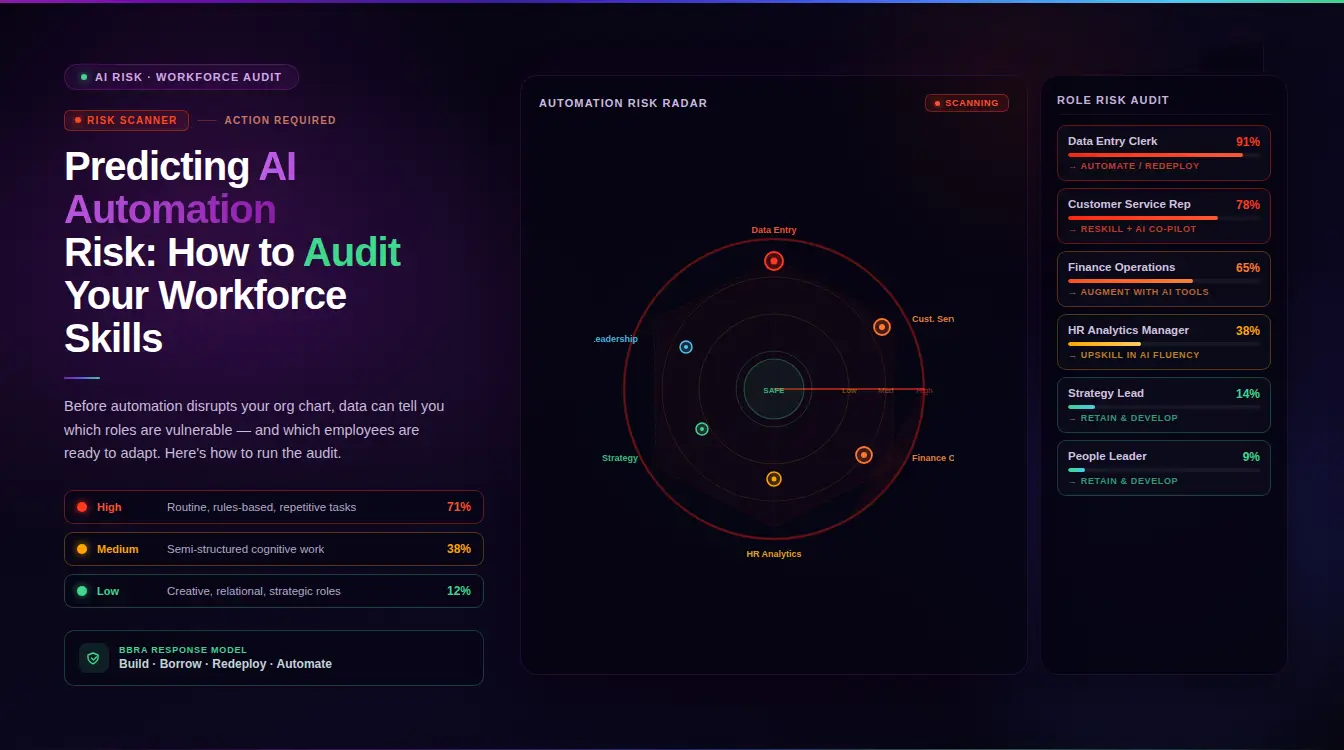
| AI and Automation | Which specific HR processes are genuinely ready for automation now versus which still require human judgment |
BBRA: Turning Reclaimed HR Capacity Into a Modeled Decision
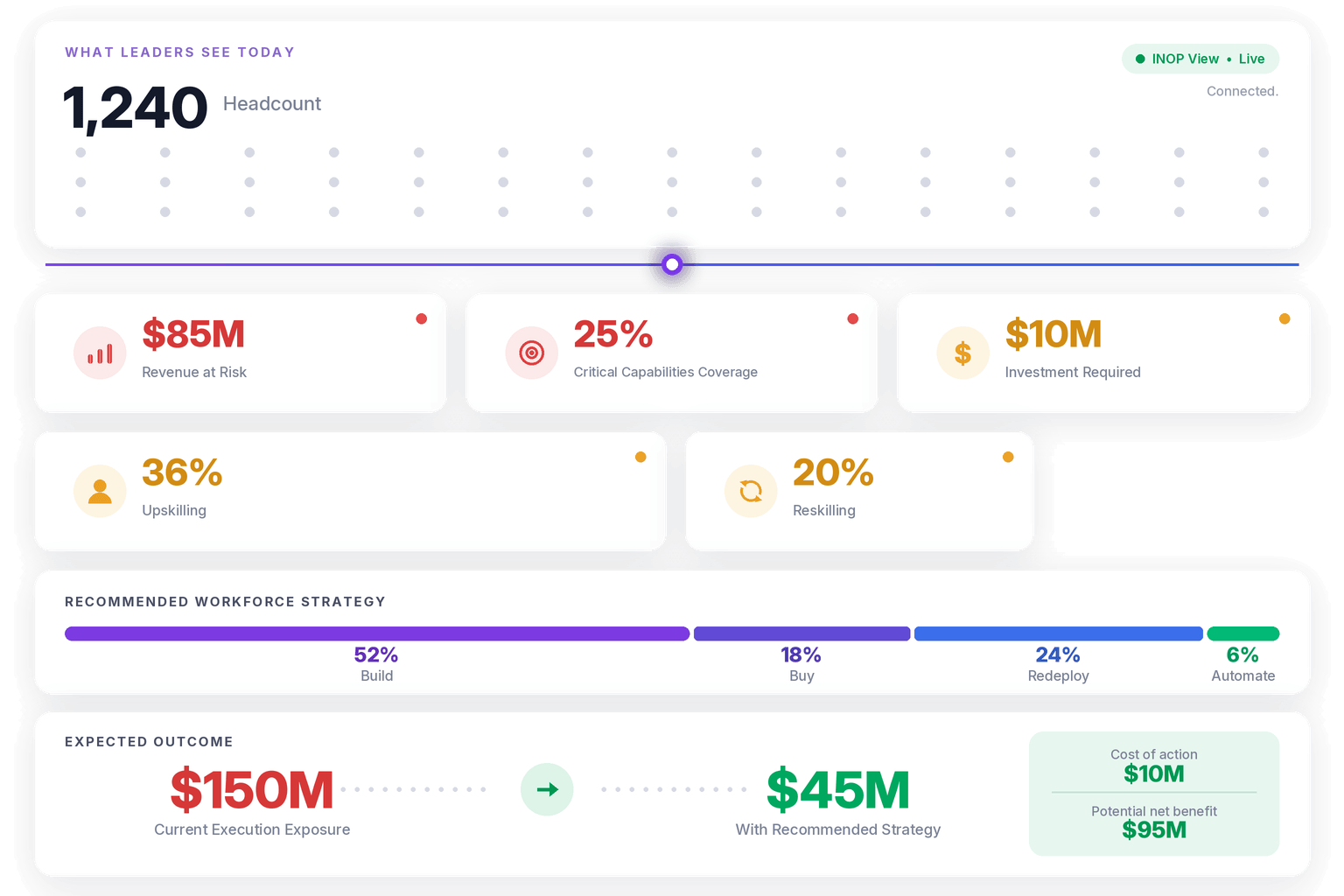
Once HR automation frees up real capacity, INOP’s proprietary BBRA framework, Build, Buy, Redeploy, and Automate, gives that capacity a modeled destination instead of leaving it to drift back into administrative work by default. BBRA compares all four pathways against financial tradeoffs across four time horizons: thirty days, one hundred eighty days, one year, and three years.
Applied to an HR team that has automated its recruiting coordination and onboarding paperwork, this means the freed hours get a deliberate destination: building internal capability in workforce analytics, redeploying a team member toward strategic planning work the function has never had bandwidth for, or, in some cases, right-sizing the team if the automated work represented the majority of the role. Verifying that the reclaimed time is actually producing this kind of strategic output, rather than assuming it automatically will, connects directly to the same discipline covered in INOP’s guide on AI workforce impact measurement and why self-reported productivity gains consistently outpace what verified data confirms.
HR Automation for Private Equity Operating Partners
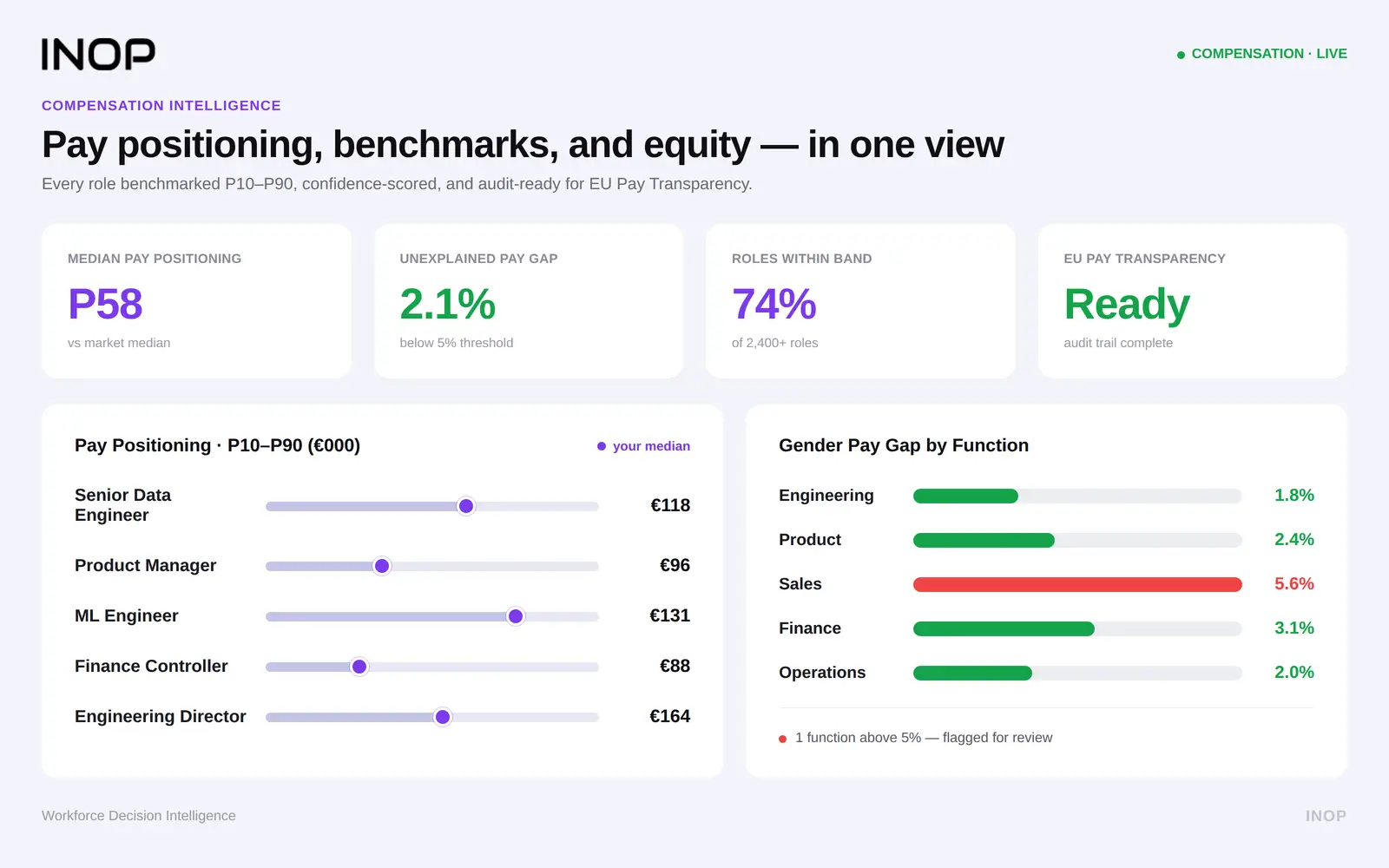
Inside a portfolio company, HR automation claims are easy to overstate and hard to verify without asking the right question. A company reporting HR automation savings is only reporting something meaningful if that claim is tied to a business metric, not just a vague reference to time saved, and if it accounts for what the freed HR capacity is actually being used for. Standardizing this evaluation across a portfolio through INOP’s strategic workforce planning platform gives operating partners a consistent way to check whether HR automation investment is translating into strategic capability or simply reducing headcount without a plan behind it. Where automation reshapes what an HR role actually requires, INOP’s compensation analytics platform connects that shift directly into pay benchmarking, since a role redesigned around higher-value strategic work often carries a different market rate than the administrative version it replaced.
Common Mistakes in HR Automation
Automating without a prioritization method. Treating every HR process as equally worth automating spreads investment thin. High-volume, low-judgment tasks consistently deliver faster, more measurable returns than complex, judgment-heavy processes automated too early.
Measuring time saved instead of business impact. A program that only tracks hours saved will struggle to survive its next budget review. Tying automation investment to cost per hire, time to fill, or compliance exposure gives finance a metric it actually recognizes.
Automating decisions without bias verification. Screening, shortlisting, and promotion recommendations carry real legal exposure when automated without an audit process behind them, a gap that shows up specifically in the roughly 30 percent of AI HR deployments that have already surfaced bias issues in production.
Assuming freed capacity automatically becomes strategic work. Reclaimed hours drift back into administrative tasks by default unless there is a deliberate plan for redirecting them, which is exactly the gap BBRA is built to close.
Ignoring how HR automation connects to workforce data quality. Automated systems are only as reliable as the underlying data feeding them. INOP’s skills intelligence platform supports this by keeping the skills and role data behind HR automation decisions current and verified against external market signals, rather than left to drift out of date the way a static HRIS record often does.
Frequently Asked Questions
What are the best HR automation examples to start with?
Candidate sourcing and screening, interview scheduling, and onboarding workflows typically deliver the fastest, most measurable returns and carry the least judgment-related risk, which makes them a reasonable starting point among the ten examples covered above.
How do you measure the ROI of HR automation accurately?
Tie the automation investment to a business metric finance already tracks, such as cost per hire, time to fill, or compliance exposure reduction, rather than reporting only hours or tasks saved. Programs without this connection struggle to demonstrate real return even when they are genuinely saving time.
Is it risky to automate HR decisions like candidate screening?
Yes, more so than automating administrative tasks. Automated screening and shortlisting tools have surfaced bias issues in roughly 30 percent of deployments, which is why these use cases need audit and verification processes that simple workflow automation does not require.
What should happen to HR capacity freed up by automation?
It should be redirected deliberately toward higher-value work such as workforce planning, skills analysis, or succession strategy, modeled against the alternative of redeployment or right-sizing rather than assumed to become strategic work automatically.
How should private equity operating partners evaluate HR automation claims at a portfolio company?
By checking whether reported savings are tied to a specific business metric and whether there is a clear plan for the freed capacity, not just a general claim about time saved. Vague automation ROI claims are one of the easier things to overstate during diligence.
Ready to prioritize HR automation investment and see exactly where the reclaimed capacity should go? Book a demo and INOP will walk through the five-lens model and BBRA, live.