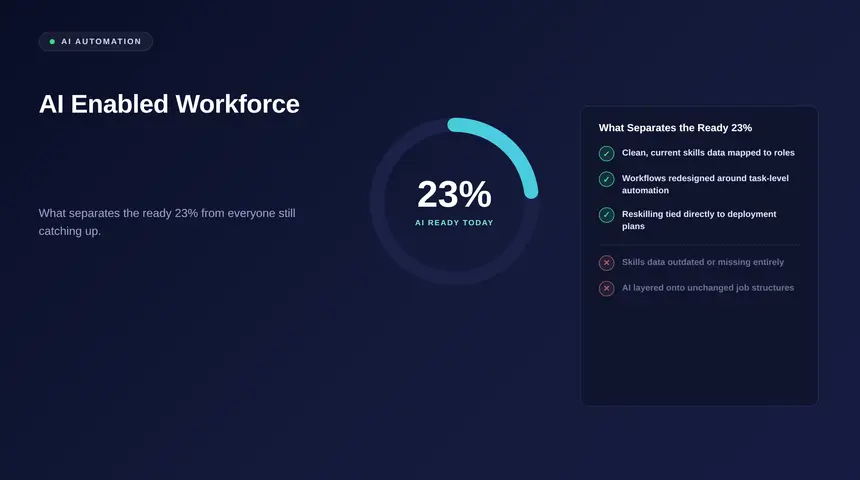
An AI enabled workforce is one where employees across every function have the skills, tools, and organizational support to use AI effectively as part of how work actually gets done, not just access to a chatbot license nobody was trained to use well. Adoption has moved fast. Readiness has not kept pace, and the gap between the two is now wide enough that only a small minority of organizations can credibly say their workforce is prepared for what they have already deployed.
This guide covers what an AI enabled workforce actually requires beyond tool access, why current data shows readiness declining even as adoption accelerates, what the small group of organizations getting this right are doing differently, and how to close the gap deliberately rather than hoping it closes on its own.
What an AI Enabled Workforce Actually Means
Building an AI enabled workforce means embedding AI tools, practices, and mindsets into every level of the organization so employees can use AI responsibly, strategically, and in ways that produce real behavior change, not just increased tool usage. Adoption alone does not get an organization there. Roughly 50 percent of United States employees now use AI at work at least a few times a year, and 88 percent of organizations report regular AI use in at least one business function, up from 78 percent the year before. Those adoption numbers, on their own, say nothing about whether that usage is skilled, governed, or actually changing outcomes.
The World Economic Forum frames the shift around five foundational pillars, Vision, Skills, Technology, Process, and Culture, applied differently across industries but consistently requiring all five to move together rather than treating any one of them, technology deployment especially, as sufficient on its own. That five-pillar structure is a useful sanity check for any organization that has invested heavily in the Technology pillar while leaving Skills, Process, and Culture to catch up on their own timeline, since the pillars left behind are usually the ones that determine whether the technology investment actually pays off.
The Readiness Gap Current Data Keeps Confirming
The gap between AI deployment and workforce readiness is not just wide. It is getting wider even as adoption accelerates. Only 23 percent of business leaders now believe their workforce is fully prepared for AI, a decline of six percentage points from the year before, and nearly four in five leaders agree that the pace of AI development is outstripping their organization’s workforce, governance, and operating models. That decline is happening while worldwide AI spending is forecast to reach 2.52 trillion dollars in 2026, a 44 percent year-over-year increase, according to the same research, which means capital is flowing into tools far faster than organizations are building the human capability to use them well.
What the Organizations Getting This Right Do Differently
Kyndryl’s research identifies a specific cohort, roughly 9 percent of surveyed organizations, that it calls Pacesetters, and the pattern separating them from everyone else is instructive.
Simultaneous Change, Not Sequential Rollout
Pacesetters combine role redesign, structured change management, governance guardrails, and workforce investment simultaneously, rather than sequencing them, deploy the technology first, figure out training later, governance whenever there is time. This simultaneous approach is precisely what most organizations get backward, treating workforce enablement as a follow-up project rather than a parallel track running alongside deployment from day one.
Governance as a Trust Multiplier, Not a Blocker
Organizations with stronger governance frameworks report higher employee confidence in AI and are significantly more likely to achieve transformative business outcomes from it, according to the same Kyndryl research, and Pacesetters specifically are roughly twice as likely to have fully implemented AI governance across every dimension the research tracks. Only 27 percent of all organizations use registries and monitoring capabilities across their AI systems, which means most enterprises are effectively running blind on auditability while still expecting employees to trust and adopt the tools deployed on top of that ungoverned foundation.
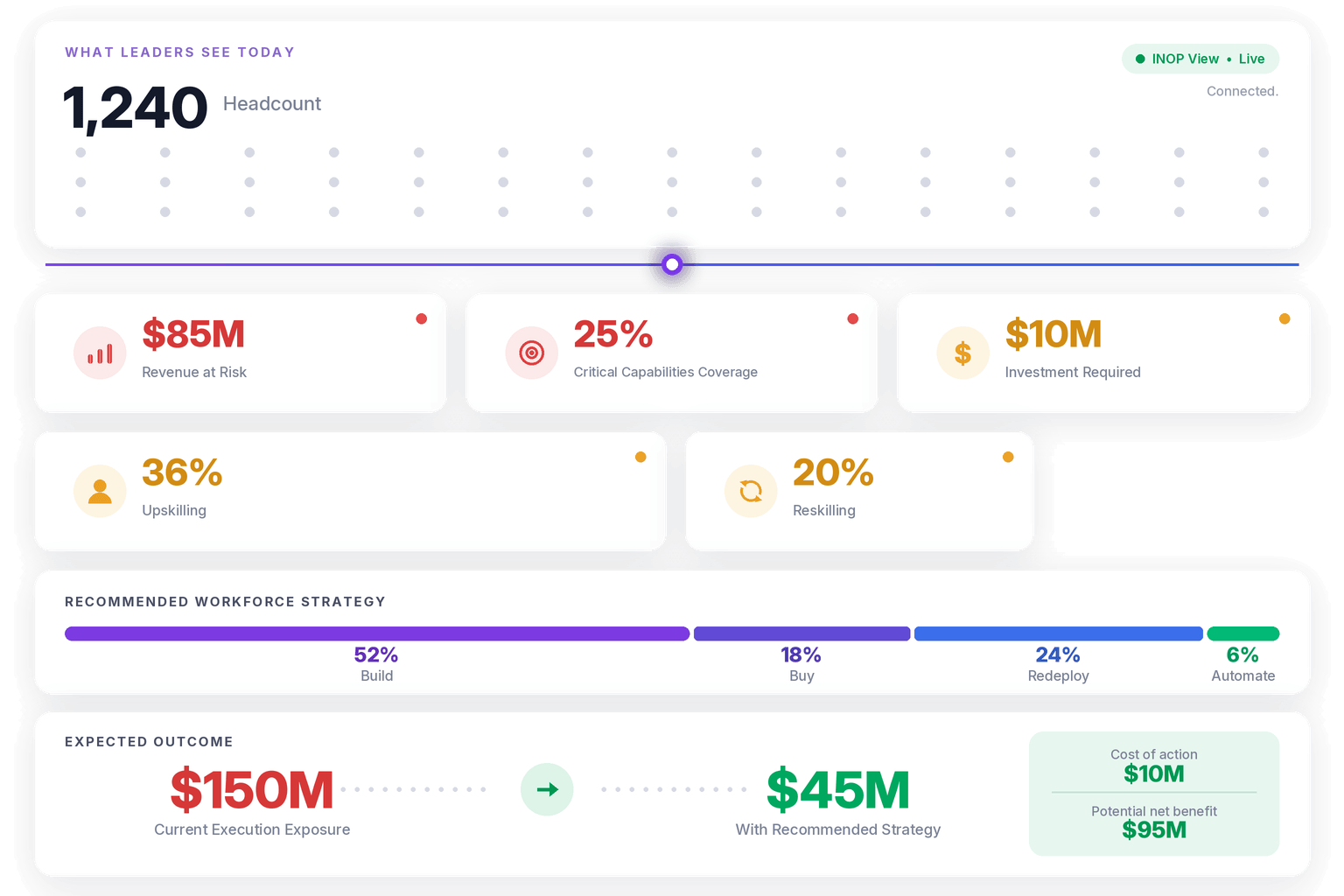
See how INOP scores AI enablement readiness across your workforce, function by function. Book a demo to walk through a live readiness view for your organization.
The Four Readiness Zones Most Organizations Fall Into
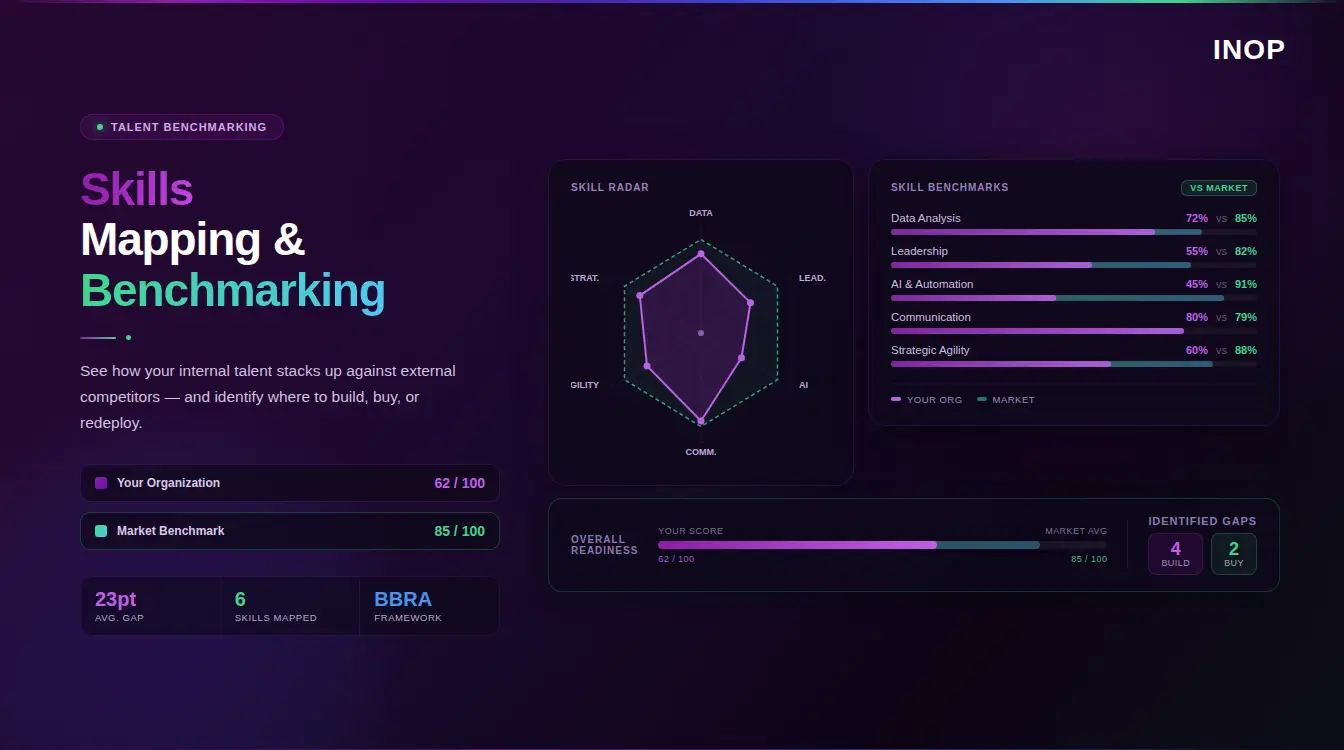
Individual and organizational readiness do not always move together, and treating them as a single combined score hides a distinction worth understanding. Microsoft’s 2026 Work Trend Index maps respondents across two dimensions, individual readiness to work with AI and organizational readiness to support that work, producing five distinct zones, according to Microsoft’s 2026 Work Trend Index research. Only 19 percent land in the Frontier zone, high on both dimensions. Ten percent sit in Blocked Agency, individually ready but held back by an organization that has not caught up, and 5 percent sit in the reverse position, an organization ready to support AI use with individuals who are not yet there. Sixteen percent are Stalled on both dimensions, and the largest group, half of all respondents, sits in an Emergent Zone still finding its footing. This matters for enablement strategy specifically because an organization stuck with a large Blocked Agency population needs a very different intervention, removing organizational friction, than one with a large Stalled population, which needs individual capability building first. INOP’s skills intelligence platform supports this diagnosis directly by mapping verified skill and capability data against external labor market signals, so an organization can tell which readiness zone a given team actually sits in rather than guessing from adoption numbers alone.
INOP’s Five Intelligence Lenses Applied to AI Enablement
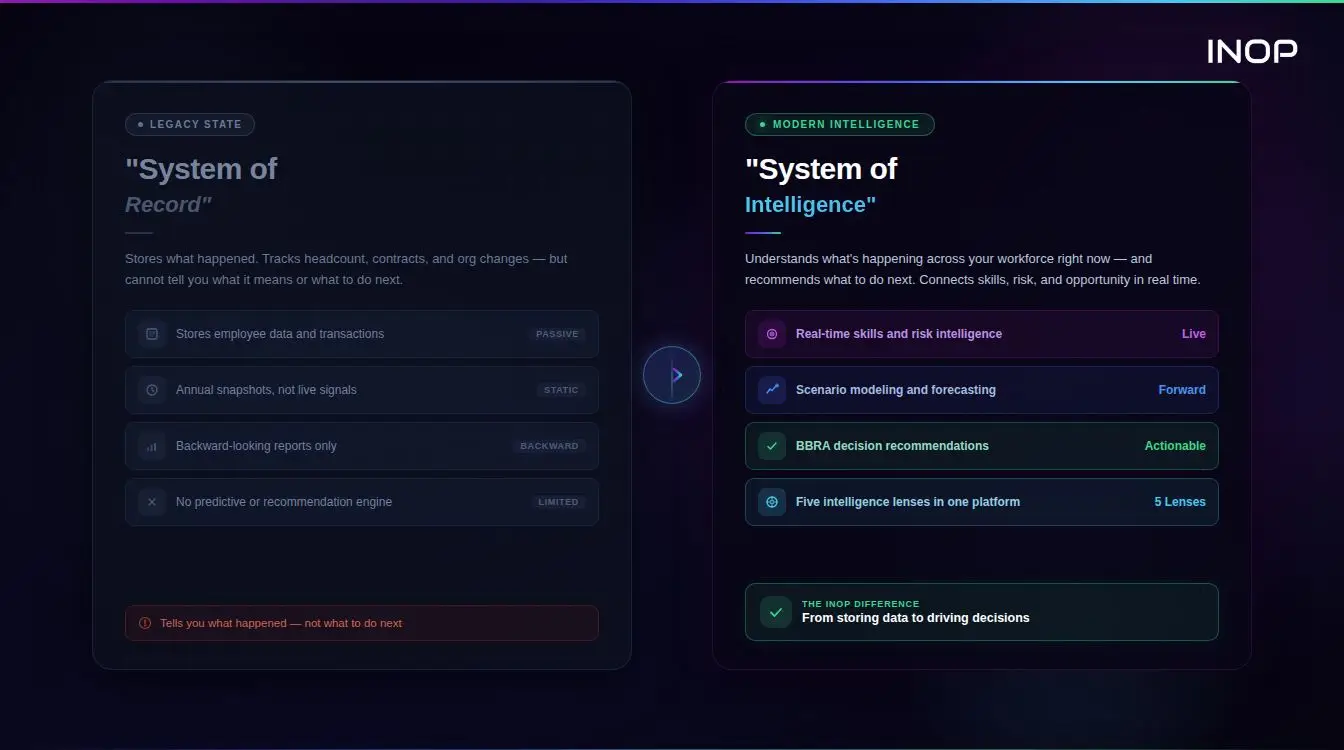
Building an AI enabled workforce is not purely a training question, and treating it as one is part of why so many enablement programs stall. INOP evaluates AI enablement across five intelligence lenses to keep the effort connected to the full picture.
| Lens | What It Evaluates in AI Enablement |
|---|---|
| Strategy | Whether AI enablement investment is concentrated where it supports a specific business priority, not spread evenly regardless of impact |
| Finance | Whether enablement spend is tracked against a real return, since mature programs report meaningfully higher ROI than ad hoc ones |
| People | Which employees and functions sit in which readiness zone, since a single enablement approach will not fit both a Stalled team and a Blocked Agency team |
| Market | How the organization’s AI enablement maturity compares externally, given how unevenly readiness is currently distributed across companies |
| AI and Automation | Which tasks genuinely benefit from AI-enabled employees versus which are better served by direct automation instead |
BBRA: Turning an AI Enablement Gap Into a Modeled Plan
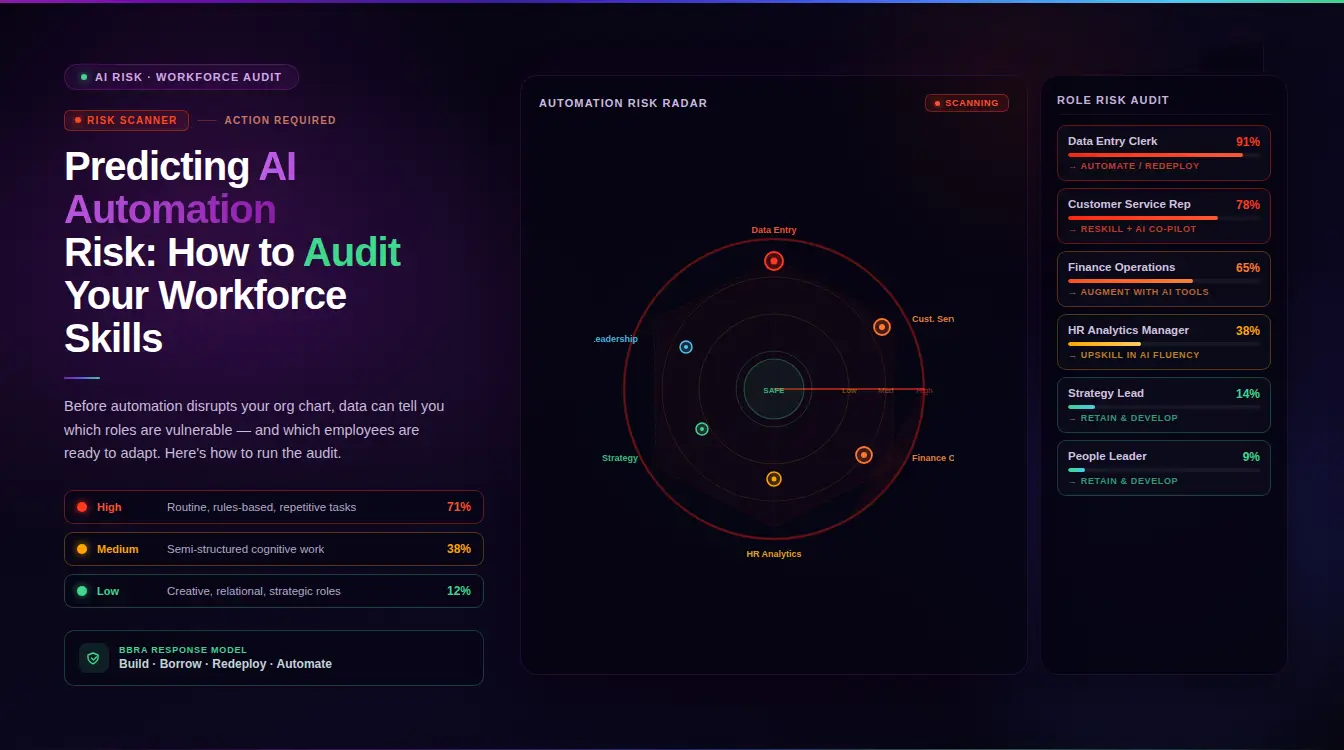
Once a readiness gap is identified in a specific function or team, INOP’s proprietary BBRA framework, Build, Buy, Redeploy, and Automate, gives that gap a modeled response instead of a generic training rollout. BBRA compares all four pathways against financial tradeoffs across four time horizons: thirty days, one hundred eighty days, one year, and three years.
Applied to an AI enablement gap, this means a team stuck in the Stalled zone does not automatically get the same response as a team in Blocked Agency. Building internal AI fluency through targeted training might close the first gap fastest. Redeploying an AI-fluent employee to lead by example within a stalled team might work faster than a formal program. Removing organizational friction, updating tooling access or governance approval processes, might be the actual fix for a Blocked Agency team whose individuals are already ready. Organizations with mature workforce AI enablement report 3.8 times higher ROI on AI investment and 67 percent faster deployment cycles than organizations without it, a gap that depends entirely on matching the response to the specific readiness gap rather than applying the same generic fix everywhere.
AI Enabled Workforce for Private Equity Operating Partners
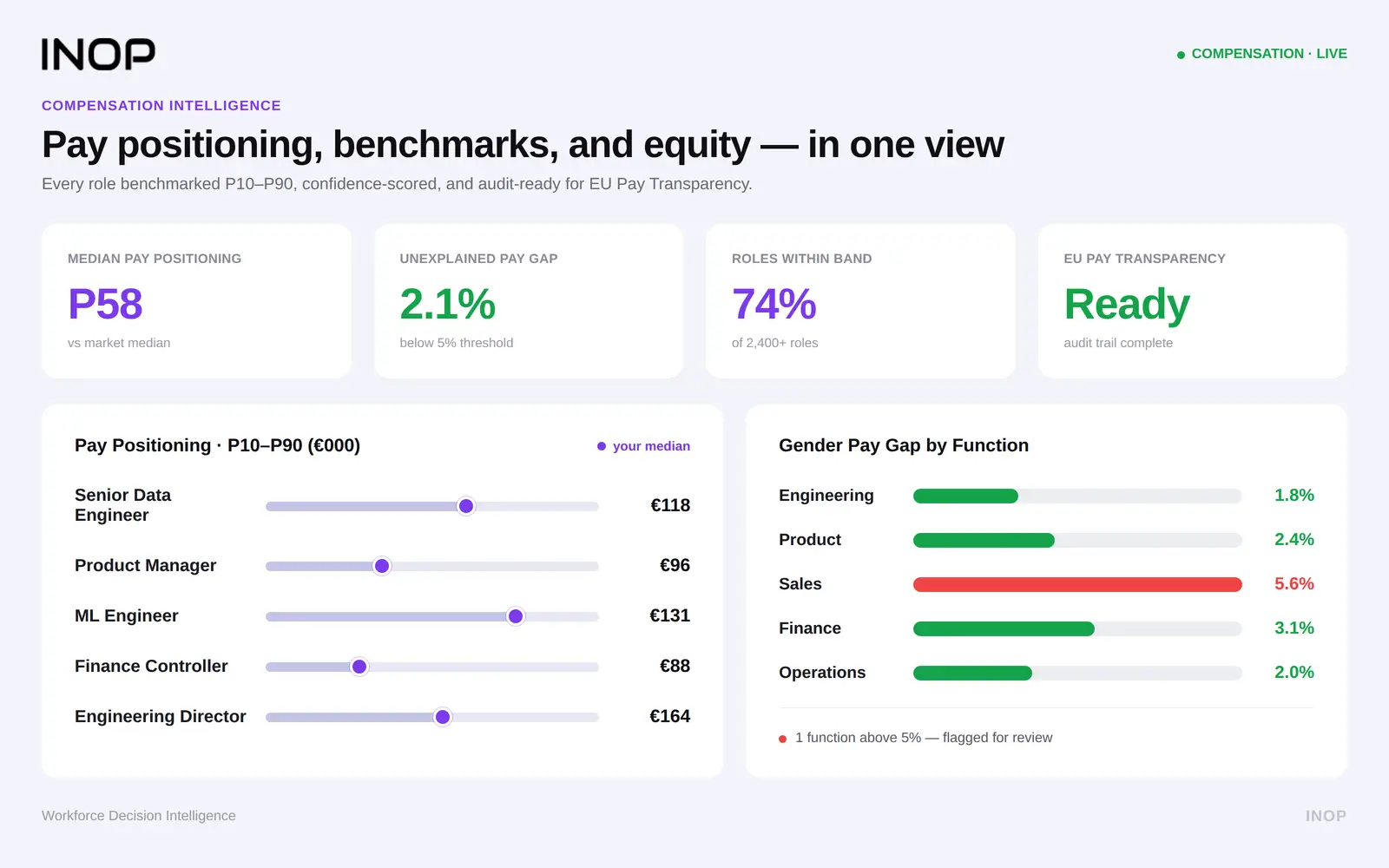
Inside a portfolio company, an AI enablement claim deserves the same scrutiny as any other transformation metric during diligence or a hundred-day plan. A company reporting strong AI adoption numbers, high tool usage, broad rollout, without a corresponding governance framework or readiness measurement is very likely one of the roughly 77 percent of organizations current data shows are not actually prepared for what they have deployed. Standardizing this evaluation across a portfolio through INOP’s strategic workforce planning platform gives operating partners a consistent way to check whether AI enablement is genuinely maturing across assets or simply reflected in tool licenses purchased. Where AI enablement surfaces employees with verified, in-demand AI fluency, INOP’s compensation analytics platform connects that finding directly into pay benchmarking, since AI-fluent talent increasingly commands a market premium that a generic workforce plan will not account for.
Common Mistakes in Building an AI Enabled Workforce
Treating adoption as evidence of readiness. High tool usage numbers say nothing about whether that usage is skilled, governed, or connected to a measurable outcome. Readiness has to be measured separately from adoption, not inferred from it.
Sequencing deployment before enablement. Rolling out AI tools first and treating training and governance as a follow-up project is the reverse of what the organizations getting this right actually do. Pacesetter organizations run all three simultaneously from the start.
Treating governance as a blocker rather than a trust builder. Organizations with weaker governance see lower employee confidence in AI, not more flexibility. Skipping governance to move faster tends to slow adoption down rather than speed it up.
Applying one enablement program to every team regardless of readiness zone. A team that is individually ready but organizationally blocked needs a different intervention than a team that needs foundational capability building first. INOP’s guidance on AI driven upskilling covers how to target that capability building at the specific gap rather than deploying the same generic program everywhere.
Ignoring the bias risk that comes with uneven AI fluency. As some employees become significantly more AI-capable than others, the organization risks over-trusting recommendations from whichever tools or people appear most confident, a pattern covered in more depth in INOP’s guide on AI automation bias and why it distorts workforce decisions.
Frequently Asked Questions
What is the difference between AI adoption and an AI enabled workforce?
AI adoption measures how many employees use AI tools. An AI enabled workforce requires that usage to be skilled, governed, and connected to real behavior change and measurable outcomes, which is why adoption rates and readiness rates are currently moving in opposite directions.
Why is workforce AI readiness declining even as adoption increases?
Because most organizations are investing in tools and infrastructure faster than they are investing in training, governance, and role redesign. Capital spending on AI is accelerating sharply while the human enablement side of the equation lags behind it.
What do organizations with high AI enablement maturity do differently?
They pursue role redesign, structured change management, governance, and workforce investment simultaneously rather than sequentially, and they build governance frameworks that increase employee trust rather than treating governance as friction to minimize.
How should an organization prioritize AI enablement across different teams?
By identifying which readiness zone each team actually sits in, individually ready but organizationally blocked, organizationally ready but individually unprepared, or stalled on both dimensions, since each zone calls for a different intervention rather than one standardized program.
How should private equity operating partners evaluate AI enablement at a portfolio company?
By checking for governance maturity and readiness measurement alongside adoption numbers, not adoption alone. High tool usage without governance or measured readiness is a weak signal that likely reflects the majority of organizations current data shows are unprepared, not genuine enablement.
Ready to see where your workforce actually sits on AI readiness, function by function? Book a demo and INOP will walk through live readiness scoring and BBRA, together.