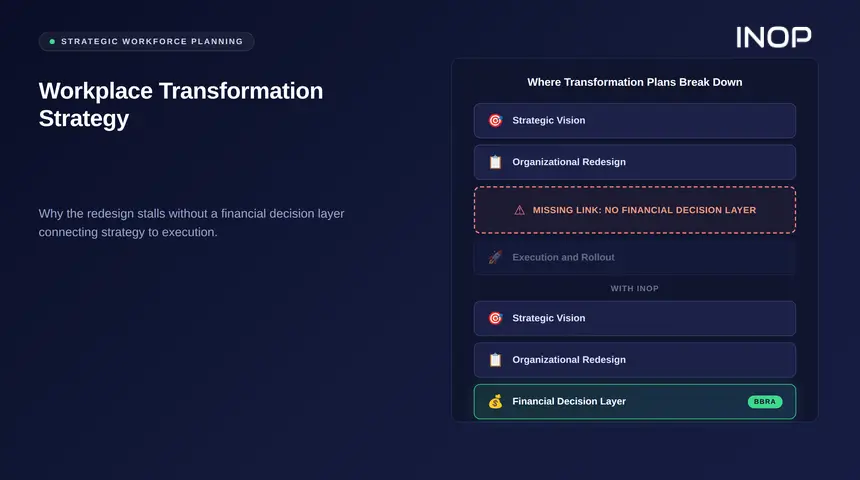
A workplace transformation strategy is an enterprise-wide approach to redesigning how work gets done across people, structure, technology, and process, aligning the operating model to where the business is actually headed rather than where it happened to land. Most organizations can describe this ambition clearly. Far fewer can point to a modeled financial comparison behind any specific redesign decision, which is exactly why so many transformation strategies produce a thorough diagnosis and a much thinner follow-through.
This guide covers what a workplace transformation strategy needs to include, why the redesign phase is where most efforts quietly stall, and the financial decision layer, comparing real response options against real cost and time tradeoffs, that most transformation frameworks describe in principle and rarely build in practice.
What a Workplace Transformation Strategy Actually Requires
A workplace transformation strategy has to connect four things that most organizations plan separately: the work itself, who does it and with what structure, the technology that enables it, and the skills required to deliver it. Treating any one of these in isolation, redesigning technology without touching structure, or restructuring without checking whether the workforce can actually staff the new design, produces a plan that looks complete on a slide and breaks the first time it meets execution.
Why So Many Workplace Transformation Efforts Quietly Fail
The failure pattern is well documented and remarkably consistent. Of organizations that made layoffs on the promise of AI-driven cost savings, 32 percent had to rehire staff because those savings never materialized. That number lines up with broader research on transformation failure: more than 80 percent of AI-related projects fail to reach durable production value, and 57 percent of infrastructure and operations AI failures trace directly back to unrealistic expectations set at the outset. The same research found that organizations defining quantified success metrics before a project is approved achieve a 54 percent success rate, compared with just 12 percent for those that do not, a gap large enough to function as a filter on which redesign decisions are worth funding in the first place. Nearly 90 percent of organizations report regular AI use in at least one business function, yet only a small fraction consider their deployment mature, a gap between activity and actual readiness that shows up in workplace transformation efforts as directly as anywhere else.
The Five Dimensions a Workplace Transformation Strategy Has to Cover
A durable strategy has to touch five connected dimensions rather than treating any one of them as sufficient on its own.
Work and Organizational Structure
Transformation has to start below the job title, at the level of what people actually do, since roles rarely map cleanly onto the work a business now needs performed. Understanding work at this granularity is what makes it possible to redesign structure, reporting lines, decision rights, and spans of control around actual value creation rather than around a chart that has not changed in years.
Technology and Governance
AI and digital tools should support a clearly defined operating model rather than define the strategy on their own. Boston Consulting Group’s research across its case work puts a number on this balance directly: only about 10 percent of AI-driven value comes from the algorithms themselves and another 20 percent from the underlying technology, while the remaining 70 percent comes from the workforce and process changes built around it. A transformation strategy that leads with technology procurement is investing heavily in the smaller share of what actually determines the outcome.
Workforce Capability
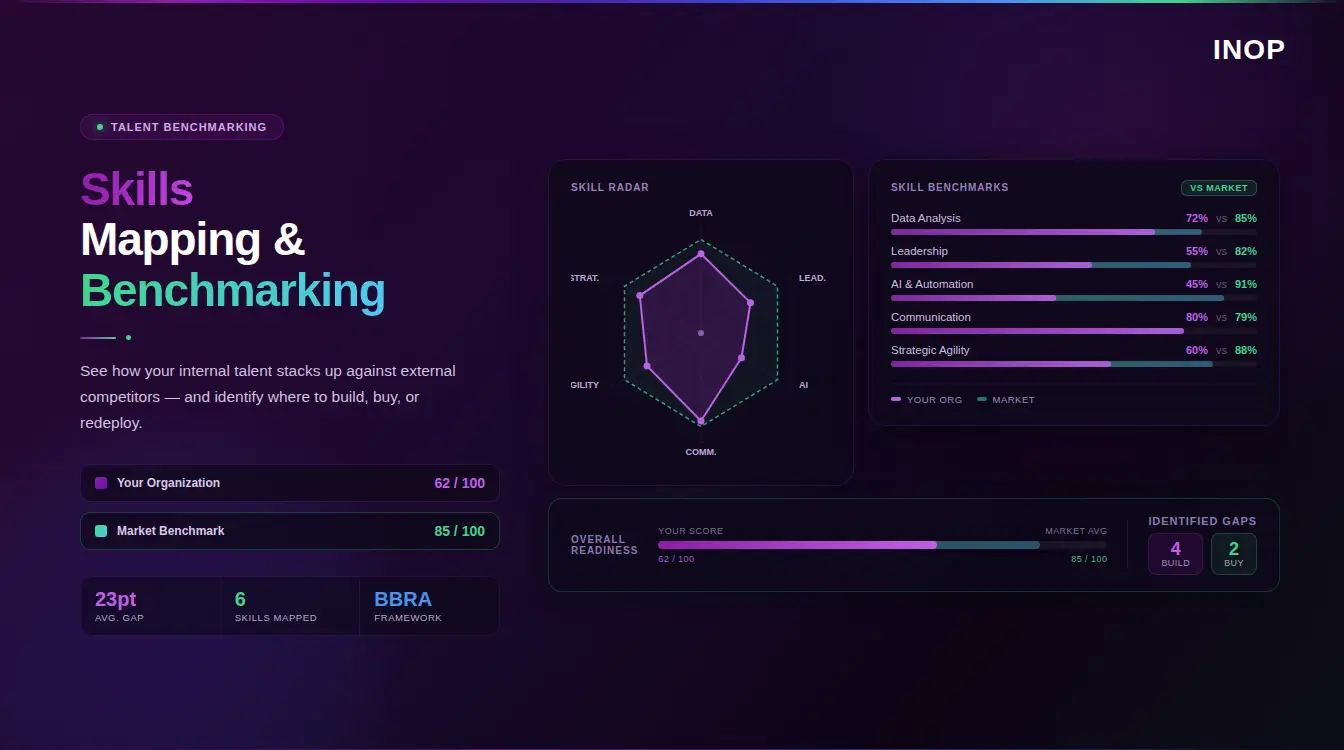
As work and structure change, the skills required to deliver it shift too, some roles expand, others narrow, and new combinations of capability become critical. A redesign that never checks whether the organization actually has, or can quickly build, the capability the new structure assumes is planning against a workforce that does not yet exist.
See how INOP connects your workplace transformation strategy to a modeled financial decision. Book a demo to walk through a live view for your organization.
The Missing Layer: Turning a Redesign Decision Into a Financial Model
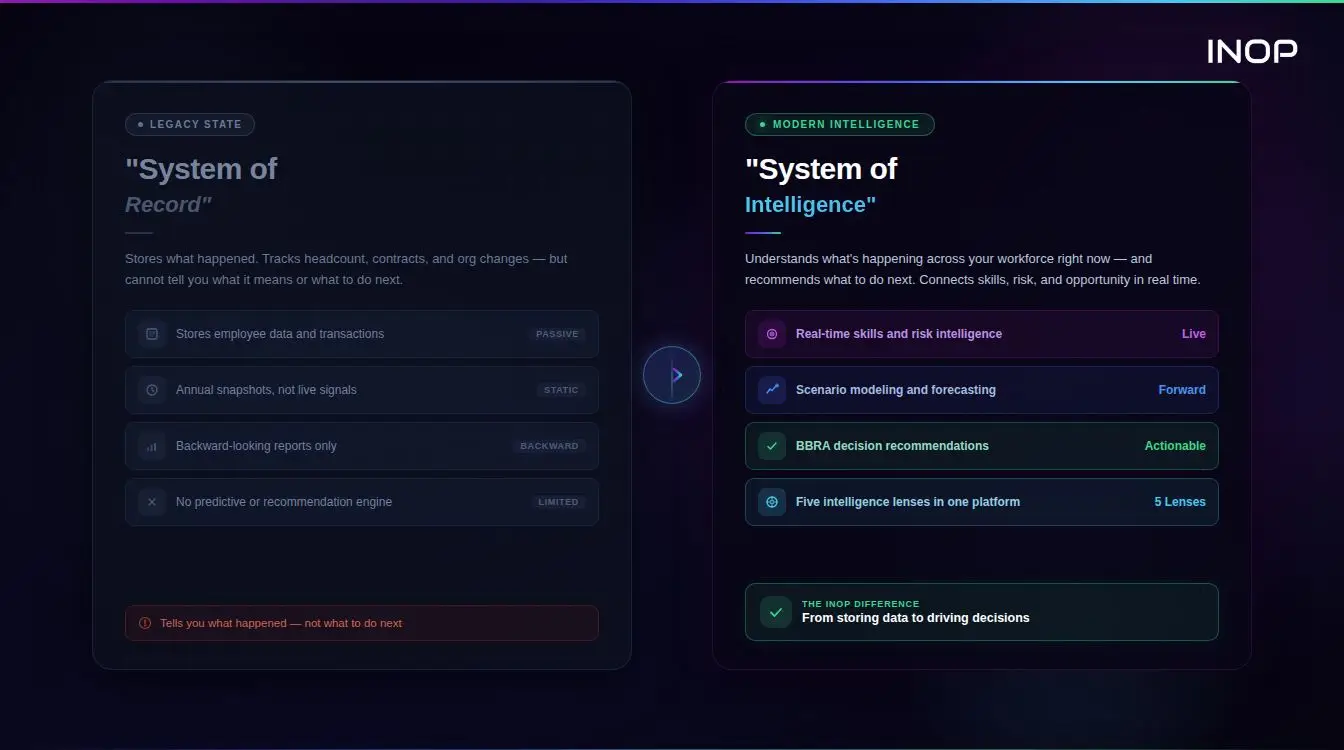
Most workplace transformation guidance describes a similar sequence: diagnose the current state, model future-state options, then pilot and scale. What that sequence typically skips is the specific mechanism for comparing future-state options against each other financially, which is precisely the gap between a well-diagnosed transformation and one that actually gets funded and executed. A finding that a function is overstaffed relative to its value creation, or understaffed relative to a new strategic priority, is not yet a decision. It becomes one only once it is run through a real comparison of what closing that gap costs through different paths and how long each path actually takes.
INOP’s Five Intelligence Lenses Applied to Workplace Transformation
Rather than treating work redesign, structure, technology, and capability as separate planning tracks, INOP evaluates every workplace transformation decision through five intelligence lenses simultaneously, so a change that looks right from one angle does not quietly create a problem from another.
| Lens | What It Evaluates in a Workplace Transformation Decision |
|---|---|
| Strategy | Whether a proposed redesign actually supports a defined business priority, not just a generic efficiency goal |
| Finance | The real cost, delay risk, and remediation exposure behind each redesign option, not just the projected savings |
| People | Whether the workforce can actually staff the new structure, and who is closest to the capability the redesign requires |
| Market | How the proposed structure and required skills compare to what is actually available externally |
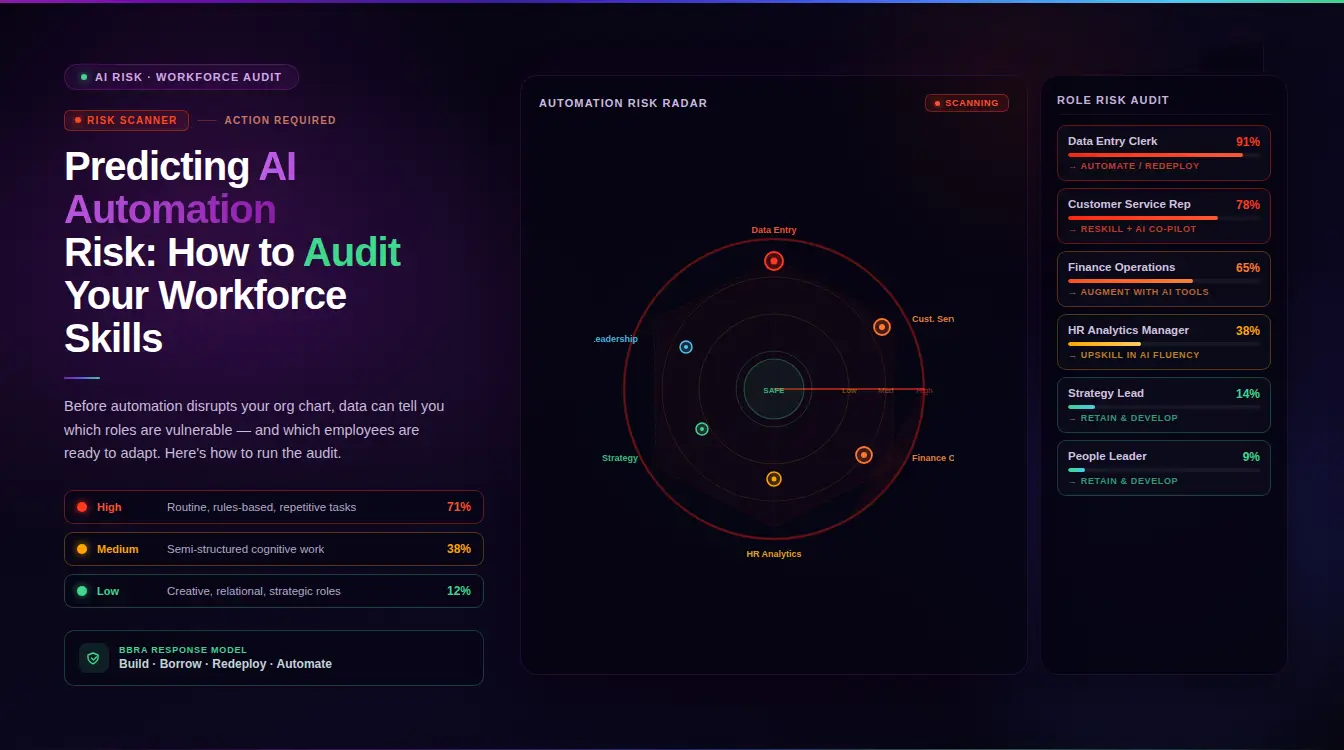
| AI and Automation | Which parts of the redesign genuinely warrant automation versus which still require human judgment, since over-trusting an automated redesign recommendation carries its own risk |
That last lens matters more than it might first appear. Leaders increasingly rely on AI tools to help model and recommend organizational redesign options, and accepting those recommendations without independent verification is its own failure mode, one covered in more depth in INOP’s guide on AI automation bias and why over-trusting an automated recommendation distorts workforce decisions.
BBRA: Modeling Every Workplace Transformation Decision
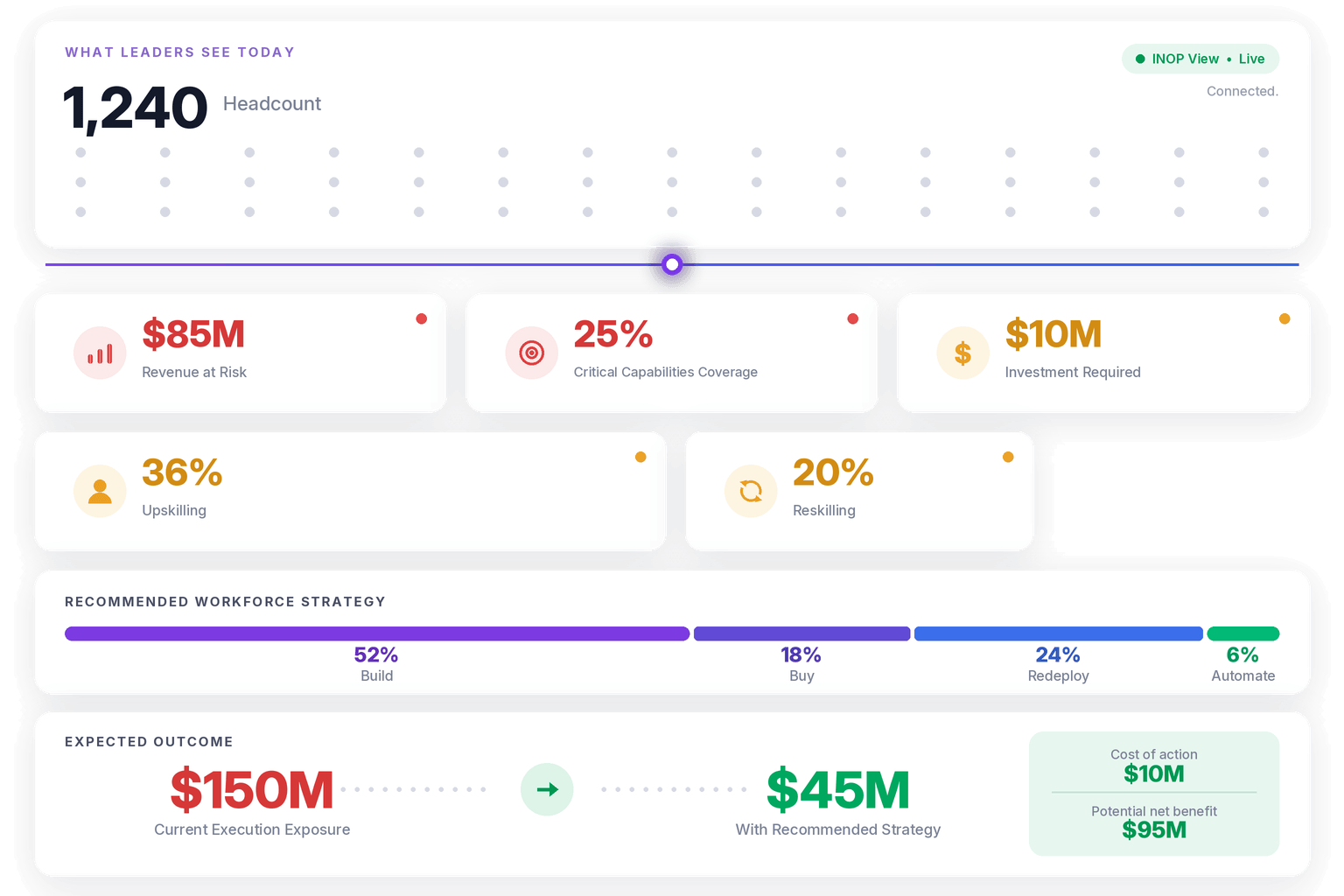
Once a redesign identifies a specific capability or structural gap, INOP’s proprietary BBRA framework, Build, Buy, Redeploy, and Automate, gives that gap the financial comparison most transformation strategies describe only in principle. BBRA models all four intervention pathways against financial tradeoffs across four time horizons: thirty days, one hundred eighty days, one year, and three years.
Applied to a redesign finding, this means a function identified as understaffed for a new priority does not default automatically to a hiring plan. It gets compared: would upskilling existing employees close the gap fastest, would redeploying talent from a lower-priority function work sooner, does the scale of the need justify external hiring given current market conditions, or does the underlying work make more sense to automate rather than staff at all. This is also where transformation claims deserve real scrutiny before they get reported as success: self-reported productivity gains from workforce and AI-driven change consistently run well ahead of what verified, firm-level data confirms, a gap covered in detail in INOP’s guide on AI workforce impact measurement, which is exactly why every BBRA-modeled decision gets tracked against real outcomes rather than assumed to have worked once implemented.
Workplace Transformation Strategy for Private Equity Operating Partners
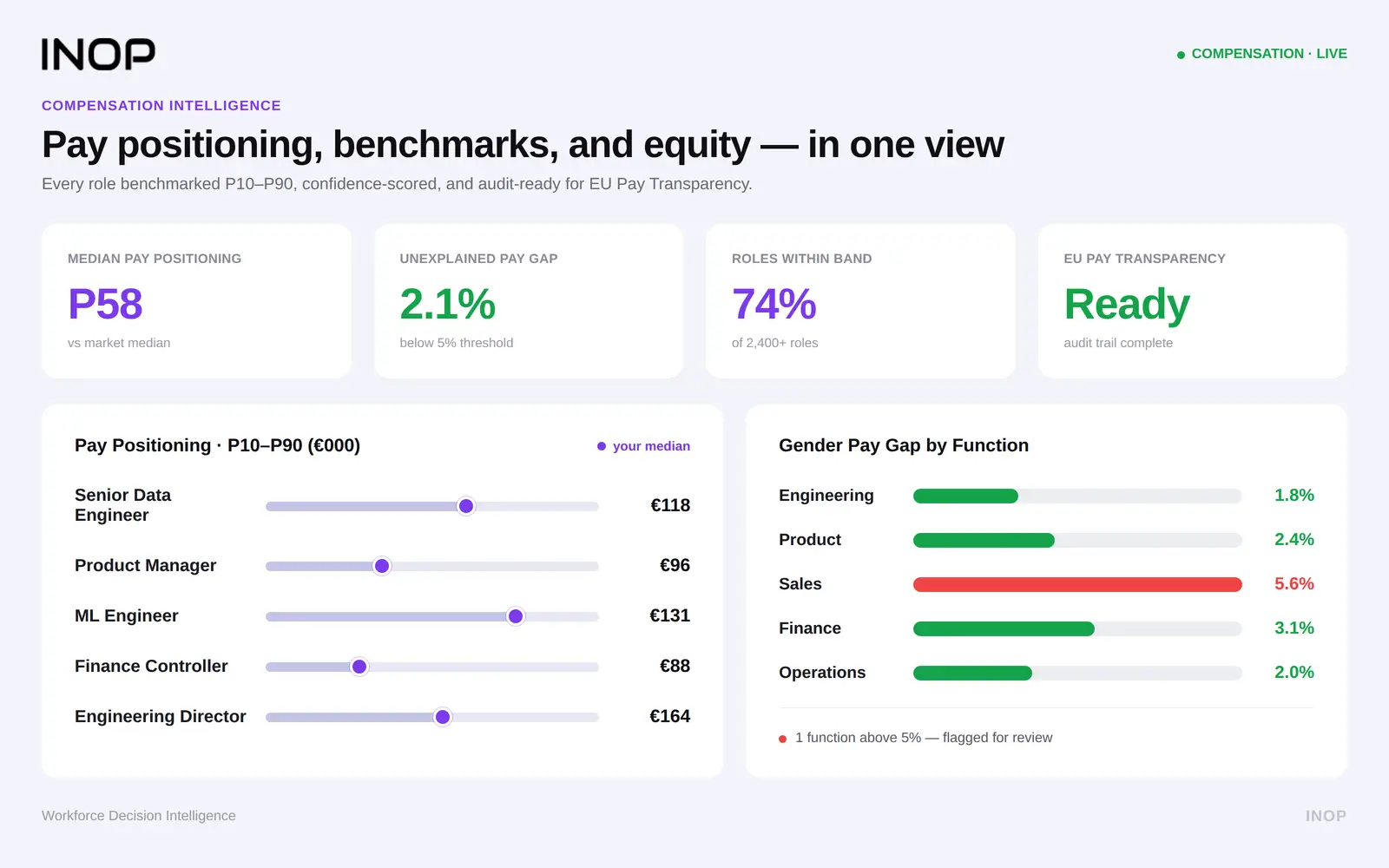
Inside a portfolio company, a workplace transformation strategy that looks thorough on paper, a clean diagnosis deck, a defined set of pillars, executive sponsorship named, can still be missing the one component that determines whether it survives contact with a hundred-day plan: a modeled financial comparison behind each proposed change. A redesign that recommends restructuring a function without comparing that option against redeployment, targeted upskilling, or automation is presenting a preference, not an analyzed decision. Standardizing this evaluation across a portfolio through INOP’s strategic workforce planning platform gives operating partners a consistent way to check whether a portfolio company’s transformation plan includes real financial modeling behind its redesign choices, rather than taking a well-produced deck at face value. Where a transformation plan surfaces roles carrying scarce, high-demand capability, INOP’s compensation analytics platform connects that finding directly into pay benchmarking, since a redesigned role often carries a different market rate than the one it replaced.
Common Mistakes in Workplace Transformation Strategy
Leading with technology instead of the work itself. Given that roughly 70 percent of transformation value comes from workforce and process changes rather than the underlying technology, a strategy that starts with tool selection is investing first in the smaller share of what actually determines the outcome.
Diagnosing thoroughly and stopping there. A clear picture of the current operating model is necessary and not sufficient. Without a financial comparison behind each proposed change, a well-documented diagnosis produces a report, not a funded transformation.
Treating the redesign as a one-time event. A structure declared finished and left untouched drifts out of alignment with the business it was built to serve. Workplace transformation functions best as an ongoing capability, revisited continuously as conditions shift, not a project with a defined end date.
Skipping quantified success metrics before approval. The gap between a 54 percent success rate with defined metrics and a 12 percent success rate without them is too large to leave to chance, and it applies to workplace transformation decisions as directly as it applies to any other AI-related initiative.
Redesigning structure without verifying the workforce can staff it. A new operating model that assumes capability the organization does not currently have, and has no modeled plan to acquire, is designing for a workforce that does not yet exist. INOP’s skills intelligence platform closes this gap by mapping verified skills data against external labor market signals, so a redesign is checked against real capability rather than assumption.
Frequently Asked Questions
What is the difference between workplace transformation strategy and workforce transformation?
Workplace transformation strategy focuses on how work happens, workflows, structure, governance, and technology. Workforce transformation focuses on who does the work, roles, skills, and capacity. The two are closely linked, since a change to one usually requires a corresponding change to the other.
Why do workplace transformation strategies often stall after diagnosis?
Because the diagnosis phase produces a clear, presentable deliverable while the harder step, financially comparing redesign options against each other before committing budget, gets skipped or left informal. Without that comparison, a well-documented plan rarely converts into funded, executed change.
How long should a workplace transformation strategy take to implement?
It depends heavily on scope, but the more useful framing is that workplace transformation works best as an ongoing capability rather than a single project with a fixed end date, revisited continuously as business priorities and market conditions shift.
What role should AI play in a workplace transformation strategy?
AI should support a clearly defined operating model rather than define the strategy on its own. Given that the majority of transformation value comes from workforce and process changes rather than the underlying technology, leading with AI tool selection tends to under-resource what actually drives the outcome.
How should private equity operating partners evaluate a portfolio company’s workplace transformation strategy?
By checking whether proposed redesign decisions include a real financial comparison against alternative pathways, not just a well-produced diagnosis. A thorough current-state assessment with no modeled comparison behind its recommendations is a plan half-finished.
Ready to see your workplace transformation strategy connected to a real financial model instead of a diagnosis deck? Book a demo and INOP will walk through the five-lens model and BBRA, live.