Most organisations agree on why competency mapping matters. The harder decision is how to do it. The methods of competency mapping range from structured interviews with top performers to surveys, observation, assessment centres and analysis of skills data, and each one answers a different question at a different cost.
Picking the wrong method can produce a framework that looks complete but cannot support decisions. A model built only on manager opinion, for example, may describe the roles you had three years ago rather than the work your strategy now needs.
This guide covers the main methods, what each one is good at, where each falls short, and how to combine them into a competency map that leaders can act on.
What Are the Methods of Competency Mapping?
The methods of competency mapping are the techniques used to identify which competencies a role needs and to assess how far people currently meet them. They fall into two groups. Identification methods define the competencies and proficiency levels a role requires. Assessment methods measure where individuals and teams stand against those requirements.
If you need a refresher on the core concept before choosing a method, INOP’s guide to competency mapping meaning explains the definition, the four types of competencies and the six-step mapping process.
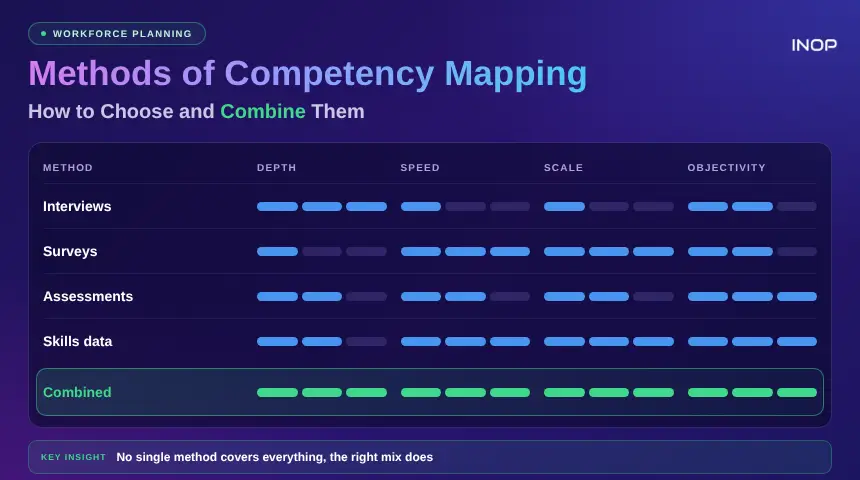
Most robust competency maps use several methods together. Identification methods set the standard, assessment methods measure against it, and data-driven methods keep the map current as roles change.
Which Methods Identify the Competencies a Role Needs?
Job and Task Analysis
Job and task analysis breaks a role down into the activities it involves, the conditions it operates in and the knowledge, skills and abilities those activities require. It is the most common starting point because it grounds the competency model in the work itself rather than in assumptions about the work.
Many organisations draw on external occupational data to speed this up. The O*NET Content Model organises occupational information into worker characteristics and requirements, such as skills and knowledge, alongside occupational requirements such as work activities and context. That structure gives teams a reference point when they define role requirements from scratch.
Best for: building a baseline model for a role or job family.
Limitation: task lists describe what people do today. They need a forward-looking input to reflect where the role is heading.
Behavioural Event Interviews
A behavioural event interview asks high performers to describe specific situations in detail: what happened, what they did, what they were thinking and what the outcome was. Analysts then code the transcripts to find the behaviours that separate top performers from typical ones.
Best for: identifying the behaviours behind superior performance, particularly in leadership and complex roles.
Limitation: interviews take time to run and code, and the method depends on choosing the right high performers in the first place.
Critical Incident Technique
The critical incident technique collects examples of behaviour that made a clear difference to an outcome, either positive or negative. John Flanagan set out the method in a 1954 paper in Psychological Bulletin, and it remains one of the foundations of competency research.
Managers, peers and role holders describe incidents where performance stood out. Analysts group the incidents into themes, which become candidate competencies and behavioural indicators.
Best for: surfacing the behaviours that matter most in high-stakes moments.
Limitation: people tend to remember unusual events, so routine but important behaviours can be missed.
Expert Panels and Focus Groups
Expert panels bring together subject matter experts, such as experienced role holders, managers and functional leaders, to define the competencies a role requires and agree the proficiency levels. Public sector practice follows the same pattern: the US Office of Personnel Management describes its competency modelling services as including focus groups, site visits and customised surveys.
Best for: fast consensus and buy-in from the people who will use the model.
Limitation: panels can reflect how the group sees the role rather than evidence about performance, so they work best combined with interview or data inputs.
Repertory Grid
The repertory grid technique asks managers to compare people or roles in sets of three and explain how two are alike and different from the third. The distinctions they draw reveal the criteria they use, often unconsciously, to judge effective performance.
Best for: making implicit performance criteria explicit.
Limitation: it needs a skilled facilitator, and results reflect the views of the managers involved.
Which Methods Assess Competencies Against the Map?
Questionnaires and Self-Assessments
Surveys ask employees and managers to rate proficiency against each competency. They scale across large populations at low cost and give a quick first signal of where gaps may sit.
Limitation: self-ratings tend to reflect confidence rather than capability, so treat them as a starting point rather than a final score.
360-Degree Feedback
Multi-rater feedback collects ratings from managers, peers, direct reports and the individual. Combining views reduces the bias of any single rater and gives a fuller picture of behavioural competencies such as collaboration and leadership.
Limitation: it is resource-intensive, and its quality depends on clear behavioural anchors for each proficiency level.
Direct Observation
Observers watch people perform their work and record the behaviours they see against the competency framework. Observation works well for roles with visible, repeatable tasks.
Limitation: people may act differently when observed, and the method is hard to scale across knowledge work.
Assessment Centres
Assessment centres combine several exercises, such as simulations, role plays, case studies and presentations, scored by trained assessors against defined competencies. They give a strong read on how people perform in realistic scenarios.
Best for: leadership and succession decisions where accuracy matters most.
Limitation: they are the most expensive and time-consuming method on this list.
Skills Data and Inference
Data-driven methods infer skills and proficiency from information the organisation already holds, such as role profiles, project records, learning history and work outputs, then compare it with external demand signals. Unlike the methods above, they can update continuously rather than once a year.
Best for: keeping competency maps current across large populations and spotting where demand for a skill is rising or falling.
Limitation: inferred data needs validation for high-stakes decisions, which is where the methods above still play a role.
How Do the Methods of Competency Mapping Compare?
| Method | Primary Use | Scale | Cost and Effort | Key Limitation |
|---|---|---|---|---|
| Job and task analysis | Identify | Medium | Medium | Describes current work, not future needs |
| Behavioural event interviews | Identify | Low | High | Time to run and code |
| Critical incident technique | Identify | Medium | Medium | Misses routine behaviours |
| Expert panels and focus groups | Identify | Medium | Low to medium | Reflects group opinion |
| Repertory grid | Identify | Low | Medium | Needs skilled facilitation |
| Questionnaires and self-assessments | Assess | High | Low | Measures confidence, not capability |
| 360-degree feedback | Assess | Medium | Medium to high | Depends on clear anchors |
| Direct observation | Assess | Low | Medium | Hard to scale for knowledge work |
| Assessment centres | Assess | Low | High | Most expensive option |
| Skills data and inference | Identify and assess | High | Low once set up | Needs validation for high-stakes use |
How Should You Choose Between Competency Mapping Methods?
Start with the decision the map needs to support, then choose the methods that give enough evidence for that decision at a reasonable cost.
- Building a model for a new or redesigned role: combine job and task analysis with an expert panel, then validate with behavioural event interviews or critical incidents.
- Assessing a large workforce: use skills data and inference as the base, add self-assessment and manager ratings, and reserve deeper methods for critical roles.
- Leadership and succession decisions: use 360-degree feedback and assessment centres, where the cost of a wrong call justifies the effort.
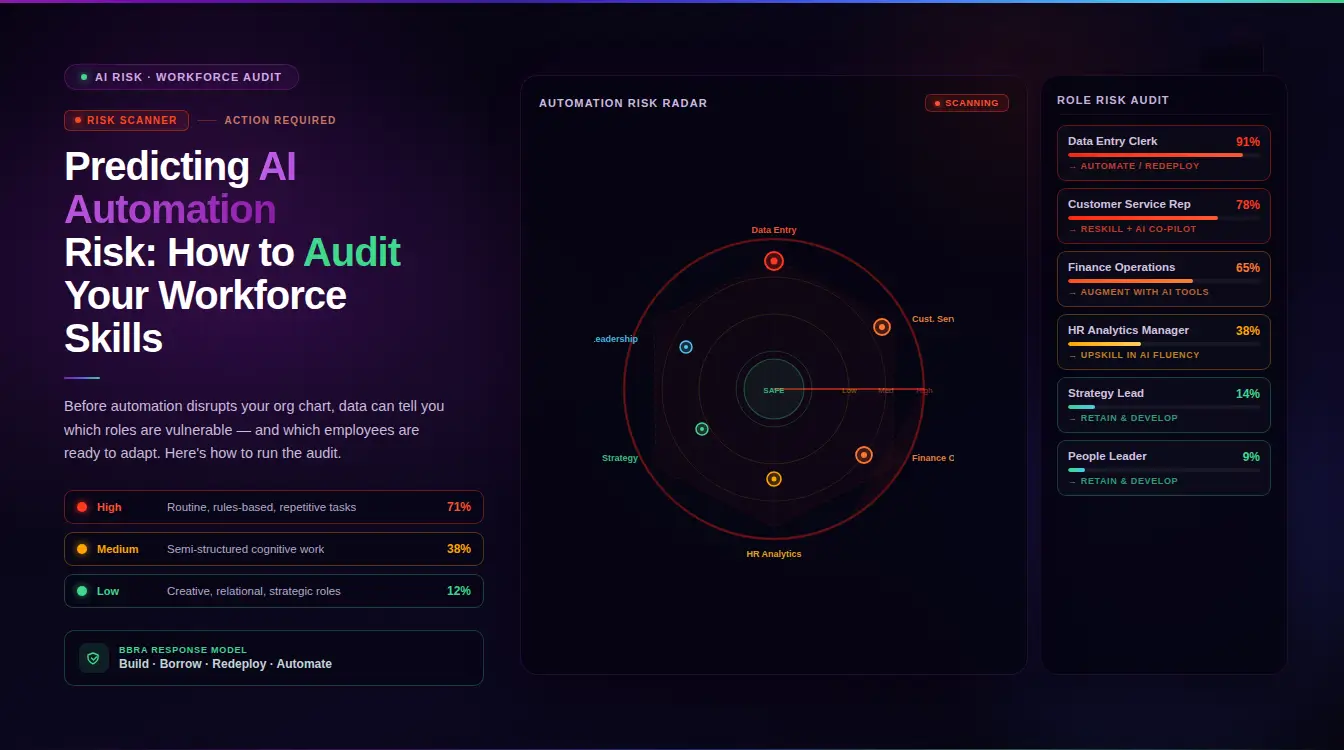
- Planning for AI and automation: pair task analysis with data on how each task is exposed to automation, so the map reflects how roles will change.
The pace of change makes the last point more pressing. The World Economic Forum’s Future of Jobs Report 2025 found that employers expect 39% of workers’ core skills to change by 2030. A competency map built once and reviewed annually will drift out of date between reviews.
Why Should Methods of Competency Mapping Be Combined?
Each method has a blind spot, and combining them closes the gaps. Interviews and critical incidents show what good performance looks like. Panels build agreement. Surveys and 360-degree feedback measure where people stand. Skills data keeps the picture current. Triangulating across sources also gives each score a level of confidence, so leaders know which findings are solid enough to act on.
AI is adding urgency to this. PwC’s 2026 Global AI Jobs Barometer found that jobs requiring specific AI skills grew 69%, compared with 9% for the overall job market, while employers placed more weight on judgement, creativity and leadership. A competency map needs methods that capture both technical skills and these human capabilities.
What Mistakes Should You Avoid When Mapping Competencies?
- Relying on one method. A single source carries its own bias and leaves gaps the other methods would catch.
- Mapping job titles instead of tasks. People with the same title often do different work and face different exposure to automation.
- Treating self-ratings as final. Use them as a signal, then verify with other evidence.
- Stopping at the map. A competency gap is only useful once you know what it costs and how to close it.
- Updating once a year. Skills demand moves faster than annual review cycles.
How Does INOP Turn Competency Mapping Into Strategic Decisions?
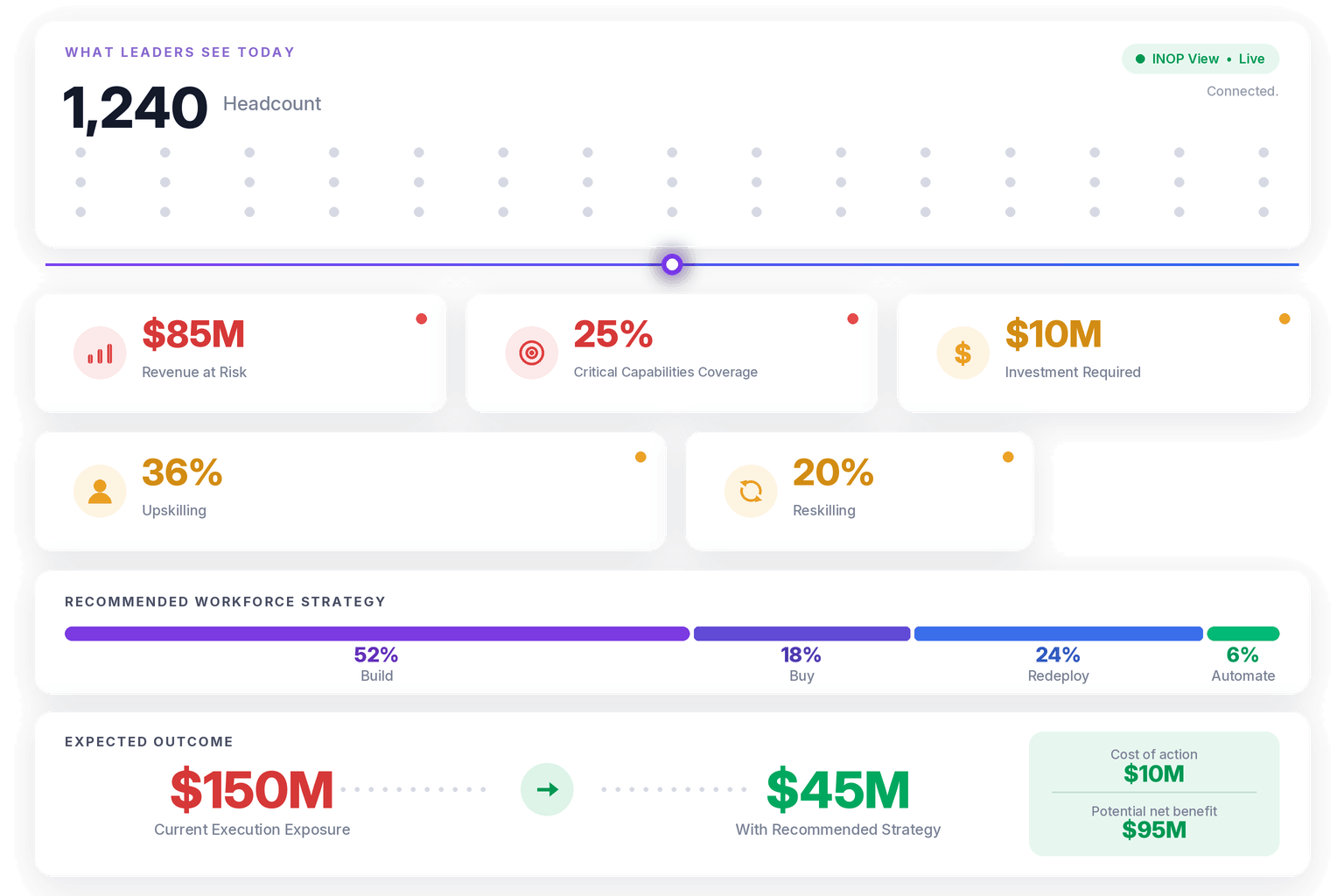
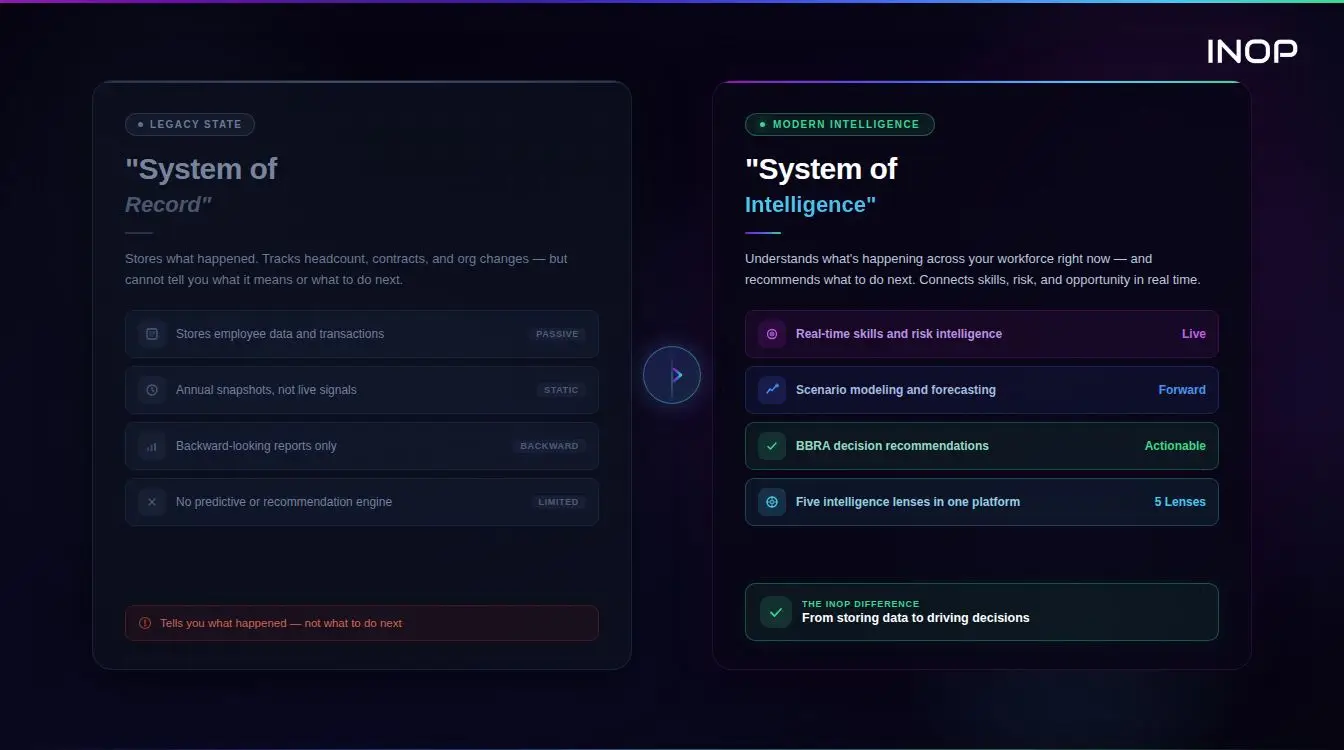
Competency mapping comes down to one question: does the organisation have the capabilities to execute its strategy today, and to stay ready as AI changes the work? INOP answers that question by connecting strategy, finance, people, market and AI data in one model. It shows which capabilities are in place, where the gaps and risks are, what those gaps cost if nothing changes, and the available options for addressing each gap.
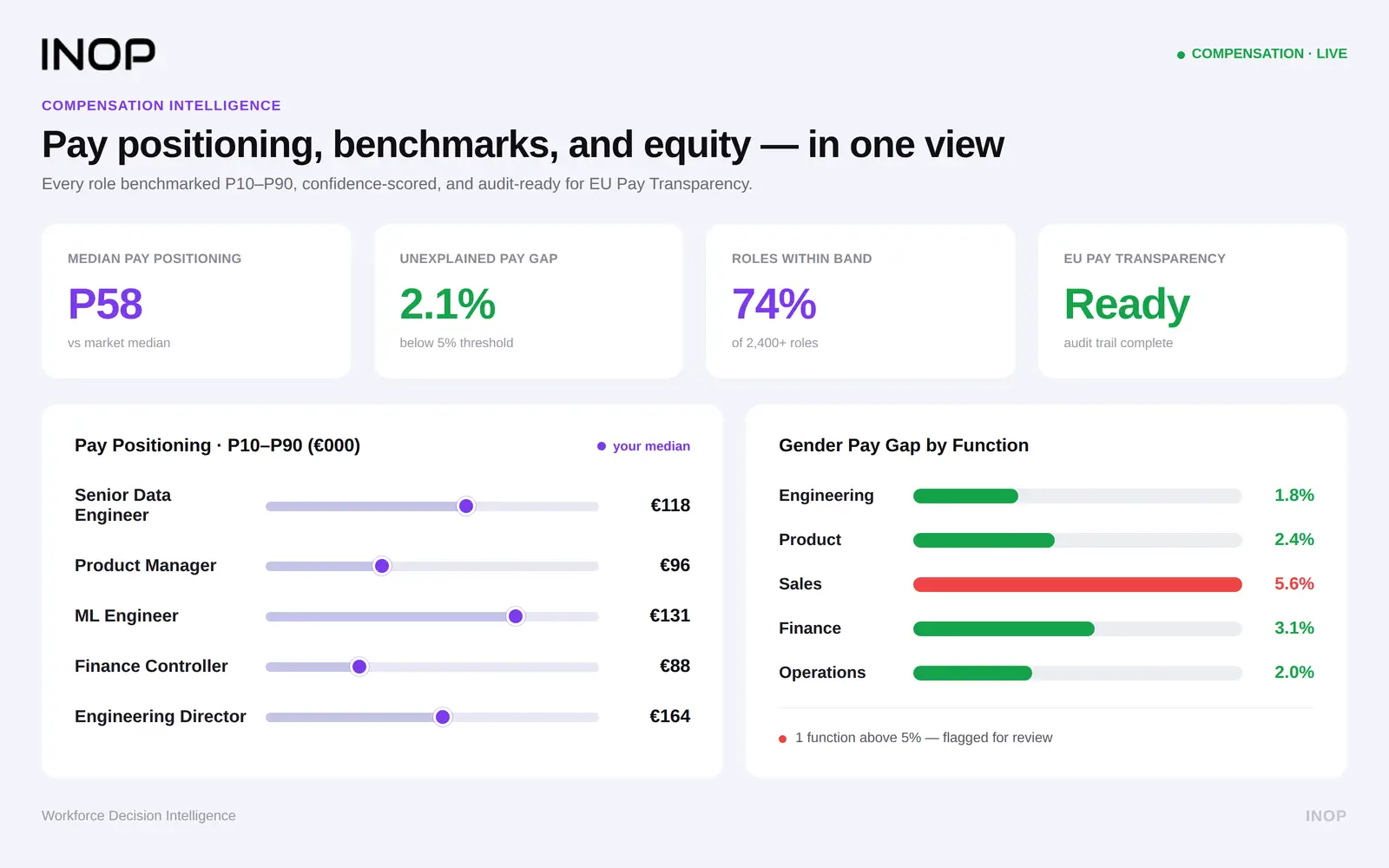
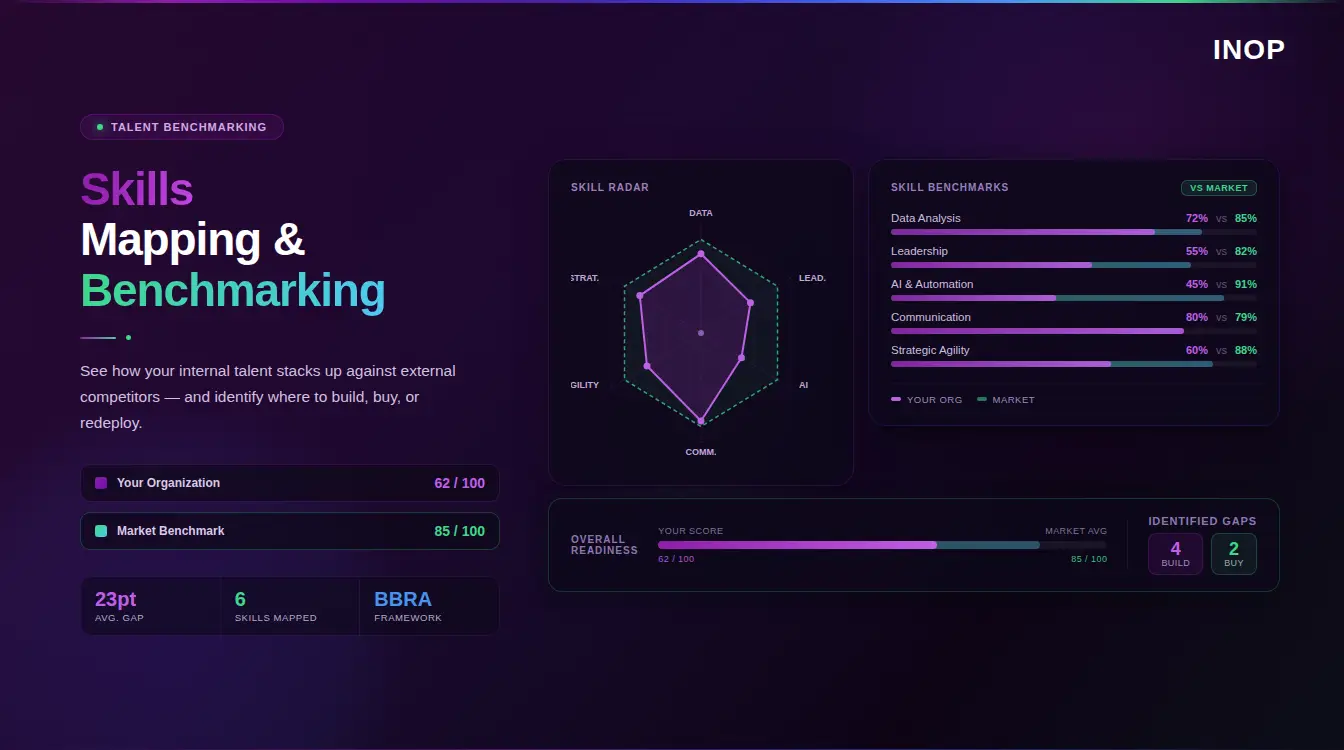
INOP never assesses competencies in isolation. A gap only matters in relation to the strategy it affects, the budget involved, the people who hold the capability today and the market the business competes in. Each INOP finding therefore draws on five intelligence lenses: Strategy, Finance, People, Market, and AI and Automation. INOP infers skills and proficiency from client data and external signals, maps them to INOP’s taxonomy, the client’s own taxonomy or a blend of both, and classifies each task within a role as not impacted, partially augmented or fully automatable.
INOP covers the dimensions that influence whether a strategy can be delivered: capability, leadership, role value, mobility and culture. It complements the competency methods your teams already use rather than replacing them, and results can be read at organisation, business unit, department, country and individual employee level. Where employee-level data is unavailable, INOP works with role and task-level data.
Once a gap is identified, INOP’s BBRA decision architecture turns it into a choice. It compares four pathways, Build, Buy, Redeploy and Automate, and prices each across 30-day, 180-day, one-year and three-year horizons. That moves a competency map from a description of the workforce to a plan for where to invest.
See whether your organisation has the capabilities to execute its strategy today and remain ready as AI changes the work, where the gaps lie and what closing them will cost. Book a demo.
How Can PE Operating Partners Apply Competency Mapping Across a Portfolio?
PE operating partners get the most from competency mapping when every portfolio company uses the same methods, scale and definitions. Without that consistency, each company reports its capability in its own terms and the results cannot be compared.
Three uses stand out:
- Diligence: test whether the target has the capabilities its value creation plan assumes, particularly in leadership and critical roles.
- Value creation planning: prioritise the first hundred days around the capability gaps that pose the greatest risk to the plan.
- Portfolio review: compare capability gaps and the cost of closing them company by company, and direct support where it will protect the most value.
INOP applies the same five intelligence lenses and BBRA horizons in each company you assess, so capability gaps and pathway costs line up across your portfolio.
See whether your portfolio companies have the capabilities to deliver their value creation plans, where execution risks lie and what addressing the gaps will cost. Book a demo.
Frequently Asked Questions
What are the main methods of competency mapping?
The main methods of competency mapping are job and task analysis, behavioural event interviews, the critical incident technique, expert panels, the repertory grid, questionnaires, 360-degree feedback, direct observation, assessment centres and skills data inference. The first five mainly identify required competencies, while the rest assess how far people currently meet them.
Which competency mapping method is the most accurate?
No single method is most accurate for every purpose. Assessment centres and behavioural event interviews give deep, reliable evidence for individual roles but are expensive. Skills data scales across large workforces. Most organisations combine several methods and attach a confidence level to each finding.
What is the difference between competency identification and competency assessment?
Competency identification defines which competencies and proficiency levels a role requires, using methods such as job analysis, interviews and expert panels. Competency assessment measures where individuals or teams stand against those requirements, using methods such as surveys, 360-degree feedback, observation and assessment centres.
How often should a competency map be updated?
Review competency maps at least once a year and whenever the organisation goes through major change, such as a transformation, acquisition or new market entry. With employers expecting a large share of core skills to change by 2030, continuous updates from skills data help keep maps current between formal reviews.
How can PE operating partners use competency mapping?
PE operating partners can apply one competency mapping approach across every portfolio company to test capability assumptions during diligence, prioritise early actions around the gaps that most threaten the value creation plan, and compare capability gaps and the cost of closing them company by company.