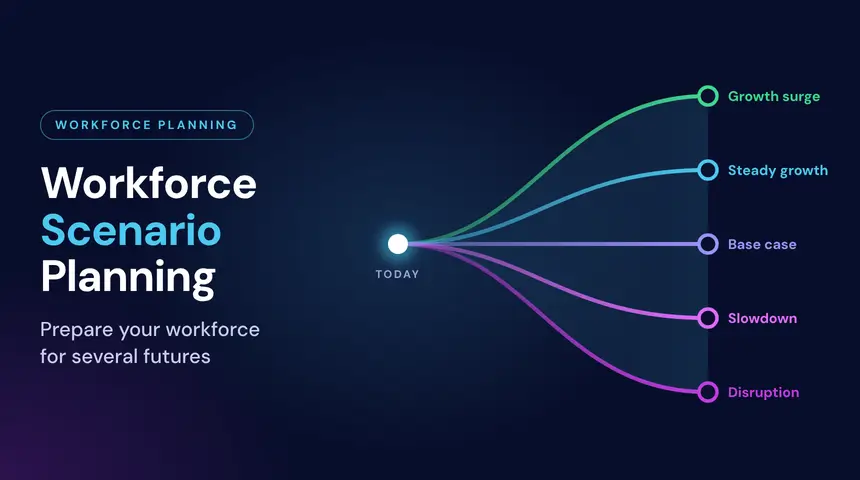
No workforce plan survives contact with reality unchanged. Demand shifts, AI adoption speeds up or stalls, budgets tighten and deals reshape the organisation. Workforce scenario planning prepares leaders for that uncertainty by modelling how the workforce would need to change under several plausible futures, then deciding which moves make sense in all of them and which should wait for a signal. It replaces a single forecast with a set of tested options, each with a cost, a timeline and a trigger. This guide explains what workforce scenario planning is, how to run it step by step and how to turn the results into decisions.
What Is Workforce Scenario Planning?
Workforce scenario planning is a method for estimating the roles, skills, capacity and cost an organisation would need under several plausible futures, and for preparing a response to each. Each scenario combines assumptions about the drivers that matter most, such as revenue growth, the pace of AI adoption or a change in regulation. Leaders then compare the workforce each scenario requires with the workforce they have today.
The aim is preparedness. A good set of scenarios shows which actions pay off whatever happens, which ones depend on a particular future, and which early signals should prompt a change of course.
Workforce Scenario Planning vs Workforce Forecasting
| Workforce forecasting | Workforce scenario planning | |
|---|---|---|
| Question | What is most likely to happen? | What could happen, and how should we respond to each case? |
| Output | One projection of demand and supply | Several workforce plans, each tied to a set of assumptions |
| Best for | Stable conditions and short horizons | Uncertain conditions and decisions that are costly to reverse |
| Main risk | False precision when conditions change | Too many scenarios and no decision |
| Decision rule | Plan to the forecast | Act on no-regret moves, prepare options for the rest |
Most organisations need both. The forecast becomes the base case, and the scenarios test how far the plan holds when the assumptions move.
Why Workforce Scenario Planning Matters Now
The forces reshaping work move faster than annual planning cycles. The World Economic Forum’s Future of Jobs Report 2025 expects 170 million roles to be created and 92 million displaced between 2025 and 2030, with 39% of workers’ core skills changing or becoming outdated. The IMF estimates that almost 40% of global employment is exposed to AI, rising to about 60% in advanced economies. Nobody can say with confidence how fast that exposure turns into changed work in a given company, and scenarios are built for that kind of uncertainty.
Many organisations still plan to one number. In a 2026 McKinsey survey of 202 executives on geopolitical risk, a third of respondents said their organisations do not run scenario analyses at all. Those that do tend to benefit. BARC’s Planning Survey 25 found that 51% of companies regularly use simulations to navigate uncertainty, and 63% of the top-performing planners view scenario planning and simulations as essential, while 67% of laggards do not.
Workforce decisions carry long lead times. Building a capability can take a year or more, and reversing a structural change is slow and expensive. Scenarios let leaders prepare those decisions before the business needs them.
Which Scenarios Should a Workforce Plan Cover?
Choose scenarios around the drivers that would change your workforce most. Common ones include:
- Pace of AI adoption. How fast AI takes over or speeds up tasks in your core processes, and how much capacity that frees.
- Demand. Faster growth, flat demand or a downturn in your main markets.
- Cost pressure. Budget cuts that force trade-offs between capability and spend.
- Strategic moves. A merger, divestment, new market entry or new product line.
- Regulation. Rules on AI, pay transparency or working practices that change how work is done.
- Labour market. Scarcity or surplus of the skills your strategy depends on.
Pick the two or three drivers with the highest impact and the most uncertainty. Put the drivers you can predict with confidence into the base case.
How to Run Workforce Scenario Planning
The process below moves from strategic questions to decisions. Each step builds on the one before it.
Anchor Scenarios to Strategic Questions
Start with the decisions leadership needs to make, such as how fast to roll out AI in operations, whether to enter a new market or how to protect margin in a downturn. Scenarios that do not inform a real decision become an academic exercise.
Identify the Drivers That Matter Most
List the external and internal forces that could change the answer, then rank them by impact and uncertainty. Bring finance, operations and strategy into this step, because workforce assumptions depend on their numbers.
Build a Small Set of Distinct Scenarios
Three or four scenarios are usually enough: a base case and two or three alternatives that differ in meaningful ways. Deloitte describes how the biotech company MyoKardia built four scenarios, from status quo to highly disruptive, with KPIs to signal which one was emerging. When a key alliance dissolved, the company moved to a scenario it had already planned for. Include at least one uncomfortable but plausible case, so the plan is tested where it matters.
Model Workforce Demand and Supply in Each Scenario
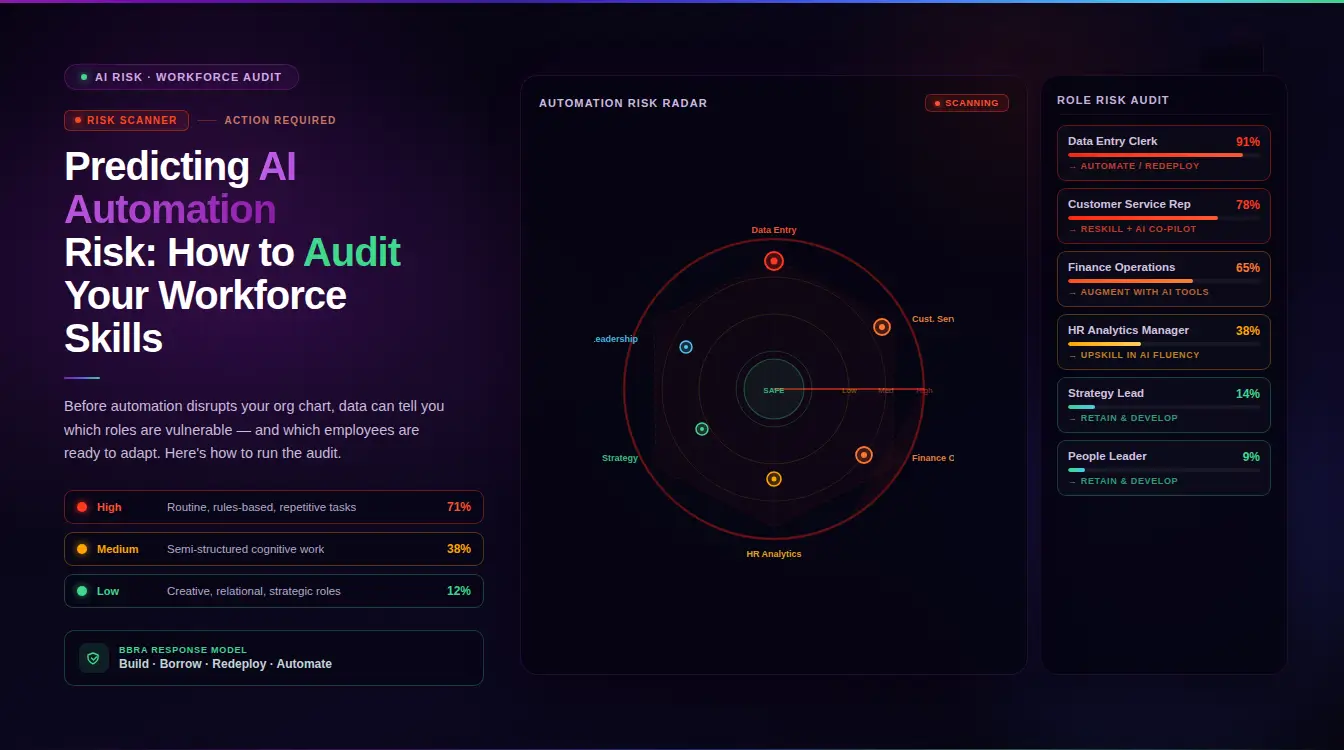
For each scenario, estimate the roles, skills and capacity the business would need over the planning horizon. Work at task level where AI is a driver, because AI changes tasks inside roles before it changes headcount. Then project supply: the people you have, expected attrition, retirements and how far current skills will carry into the future work. Our guide to auditing workforce skills for AI automation risk covers the task-level method, and capability modelling explains why capability is a better unit than headcount.
Price the Response to Each Gap
Compare the workforce each scenario needs with the workforce you have, and price the options for closing each gap: developing skills internally, bringing in external capability, moving people whose skills already fit, or automating the work. Include the cost of doing nothing, because a gap left open delays the work it blocks. Our guide to what a skill gap is explains how to size each one.
Choose No-Regret Moves and Trigger Points
Some actions pay off in every scenario, such as building skills that every future needs or improving the quality of workforce data. Make those moves now. For actions that only pay off in one scenario, define the signal that would trigger them: a demand threshold, an AI adoption milestone or a regulatory decision. This turns the scenarios into a playbook leaders can act on quickly.
Review and Update
Revisit the scenarios at least quarterly and whenever a major driver moves. Update assumptions, retire scenarios that no longer apply and add new ones as the strategy changes.
A Workforce Scenario Planning Example
Consider an illustrative insurer planning its claims operation over three years. The two drivers with the highest impact and uncertainty are the pace of AI adoption in claims handling and the growth of claims volume.
| Scenario | Assumptions | Workforce implication | Response |
|---|---|---|---|
| Base case | Steady volume growth; AI handles first-line triage within 18 months | Capacity freed in triage; demand for AI oversight and complex case skills | Reskill triage staff for complex cases and AI review |
| Fast AI adoption | AI handles triage and routine settlement within a year | Larger capacity release; oversight and process design skills scarce | Redeploy staff to growth lines; bring in external capability for process design |
| Volume surge | A major weather year doubles claims for two quarters; AI on base-case timeline | Short-term capacity shortfall in all claims roles | Contingent capacity and cross-trained staff from other teams |
Two moves pay off in all three scenarios: building AI oversight skills and cross-training staff across claims types. The insurer makes those now. The decisions on external capability and contingent capacity wait for their triggers.
How to Read Workforce Scenario Planning Results
Focus on three outputs. First, the gaps that appear in every scenario, because they are the most certain priorities. Second, the spread between scenarios in cost and capacity, which shows how much flexibility the plan needs. Third, the leading indicators that tell you which scenario is unfolding, so the organisation can switch plans before the gap opens.
Common Mistakes in Workforce Scenario Planning
- Too many scenarios. Ten scenarios produce analysis and no decision. Three or four distinct ones are enough.
- Scenarios that differ only in growth rate. Plus or minus 5% is a sensitivity test. Real scenarios change the shape of the work.
- Planning in headcount only. Headcount hides the skills and tasks that AI and strategy change.
- Leaving finance out. Scenarios without costs rarely reach budget decisions.
- No trigger points. Without agreed signals, scenarios sit in a report while the business reacts too late.
- Running it once. Scenarios lose value as conditions change. Deloitte notes that large organisations can spend about six months on a planning cycle, by which time the assumptions may already be out of date.
How INOP Supports Workforce Scenario Planning
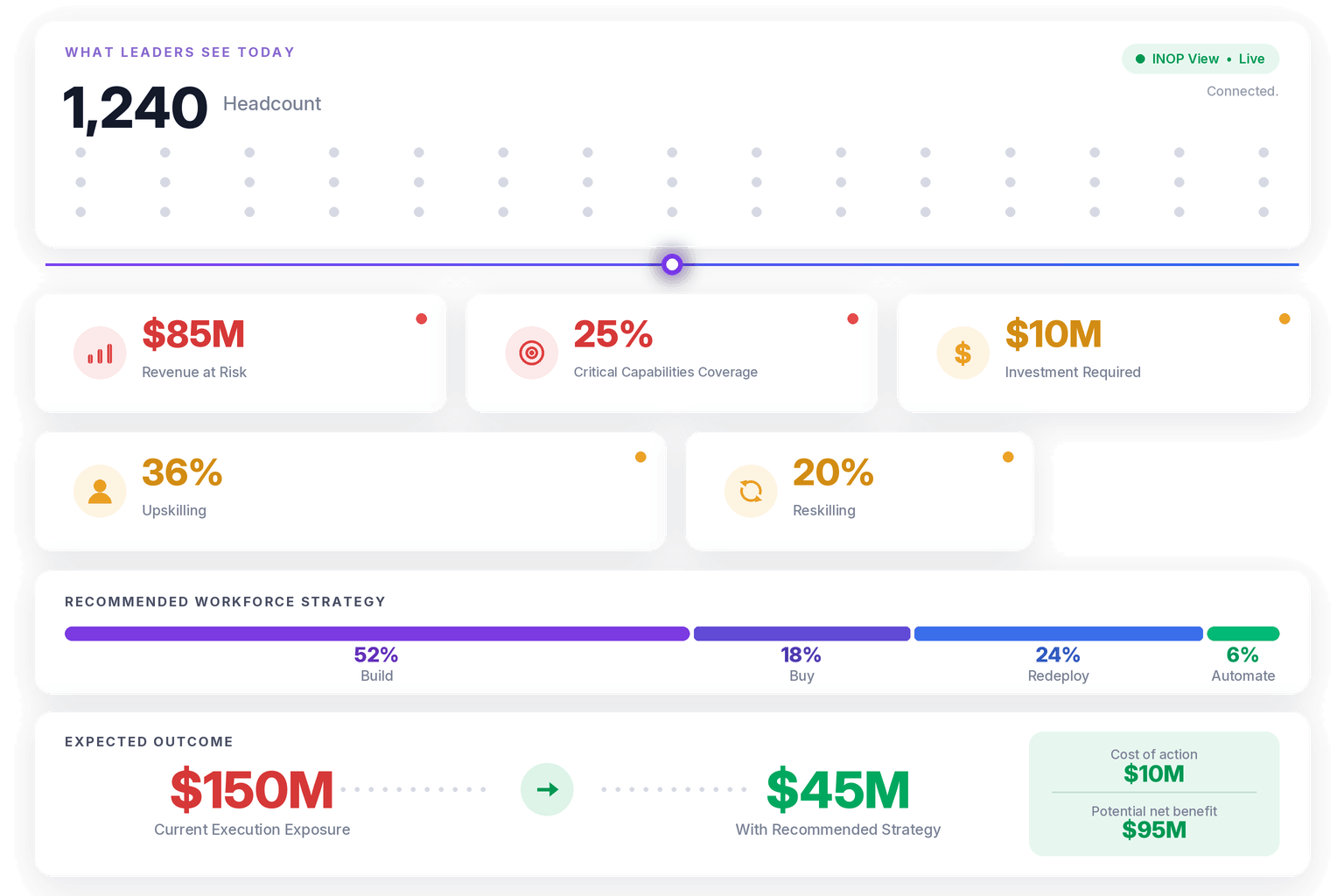
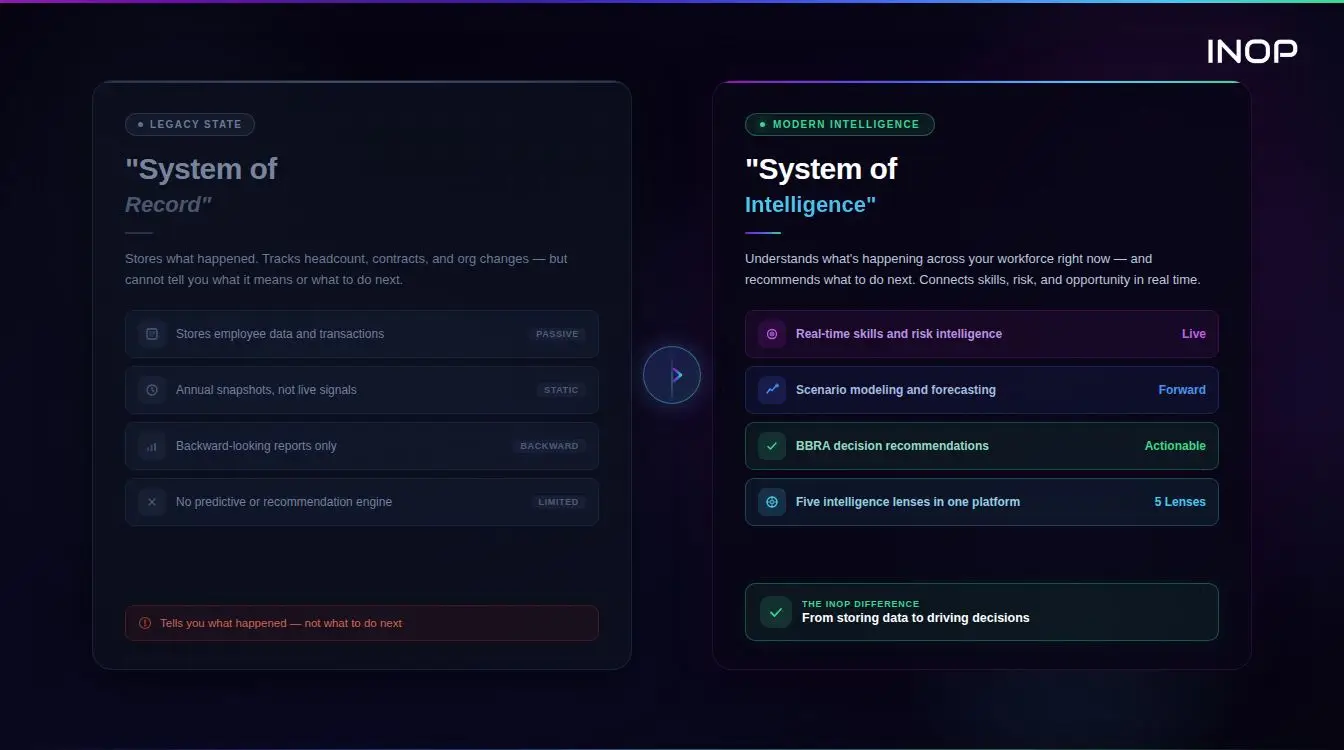
INOP starts from one question: does the organisation have the capabilities to execute its strategy today, and to stay ready as AI changes the work? Workforce scenario planning tests that question against several futures at once. INOP connects strategy, finance, people, market and AI data in one model, so each scenario shows which capabilities are in place, where the gaps and risks are, what those gaps cost if nothing changes and the best response to each one.
INOP never assesses a scenario in isolation. Each one passes through five intelligence lenses:
| Lens | Question it answers in each scenario |
|---|---|
| Strategy | Which capabilities does the strategy depend on under these assumptions? |
| Finance | What does each response cost, and what does inaction cost? |
| People | Who holds the capability today, and how far can they move? |
| Market | Which skills are gaining or losing value, and what would external capability cost? |
| AI and Automation | Which tasks will AI change, and how fast, under this scenario? |