Most organizations believe they are doing workforce planning. The reality is that the vast majority are doing something far simpler: they are counting heads. The distinction between capability modeling vs headcount planning may sound academic, but it carries real consequences for business performance, talent investment, and competitive resilience. When your planning model can only tell you how many people you have, it cannot tell you whether those people are capable of executing next year’s strategy, let alone the one after that.
This article breaks down what separates these two approaches, why the shift from headcount to capability matters urgently for CHROs, and how organizations can make the transition in a structured, financially grounded way.
What Is Traditional Headcount Planning?
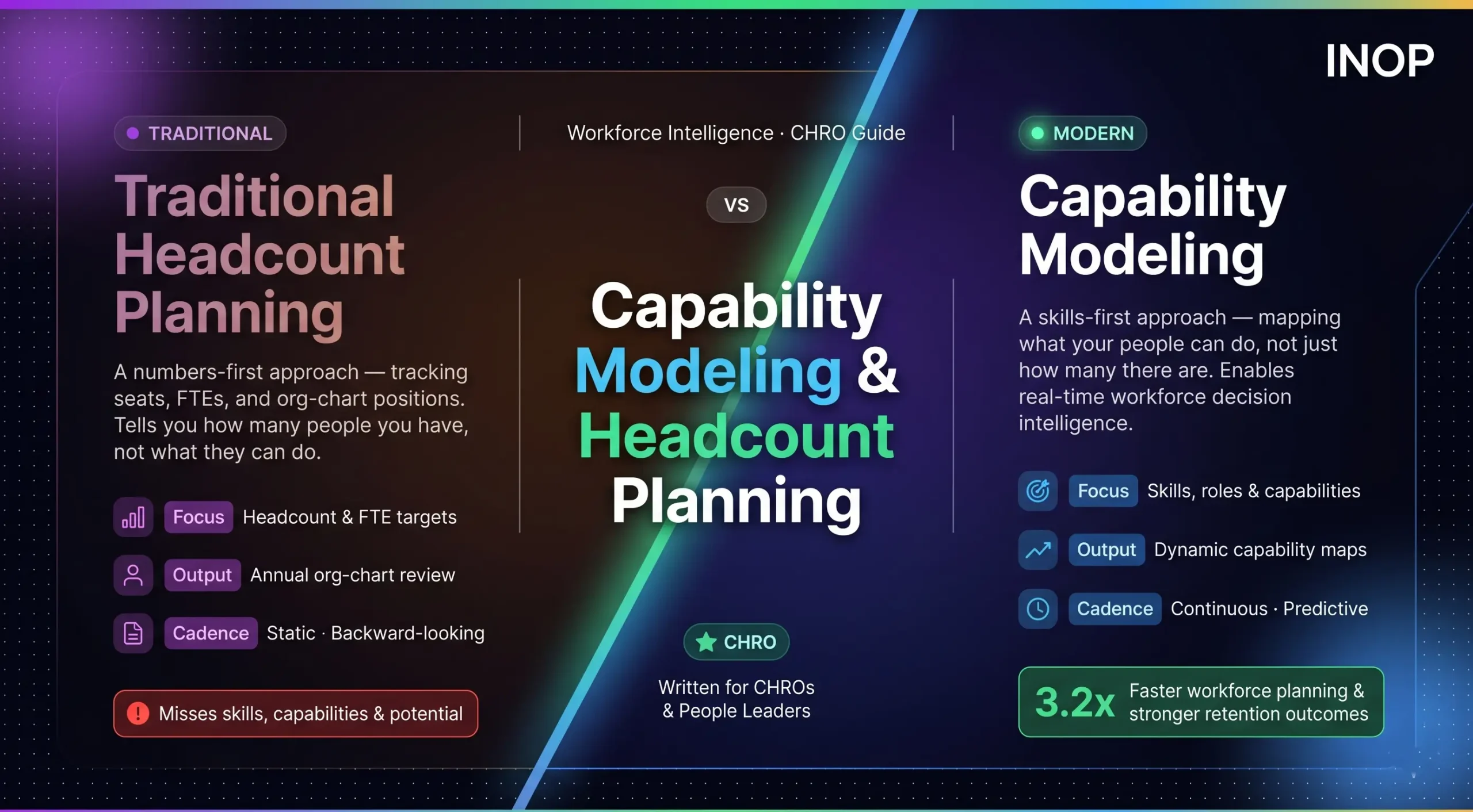
Traditional headcount planning is the most common workforce planning method used in organizations worldwide. It centers on a single primary question: How many employees do we need, by department, to meet next year’s business targets?
The process typically follows a predictable annual cycle. Finance sets budget envelopes. Business unit leaders submit headcount requests. HR reconciles those requests against attrition forecasts and approved budgets. The output is a hiring plan expressed in full-time equivalents (FTEs).
This approach is not entirely without merit. It provides a clear financial framework, it integrates naturally with budget cycles, and it gives operations leaders a simple lever for managing workforce costs. In stable business environments with predictable growth, it functions reasonably well.
The problem is that business environments are no longer stable, and headcount figures tell leaders almost nothing about organizational capability. A company could add 50 engineers and still be critically underequipped for a cloud transformation initiative if those engineers lack the specific skills the strategy demands. McKinsey’s 2025 HR Monitor found that while 73% of organizations conduct operational workforce planning, only 12% of U.S. HR leaders say their strategic workforce planning has a three-year or longer focus. The gap between activity and strategic impact is substantial.
The Core Limitations of Headcount Planning
Headcount planning fails in several specific ways that are worth naming directly:
It mistakes inputs for outcomes. Headcount is an input. What the business actually needs are capabilities, capacity, and execution readiness. Planning exclusively around FTEs conflates the resource with the result.
It assumes role stability. Traditional planning treats job roles as fixed containers. In practice, roles evolve rapidly, especially in technology-intensive functions. A “data analyst” role in 2021 bears little resemblance to the same title in 2026.
It creates hidden blind spots. Organizations routinely sit on significant latent talent they cannot see because their planning systems are not designed to capture skills at the individual or team level. Research consistently shows that large organizations utilize only 30–50% of their employees’ full skill sets, because without visibility into capabilities, that talent remains invisible and undeployed.
It is inherently reactive. Annual headcount cycles make decisions in November about a world that will look different by March. By the time a capability gap surfaces as a hiring need in a headcount plan, the organization has already been underequipped for months.
What Is Capability Modeling?
Capability modeling is a fundamentally different approach to workforce planning. Rather than asking “how many people do we need?”, it asks a richer set of questions:
- What capabilities does our strategy require, at what depth, and by when?
- What capabilities do we currently have, where are they concentrated, and where are they absent?
- Which gaps are strategically material, meaning they carry real execution or financial risk?
- What is the most cost-effective and time-appropriate way to close each gap?
The unit of analysis shifts from the headcount number to the organizational capability, defined as a combination of skills, knowledge, experience, and behavioral competencies required to execute a specific strategic function.
Capability modeling typically involves four interconnected components:
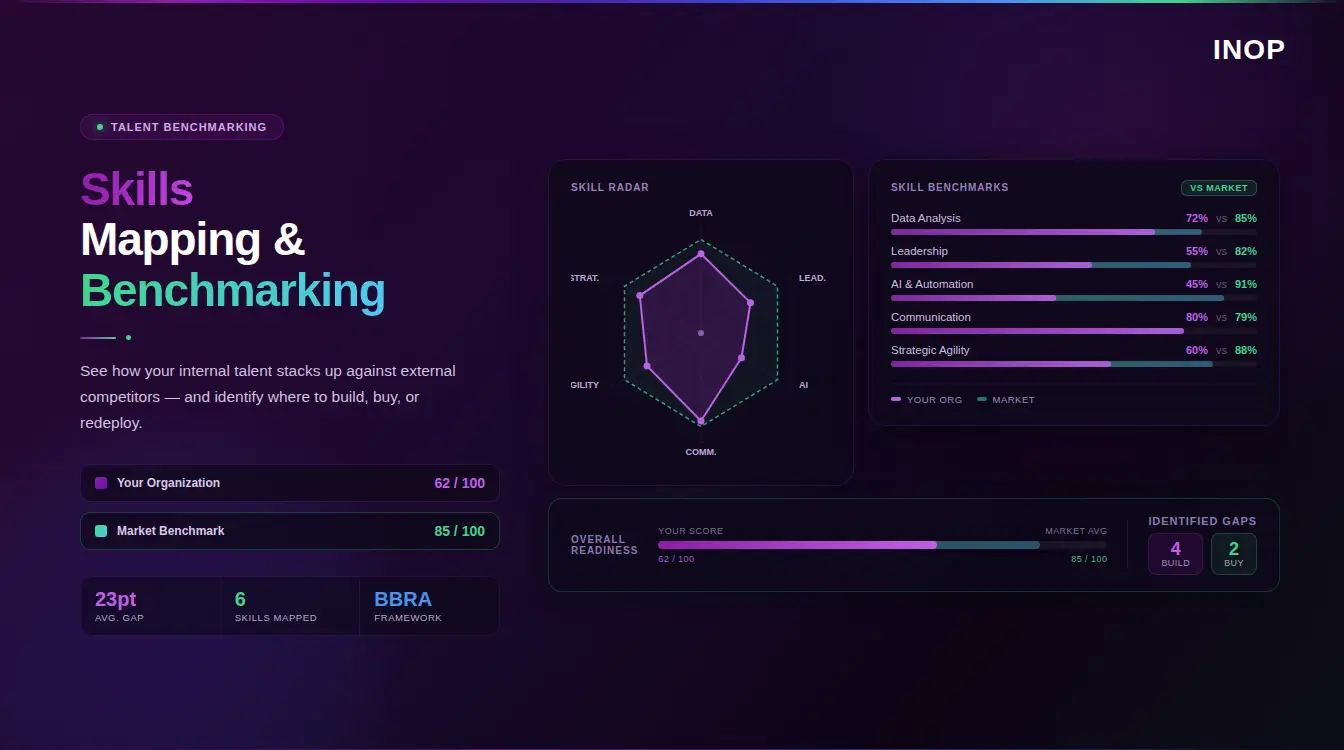
Capability mapping is the process of inventorying existing workforce capabilities at a granular level, not just job titles, but actual proficiency levels across defined skill dimensions. This requires structured data capture from assessments, performance records, project histories, and learning management systems.
Strategic capability demand forecasting translates business strategy into specific capability requirements. If the strategy calls for AI-driven product development, what technical skills, at what levels, are needed, in what volumes, across what timeframes?
Gap analysis places supply against demand and identifies where the organization is under-invested, over-invested, or misaligned. Not every gap is equally important. Capability modeling prioritizes gaps by their strategic and financial materiality.
Intervention pathway modeling determines the best way to close each identified gap. This is where INOP’s BBRA framework becomes particularly powerful.
The BBRA Framework: A Strategic Decision Lens for Capability Gaps
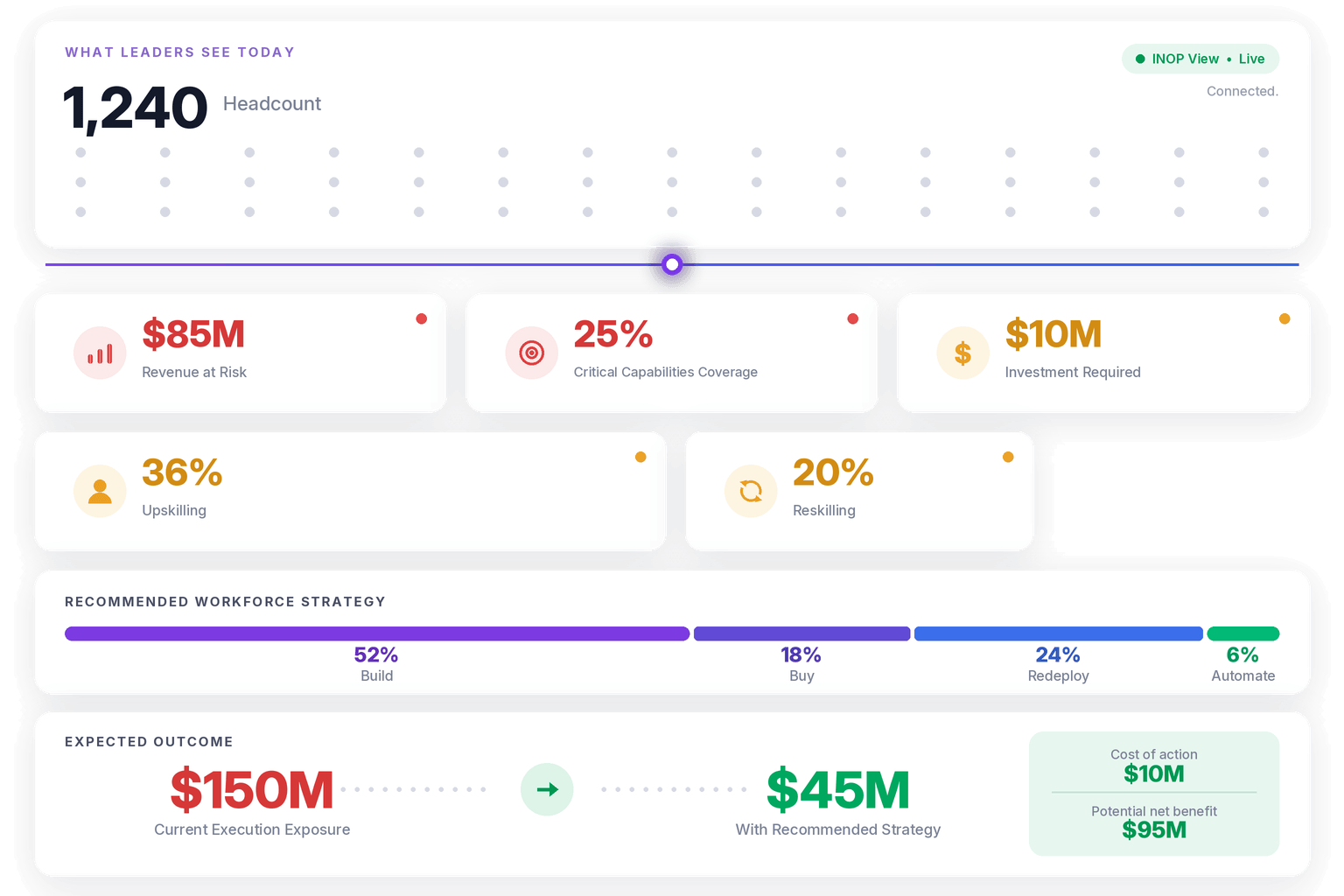
One of the most useful structures for thinking through capability gap response is the BBRA model: Build, Buy, Redeploy, Automate. This framework moves workforce leaders away from the default instinct of hiring (buy) toward a more deliberate, financially grounded evaluation of every available option.
Build
Building means developing capability internally through targeted learning, upskilling, and structured career development. This pathway is most appropriate when the capability in question is core to long-term competitive advantage, when internal talent with adjacent skills exists, and when the development timeline is compatible with strategic need.
Build decisions are often underutilized because they require investment that shows up in L&D budgets rather than headcount lines, and because the ROI is harder to quantify in traditional planning frameworks. However, McKinsey data shows that 80% of leaders consider upskilling the most effective way to reduce skills gaps, yet only 28% are actively investing in structured reskilling programs at scale.
Buy
Buying means acquiring capability externally through hiring, contracting, or acquisition. It is appropriate when the capability gap is urgent, when internal development is not feasible within the required timeframe, or when the required depth of expertise does not exist inside the organization.
The challenge with defaulting to “buy” is cost and time. External hiring carries significant onboarding burden, cultural risk, and market availability constraints, particularly for in-demand technical skills. McKinsey estimates a tech talent gap of 1.4 to 3.9 million people by 2027 in the European Union alone, making “just hire more” an increasingly unreliable strategy.
Redeploy
Redeployment means moving existing employees from lower-priority areas to higher-priority ones, often with targeted bridge training to fill minor skill gaps. This is frequently the most underutilized and highest-value pathway available to CHROs.
The reason redeployment is underused is simple: organizations cannot redeploy what they cannot see. Without a robust capability inventory, HR leaders have no way to identify which employees have relevant adjacent skills that could be rapidly developed. Capability modeling makes internal mobility a strategic tool rather than an occasional ad hoc decision.
Automate
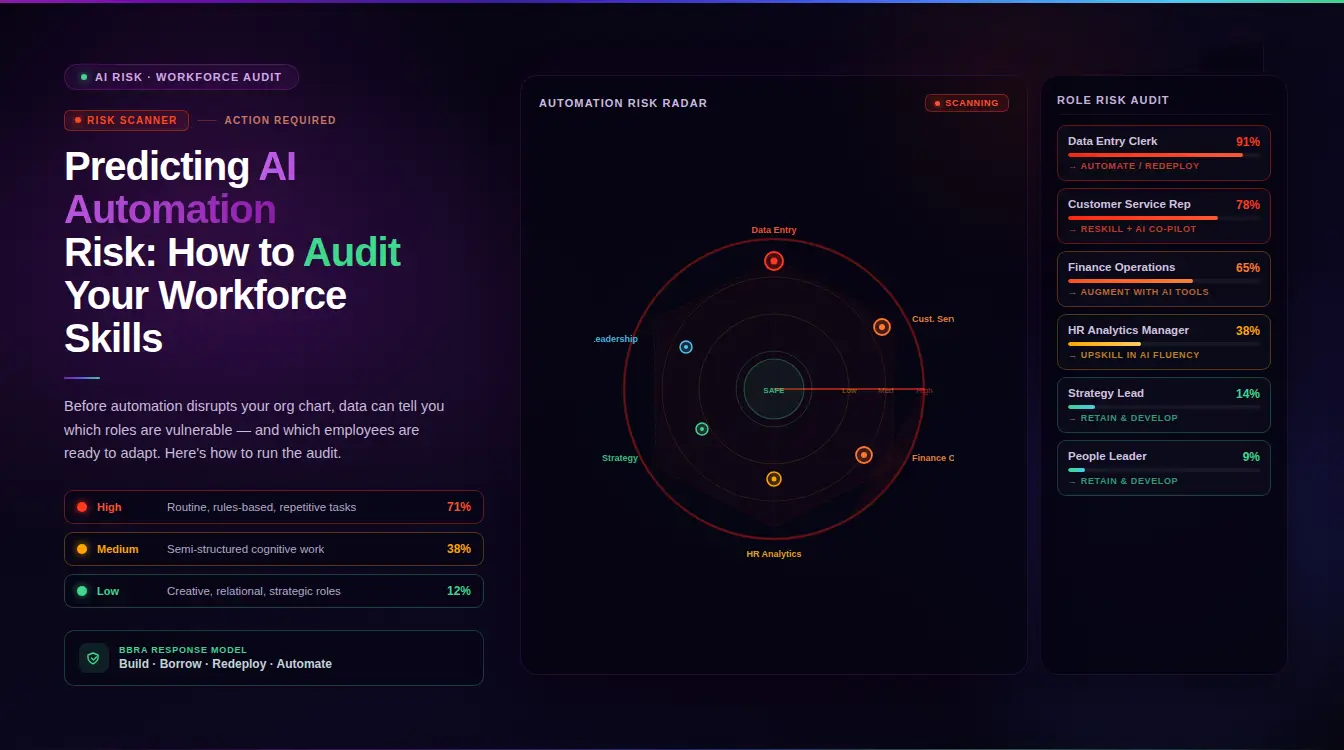
Automation means redesigning work so that AI, robotics, or software replaces the human capacity previously required. This pathway is appropriate when tasks are repetitive, rule-based, or data-intensive, and when the investment in automation yields a better return than continuing to staff the function with human roles.
Automation is not just a cost reduction mechanism. Properly applied, it frees human capacity for higher-value work, which can then be redeployed. Gartner predicts that 39% of the workforce will experience role disruption in the next two to five years, including redeployment to new roles and significant skill shifts, making automation planning an essential component of any serious capability model.
The BBRA framework is most powerful when each pathway is evaluated with explicit financial modeling, not just strategic rationale. Each option carries a different cost profile, risk level, and time horizon. Choosing between Build and Buy, for example, is a financial decision as much as a talent one.
Capability Modeling vs Headcount Planning: A Direct Comparison
The differences between these two approaches are significant across every dimension that matters to a CHRO.
| Dimension | Traditional Headcount Planning | Capability Modeling |
|---|---|---|
| Primary question | How many FTEs do we need? | What capabilities does our strategy require? |
| Planning horizon | 12 months (annual cycle) | 1–5 years, scenario-based |
| Unit of analysis | Full-time equivalent (FTE) | Capability, skill, competency |
| Gap identification | Vacancy vs. approved headcount | Capability supply vs. strategic demand |
| Response options | Hire or freeze | Build, Buy, Redeploy, Automate |
| Strategic alignment | Indirect (via budget) | Direct (capabilities linked to strategic outcomes) |
| Visibility into existing talent | Low | High |
| Ability to model AI disruption | None | Explicit |
| Financial granularity | Budget envelope | Cost per gap closure pathway |
| Adaptability | Annual cycle | Continuous or quarterly |
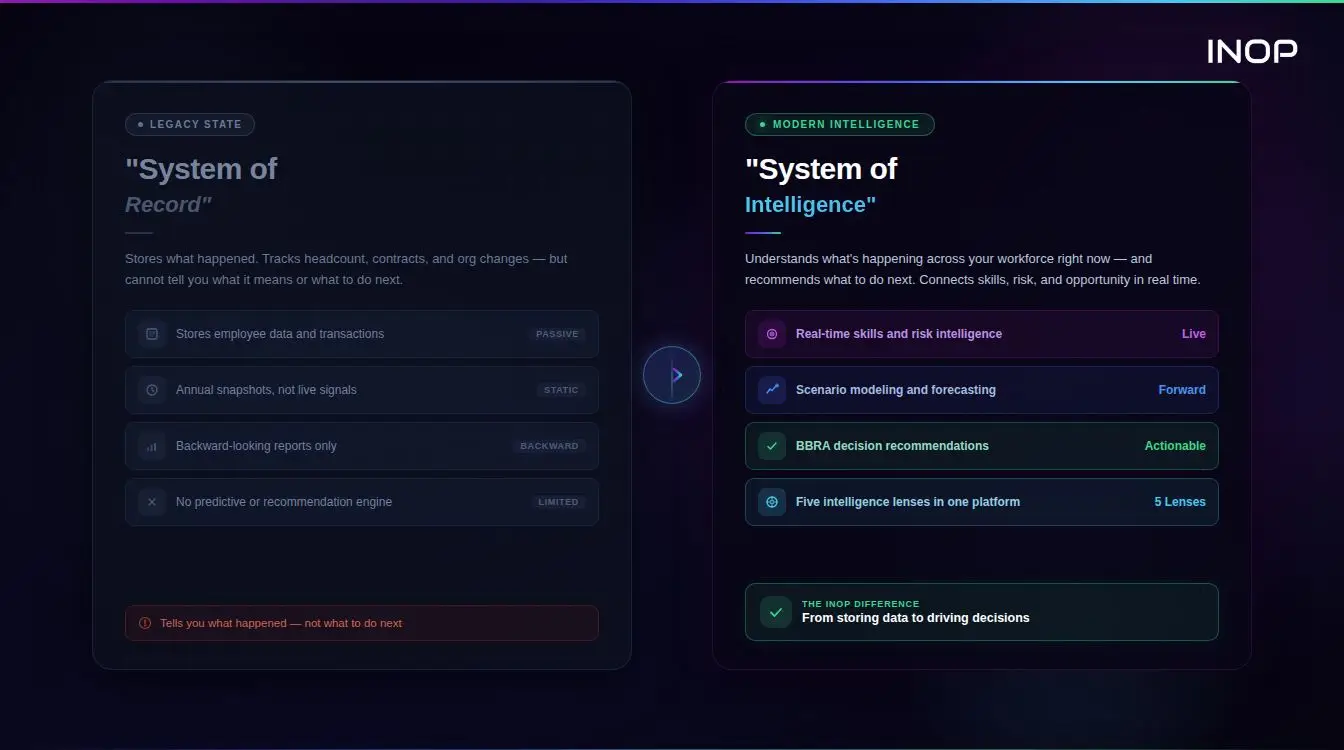
This comparison is not meant to suggest that headcount tracking is irrelevant. FTE counts, budget lines, and organizational structure all remain important operational data. The point is that headcount planning, used alone, is not workforce planning. It is workforce administration.
Why CHROs Are Moving Toward Capability-Led Planning
The shift from headcount to capability is being driven by several structural forces that CHROs are navigating simultaneously.
Strategy complexity is increasing. Digital transformation, AI adoption, and market disruption are changing what organizations need from their people faster than traditional planning cycles can respond. A strategy built around data-driven customer experience, for example, requires not just more analysts, but specific skills in behavioral data interpretation, real-time personalization, and cross-functional data governance, capabilities that have no obvious headcount proxy.
The cost of capability gaps is material. Leaving a critical capability gap unaddressed is not a neutral outcome. It shows up in delayed product launches, failed transformation initiatives, elevated dependence on expensive external consultants, and missed revenue targets. Capability modeling allows CHROs to quantify these risks in financial terms that CFOs and boards can engage with directly.
Internal talent is significantly underutilized. As noted earlier, research suggests that organizations deploy only 30–50% of their employees’ full capabilities. This represents both a productivity loss and an engagement risk. According to Gallup, only 20% of employees globally are engaged at work, with underutilization identified as a significant driver of disengagement. Capability modeling creates the visibility needed to unlock this latent value.
Workforce planning is increasingly a board-level conversation. Human capital risk, workforce resilience, and talent strategy are no longer solely HR concerns. They are appearing in investor disclosures, board risk registers, and CEO communications. CHROs who can speak to capability gaps in financial and strategic terms have a fundamentally different seat at the table than those who can only report headcount variances.
How to Transition from Headcount to Capability Planning
Making this shift does not require an organizational overhaul. It requires deliberate sequencing, the right data infrastructure, and executive alignment. Here is a practical approach:
Build a Capability Taxonomy
Start by defining the capabilities that matter to your strategy. A capability taxonomy is a structured inventory of the skills, competencies, and knowledge domains relevant to your organization’s work, organized by function, level, and strategic importance.
This does not need to be exhaustive from day one. Begin with the capability domains most critical to your top three strategic priorities. A healthcare organization executing a digital care delivery strategy might start with data science, patient experience design, and regulatory compliance technology as its three priority domains.
Conduct a Capability Audit
Map your current workforce against your taxonomy. This step requires structured data gathering, which may combine self-assessments, manager evaluations, skills inferred from project histories, and learning records. The output is a capability heat map showing where you are strong, where you are thin, and where you are absent entirely.
Quantify the Strategic Materiality of Each Gap
Not all gaps are equal. Prioritize by asking: What is the cost to business execution if this gap remains open for 12 months? Which gaps directly enable or block your highest-priority strategic bets? This quantification is the step that transforms capability modeling from an HR exercise into a business planning tool.
Apply the BBRA Framework to Gap Closure
For each material gap, evaluate Build, Buy, Redeploy, and Automate options explicitly. Model each option’s cost, time to impact, and risk profile. In many cases, the analysis will reveal that a Redeploy pathway is faster and cheaper than a Buy pathway, something that would never surface in traditional headcount planning.
Connect to Strategic Workforce Planning
Capability modeling does not replace strategic workforce planning; it becomes its foundation. The capability inventory, gap analysis, and BBRA modeling feed directly into a strategic workforce plan that is grounded in organizational reality rather than organizational aspiration. This is what separates workforce plans that get executed from those that gather dust.
The Role of Skills Intelligence in Capability Modeling
Effective capability modeling depends on high-quality, real-time data about organizational capabilities. This is where ai skills taxonomy directory becomes a critical enabler.
Skills intelligence refers to the systematic collection, analysis, and activation of data about the skills and competencies present in a workforce. It goes beyond a static skills inventory. A mature skills intelligence system continuously updates capability data, benchmarks it against external labor market signals, identifies adjacencies that enable internal mobility, and surfaces capability decay in roles where skills are not being actively used.
Without skills intelligence infrastructure, capability modeling remains a periodic, labor-intensive exercise. With it, capability modeling becomes a continuous, automated process that gives CHROs a live view of organizational capability at any point in time.
Platforms designed for this purpose, such as INOP, are purpose-built to connect capability data directly to strategic and financial outcomes. Rather than simply showing which skills exist, they model how capability gaps create execution risk, quantify the financial consequence of leaving gaps open, and surface the optimal BBRA pathway for each situation. The result is that workforce decisions are made with the same analytical rigor applied to capital investment decisions.
Common Objections to Capability Modeling
CHROs who see the value of this approach often face internal resistance. Here are the most common objections and how to address them:
“We don’t have the data.” No organization has perfect capability data to begin with. The practical answer is to start with the data you have, build structured capture processes for the domains that matter most, and treat capability data as a continuous improvement initiative rather than a one-time project.
“It’s too complex for our organization.” Complexity is a function of scope, not methodology. Start with one business unit or one strategic priority. A focused pilot that demonstrates the value of capability modeling in a specific context is far more persuasive than a comprehensive enterprise rollout.
“Our leaders won’t engage with it.” This objection usually reflects a presentation problem, not a leadership problem. When capability gaps are presented as financial risks with specific cost implications, rather than HR metrics, they generate immediate attention from business leaders.
“Headcount planning is what Finance requires.” This is a coordination challenge, not a strategic constraint. Capability modeling can coexist with headcount budgeting. The goal is to enrich headcount decisions with capability context, not to eliminate the budget conversation.
Conclusion
The organizations that will navigate the next decade of workforce complexity most effectively are those that stop treating headcount as a proxy for capability. The shift from counting people to understanding what those people can do, and what the organization needs them to be able to do, is the defining transition in modern workforce strategy.
For CHROs, capability modeling is not a technology project or an HR initiative. It is a strategic discipline that connects people decisions to business outcomes with a level of rigor and transparency that traditional headcount planning cannot provide. The BBRA framework, Build, Buy, Redeploy, Automate, gives leaders a structured decision model for acting on capability intelligence. Skills intelligence platforms give them the data infrastructure to do it continuously, not just once a year.
If your organization is still managing workforce strategy primarily through headcount figures, the question is not whether to make this shift. The question is how long you can afford to wait.
To explore how INOP’s AI-first platform can support your transition to capability-led workforce planning, visit the strategic workforce planning page or speak directly with the INOP team.
Frequently Asked Questions
What is the main difference between capability modeling and headcount planning?
Headcount planning focuses on determining how many employees an organization needs by role or department, typically on an annual cycle. Capability modeling focuses on understanding what skills, competencies, and knowledge domains the organization needs to execute its strategy, mapping those requirements against existing workforce capabilities, and identifying how to close gaps through the most appropriate pathway, whether that is developing internal talent, hiring externally, redeploying existing people, or automating specific work.
Can capability modeling replace headcount planning entirely?
No. Headcount planning serves a legitimate budgetary and operational function. The more effective approach is to use capability modeling as the strategic layer that informs and enriches headcount decisions. Knowing that you need 10 more engineers is more useful when you also know which specific capability domains those engineers need to cover and whether some of that need could be met by redeploying or upskilling existing team members.
How does the BBRA framework help CHROs make better workforce decisions?
The BBRA framework (Build, Buy, Redeploy, Automate) structures the response to capability gaps by forcing a deliberate evaluation of all available options rather than defaulting to hiring. It helps CHROs and their finance partners model the cost, speed, and risk profile of each pathway, leading to decisions that are more financially defensible and strategically aligned. In many organizations, applying the BBRA framework reveals that Redeploy and Build options offer faster and cheaper gap closure than external hiring.
What data is needed to start capability modeling?
A capability modeling initiative can begin with existing data from HRIS systems, performance reviews, learning management systems, and self-assessment tools. Perfect data is not a prerequisite. Many organizations start by mapping capability requirements for their highest-priority strategic initiatives, then build out structured data capture processes from there. The key is to establish a capability taxonomy first so that data is captured consistently across the organization.
How does skills intelligence connect to capability modeling?
Skills intelligence is the data infrastructure that makes capability modeling continuous and scalable. A skills intelligence platform continuously aggregates data about workforce capabilities from multiple sources, benchmarks it against external labor market signals, identifies emerging gaps before they become critical, and supports internal mobility by surfacing relevant talent for open roles or strategic projects. Without skills intelligence, capability modeling is a periodic, manual process. With it, CHROs have a live, dynamic view of organizational capability that can inform decisions in real time.
How long does it take to transition from headcount to capability-led workforce planning?
The timeline depends on organizational size and the maturity of existing people data infrastructure. A focused pilot covering a single business unit or strategic priority can typically produce meaningful outputs within three to six months. A full enterprise capability model, with continuous updating and BBRA decision modeling, generally requires 12 to 18 months to reach operational maturity. The key is to start with a defined, high-value scope rather than attempting a comprehensive rollout from day one.
Is capability modeling only relevant for large enterprises?
No. While the complexity and data infrastructure requirements scale with organizational size, the fundamental logic of capability modeling applies to any organization where workforce capabilities must align with strategic priorities. Mid-sized organizations often find capability modeling particularly valuable because they have fewer people to misallocate and less margin for capability gaps than large enterprises with more organizational slack.
Book a Demo
Make confident workforce decisions that support strategy and value creation.