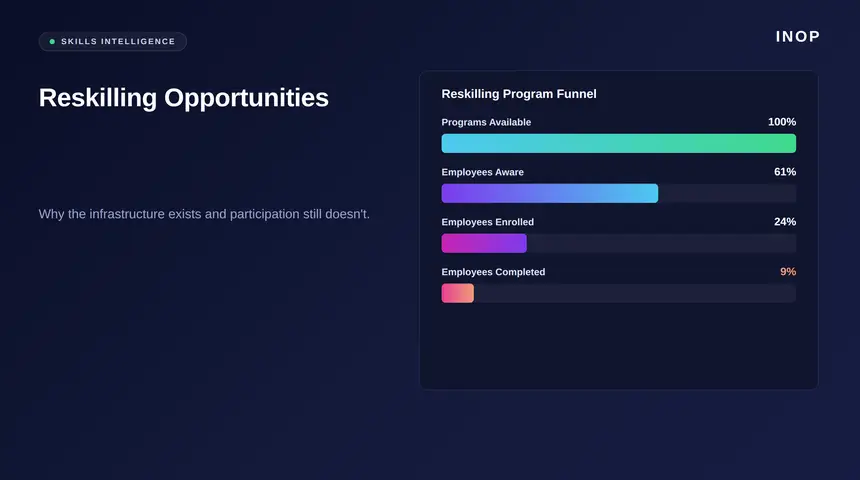
Most organisations have funded training platforms, course libraries and learning budgets. Far fewer have created reskilling opportunities that employees see as a real route into a different role. That gap explains why so many reskilling programmes report healthy content usage and very little movement. A reskilling opportunity is a visible, credible path to a specific new role, backed by a plan to close the skills gap between where a person is today and where the business needs them next. This guide explains why participation lags, how to design opportunities people take up and how to measure whether they work.
What Makes a Real Reskilling Opportunity?
A course is a resource. A reskilling opportunity is a move. It has four parts:
- A destination role. A named role the business needs filled, with a realistic number of openings.
- A skills gap that can be closed. The distance between the person’s current skills and the destination role, broken down by skill and proficiency.
- A learning pathway. The training, projects and support that close that gap within a stated timeframe.
- A commitment. Agreement from the business that people who complete the pathway will be considered for the role.
Remove the destination and what is left is more training. Employees can tell the difference. Our guide to reskilling covers how to build the wider programme. This article focuses on the opportunities inside it and why employees do or do not take them up.
Why Do Reskilling Opportunities Go Unused?
The demand is there. BCG’s global survey of workers found that 68% were willing to retrain for a new job. Yet participation in development stays low. Gallup reports that less than half of US employees (45%) took part in training or education for their current job in 2024. Four barriers explain most of the gap.
No Visible Destination Role
Employees invest effort when they can see what it leads to. LinkedIn’s Workplace Learning Report 2024 found that only one in five employees has strong confidence in their ability to make an internal move, and only 19% say their organisation encourages them to explore internal role changes. If the route is invisible, the training looks like extra work with no payoff.
No Time to Learn
Time is the most common obstacle. In the same Gallup research, 89% of CHROs named time away from job responsibilities as their organisation’s biggest barrier to development, and 41% of employees named it as their own top obstacle. Reskilling squeezed around a full workload rarely gets finished.
Managers Who Hold People Back
Line managers decide whether people get time to learn and whether they get released for a move. Gallup found that 39% of CHROs cite support from direct managers as a key obstacle, second only to time. A manager measured on team output has a reason to keep strong performers where they are, unless the organisation rewards them for developing people who move on.
Low Confidence in Internal Moves
Even when a role exists, employees often doubt they would be considered. LinkedIn found that only 33% of employers have internal mobility programmes. Without a clear process for applying, assessing and moving, people assume the role will go to someone else.
Reskilling Opportunities vs Upskilling Opportunities
Upskilling deepens the skills a person uses in their current role. Reskilling prepares them for a different one. The right choice depends on how far a person’s current skills sit from the work the business needs next, and on whether their current role will still exist in its present form.
Most organisations need both. Our comparison of upskilling vs reskilling explains how to split the budget between them.
How to Create Reskilling Opportunities Employees Take Up
Design the opportunity around the move, then build the learning to support it. Six steps make the difference.
Start From the Roles the Strategy Needs
Identify the roles that will grow over the next one to three years, and how many people each will need. The World Economic Forum’s Future of Jobs Report 2025 expects 39% of workers’ core skills to change or become outdated by 2030, so the destination roles of 2028 may look different from today’s job catalogue.
Match People to Roles by Skill Adjacency
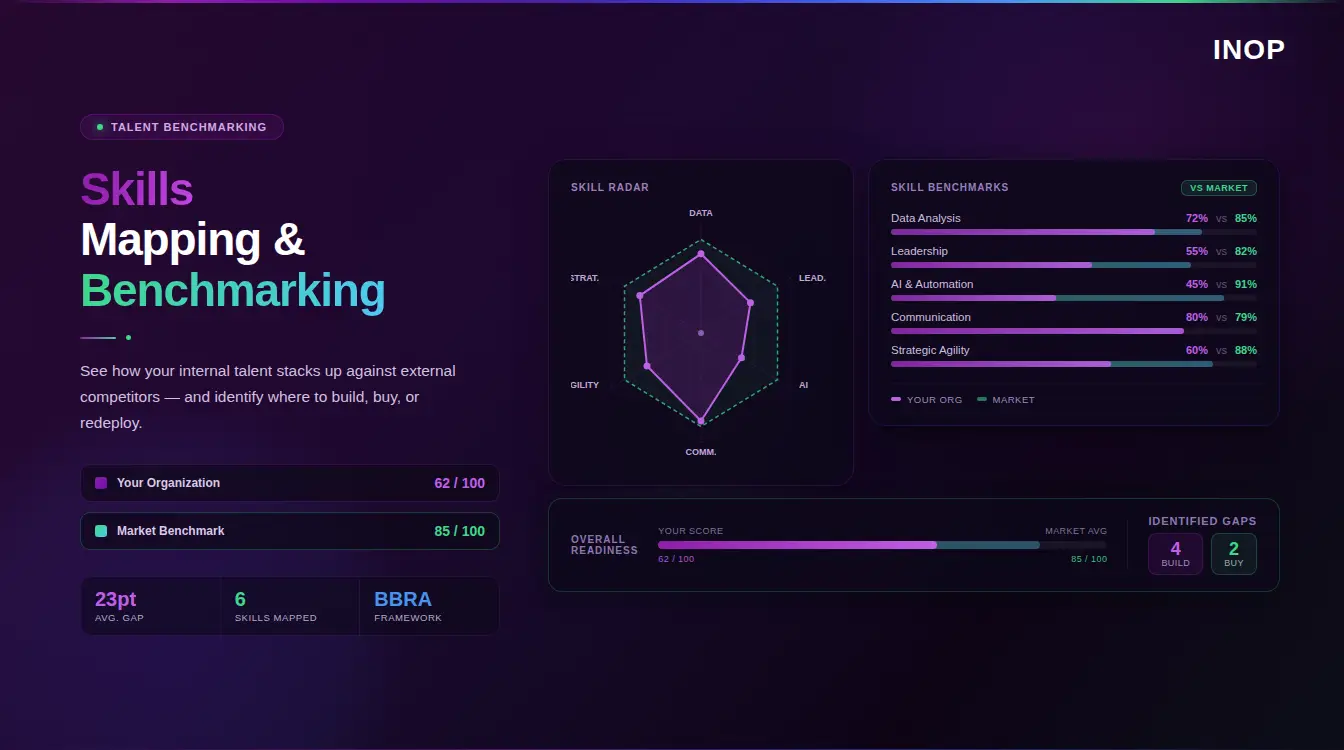
Find employees whose current skills sit closest to each destination role. A customer service agent who resolves complex complaints already holds much of what a customer success role needs. Short skill distances mean faster, cheaper reskilling and a higher completion rate. Our guide to what a skill gap is explains how to size the distance.
Which Reskilling Opportunities Should You Offer First?
Prioritise moves where three conditions meet: the destination role supports a business priority, the skill distance is short, and the people affected work in roles AI and automation will reduce. Those moves deliver value soonest and protect people whose current work is changing.
Publish the Pathway and the Destination Together
Show employees the role, the skills it needs, the gap they would need to close, the learning involved and how long it takes. LinkedIn found that learners who set career goals engage with learning four times more than those who do not. A visible destination gives people that goal.
Protect Learning Time and Make Managers Accountable
Give people paid time to learn and agree a transition date in advance. Measure managers on the number of people they develop and release into new roles, so supporting a move counts in their favour.
Measure Internal Moves
Enrolment and completion show activity. The measure that matters is how many people moved into the destination roles and how they perform there. Add cost per move, compared with the alternatives, so leaders can see the return.
How INOP Evaluates Reskilling Opportunities
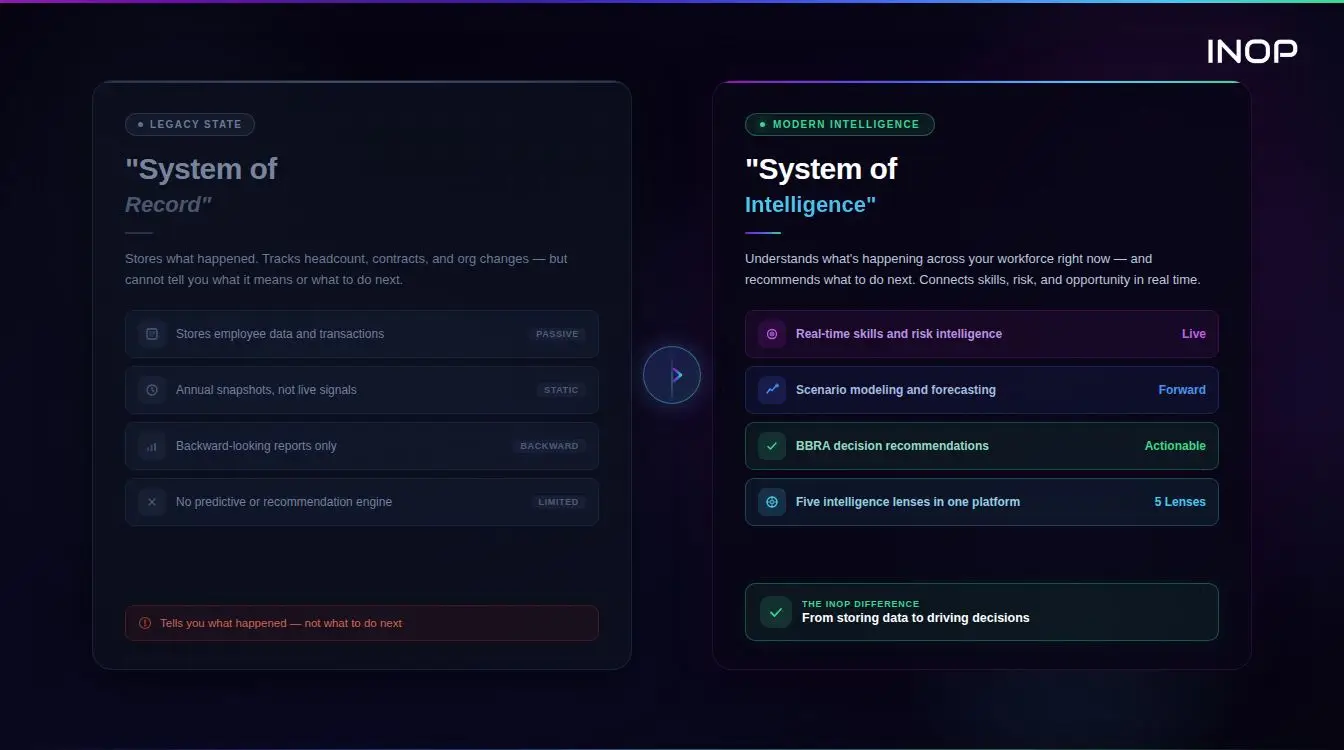
INOP starts from one question: does the organisation have the capabilities to execute its strategy today, and to stay ready as AI changes the work? A reskilling opportunity earns its place when it closes a gap the strategy depends on. INOP never assesses it in isolation. Each opportunity passes through five intelligence lenses:
| Lens | Question it answers for a reskilling opportunity |
|---|---|
| Strategy | Does the destination role support a business priority? |
| Finance | What does closing the gap cost compared with the alternatives, and what does leaving it open cost? |
| People | Are the employee’s current skills close enough for a realistic move? |
| Market | Are the required skills gaining or losing value in the external market? |
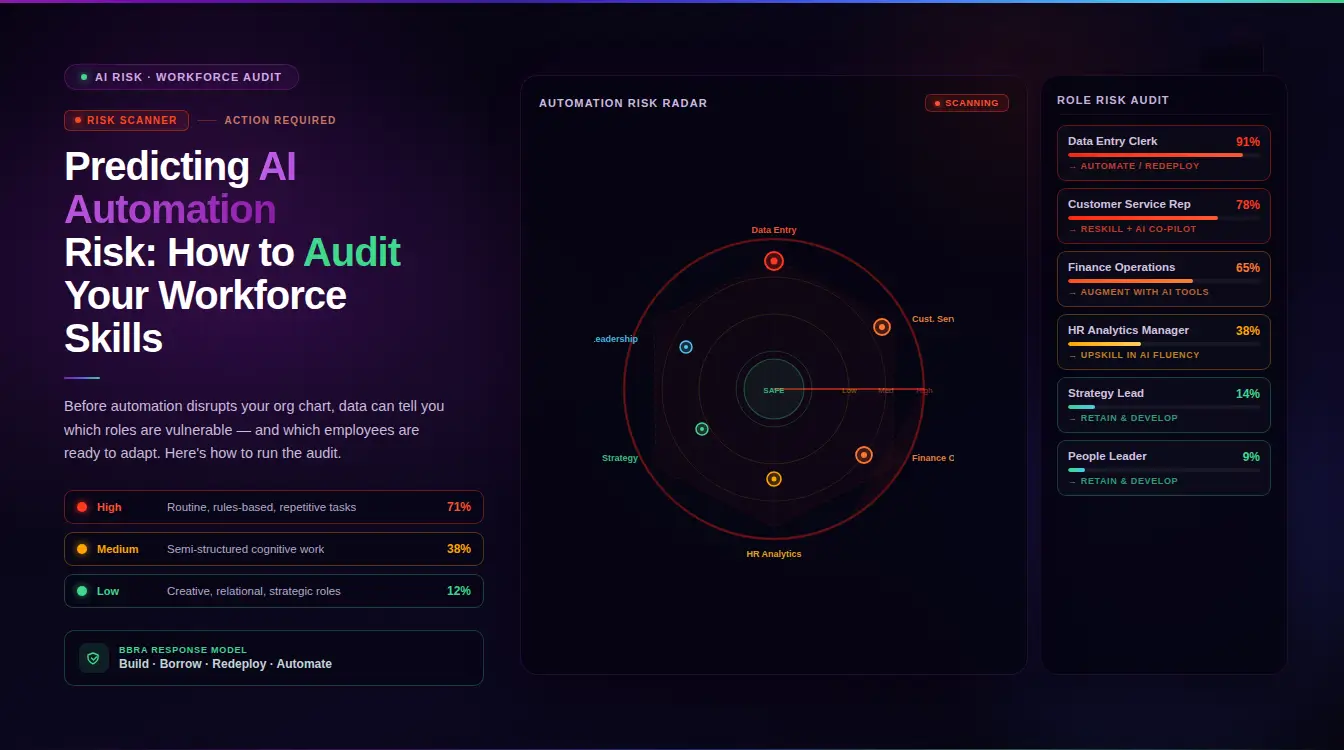
| AI and Automation | Will the destination role stay stable, or will AI change it soon? |
INOP’s skills intelligence maps external demand signals to your own taxonomy, INOP’s taxonomy or a blend of both, and classifies each skill as Emerging, In Demand, Stable or Declining. That stops you building pathways towards skills the market is leaving behind. Our case studies on companies using skills intelligence for growth show the approach in practice.
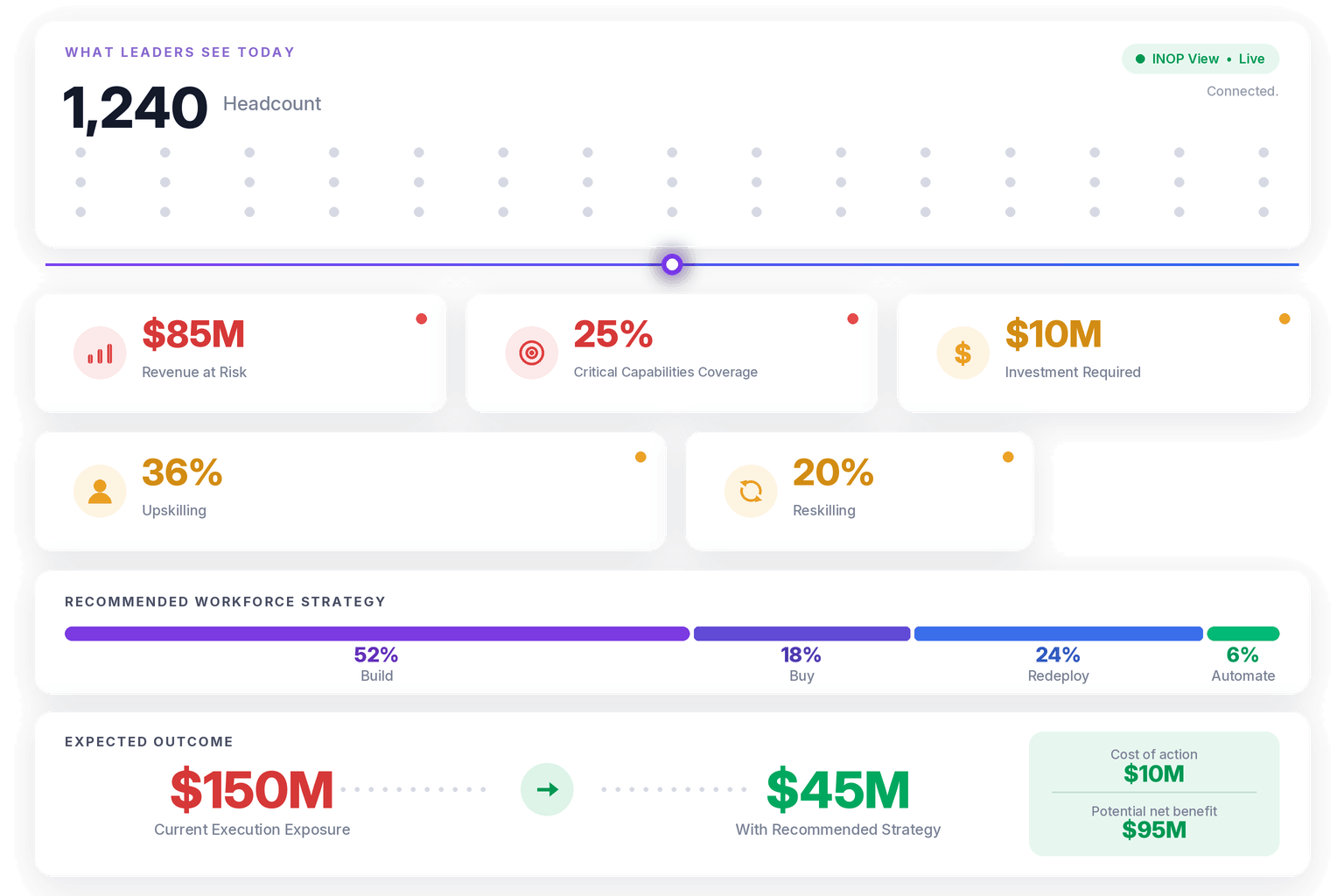
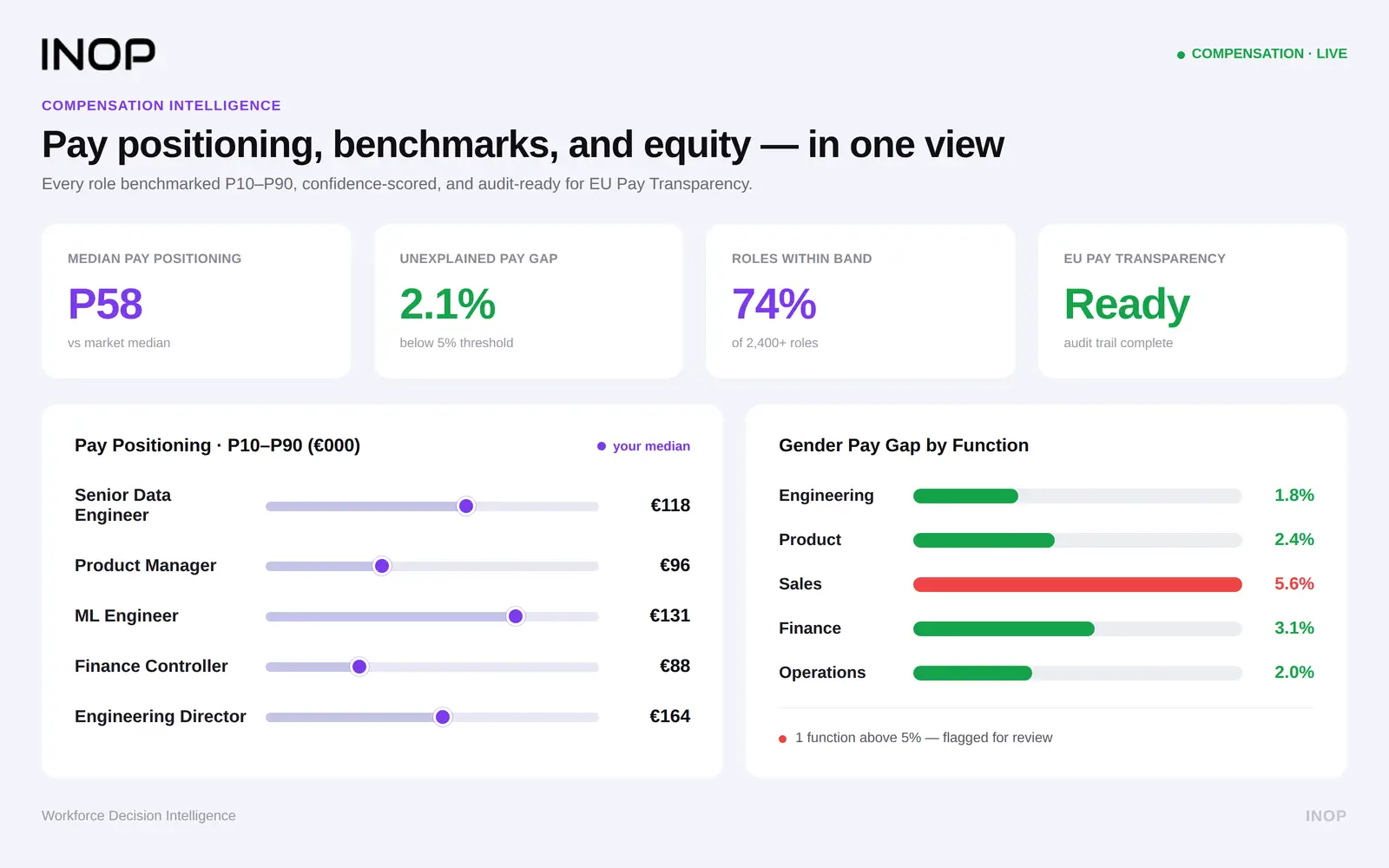
INOP’s proprietary BBRA decision architecture then compares four responses for each gap: Build, Buy, Redeploy and Automate. Build is the reskilling route. Buy brings in external capability. Redeploy moves people whose skills already fit, and Automate covers work AI can take over. INOP models each pathway with its financial trade-offs across 30-day, 180-day, one-year and three-year horizons, using pay benchmarks from its compensation analytics platform.
The strategic workforce planning platform scores readiness across five domains: Capability, Leadership, Role-Value, Mobility & Agility, and Cultural. Mobility & Agility shows how far people can move into new roles, which is the condition reskilling opportunities depend on. Strategic Execution Risk is derived from those five domains and the workforce plan, and Execution Materiality shows what each open gap costs. Together they turn a reskilling idea into a decision.
See which reskilling opportunities your strategy depends on, who is closest to each role and what every option costs. Book a demo.
Reskilling Opportunities for PE Operating Partners
High training enrolment can look like a healthy workforce in diligence while very few people change roles. Operating partners should test what a portfolio company’s reskilling opportunities deliver, not what they offer.
Where a value creation plan relies on AI or a new operating model, the company needs people who can run the redesigned work. McKinsey Global Institute estimates an additional 12 million occupational shifts in the US by 2030, so many of those moves will happen inside a holding period. Ask each company:
- How many employees moved into new roles through reskilling in the last year?
- Which destination roles does the value creation plan depend on, and how many internal candidates sit close to each one?
- What does reskilling cost per move compared with redeployment, external capability or automation?
- Does the time to proficiency fit the holding period?
INOP applies the same lenses and BBRA horizons across each company you assess, so reskilling opportunities and their returns can be compared across a portfolio on one basis.
See whether your portfolio companies can move people into the roles their value creation plans need. Book a demo.
Common Mistakes in Offering Reskilling Opportunities
- Building training without a destination role. Employees complete courses and stay where they are.
- Leaving managers out. Managers who lose team members with no recognition will slow every move.
- Measuring enrolment instead of moves. Completion rates rise while internal mobility stays flat.
- Treating every gap as a reskilling case. Some gaps close faster through redeployment, external capability or automation.
- Ignoring skill decline. Pathways into skills the market is moving away from waste budget and goodwill.
- Launching before the skills data is reliable. Inaccurate data sends people towards the wrong roles. Our article on human capital risks covers why data quality matters.
For organisations reskilling at scale, workforce transformation consulting can help design the first wave, while a platform keeps the skills data and the decisions inside the business.
Frequently Asked Questions
What makes something a reskilling opportunity rather than training?
A reskilling opportunity is a visible path to a specific new role, with a defined skills gap, a learning pathway and a commitment that people who complete it will be considered for the role. Training without a destination role is development, not a reskilling opportunity.
Why do employees not take up reskilling opportunities?
The most common reasons are no visible destination role, no protected time to learn, managers who discourage moves and low confidence that internal applicants will be considered. Fixing these four barriers does more for participation than adding courses.
How do reskilling opportunities differ from upskilling opportunities?
Reskilling opportunities prepare employees for a different role, often in another function. Upskilling opportunities deepen skills in their current role. The right choice depends on the skill distance and on whether the current role will remain in its present form.
What is the best measure of reskilling success?
The internal move rate: how many employees moved into destination roles through reskilling, and how they perform there. Add cost per move compared with the alternatives. Enrolment and completion rates show activity rather than results.
How should PE operating partners evaluate reskilling opportunities?
Operating partners should check how many people changed roles through reskilling, whether the destination roles support the value creation plan, what each move cost and whether time to proficiency fits the holding period. Enrolment figures alone can hide a programme that moves nobody.