Have you ever wondered why some businesses thrive during rapid change while others fall behind? The answer often lies in how well they understand and address their skill gaps. A skill gap — the difference between the skills employees currently have and the skills they need to succeed — can quietly erode productivity, innovation, and profitability. In today’s fast-moving job market, where technology and roles evolve quickly, identifying and closing these gaps has never been more critical.
This guide explores what a skill gap is, why it matters, and how organizations can systematically identify and close these gaps as part of a stronger, more future-ready workforce strategy. If you’re a business leader, HR professional, or team manager, this article will help you transform workforce challenges into opportunities for growth and competitive advantage.
Understanding the Concept of Skill Gaps
Before we dive into solutions, let’s clarify the skill gap meaning. A skill gap exists when the knowledge, abilities, or competencies of employees fall short of what is required for their roles — either now or in the near future.
For example, a manufacturing company may find its workforce highly skilled in traditional production methods but lacking in automation or robotics expertise. This creates an operational bottleneck and limits growth potential.
Skill gaps are not limited to technical skills. They also include soft skills, such as leadership, problem-solving, and adaptability, which are increasingly important in the era of hybrid work.
Types of Skill Gaps: Understanding What You Are Actually Dealing With
Not all skill gaps are the same, and the closure strategy that works for one type frequently does not work for another. Misdiagnosing the type of gap you are facing is one of the most common reasons skill gap programmes fail to deliver results.
Technical Skill Gaps
Technical skill gaps occur when employees lack the specific domain knowledge, tool proficiency, or methodology expertise required to perform their role at the required standard. A software engineering team without cloud architecture proficiency, a finance function without advanced data modeling capability, or a manufacturing workforce without automation programming experience all represent technical skill gaps. These gaps are typically the most straightforward to assess objectively through structured technical evaluation and the most directly connected to specific training or hiring interventions.
Digital Skill Gaps
Digital skill gaps are a specific and increasingly urgent category of technical gap, driven by the pace of technology adoption across every function. According to Deloitte’s 2025 Digital Workforce Survey, 77% of organizations identify digital skills as their most critical talent priority. Digital skill gaps are distinct from general technical gaps because they affect roles that were not previously considered technical, including marketing, finance, operations, and HR functions where digital tools are now core to job performance rather than optional enhancements. A finance analyst who cannot use advanced data visualization tools, a marketer who cannot interpret attribution data, or an HR leader who cannot navigate workforce analytics platforms all have digital skill gaps even though their roles are not classified as technical.
Soft Skill Gaps
Soft skill gaps are capability deficiencies in areas like leadership, communication, adaptability, emotional intelligence, and collaboration. They are the hardest to assess accurately because soft skills are expressed in behavior rather than demonstrated in test environments, and they are resistant to quick training interventions because behavioral change requires practice in real contexts over time. Soft skill gaps are particularly consequential at management and leadership levels, where the quality of these capabilities determines team performance, retention, and organizational culture. The gap between technical competence and leadership effectiveness is one of the most common and most costly soft skill gaps in organizations promoting high-performing individual contributors into people management roles.
Knowledge Gaps
Knowledge gaps are different from skill gaps in a specific and important way: they represent missing information or understanding rather than missing capability. An employee who understands how to conduct financial analysis but lacks knowledge of the specific regulatory framework governing their industry’s financial reporting has a knowledge gap, not a skill gap. Knowledge gaps are typically faster and cheaper to close than skill gaps because they respond to information transfer, training, documentation, coaching, and peer knowledge sharing can close them relatively quickly. Skill gaps require practice and behavioral change alongside information.
Future Skills Gaps
Future skills gaps are the capability differences between what employees can do today and what they will need to do in three to five years as technology, market dynamics, and business strategy evolve. They are the hardest to diagnose because they require predicting which capabilities will be most valuable in a future that has not yet arrived. The World Economic Forum’s 2025 Future of Jobs Report identifies that approximately 40% of core skills will change by 2030, which means most organizations have significant future skills gaps that do not yet register as performance problems because the roles requiring those capabilities do not fully exist yet.
The Real Cost of Skill Gaps in Organizations
A skill gap isn’t just a minor inconvenience, it can have significant impacts across a business. According to recent HR research:
- Companies with critical skill shortages experience up to 20% lower productivity.
- 70% of HR leaders say unfilled roles cause project delays and missed opportunities.
- Organizations that proactively close skill gaps report 50% higher retention rates.
The ripple effects go beyond operations. Skill gaps can hinder innovation, slow decision-making, and even damage customer satisfaction if employees can’t deliver to expectations.
How to Identify Skill Gaps: A Complete Step-by-Step Process
Step 1 — Connect the Analysis to Business Strategy
Every skill gap analysis should begin with the business strategy question, not the HR data question. The skills that matter are the ones required to execute your organization’s specific plan over the next one to three years. Without this anchor, skills assessments produce interesting data about the current workforce that generates no planning decisions because there is no strategic reference point to measure gaps against.
Start by identifying the three to five strategic priorities your organization is investing in over the next 12 to 36 months. Each priority requires specific capabilities. A digital transformation initiative requires data literacy and change management. A market expansion requires local market knowledge and multilingual capability. An operational efficiency programme requires process analysis and automation proficiency. The skill gap analysis is meaningful only when it measures current capability against these specific strategic requirements.
Step 2 — Build Your Skills Taxonomy
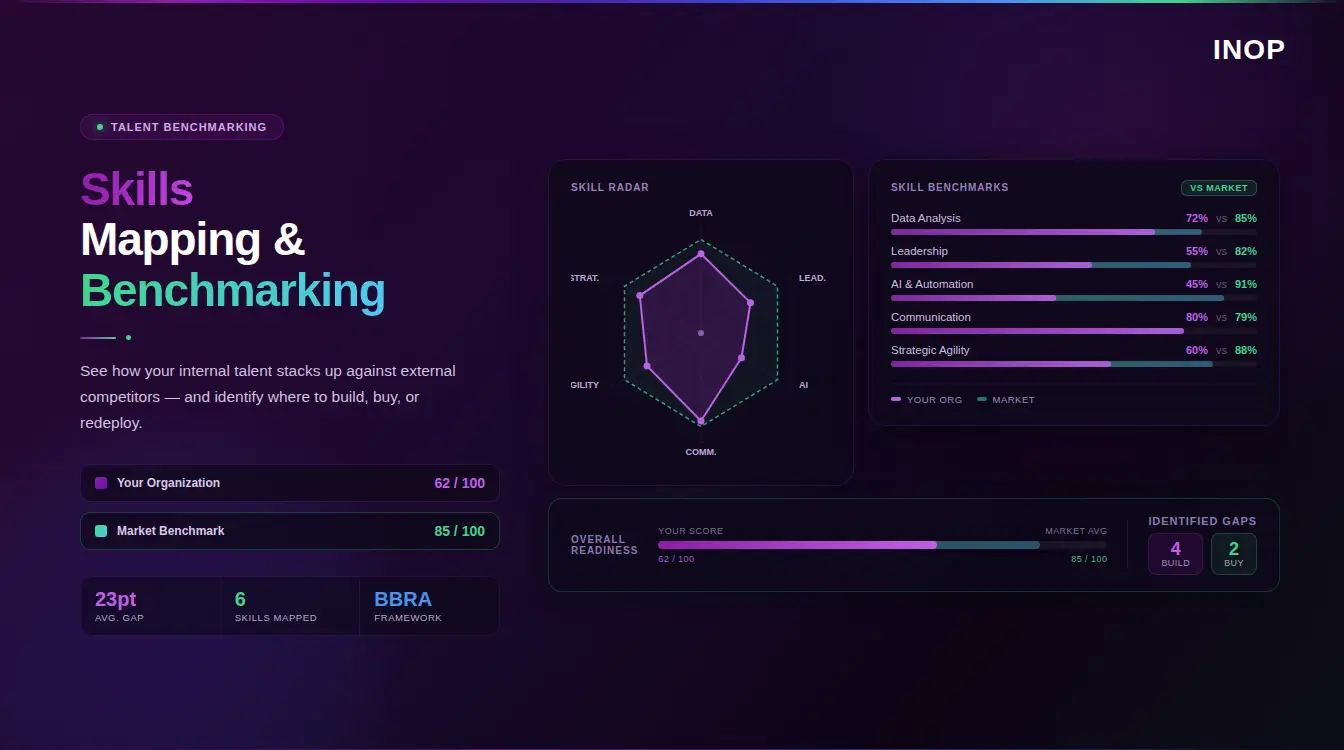
Before assessing which skills are missing, define which skills you are measuring. A skills taxonomy is a structured list of capabilities relevant to your organization’s roles and strategy, organized by category and with defined proficiency levels. The taxonomy is the shared language that makes skills data comparable across functions, managers, and time periods.
The taxonomy does not need to cover every skill in the organization at launch. Start with the skills most directly connected to your strategic priorities from Step 1, and the skills most frequently identified as gaps or competitive differentiators by your business leaders. A focused taxonomy of 50 to 100 skills with well-defined proficiency anchors is more useful than a comprehensive list of 500 skills with vague definitions.
Step 3 — Assess Current Capability Using Multiple Sources
Single-source assessment is the most common reason skill gap analyses produce unreliable data. Self-assessments alone overstate proficiency in areas where employees have low self-awareness and understate it in areas where they are outliers. Manager assessments alone introduce proximity and favoritism bias. Technical assessments alone miss behavioral and collaborative dimensions.
Combine at least three sources: structured self-assessment against the defined proficiency levels from your taxonomy; manager evaluation using the same rubric; and objective verification through technical assessments, certification records, or work product review for the skills where the gap decision will drive significant investment. The combination reduces the blind spots of each individual method.
Step 4 — Calculate and Prioritize the Gaps
For each skill and each employee, calculate the gap as the difference between required proficiency and current assessed proficiency. Then aggregate these individual gaps to the team, department, and organizational level to understand where the most significant collective shortfalls exist.
Prioritize gaps by two dimensions: business criticality and gap magnitude. A large gap in a peripheral skill is less urgent than a smaller gap in a capability central to strategic execution. Build a two-by-two prioritization matrix: high criticality and large gap equals immediate action required; high criticality and small gap equals monitor and develop; low criticality and large gap equals lower priority; low criticality and small gap equals deprioritize. This matrix prevents the common mistake of investing in closing the most visible gaps rather than the most strategically significant ones.
Step 5 — Select the Closure Strategy
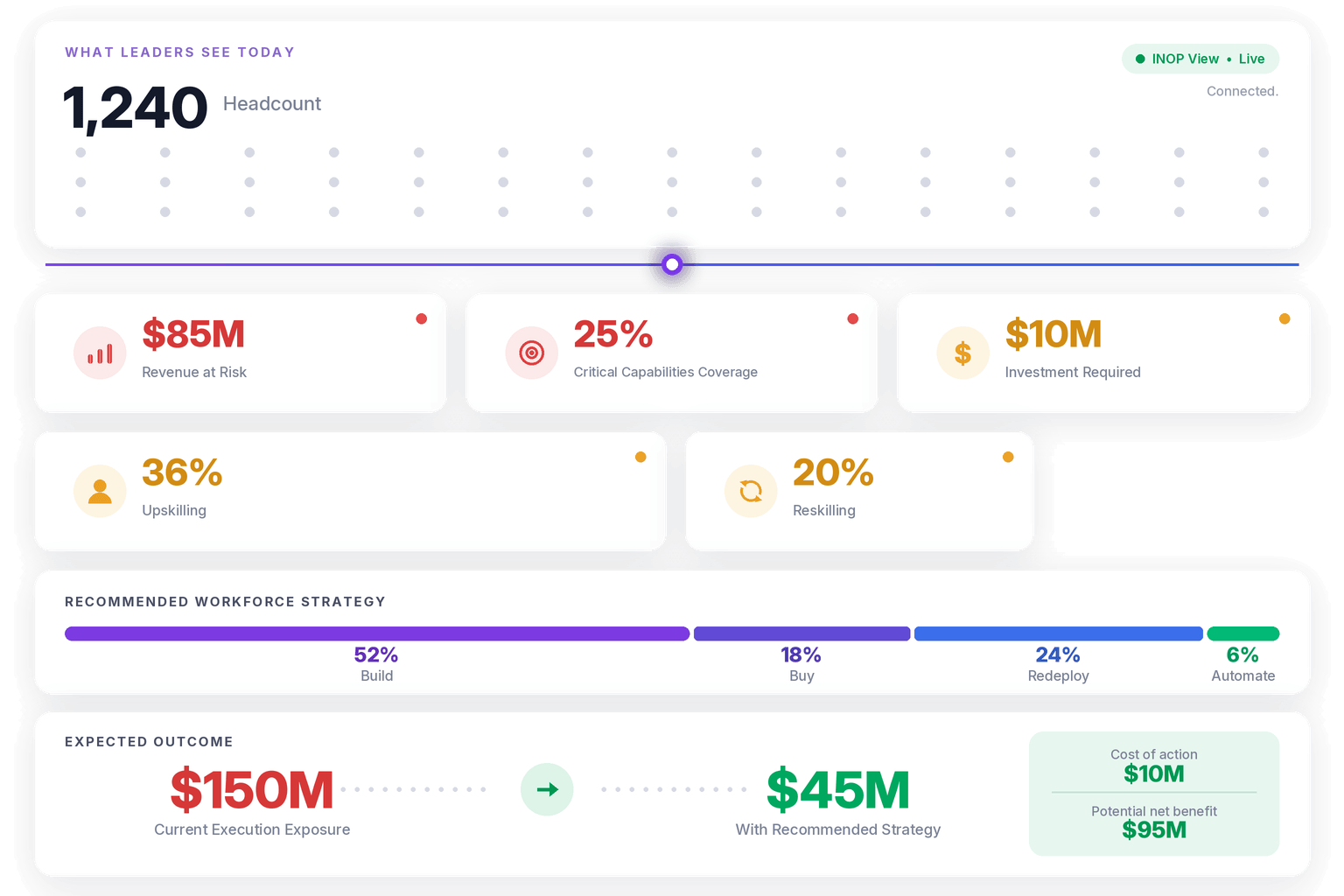
For each prioritized gap, select the appropriate response. INOP’s BBRA framework provides a practical four-pathway decision structure: Build the capability internally through training, development programmes, and stretch assignments; Buy the capability externally through targeted hiring of individuals who already hold it at the required proficiency; Redeploy internal talent with adjacent capabilities who can be developed to the required level faster than an external hire can reach full productivity; or Automate the task that required the skill, eliminating the gap by removing the human dependency on that capability.
The right choice for each gap depends on four factors: how quickly the capability is needed, how available it is in the external market, whether the gap can be closed internally within the required timeframe given the development velocity of the candidates, and what each pathway costs over a defined time horizon. For strategic capability gaps where the required proficiency is high and the development timeline is long, external hiring is often the only path that meets the business timeline. For gaps where internal candidates have adjacent capabilities and the timeline allows for development, the Build or Redeploy pathway is typically more cost-effective and produces higher retention.
Step 6 — Implement, Measure, and Refresh
Implementation requires connecting each identified gap to a specific intervention with a named owner, a defined timeline, and a success metric. A skill gap analysis that produces a list of gaps without corresponding action owners does not close gaps. It produces a report.
Measurement should track whether gaps are actually closing over the timeline committed to, not just whether training was delivered. An employee who completes a course on data visualization but whose proficiency score in the next assessment is unchanged has consumed a training investment that did not produce a capability outcome. Tracking the outcome, not the input, is what identifies whether the closure strategy is working or whether a different approach is needed.
Refresh the assessment at minimum annually for stable role types and every six months for functions in rapidly evolving domains like technology, AI, and digital marketing, where the capability landscape changes faster than annual review cycles can track.
The BBRA Framework: INOP’s Four-Pathway Approach to Closing Skill Gaps
Once skill gaps are identified and prioritized, the closure decision requires evaluating four pathways and selecting the most appropriate one for each specific gap. INOP’s proprietary BBRA framework provides a structured decision process for making this evaluation across four time horizons: 30 days, 180 days, one year, and three years.
Build means developing the capability internally through training programmes, structured development assignments, mentoring, or supported self-study. The Build pathway is most appropriate when the gap can be closed within the required timeframe using internal candidates, when the capability is one where hands-on organisational context adds significant value to the development, and when the cost of development is lower than the external market rate for the equivalent skill. The limitation of the Build pathway is time: skills that require significant practice before reaching the required proficiency level cannot be built on short timelines regardless of training intensity.
Buy means acquiring the capability through external hiring. The Buy pathway is appropriate when the required proficiency level is high and the development timeline within the Build pathway is too long to meet the business need, when the capability is not available in the existing workforce at any proficiency level, or when the cost of external hiring is lower than the cost of internal development when modeled over the relevant time horizon. The hidden cost of the Buy pathway that most organizations underestimate is time-to-productivity for external hires: an external hire who requires six months to reach full effectiveness at the role represents six months of productivity cost that a successfully Redeployed internal candidate with the same capability profile would not carry.
Redeploy means identifying internal employees whose current skills profile is closest to the required capability and moving them toward the gap, either through a role change or a temporary assignment that develops the adjacency. The Redeploy pathway is most effective when the organization has employees with adjacent skills who can reach the required proficiency level faster than an external hire and at lower total cost. It also produces higher retention than external hiring because the redeployed employee typically has stronger organizational commitment and the move is experienced as career development rather than a transactional hire.
Automate means eliminating the human dependency on the skill by deploying technology to perform the tasks that currently require it. As AI tools handle increasing proportions of routine knowledge work, the Automate pathway is becoming relevant for a much wider range of skill gaps than it was even three years ago. The key analysis for the Automate pathway is not whether the task can be automated in principle, but whether the automation is currently reliable enough to meet the required quality standard, what the implementation cost is relative to the ongoing human labor cost, and whether the people who previously performed the automated tasks can be redeployed toward higher-value work or whether workforce reduction is the likely outcome.
For each identified priority gap, model all four pathways against the required capability timeline and total cost. The optimal pathway is rarely the same across different gaps even within the same organisation.
Real-World Examples of Organizations Closing Skill Gaps
AT&T: Closing the Digital Skills Gap at Scale
AT&T’s response to identifying a fundamental digital skills gap in its workforce in 2013 is one of the most documented skill gap closure programmes in enterprise history. The company recognized that approximately half of its 250,000 employees lacked the skills the company would need within a decade as it shifted from hardware-based to software-defined infrastructure. Rather than planning a workforce replacement strategy, AT&T invested over one billion dollars in a programme called Workforce 2020, using the Build pathway to develop digital capability in the existing workforce through partnerships with Georgia Tech and Udacity.
The outcome at the programme’s ten-year mark: over 140,000 employees participated in skills development programmes, internal fill rates for technology roles improved significantly, and external hiring costs for digital roles declined as internal capability supply grew. AT&T’s case is significant not only for its scale but for its timeline: the company identified the gap and began closing it a decade before the capability crisis would have materially affected competitive position. That lead time is only available to organizations that conduct systematic skill gap analysis rather than discovering gaps when they become operational crises.
Amazon: Upskilling for Automation Transition
Amazon committed in 2019 to invest 700 million dollars to upskill 100,000 US employees by 2025, using a combination of Build and Redeploy pathways. The Upskilling 2025 programme focused on technical skills in areas including machine learning, IT, and data analysis, providing employees with pathways to move into higher-skilled roles within the company rather than facing displacement as automation changed the task composition of operational roles.
Amazon’s approach illustrates the strategic timing dimension of skill gap closure: the programme was launched when automation was beginning to reshape warehouse and logistics roles, not after it had already created workforce displacement. Organisations that identify future skill gaps and begin closure programmes while there is still sufficient runway to develop internal candidates avoid the crisis management cost that reactive responses require.
IBM: Addressing the Credential Gap to Reveal Hidden Skill Supply
IBM’s decision to eliminate degree requirements for over 50% of US positions addressed a specific type of skill gap problem: not that the skills did not exist in the available workforce, but that the credential filters used in traditional hiring were preventing those skills from being accessed. By shifting to skills-based hiring and redefining the internal talent pathways based on verified competency rather than educational credentials, IBM significantly expanded the pool of internal candidates for technical roles and reported that skills-matched candidates performed better on first-year metrics than credential-matched external hires.
IBM’s case makes a point that most skill gap frameworks miss: some apparent skill gaps are actually visibility gaps. The skills exist in the workforce but are not documented, assessed, or connected to the decision systems that could deploy them. Skills-based talent practices, supported by systematic skills mapping and assessment, surface this hidden supply before organisations default to external hiring.
Practical Ways to Close Skill Gaps
Now that you know where your competency gaps are, here’s how you can address them effectively:
Upskilling and Reskilling Programs
Investing in employee development is one of the most cost-effective strategies. For instance, a financial services company might retrain its customer service agents in data literacy to better support AI-driven tools.
Targeted Hiring
When internal training isn’t enough or is too slow, hiring for specific skills can fill immediate gaps. Recruit strategically, focusing on both technical capabilities and adaptability to future changes.
Mentorship and Knowledge Sharing
Create a culture where experienced employees pass on their expertise to others. Peer-to-peer training can speed up knowledge transfer and foster collaboration.
Leveraging Technology
Adopt learning management systems (LMS) and AI-driven talent analytics to personalize learning and measure progress. Technology can also automate repetitive tasks, allowing employees to focus on high-value work.
Closing the Digital Skills Gap: The Priority That Cannot Wait
Of all the skill gap categories requiring attention in 2026, the digital skills gap has the widest scope and the highest urgency. Digital skills are no longer the exclusive domain of technology functions — they are now required capabilities across finance, operations, marketing, HR, and customer success as these functions operate increasingly through data, analytics, and AI-assisted tools.
The scale of the gap is substantial. Deloitte’s 2025 Digital Workforce Survey found that 77% of organizations identify digital skills as their most critical talent priority, while only 23% feel their current digital skills development programmes are adequate to meet their needs.
Closing the digital skills gap effectively requires a different approach than general upskilling because digital skills span both a technical dimension and a confidence dimension. Employees often have more digital capability than they deploy, because uncertainty about whether they are using tools correctly, fear of making mistakes in data-driven processes, or discomfort with ambiguity in new digital workflows prevents them from practicing the skills they are developing. Effective digital skills programmes address both the technical proficiency and the psychological safety to apply it.
Practical interventions that work for digital skills gaps specifically include: microlearning programmes embedded in existing workflows rather than requiring employees to leave their work context for training; peer learning cohorts where employees with stronger digital proficiency share practices with those developing them; sandbox environments where employees can practice with digital tools without risk to live systems or client-facing data; and explicit connection of digital skill development to career advancement, so that employees understand that building digital proficiency has direct implications for their compensation and opportunities.
Overcoming Common Challenges
Even with the right approach, businesses often face obstacles when addressing skill gaps:
- Budget constraints – Training and development require investment, but the ROI often justifies it.
- Employee resistance – Some may fear change. Clear communication about the benefits of upskilling can help.
- Time limitations – Finding time for training can be difficult. Microlearning and blended learning models can solve this issue by offering shorter, flexible lessons.
Measuring Success After Closing Skill Gaps
Closing skill gaps is an ongoing process, not a one-time event. To measure impact, track:
- Improvement in KPIs (sales, productivity, error rates)
- Employee engagement and retention rates
- Speed of project delivery and innovation adoption
When done right, addressing skill gaps can lead to higher morale, better financial results, and a more agile organization.
Suggested Article: skill gap analysis process
Future Trends in Skill Gap Management
By 2025, more than 40% of core job skills are expected to change due to automation and AI (World Economic Forum). Businesses that build continuous learning ecosystems will have a major competitive advantage.
Expect to see:
- AI-driven skills gap analysis to predict future needs.
- Microcredentialing to certify employees quickly in niche skills.
- Blended workforce strategies combining full-time, freelance, and gig workers to stay flexible.
Conclusion
Skill gaps may seem daunting, but they are also an opportunity for growth and innovation. By taking a proactive approach to identifying and closing these gaps, you create a workforce that is resilient, engaged, and ready for the future.
Whether through upskilling, hiring, or technology, every step you take brings your business closer to its strategic goals. Now is the time to act — start your skills inventory today and make workforce development a core part of your strategy.
Have you already started addressing skill gaps in your organization? explore our Software for skills based workforce planning platform and talent development to continue building a future-ready team.
Frequently Asked Questions (FAQ)
What is a skill gap?
A skill gap is the difference between the skills employees currently possess and the skills required to perform their jobs effectively.
How do you identify skill gaps?
Through skills inventories, employee assessments, manager feedback, and comparing current capabilities with future business needs.
What is the difference between a skill gap and a skill shortage?
A skill gap occurs within an organization, while a skill shortage refers to a lack of qualified candidates in the overall labor market.
Why is closing skill gaps important?
It improves productivity, employee engagement, and organizational competitiveness while reducing turnover and project delays.
Can technology help close skill gaps?
Yes. Learning management systems, AI-driven analytics, and digital training tools can make skill development more efficient and measurable.


One reply on “Closing Skill Gaps Complete Guide to Identifying for Strategic Workforce Planning”
[…] decisions rather than HR reports. For a deeper treatment of this process, INOP’s guide on closing skill gaps for strategic workforce planning walks through the full six-step identification and closure […]