The year 2030 is close enough to plan for and far enough that most organizations are still treating it as someone else’s problem. That gap is where workforce risk accumulates.
The skills that determined professional success in 2020 are already becoming insufficient. Not because the fundamentals have changed, but because the context around them has. Artificial intelligence is not just automating tasks; it is restructuring which human capabilities carry the most economic value. Workers who understand that shift, and act on it now, will be in a fundamentally different position from those who do not.
This article maps what that shift actually looks like: what emerging skills are, how the macro trends are reshaping work, which jobs are genuinely at risk and which are not, what skills matter most by 2030, and what individuals and organizations can do about it.
What Are Emerging Skills?
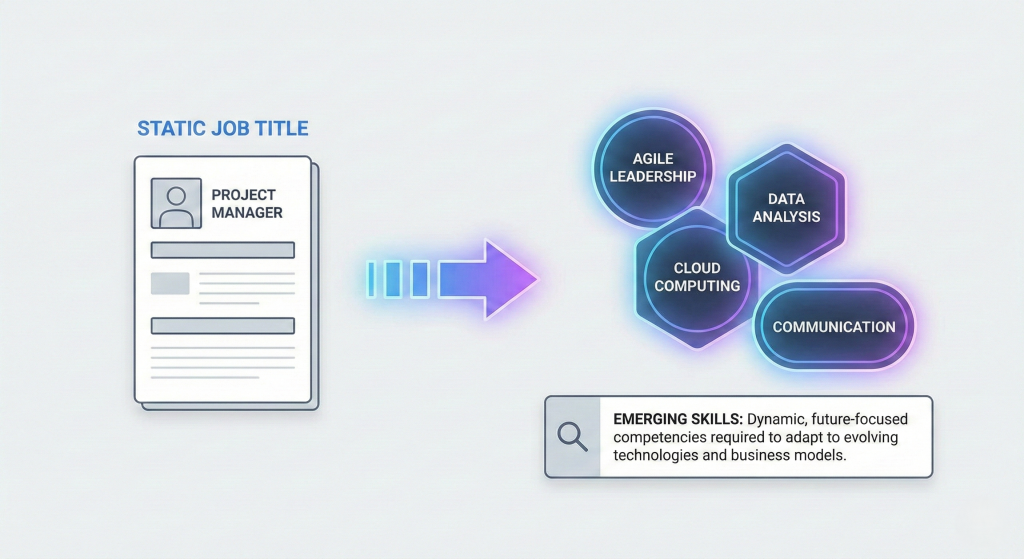
The phrase “emerging skills” gets used loosely. Used precisely, it refers to competencies that are accelerating in market demand due to a technological, economic, or social shift, while the supply of professionals who hold them has not yet caught up.
Three criteria define an emerging skill:
High growth velocity: the skill appears in job postings at an accelerating rate, faster than the workforce average. A technological or social catalyst: a breakthrough like generative AI, or a structural shift like ESG reporting mandates, is driving the demand. Low market saturation: more organizations need the skill than there are people qualified to perform it.
That last point is where emerging skills differ from skills that are simply common or valued. Supply and demand are misaligned. That misalignment creates both a risk for organizations that lack the skill and an opportunity for professionals who develop it early.
The Anatomy of an Emerging Skill
Emerging skills are not always entirely new. More often they are evolved versions of capabilities that already exist. Data analysis is a stable skill. Prompt engineering and ethical AI auditing branched off from it and are now emerging in their own right. Understanding the difference between a stable skill and an emerging one, and tracking which stable skills are generating high-value offshoots, is part of what INOP’s Skills Intelligence service does: mapping external demand signals against your existing taxonomy to show you where the frontier of your workforce’s relevance is moving.
The half-life of a learned skill is now estimated at around five years. That means what your workforce learned in 2021 may already be approaching obsolescence in some disciplines. The question is not whether your organization has the skills it needs today. It is whether you can see the gap forming before it costs you.
Examples of Emerging Skills Across Industries
| Industry | Emerging Skill | Context |
|---|---|---|
| Tech and IT | Agentic Orchestration | Designing workflows where autonomous AI agents collaborate with human supervisors |
| Business | Sustainability Management | Navigating carbon reporting requirements and green compliance frameworks |
| Healthcare | Telehealth Navigation | Managing remote diagnostics and digital patient relationships |
| Marketing | Algorithmic Literacy | Understanding how distribution algorithms shape content reach |
Understanding the Changing Nature of Work
The skills that will matter in 2030 do not exist in isolation. They are products of specific forces reshaping how work gets done, where it happens, and what economic value it generates. Three of those forces deserve particular attention.
The Acceleration of AI and Technological Transformation
Every major general-purpose technology in history, from electricity to the internet, followed the same pattern: initial disruption to existing roles, followed by the creation of entirely new categories of work that the pre-disruption world could not have anticipated. AI is following that pattern, but faster.
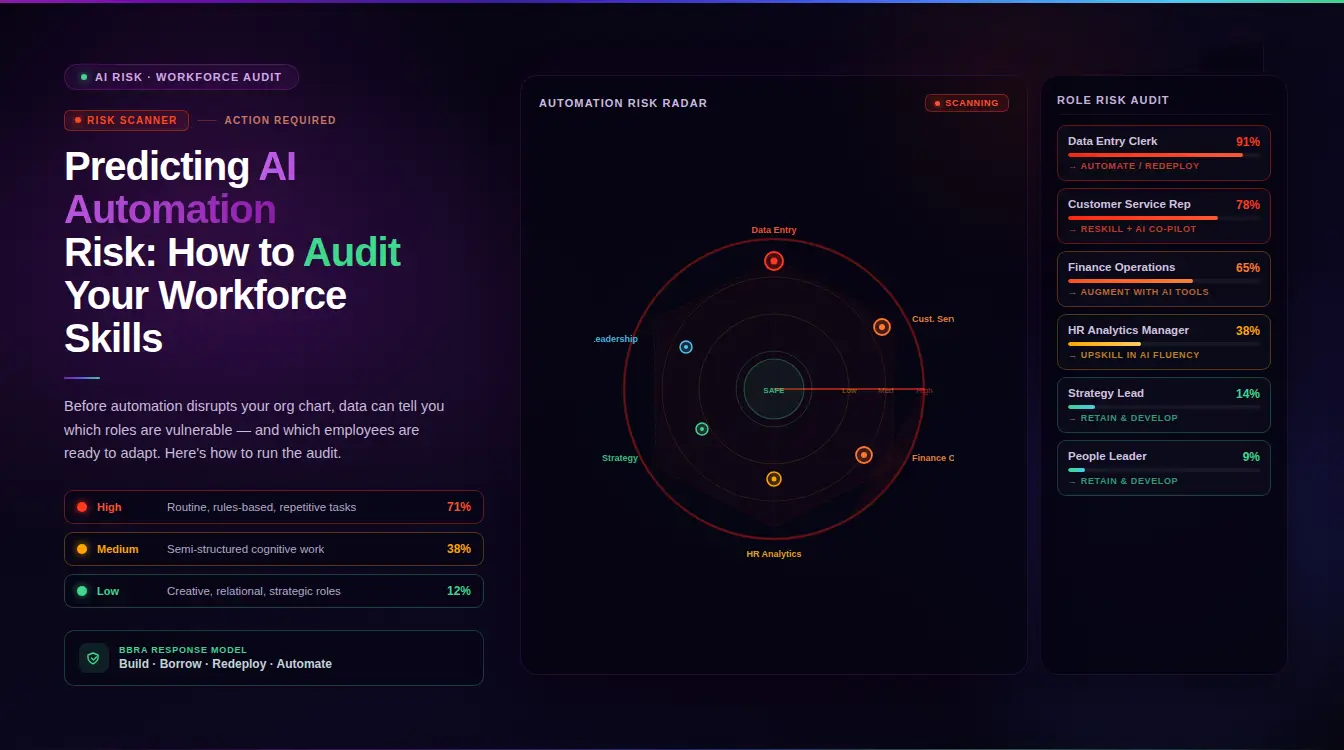
The roles most exposed are those built around predictable, rules-based tasks: data entry, standard reporting, basic content generation, routine administrative coordination. These are not disappearing overnight, but their economic value is declining, and the organizations that have not already started redeploying people in these roles are accumulating transition risk.
The roles least exposed are those that require judgment under ambiguity, sustained human relationships, physical dexterity in unpredictable environments, and ethical reasoning in high-stakes contexts. AI can support these roles. It cannot replace them.
Emerging Work Trends: Remote Work, Gig Economy, and Green Jobs
Remote and hybrid work are structural, not temporary. By 2030, a substantial share of global knowledge work will be performed outside a central office. That changes the competencies organizations need: self-management, asynchronous communication, and the ability to build trust across digital channels are moving from soft-skill extras to role requirements.
The gig and project-based economy is expanding in parallel. More professionals will operate with portfolio careers, managing multiple client relationships simultaneously rather than climbing a single organizational ladder. That model rewards the ability to signal competence quickly, adapt to new contexts fast, and manage personal brand as deliberately as any other professional capability.
Green jobs represent a third structural shift. The transition to a lower-carbon economy is creating demand for skills in renewable energy systems, circular economy design, ESG data management, and climate risk modeling. These roles are not niche. They are becoming mainstream across energy, finance, construction, and logistics.
The Human Side of Technological Growth
The more capable AI becomes at technical tasks, the more valuable genuinely human capabilities get. This is not a philosophical observation. It is a market dynamic. Organizations already competing on AI adoption are discovering that the constraint is not access to AI tools but access to people who can deploy them effectively, govern them responsibly, and communicate their outputs to stakeholders who need to act on them.
According to the Deloitte 2025 Gen Z and Millennial Survey, more than 80% of Gen Z and millennial professionals rank soft skills like empathy, adaptability, and leadership above technical expertise for career advancement. More than half of those same respondents already use generative AI tools daily. They are not choosing between human skills and AI literacy. They are building both, and they understand that the human capabilities AI cannot replicate are precisely the ones that will define career trajectory in the decade ahead.
How AI is Reshaping the Job Market
The AI Evaluation Rubric for Future-Proof Roles
The analytical concept behind this rubric is automation risk: the task-level exposure a role carries to AI or software substitution, scored by how much of the role’s weekly work sits in routine, rules-based tasks versus work requiring judgment, physical presence, or relational trust. Understanding what the term actually measures, rather than treating it as a synonym for job loss, is what makes this kind of role evaluation useful for workforce planning rather than just anxiety management. Organizations cannot design effective workforce strategies without a clear framework for assessing which roles are genuinely at risk and which are not. The following three-factor rubric provides that clarity.
The organizational dimension of this shift is captured in a single statistic: only 23% of business leaders currently say their workforce is fully prepared for AI, and that number has been declining even as adoption accelerates. Building an AI enabled workforce is the organizational response to the skills agenda these rubrics describe, connecting individual AI capability development to the governance, role redesign, and cultural infrastructure that determines whether those skills actually get used.
Roles with high routine and repetitive task load are most exposed. AI processes rules-based, predictable workflows faster and more accurately than humans, and the cost advantage compounds over time. If a role’s primary output can be described as executing a defined sequence of steps, that role needs to be assessed honestly.
Roles requiring complex human empathy are far more resilient. Jobs that center on psychological support, high-trust relationships, conflict resolution, or nuanced communication in emotionally charged situations do not have a near-term automation path. The demand for this capability is increasing as AI handles the analytical substrate of work and humans are expected to handle the relational layer.
Roles requiring strategic judgment in ambiguous situations are also highly resilient. AI performs well with historical data in well-defined problem spaces. It performs poorly in novel situations where the right answer is not derivable from precedent. Executives, senior strategists, complex negotiators, and crisis managers operate in exactly those conditions.
What Jobs Will AI Replace by 2030? (And How to Pivot)
The roles at highest displacement risk share a common profile: they are high in rule-based task volume, low in relationship complexity, and their outputs can be evaluated by a machine.
Basic data entry and processing roles are already being automated. The pivot path is upskilling toward data interpretation, AI governance, or analytical communication: the work that happens after the data is collected, not during.
Routine administrative support, including scheduling, basic customer service, and standard bookkeeping, is being handed to AI agents at an accelerating rate. The pivot path moves toward strategic operations, complex stakeholder management, and the coordination work that requires human judgment rather than process execution.
Entry-level content generation, including basic copywriting and translation, is heavily automated. The pivot path leads toward context engineering and editorial strategy: shaping what the AI produces rather than producing content directly.
The underlying principle is consistent: professionals who position themselves as supervisors and directors of AI output will be far more durable than those who position themselves as competing with it for the same tasks.
Future-Proof Jobs Not Affected by Automation (2026 to 2030)
Resilience in the 2030 job market concentrates in three areas: complex physical dexterity, high-level strategic oversight, and deep human psychology.
Strategic HR leaders and workforce planners will remain essential. AI can map skills and model scenarios. Aligning human capital to business strategy, managing organizational culture through change, and navigating the political and relational complexity of people decisions at scale requires human judgment and organizational credibility that no system can substitute.
Complex B2B sales directors operate in a space where relationship trust, situational reading, and multi-year stakeholder management determine outcomes. Transactional sales is automatable. High-ticket enterprise sales built on trust and nuanced negotiation is not.
Healthcare professionals in therapeutic, nursing, and specialist roles anchor their work in physical care and human connection during vulnerable moments. AI will transform diagnostics and clinical data management. The delivery of care will remain a human responsibility.
AI orchestrators and ethics professionals are themselves emerging as a resilient category. As AI systems proliferate, organizations need people who can govern them, audit them for bias, ensure regulatory compliance, and make judgment calls about when human intervention is required. This is a growth area, not a contraction one.
Emerging Jobs: Roles That Do Not Exist Yet (AI, Climate, and Biotech)
The most consequential emerging roles sit at the intersection of AI, climate, and biotechnology.
AI Ethicist and Governance Auditors ensure that corporate AI systems comply with regulations like the EU AI Act, operate without discriminatory bias, and align with organizational values. As AI embeds itself in hiring, credit, healthcare, and criminal justice, this role carries serious legal and reputational weight.
Chief Prompt and Context Officers are emerging in organizations that depend on consistent, high-quality AI outputs at scale. This is a strategic role: overseeing how an entire organization communicates with large language models to maintain quality, security, and brand alignment.
Human-Machine Teaming Managers sit at a new intersection of HR and operations, designing and optimizing workflows where human employees and autonomous AI agents collaborate on the same work streams.
Climate Tech Integration Specialists combine AI modeling capability with sustainability expertise, optimizing enterprise carbon footprints using predictive analytics and managing the data infrastructure behind carbon disclosure requirements.
The Crucial Skills You Need for 2030
Technical AI Skills: Agentic Orchestration, Context Engineering, Governance
The most valuable AI technical skills by 2030 are not the ones most people are developing today.
Agentic orchestration is the ability to design workflows where autonomous AI agents take independent actions toward a defined goal, interacting with each other and flagging exceptions for human review. This goes far beyond writing prompts. It requires understanding how to map business processes into automated chains, which agent frameworks are appropriate for which tasks, and where human oversight needs to be embedded to catch errors before they compound.
Context engineering is the evolution of prompting. Basic prompt writing is already approaching commodity status. Context engineering, specifically providing an AI system with the right proprietary data, constraints, and operating parameters to produce consistent, high-stakes outputs, is the high-value skill. Retrieval-Augmented Generation management, ensuring AI systems draw on the right organizational knowledge before generating responses, sits at the center of this capability.
The reason AI oversight sits so high on the 2030 skills priority list is visible in current deployment data. AI workforce automation at enterprise scale produces an average of 54 agent incidents per year in organizations that have moved to production, more than a third of which lead to data exposure or a breach. Employees who can monitor agent outputs, catch errors before they propagate, and know when to override an automated decision are not a transitional role. They are the governance layer that makes production-grade automation sustainable.
AI governance and trust engineering addresses the regulatory and ethical layer. The EU AI Act, and the regulatory frameworks following it globally, require organizations to demonstrate that their AI systems are auditable, unbiased, and transparent. Professionals who can conduct algorithmic audits, ensure AI sovereignty compliance, and run adversarial testing to identify system vulnerabilities are in high demand and will remain so.
The Human Advantage: Cognitive Flexibility, EQ, and Creative Thinking
The skills that AI cannot replicate are not soft in the sense of being easy. They are hard in the sense that they require sustained development and cannot be automated.
Cognitive flexibility, the ability to shift between different conceptual frameworks and adapt to rapidly changing priorities, is foundational for work in environments where conditions change faster than documented processes can keep up with. A data analyst who can combine statistical reasoning with ethical consideration when interpreting AI outputs that affect people’s livelihoods is not performing a soft skill. They are performing a high-complexity judgment function.
Emotional intelligence is becoming a structural differentiator as AI absorbs the analytical substrate of work. In healthcare, high-stakes negotiation, leadership, and any context where trust is the primary currency, the ability to read, understand, and respond to human emotional states is irreplaceable.
Creative thinking remains one of the most durable advantages a professional can hold. AI can generate options. It cannot determine which option resonates, challenges convention productively, or opens an entirely new solution space. The creative judgment to know which AI output is worth pursuing is itself a skill.
The Human-Technology Balance: Collaborative Intelligence
The most effective model for 2030 is not human or AI. It is human with AI, where each handles what it does best. AI processes data, surfaces patterns, executes routine sequences, and generates options at scale. Humans exercise judgment, maintain relationships, navigate ethics, and make decisions in contexts where the right answer is not derivable from prior data.
Building that collaborative intelligence means developing the meta-skill of knowing when to trust AI output, when to interrogate it, and when to override it. The professionals who develop that judgment early will be the ones organizations reach for when the stakes are highest.
| Skill Category | Priority in 2026 | Evolution by 2030 |
|---|---|---|
| Technical | MLOps and AI infrastructure | Autonomous system maintenance |
| Operational | Advanced prompting | Agent orchestration |
| Ethical | Bias detection | AI governance and compliance |
| Human | Adaptability | Strategic judgment and empathy |
Future Skills by Industry
Technology and engineering professionals will need AI programming, cybersecurity, and systems design as baseline competencies, with ethical understanding and cross-functional communication distinguishing top performers.
Healthcare workers will combine clinical knowledge with data interpretation, telehealth systems, and the interpersonal skills that patient trust requires. The data layer of healthcare will be largely AI-managed. The care layer will remain human.
Education professionals in 2030 will act more as learning architects than instructors, designing personalized digital experiences and developing the socio-emotional intelligence to support learners through increasingly complex, self-directed paths.
Business and marketing professionals will rely on predictive analytics, consumer psychology, and narrative skills. The ability to translate AI-generated insight into a compelling human story will be a premium capability.
Creative industry professionals will use generative AI as a production accelerator while retaining the editorial and aesthetic judgment that determines what is worth producing. Human creative direction will become more valuable as AI generation becomes cheaper.
Preparing Yourself for the Future Workforce
Advice for Students: Preparing for Careers in 2030
The question students face is not which information to memorize. It is which capabilities to build. AI will always outperform any human at data recall. The strategy of competing on knowledge volume is a losing one.
The effective strategy is developing learnability alongside AI literacy. Practicing empathy, critical thinking, and adaptability while building comfort with AI tools as collaborative instruments is the combination that holds value through 2030 and beyond. Students who graduate with both the human capabilities that AI cannot replicate and the AI fluency to work alongside it will enter the market with a profile that most of their peers will not have.
Specific entry points: take courses in data literacy and analytical communication. Build experience with generative AI tools in real work contexts. Develop and demonstrate emotional intelligence through leadership roles, mentorship, and cross-cultural collaboration. Create a portfolio that shows judgment, not just output.
Best Skills for Entrepreneurs in 2030
The opportunities for founders in 2030 are concentrated at the intersection of AI with hard-science domains: climate technology, biotechnology, and sustainable systems. Building a basic SaaS application will be insufficient to attract serious venture capital. The premium is on founders who can apply AI to problems with genuine scientific and physical complexity.
Cross-disciplinary literacy will be a defining founder skill: the ability to communicate fluently with software engineers, biological scientists, and climate policy regulators simultaneously, and to synthesize their inputs into coherent product strategy. AI orchestration will matter more than coding. Founders who can design autonomous systems to accelerate research and development will move faster than those building manually. And as regulatory frameworks around AI and biology tighten, ethical scaling, building compliant, responsible, and sustainable business models from the start, will be a competitive advantage rather than a compliance cost.
Building a Personalized Development Plan and Personal Brand
Effective preparation starts with an honest assessment of where you currently stand. Map your existing skills against the categories described in this article. Identify which of your current competencies are in the high-resilience zone, which are in the high-risk zone, and which emerging skills are most adjacent to your existing strengths.
From there, build a development plan around three to five specific competencies rather than attempting to cover everything. Prioritize skills that align with both your professional direction and the most pressing demand signals in your industry. Take courses and micro-credentials, but apply new knowledge to real projects immediately. Learning without application decays quickly.
On personal brand: your network and your visible body of work matter more in a portfolio economy than in a traditional employment model. Creating content, publishing thought leadership, and building relationships across industries signal the forward-looking profile that organizations and clients will pay a premium for in 2030.
How Organizations Can Close the 2030 Skills Gap
Fostering a Culture of Learning and Inclusion
Organizations that invest in continuous learning consistently outperform those that treat training as a cost to minimize. The investment is not just in training programs. It is in the organizational conditions that make learning a daily behavior rather than an annual event.
Practical actions include creating internal learning cohorts, offering micro-credentials tied to specific role requirements, and celebrating employees who apply new skills to real problems. Inclusion matters in this context because diverse teams consistently generate more creative and resilient problem-solving. If your learning culture only reaches certain demographics or levels, you are leaving capability development on the table.
Redesigning Work Environments for AI Integration
Flexibility is now a baseline expectation, not a perk. Remote options, flexible schedules, and collaborative digital infrastructure are prerequisites for accessing the talent pool that 2030 will require. But beyond logistics, organizations need to redesign work itself to reflect the human-AI collaboration model.
That means identifying which tasks in each role are appropriate for AI delegation, building the systems that enable it, and redeploying the human time that gets freed up toward the higher-judgment work that creates more value. Organizations that treat AI as a replacement will lose employees. Those that treat it as an augmentation tool will attract the professionals who want to work at the frontier.
Organizations Already Closing the Gap
The organizations best positioned for 2030 are already taking three specific actions. They have conducted role-level competency mapping against projected 2030 demand, not at a category level but function by function and role by role. They have quantified the gap in financial terms: the cost of building capability internally through upskilling versus buying it through external hiring versus automating the function. And they have built a rolling view of which roles in their organization are becoming obsolete and which new roles need to be created, acting on that view before the market forces their hand.
Book a demo with INOP to see how leading organizations are mapping their 2030 capability exposure today.
What This Means for Workforce Leaders: The Automation Accountability Gap
Reading this as an individual professional is one thing. Leading an organization of several hundred or several thousand people through this transition is another.
The skills described in this article are already appearing in competitor job postings, already creating capability gaps in current workforces, and already driving compensation premiums in markets where demand outstrips supply. The question for CHROs and workforce planning leaders is not whether these shifts are real. It is whether your organization can see them in time to act.
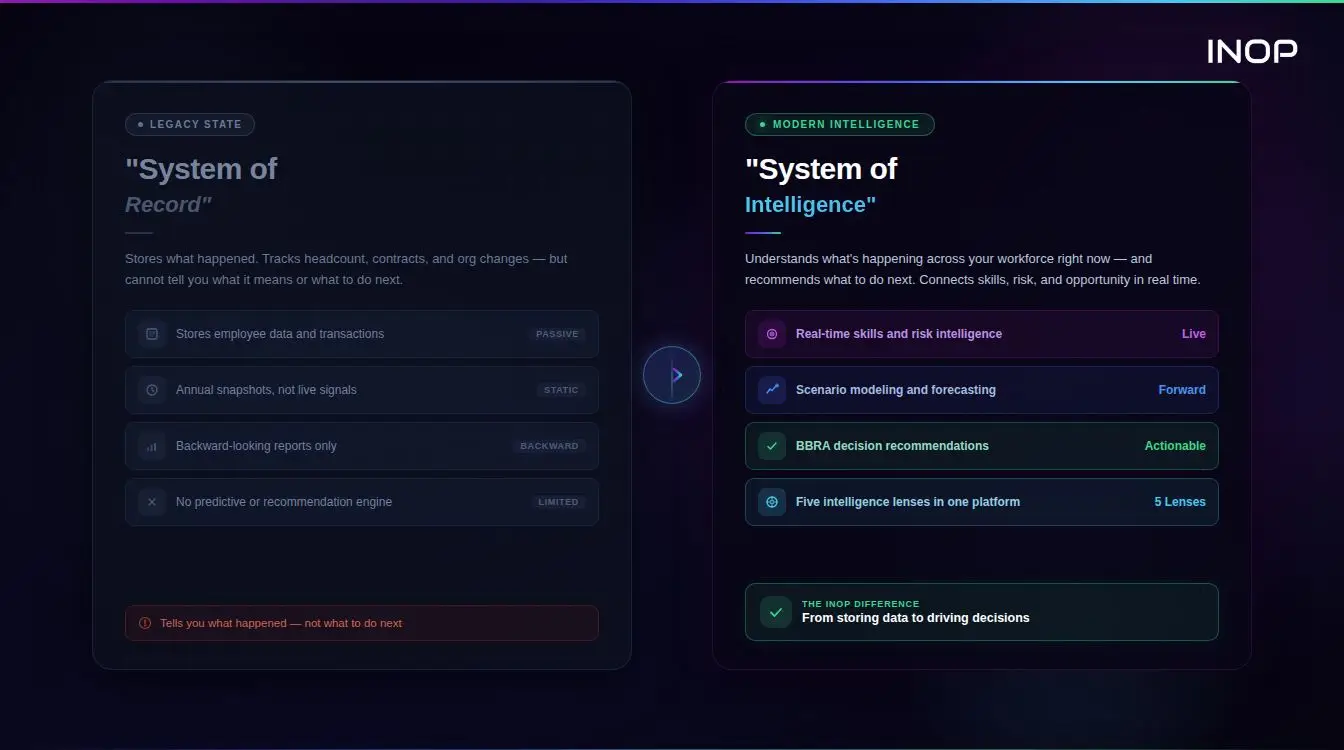
Most cannot, yet. The limiting factor is not ambition or investment. It is visibility. Organizations lack a real-time, integrated view of how their current workforce capability maps against the skill demand landscape emerging for 2030. They have HR systems that record what employees have done. They do not have a forward-looking intelligence layer that shows what the market will require and where the gap between current state and future requirement is widening.
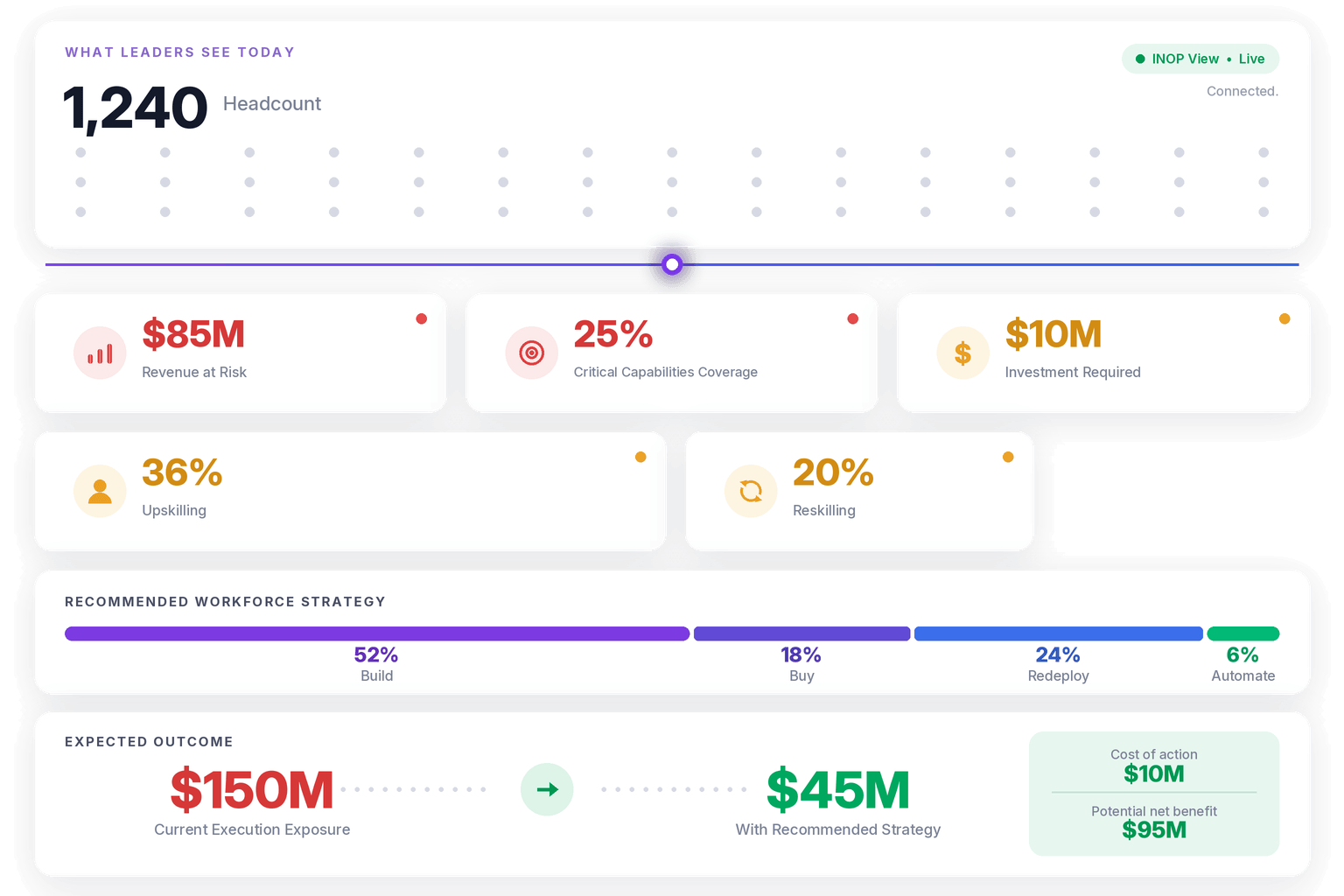
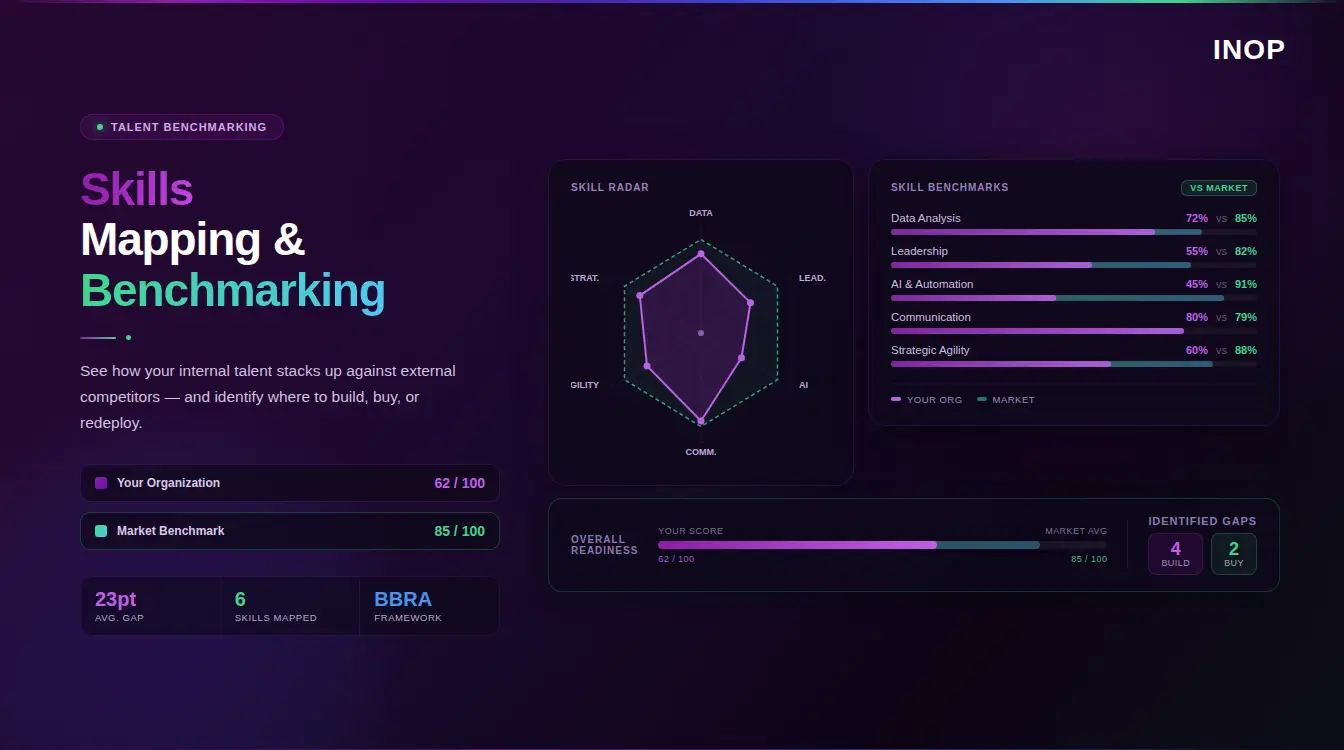
INOP’s Strategic Workforce Planning platform provides exactly that: connecting current workforce data with real-time external skills demand to produce a forward-looking view of capability exposure, mapped against your organization’s specific strategic priorities and modeled across four time horizons. INOP’s BBRA framework, INOP’s proprietary decision architecture for workforce action, structures the response across four pathways: Build capability internally through development, Buy it through external hiring, Redeploy existing talent from lower-priority areas, or Automate the underlying work. Applied at scale, with INOP’s five intelligence lenses across Strategy, Finance, People, Market, and AI and Automation, this is what workforce readiness for 2030 actually looks like in practice.
See how INOP maps your organisation’s 2030 skills gap in a 20-minute demo.
The Road to 2030 and Beyond
Preparing for 2030 is not about predicting one fixed future. The specific roles and technologies that will define 2030 are not fully knowable today. What is knowable is the direction of travel and the types of capability that will hold value regardless of how specific technologies evolve.
Professionals who remain agile in their learning, who develop both AI fluency and the human capabilities AI cannot replicate, and who build genuine expertise in domains where judgment under complexity is required, will find themselves well positioned regardless of how the specifics unfold.
Organizations that build the intelligence infrastructure to see their capability gaps forming, and that respond with the decisiveness and financial clarity that BBRA provides, will be able to shape their workforce for 2030 rather than scrambling to react to it.
The workforce of 2030 is being built right now, in the learning choices professionals make, the development investments organizations fund, and the strategic bets CHROs place on where capability will matter most.
FAQ
What exactly are “emerging skills”?
Emerging skills are competencies accelerating in market demand, driven by a specific technological or structural shift, while qualified supply has not yet caught up. They differ from stable skills in that the demand-supply imbalance is active and widening, which creates both organizational risk and individual opportunity for those who develop them early.
Is AI taking over jobs?
AI is taking over specific tasks within jobs, particularly those that are rules-based, repetitive, and high in volume. It is displacing some roles, particularly in data entry, routine administrative work, and entry-level content generation. Simultaneously, it is creating entirely new categories of work in AI governance, orchestration, and human-machine teaming. The net effect on total employment is still being determined, but the composition of what work looks like will shift substantially by 2030.
What skills should I learn to survive and thrive in 2030?
Prioritize capabilities AI cannot replicate alongside the literacy to work with AI systems effectively. Critical thinking, emotional intelligence, cognitive flexibility, and ethical reasoning are the high-resilience human skills. Agentic orchestration, context engineering, and AI governance are the high-value technical skills. The combination of both is what commands a premium in the 2030 market.
Are there jobs completely immune to AI?
No job is completely immune to AI’s influence. But many roles are highly resilient because they require a combination of physical presence, psychological trust, and judgment in genuinely novel situations that AI cannot navigate reliably. Healthcare professionals, strategic HR leaders, complex enterprise sales directors, and AI ethics specialists fall into this category.
Why are creativity and social intelligence so essential?
As AI absorbs the analytical and procedural substrate of knowledge work, the value of what AI cannot do rises in relative terms. Creativity determines which of AI’s generated options are worth pursuing. Social intelligence enables the trust-based relationships, political navigation, and emotional attunement that organizational life requires. Both are becoming more economically valuable, not less, as AI capability expands.