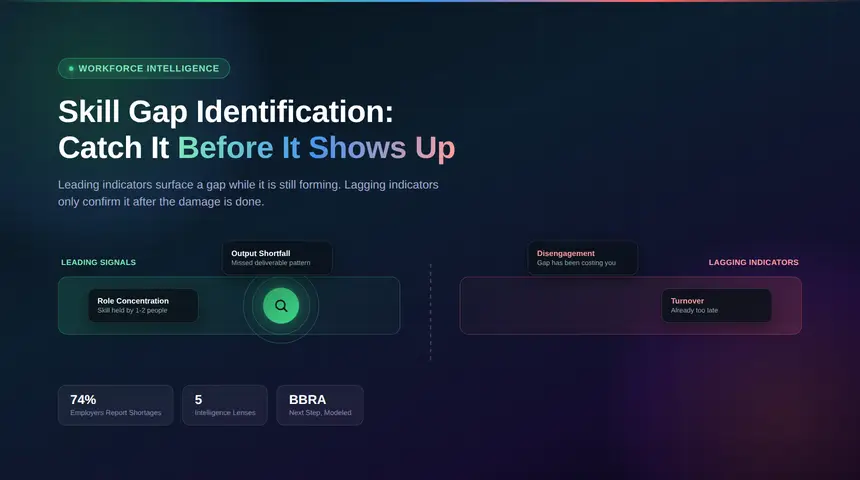
Skill gap identification is the process of recognizing that a capability shortfall exists before it shows up as a missed target, a stalled project, or an employee who quietly leaves because they were set up to fail. Most organizations still identify gaps the hard way, after they have already cost something. By the time turnover, disengagement, or a blown deadline makes a gap obvious, the organization has been operating with that gap for months.
This guide covers what separates early skill gap identification from the after-the-fact version most teams practice, the specific signals worth tracking, and how to connect identification to an actual response rather than a delayed reaction.
What Is a Skill Gap?
Before going further, it helps to be clear on what is a skill gap in the first place: the difference between the skills your workforce currently has and the skills your business actually needs to hit its goals. It rarely means employees are unqualified. Roles change faster than most development programs do, and the gap opens in that space between what a job used to require and what it requires now.
Skill gaps generally fall into three categories. Hard skill gaps are the most measurable, a specific technical ability a role requires that nobody on the team currently has. Soft skill gaps are harder to spot but often more damaging, showing up in how people communicate, lead, and handle conflict rather than in a checklist. Future skill gaps do not hurt the business today, but they will, since they represent capability the organization will need well before it becomes urgent.
Skill gaps also split into two different problems that need two different fixes. An individual skill gap sits with one employee whose role has outpaced their current capability, and targeted training or mentorship usually closes it. An organizational skill gap is systemic, a capability the company as a whole lacks, which no amount of training for a single employee will solve on its own. Confusing the two is a common reason skill gap initiatives stall: an organizational gap gets treated with an individual-level fix and the underlying shortfall never actually closes.
What Skill Gap Identification Actually Means
Skill gap identification is distinct from a full skill gap assessment. Identification is the earlier, ongoing step of noticing that a gap likely exists somewhere. Assessment is the deeper measurement that follows once identification has flagged a specific area of concern. Treating the two as the same exercise is part of why so many organizations only catch gaps once they have already become expensive.
SHRM’s own Chief Human Resources Officer, Jim Link, has been direct about where most organizations look for these signals and why it is the wrong place. Many people believe warning signs are decreased engagement, negative survey results, and higher absenteeism and turnover, but those are lagging indicators, not identification tools, according to SHRM’s research on addressing manager skill gaps early. By the time those signals appear, the gap has already been costing the organization for a while.
Why Most Organizations Catch Skill Gaps Too Late
The gap between when a skill shortfall actually starts and when an organization notices it is where most of the damage happens. Two structural habits explain why that gap stays so wide.
Lagging Indicators Arrive After the Damage Is Done
Turnover, disengagement scores, and absenteeism are real signals, but they are downstream of the actual problem. Link’s recommended alternative is to watch leading indicators tied to business or product performance instead, using the example of a manufacturing line manager who should be producing five thousand units a shift and is only producing four thousand. That shortfall is the first sign something is wrong, and it shows up well before engagement scores or exit interviews would ever surface it.
Leading Indicators Get Overlooked Without a System to Track Them
Knowing that leading indicators exist is not the same as having a system built to catch them. Most organizations still rely on periodic surveys and annual reviews as their primary identification method, which means a gap that emerges in month two of a planning cycle will not surface until the next scheduled check-in, if it surfaces at all. Globally, around 74 percent of employers report difficulty finding the skilled workers they need, according to recent research on forecasting workforce skill risk, a scale of mismatch that periodic, backward-looking identification methods are poorly equipped to catch early.
See how INOP flags emerging skill gaps before they show up in turnover or performance data. Book a demo to walk through live identification signals for your workforce.
The Signals That Actually Identify a Skill Gap Early
A handful of specific, trackable signals catch gaps well before lagging indicators would.
Role Concentration and Single Points of Failure
When a specialized capability lives in only one or two people on a team, that concentration is itself an identification signal, regardless of whether anyone has indicated intent to leave. Tracking which skills exist in only a narrow slice of the workforce, and treating those as at-risk by default, catches a structural gap long before it becomes a crisis, a pattern detailed in recent research on detecting talent gaps early through workforce analytics. Utilization imbalances, where a small subset of a team carries a disproportionate share of a specific type of work, surface the same risk from a different angle.
Output and Performance Signals at the Team Level
Following Link’s manufacturing example, the same principle applies well beyond factory floors. A team consistently missing a specific type of deliverable, or consistently needing rework on a particular category of task, is signaling a capability shortfall long before a performance review would name it directly. These signals require watching output patterns at the task level rather than waiting for an aggregate performance score to reflect the problem.
External Market Divergence
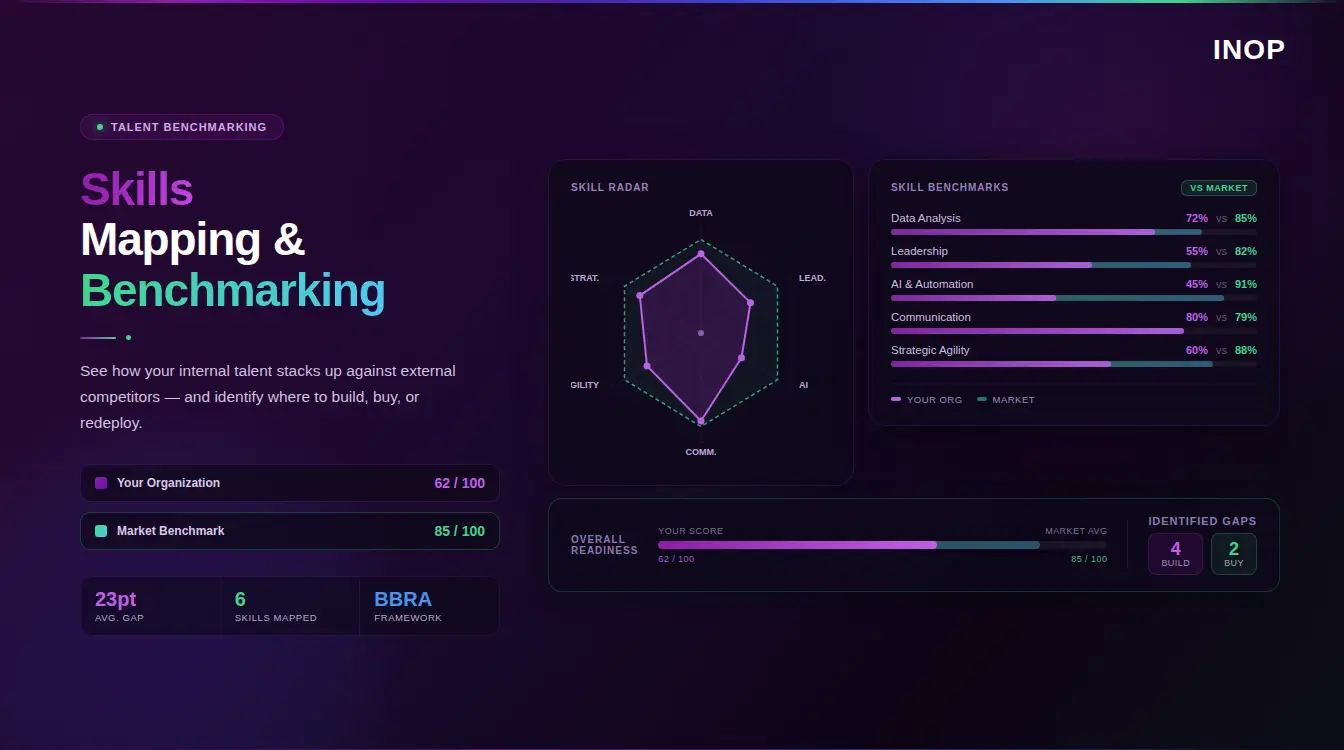
A gap can also be identified from the outside in. When the skills a role requires are shifting faster in the external labor market than the organization’s internal expectations for that role have moved, that divergence is itself an early signal, even before internal output data shows a problem. INOP’s skills intelligence platform is built specifically to surface this kind of divergence, mapping external demand signals against your existing skills taxonomy so a shift in the outside market becomes visible before it turns into an internal performance problem. Around 69 percent of HR professionals already believe their organization faces a widening skills gap, according to recent workforce gap analysis research, which suggests most leaders sense this divergence intuitively without having a system built to track it precisely.
Applying INOP’s Five Intelligence Lenses to Skill Gap Identification
An identified signal is a flag, not a conclusion. INOP evaluates every flagged signal through five intelligence lenses before deciding whether it warrants a deeper assessment.
- Strategy: Does the flagged area sit inside a role tied to a specific business priority, which would make early identification especially urgent?
- Finance: What would this gap cost if it went unaddressed for another quarter, and does that justify moving straight to a full assessment?
- People: Does the flagged concentration or performance signal point to a single point of failure, and how exposed is succession planning around it?
- Market: Does external labor market data corroborate the internal signal, or does it suggest the flagged skill is actually stable?
- AI and Automation: Could the underlying task behind the flagged signal be automated, which would change whether the gap needs a human response at all?
Turning Identified Gaps Into Action with BBRA
Identification without a next step just moves the delay further down the process. A gap gets flagged, sits in a backlog, and by the time anyone acts on it the organization is back to reacting rather than catching it early. INOP’s proprietary BBRA framework, Build, Buy, Redeploy, and Automate, gives every identified gap a defined next step by modeling four intervention pathways against financial tradeoffs across four time horizons: thirty days, one hundred eighty days, one year, and three years.
Applied to an early-stage signal, this means a role concentration flag does not sit waiting for a full annual assessment cycle. It gets compared immediately: would cross-training a second person close the single point of failure fastest, would redeploying someone with adjacent capability be quicker, does the scale of the risk justify external hiring, or does the underlying task make more sense to automate. Roughly four out of five companies report struggling to find candidates with the right skills once a gap becomes visible externally, according to recent research on the shift toward skill-based workforce strategy, which is exactly why identifying a gap early and modeling the response immediately matters more than identification alone.
Skill Gap Identification for Private Equity Operating Partners
Inside a hundred-day plan, the speed of skill gap identification often determines whether a workforce risk gets addressed proactively or discovered during a crisis. Portfolio companies relying only on lagging indicators, annual surveys, exit interviews, engagement scores, are effectively identifying gaps months after they started, which leaves an operating partner working from a picture of workforce risk that is already out of date by the time it reaches a board discussion.
Standardizing early identification across a portfolio through INOP’s strategic workforce planning platform gives operating partners a consistent way to catch emerging capability risk across assets before it surfaces as turnover or a missed milestone. Where an identified gap touches a role carrying scarce, high-demand skills, INOP’s compensation analytics platform connects that signal directly into pay benchmarking, since flight risk on a hard-to-replace skill often needs to be addressed on the same timeline as the capability gap itself.
Common Mistakes in Skill Gap Identification
Waiting for lagging indicators to trigger action. Turnover, disengagement, and absenteeism are real signals, but by the time they appear, the underlying gap has already been affecting output for a while.
Identifying gaps only on a fixed annual cycle. A gap that emerges in the second month after a planning cycle will not surface for the better part of a year if identification only happens once annually.
Treating identification and assessment as the same step. A flagged signal deserves a deeper look, not an immediate conclusion. Conflating the two either slows down response to real risk or triggers a full assessment for signals that turn out to be noise.
Ignoring structural signals like role concentration. A gap does not need to show up in performance data to be real. A skill that only one or two people on a team hold is a gap already, whether or not anyone has left yet, and connects directly to the same succession and single-point-of-failure risks worth tracking on a broader human capital risk view rather than treating skill gaps in isolation.
Relying entirely on internal signals. A gap can also be identified from outside the organization, when the external labor market moves faster than internal role definitions have. Anchoring identification to a living, regularly updated skills taxonomy rather than a static internal reference document is part of what keeps external divergence visible instead of invisible.
Frequently Asked Questions
What is the difference between skill gap identification and skill gap assessment?
Identification is the earlier step of noticing that a gap likely exists, based on leading indicators and signals. Assessment is the deeper measurement that follows to confirm the gap’s size and scope once identification has flagged an area of concern.
What are the most reliable leading indicators for skill gap identification?
Role concentration in a narrow slice of the workforce, output or performance shortfalls at the task level, and divergence between internal role expectations and external market demand all surface gaps earlier than lagging indicators like turnover or engagement scores.
Why do lagging indicators like turnover catch skill gaps too late?
By the time turnover or disengagement shows up, the underlying capability gap has typically been affecting output for months. These signals confirm that a gap existed rather than helping identify one while it is still emerging.
How often should skill gap identification happen?
Continuously, rather than on a fixed annual or quarterly cycle. Identification is meant to be an ongoing signal-tracking process, with periodic assessment reserved for confirming and measuring the gaps that identification flags.
How should private equity operating partners evaluate skill gap identification at a portfolio company?
By checking whether the company tracks leading indicators like role concentration and output signals, or relies solely on lagging indicators like turnover and engagement surveys. The latter means workforce risk is being discovered late, not identified early.
Ready to catch skill gaps while they are still emerging, not after they show up in your turnover numbers? Book a demo and INOP will walk through live identification signals for your workforce and show how BBRA turns each one into a modeled next step.