Traditional job descriptions are failing the organizations that rely on them. A document written during a hiring process, approved by legal, filed in an HRIS, and never opened again cannot serve as the foundation of talent strategy in a workplace where the half-life of a learned skill has dropped from 30 years in the 1980s to fewer than 5 years today.
Something has to replace them. This guide covers what is going wrong with the traditional model, what forward-thinking organizations are building instead, and how HR leaders can begin the transition to a skills-based job architecture that actually reflects how work happens in 2026.
Want to see how INOP maps skills to roles across your organization in real time? Book a 20-minute demo.
Why Traditional Job Descriptions Are Failing
They Are Snapshots of the Past
A job description is, by definition, a document about what a role looked like when it was last written. The typical timeline from drafting to posting to filling a position runs 60 to 90 days. By the time someone is seated in a role, the document that defined it is already months old. In fast-moving industries, that gap is enough to make the description materially inaccurate.
Emerging skills meaning in the context of workforce planning is about capabilities that did not exist in job descriptions 24 months ago but are now central to role performance. AI fluency, prompt engineering, and machine learning integration are now appearing as core requirements in roles that were defined without any reference to them. LinkedIn’s 2025 Work Change Report projected that 70% of the skills used in most jobs today will change by 2030, with AI as the primary driver. A job description written in 2023 is already, in many cases, describing a role that no longer exists in the form it was documented.
The Credential Trap Creates Internal Mobility Barriers
Traditional job descriptions are built around credentials: degrees earned, years of experience accumulated, specific certifications held. This credential focus made sense when career paths were linear and roles stable. In today’s environment, it creates a structural problem: organizations cannot see the capability that already exists in their workforce because their job descriptions are not designed to capture it.
An employee in operations who has self-taught Python, built internal dashboards, and been informally handling data requests for two years is not visible as a data analyst candidate if the job description for that role requires a formal degree in statistics and three years of analytics titles. The employee’s capability is real. The credential requirement filters them out before a human reviews their profile. The organization then hires externally at significantly higher cost for a capability it already had.
This is not an edge case. Fewer than one in three leaders believe the skills within their organizations are the ones they need to succeed in the future, and only half say they have a clear view of their workforce skills. The job description is part of what is making those skills invisible.
The “Other Duties as Assigned” Problem
Every traditional job description ends with the same phrase. Its presence is an admission that the document cannot fully capture what the role actually entails. That admission undermines the document’s entire purpose: it signals to employees that their actual responsibilities will diverge from what was written, provides no basis for meaningful performance management, and gives organizations no audit trail when scope creep becomes a retention problem.
The phrase exists because static documents cannot capture dynamic work. The solution is not a better phrase. It is a different kind of document entirely.
Which of the Following Is a Major Limitation of Traditional Job Analysis?
This is a question that appears frequently in HR certification exams and practitioner research, and the answer is precise: traditional job analysis is task-based and becomes outdated in dynamic industries. It focuses on what a role does rather than what capabilities enable someone to do it well. It captures a moment in time rather than a trajectory. And it provides no mechanism for continuous update as work evolves. These are not minor limitations. They are structural incompatibilities with the pace at which modern organizations need to move.
What Replaces Traditional Job Descriptions: Skills Profiles and Dynamic Role Cards
What a Skills Profile Actually Is
A skills profile is a living document that describes what a role requires in terms of capabilities rather than credentials, and what a specific employee brings in terms of verified competencies rather than past titles. Where a job description asks “what qualifications should someone have to apply?”, a skills profile asks “what capabilities enable someone to succeed here, and what does each employee actually demonstrate?”
The distinction is philosophical as much as structural. A job description is a filter applied before employment begins. A skills profile is an intelligence layer that operates continuously throughout the employment relationship, updating as the employee develops, as the role evolves, and as the organization’s strategy changes.
Core Components of an Effective Skills Profile
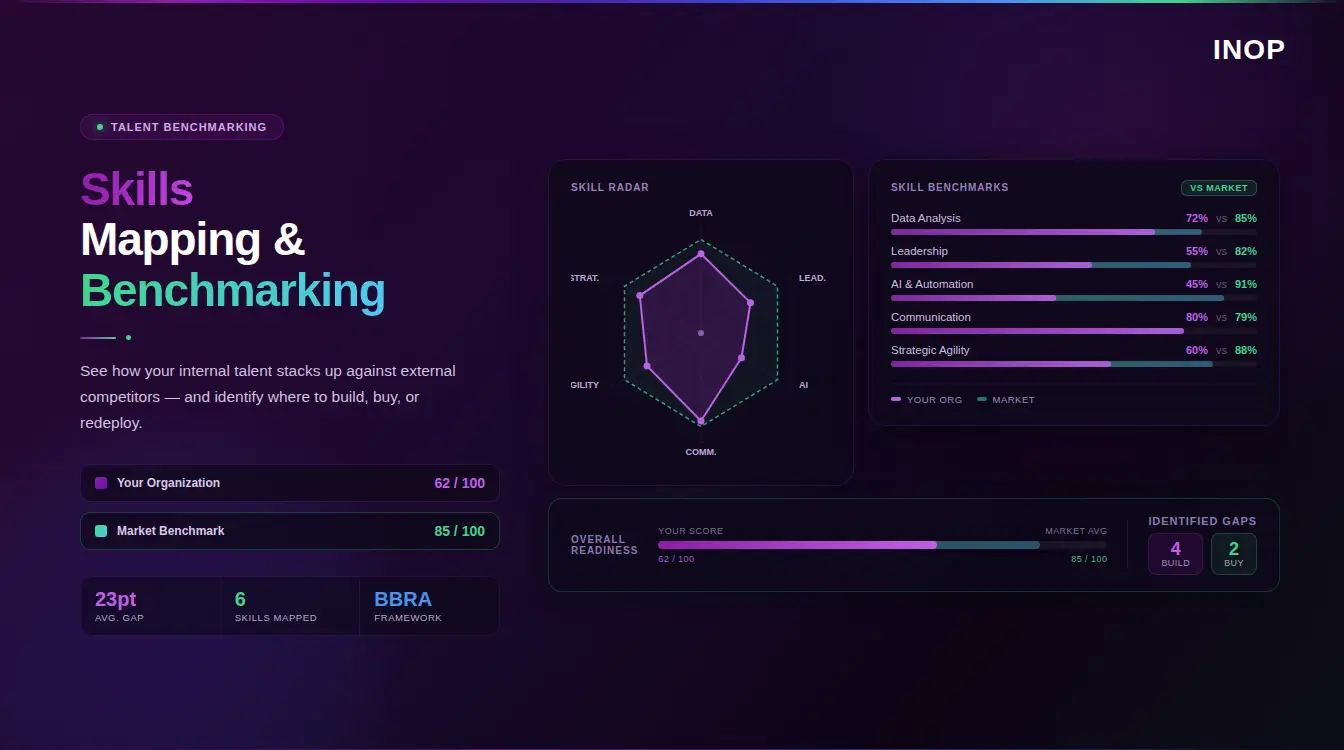
Core Skills define the essential competencies required to perform the role today. These are expressed as specific capabilities at defined proficiency levels, not credential proxies. Rather than “proficiency in data analysis required,” a skills profile specifies “SQL at intermediate level, data visualization at foundational level, statistical inference at intermediate level.” This specificity makes the profile useful for development planning, succession decisions, and internal mobility matching in ways that credential language never can.
Adjacent Skills map what the employee could develop given their current capability foundation. This is one of the most strategically valuable components. An employee with intermediate SQL and foundational Python has a visible development path to machine learning pipelines that a credential-focused document would never reveal. Mapping adjacent skills tells both the employee and the organization where development investment would generate the highest return.
Project Allocations capture what the employee is actually working on right now, providing real-time visibility into capacity and capability deployment that no job description can offer. When an organization can see not just what roles people occupy but what they are actively doing and contributing to, workforce planning becomes a live discipline rather than an annual exercise.
Development Trajectory tracks how skills are changing over time. An employee who has moved from foundational to intermediate in three skills over 12 months has a development velocity that is strategically significant. Organizations that capture this trajectory can make more accurate succession decisions and more defensible compensation adjustments than those working from static role-level comparisons.
Job Description vs. Skills Profile: A Direct Comparison
| Dimension | Traditional Job Description | Skills Profile |
|---|---|---|
| Primary question | What credentials qualify someone to apply? | What capabilities enable someone to succeed? |
| Update frequency | When the role is re-posted (often years) | Continuously as skills develop and work evolves |
| Focus | Past credentials and titles held | Current capabilities and proficiency levels |
| Internal mobility | Filters by credential match | Surfaces by capability proximity |
| Development utility | None post-hire | Ongoing gap identification and path mapping |
| Compensation link | Title and grade-based | Skills portfolio and proficiency-based |
| Workforce planning input | Headcount and title count | Capability supply and demand mapping |
| Legal defensibility | Vulnerable when applied inconsistently | Stronger when criteria are documented and uniform |
Rethinking Job Architecture: From Ladder to Lattice
What Job Architecture Actually Means
Job architecture is the structural framework that defines how work gets organized, how roles relate to each other, and how talent develops across an organization. It is the operating system beneath your compensation structure, your career pathways, your internal mobility practices, and your workforce planning capability. When job architecture is well-designed, every talent decision has a consistent foundation to reference. When it is broken, every talent decision becomes a negotiation with no shared reference point.
Most organizations’ job architectures are broken in a specific and diagnosable way: they have accumulated titles rather than designed roles. A 2,000-person organization with 1,400 unique job titles does not have 1,400 distinct roles. It has a history of ad hoc role creation, compensation workarounds through title inflation, and acquisition integrations that were never rationalized. The result is an architecture that obscures capability, distorts compensation, and actively prevents the internal mobility the organization needs.
Old Architecture: The Ladder
Traditional job architecture is hierarchical and title-obsessed. Careers move vertically through increasingly narrow specializations. An analyst becomes a senior analyst becomes a manager becomes a senior manager. Each step is gated by time served, manager nomination, and headcount approval. Lateral movement is structurally discouraged because it often means accepting a lower title or grade. The entire system optimizes for seniority accumulation rather than capability development.
This ladder model made sense in stable industrial economies where deep specialization was the primary source of organizational value. It creates systematic dysfunction in environments where cross-functional thinking, rapid reskilling, and adaptive deployment matter more than hierarchical depth.
New Architecture: The Lattice
Modern job architecture functions as a lattice rather than a ladder. Career paths move laterally across functions, diagonally into emerging domains, and vertically within specialties, with all directions considered legitimate expressions of development rather than deviations from a prescribed path.
In a lattice structure, a data analyst can evolve into a product operations role without a demotion, move laterally into customer analytics, then contribute to a strategy function before returning to a senior data science position. Each transition builds a unique combination of capabilities that makes the employee increasingly valuable and adaptable. The organization benefits from cross-functional perspective that siloed vertical progression never produces.
Job Broadbanding: The Bridge Between Old and New
Job broadbanding is one of the most widely adopted transitional structures for organizations moving away from narrow job grades toward more flexible role definitions. Rather than maintaining dozens of narrow levels, broadbanding consolidates roles into a smaller number of wide salary bands, typically four to eight across an organization, each covering a much broader range of responsibilities and compensation.
The practical effect is significant. Rather than requiring a formal promotion to move from one narrow grade to the next, employees can progress within a band based on skills development and contribution. Pay increases happen within the band through demonstrated capability growth rather than title accumulation.
Broadbanding serves as an effective bridge because it reduces title proliferation without requiring a complete rebuild of compensation infrastructure. Organizations can implement it in six to twelve months, demonstrate measurable benefits, and use the broader bands as the structural foundation for introducing job based pay alternatives within each band. The limitation is that broadbanding still groups people by position rather than pure capability, which is why skills profiles are the natural complement rather than an either-or choice.
Deconstructing Jobs Into Tasks and Projects
One of the most powerful concepts in modern job architecture is decomposing traditional roles into their component tasks and time-bound projects. Instead of defining a “Social Media Manager” as a permanent full-time role with fixed responsibilities, the organization identifies the actual work that needs doing: community engagement as an ongoing task, campaign planning as a recurring task, crisis response as an episodic capability, and quarterly strategy as a periodic project.
This decomposition reveals something most traditional job descriptions obscure: many full-time positions were created for 20 to 25 hours of actual specialized work, then allowed to accumulate unrelated responsibilities to justify the headcount. Deconstructing roles into tasks surfaces this misalignment and creates the foundation for more efficient, flexible deployment of internal capability.
Job Architecture Redesign: A Process for HR Leaders
Phase 1: Architecture Audit
Before designing anything new, map what currently exists. Pull a complete extract of all unique job titles, grades, and salary bands from your HRIS. Calculate the ratio of unique titles to total headcount. A healthy architecture maintains roughly ten to fifteen employees per unique job title in organizations of 500 or more people. If your ratio is approaching one to one, consolidation is your first priority, not redesign of individual roles.
Identify the sources of title proliferation. Common causes include manager discretion in creating new roles without governance approval, acquisition integrations that were never rationalized into the parent architecture, compensation workarounds using title inflation when salary bands were too narrow, and genuine functional differentiation that was never standardized into a shared taxonomy. Each cause requires a different design response.
Phase 2: Framework Design
Define your target architecture’s core parameters: how many job families, how many levels within each family, and whether you will use broadbanding, a traditional grade structure, or a skills-based progression model. These decisions interact with your compensation philosophy, your HRIS capabilities, and your manager population’s capacity for change. Involve Total Rewards, HR Business Partners, and at least three or four senior business leaders in this phase. Architecture designed exclusively by HR without business input will not survive contact with the organization.
Phase 3: Skills Taxonomy Integration
Map the skills required for each role family and level within your new architecture. This is where the transition from traditional job descriptions to skills intelligence actually happens. For each position in your new framework, define not just the responsibilities but the specific competencies at defined proficiency levels that determine placement and progression. This taxonomy becomes the shared language between HR, managers, and employees for every talent decision that follows.
The skills taxonomy also connects your job architecture to external market intelligence. When your internal role definitions use skills that can be benchmarked against external labor market demand, compensation decisions become more defensible, succession planning becomes more accurate, and workforce planning becomes more forward-looking.
Phase 4: Transition and Communication
Map every existing employee to a position in the new architecture before any announcement is made. This transition mapping is where most redesign projects encounter the most significant resistance: some employees will map to lower grades than their current title implied, creating perceived demotions even when compensation is protected. Proactive, direct communication that distinguishes what is changing from what is not, specifically that compensation is protected even where titles change, is the primary risk mitigation tool at this stage.
Manager preparation is as important as employee communication. Managers need to be equipped to answer “what does this mean for my team?” and “what does this mean for me?” before the announcement reaches employees. Managers who are surprised by the change will convey that surprise to their teams in ways that undermine trust in the process.
Phase 5: Governance and Maintenance
The most common failure in job architecture projects is treating the redesign as a one-time event. Without a governance model that controls future title creation, defines criteria for adding new roles, and requires periodic rationalization reviews, the new framework will drift back toward title proliferation within 18 to 24 months. Assign clear ownership, typically a Total Rewards or HR Operations function, with defined authority to approve or reject new role additions against the architecture’s design principles.
Moving Beyond Job Architecture: From Structure to Intelligence
The discipline this section is describing has a formal name: organizational design. Not just the org chart, which covers reporting lines, but the full set of design decisions that determine how work gets structured, how decision rights get allocated, and how roles are configured to actually deliver the strategy rather than simply to reflect last year’s headcount.
For organizations that have already completed a job architecture redesign, the next frontier is treating that architecture not as a static structure but as a dynamic intelligence layer. A well-designed job architecture tells you what roles exist and how they relate to each other. A workforce intelligence layer built on top of that architecture tells you which capabilities are actually present in each role, where they are concentrated or absent, how they are evolving, and where the gaps between your architecture’s requirements and your workforce’s actual skills are widening.
This is the transition from job architecture as an organizational design artifact to strategic workforce planning as a live instrument. It requires connecting your role framework to verified, current skills data at the individual level, and then connecting that skills data to business strategy, financial planning, and external market intelligence.
Deloitte’s 2026 Global Human Capital Trends research, drawing on more than 9,000 leaders across 89 countries, found that 59% of organizations are still layering AI onto legacy structures rather than redesigning for the work they actually have. The organizations that move beyond this pattern are those treating skills intelligence as a strategic planning input, not just an HR record-keeping function.
Why Your Job Architecture Must Serve Both Planning and Strategy
One of the most common failure modes in job architecture redesign projects is building a framework that serves one time horizon while neglecting the other. Organizations that design their architecture primarily around operational workforce planning, filling seats, managing headcount budgets, approving backfills, end up with a structure that is efficient for the short term and increasingly misaligned with where the business is going. Organizations that design primarily around long-term workforce strategy, defining the ideal future state capability model, embedding cultural values, shaping leadership pipelines, often find that their beautiful strategic framework provides no practical guidance for the hiring and redeployment decisions that need to happen this quarter.
Understanding the difference between workforce planning and workforce strategy clarifies what your job architecture actually needs to do. Workforce planning operates on a one to three year horizon and asks whether the organization has the right capabilities to execute current business commitments. Workforce strategy operates on a five to ten year horizon and asks how the organization needs to evolve its people and capability model to remain competitive as the market changes. Job architecture has to serve both simultaneously, which means it cannot be designed around either one exclusively.
In practice, this means your role definitions need to be stable enough to anchor short-term hiring and compensation decisions, while remaining flexible enough to accommodate the capability shifts that long-term strategy requires. Skills profiles do this more effectively than credential-based job descriptions because they can be updated as strategic priorities shift without invalidating the compensation and mobility frameworks that day-to-day planning depends on. The architecture becomes the shared infrastructure that connects what the business needs today to what it needs to become, rather than a constraint that forces a choice between the two.
How Killing the Job Description Changes Compensation
When HR and finance leaders hear that the traditional job description is being replaced, their first question is usually: if there are no static job titles, how do we know what to pay people?
It is a valid concern. Traditional compensation has been inextricably linked to the job description for decades. Companies benchmark a specific title against the market, assign it a salary band, and pay the person in that position accordingly. When work is deconstructed into dynamic role cards and skills portfolios, paying for the title no longer makes sense.
The answer is a skills-based pay model. Instead of benchmarking a generalized title, organizations benchmark the market value of specific, verified capabilities. An employee’s total compensation becomes a reflection of their dynamic skills profile: their core competencies, the adjacent skills they have developed, and the complexity of the work they are capable of executing. Two employees who previously shared the title of Marketing Manager can legitimately earn different salaries if one has verified capabilities in AI-driven campaign optimization and advanced analytics that the other does not.
For a full breakdown of how this transition works in practice, including how to benchmark skill premiums and build defensible pay bands around capability rather than title, read INOP’s guide on job based pay versus skills-based compensation.
This shift also has significant implications for pay equity. When compensation is explicitly tied to verified skill proficiency assessed through consistent methods, the subjective judgment that allows unconscious bias to influence pay decisions is structurally reduced. Pay transparency legislation in the US, UK, and EU is accelerating this shift: organizations that can document why two employees earn different amounts based on auditable capability criteria are significantly better positioned than those relying on title-based rationale that does not withstand scrutiny.
Ready to connect your job architecture to live workforce intelligence? See how INOP does it in a 20-minute demo.
Real Organizations That Have Made This Shift
Unilever: Skills as the Currency for Internal Mobility
Unilever’s transformation of its job architecture began with the recognition that its traditional grade structure was creating internal mobility barriers rather than enabling them. The company built a skills-based internal talent marketplace called Flex Experiences that allows employees to take on cross-functional projects and roles based on verified skills rather than job title or grade. A finance analyst with project management experience and multilingual capability can be matched to a global product launch project without requiring a formal transfer or promotion. Unilever has reported significant increases in internal mobility rates and improved engagement scores in functions where cross-functional movement was previously constrained by siloed job architecture.
IBM: Removing Credential Requirements to Reveal Hidden Capability
IBM eliminated degree requirements for over 50% of its US job postings, replacing them with demonstrated skill criteria assessed through structured evaluation. The company’s reasoning was explicit: degree requirements were systematically excluding qualified candidates whose capabilities matched role requirements but whose credentials did not match the document. IBM restructured its internal job architecture around skills taxonomies, creating visible development pathways that allow employees to progress based on demonstrated competency growth rather than credential accumulation. The result was an expansion of the internal talent pool for technical roles, with skills-matched internal candidates outperforming externally hired credential-matched candidates on performance metrics within the first year.
Haier: The Most Radical Departure
Chinese appliance manufacturer Haier represents the most complete documented departure from traditional job architecture. The company reorganized its 80,000-plus employees into thousands of small self-managing microenterprises where traditional job titles and hierarchical descriptions have been effectively replaced by accountability frameworks based on outcome ownership and capability contribution. Compensation is tied directly to unit performance and individual capability rather than grade or title. Haier’s model is extreme and not transplantable wholesale to most Western organizational cultures, but it illustrates the direction that skills-based job architecture is moving: work defined by capability and contribution rather than position and credential.
Skills-Based Job Architecture for PE Portfolio Companies
For private equity operating partners, job architecture is not primarily a talent management question. It is a value creation lever and a transaction risk factor that is frequently underestimated in due diligence.
Portfolio companies with fragmented job architectures, characterized by title proliferation, inconsistent compensation for equivalent work, and unclear career pathways, carry hidden costs that erode EBITDA in ways that do not surface cleanly in financial statements. Compensation compression caused by title-based negotiation, voluntary attrition among critical talent who cannot see advancement pathways, and management time absorbed by ad hoc role creation all compound over the hold period.
Operating partners who conduct a job architecture rationalization in the first 12 to 18 months of ownership typically document three categories of recoverable value. The first is compensation standardization, where equivalent roles were being paid inconsistently because the architecture could not surface the equivalence. The second is retention improvement in critical functions, where career path visibility reduced voluntary attrition among employees who left not because of pay but because they could not see a future. The third is organizational efficiency from eliminating redundant role proliferation that obscured accountability and made spans of control impossible to manage rationally.
During due diligence, a target company’s job architecture quality signals organizational maturity in ways that standard financial analysis misses. The ratio of unique job titles to total headcount, the distribution of compensation within job grades, and the internal promotion rate versus external hire rate for senior roles are all indicators of whether the workforce can execute the value creation plan or whether significant remediation investment will be required first.
INOP’s strategic workforce planning platform is designed for exactly this use case, connecting skills intelligence to financial scenario modeling in a format that serves both operating partner decision-making and exit preparation requirements.
Implementation: How to Start the Shift
Start with One Department, Not the Whole Organization
Attempting to overhaul all job architecture simultaneously is a reliable path to paralysis. Choose a single department for a pilot, ideally one already facing obvious friction with traditional structures. Engineering and product teams often make strong starting points because the pace of technology change makes their job descriptions visibly inadequate faster than any other function. Run your pilot with 20 to 50 employees, test the skills profile approach, gather evidence of impact, then expand.
Audit What You Have Before Building What You Need
Pull a report showing every unique job title in your organization. If the number shocks you, that shock is useful data. Calculate your title-to-headcount ratio. Identify where proliferation is concentrated. The audit findings will shape every subsequent design decision and will also give you the baseline against which to measure progress.
Build the Skills Taxonomy Before Selecting Technology
The most common mistake in job architecture transformation projects is purchasing technology before defining the skills framework the technology will manage. A well-governed skills taxonomy in a spreadsheet produces more value than a sophisticated platform populated with inconsistent, poorly defined skills data. Define your job families, levels, and skill requirements first. Then evaluate which technology can best support the framework you have designed, rather than allowing technology capabilities to determine your framework design.
Link Architecture to Strategic Priorities Explicitly
Your job architecture must reflect your organization’s actual strategic direction, not just its current operational state. If you are pursuing a digital transformation that will require significant AI and data capability over the next three years, your architecture needs to define those roles and the skills pathways leading to them now, not when the transformation is already underway. Architecture that lags strategy forces the organization to make every talent decision reactively rather than by design.
Measuring the ROI of Modern Job Architecture
Organizations that have made this transition report measurable impact across several dimensions that finance leadership can evaluate directly.
Internal fill rate for open roles is the most direct indicator. Organizations with skills-based architectures and current skills profiles consistently surface internal candidates for positions they previously filled externally, with some reporting 40 to 50% of open positions filled internally compared to industry averages around 20%. Each internal fill saves 30 to 60% of the external recruitment cost for that role, plus the three to six month time-to-productivity ramp that external hires require.
Voluntary attrition reduction in critical roles follows from career path visibility. When employees can see a concrete development pathway expressed in specific skills they need to demonstrate rather than a vague promise of “opportunities for growth,” retention in high-value roles improves materially. Organizations with transparent skills frameworks report 25 to 30% lower voluntary turnover in critical roles compared to industry benchmarks.
Workforce planning accuracy improves when architecture is built on skills rather than titles because skills data can be connected to both internal development velocity and external market demand signals. HR leaders can model not just how many people they have in each role but how many of them have the capabilities the business needs over the next 12 to 36 months, and where the gaps are widening faster than current development programs can close them.
Frequently Asked Questions
What is the main difference between a job description and a skills profile?
A job description is a static document focused on credentials: degrees, years of experience, prior titles. It answers the question “what qualifications should someone have to apply?” A skills profile is a dynamic framework focused on capabilities: specific competencies at defined proficiency levels, adjacent skills, and project contributions. It answers the question “what does this employee actually demonstrate, and where can they develop from here?” Job descriptions update when roles are re-posted. Skills profiles update continuously as employees grow, roles evolve, and strategy shifts.
Which of the following is a major limitation of traditional job analysis?
The primary limitation is that traditional job analysis is task-based and becomes outdated in dynamic industries. It captures what a role does at a specific moment rather than what capabilities enable excellent performance across changing conditions. It provides no mechanism for continuous update, no link to individual development trajectories, and no ability to surface capability that exists outside formally documented experience. These are not minor shortcomings. They are structural incompatibilities with the pace at which modern work changes.
What is job broadbanding and how does it relate to skills-based architecture?
Job broadbanding consolidates narrow job grades into a smaller number of wider salary bands, typically four to eight, each covering a broader range of roles and compensation. It reduces title proliferation and allows career progression within a band based on capability growth rather than formal promotion. Broadbanding is most effective as a transitional structure: it simplifies the architecture without requiring a complete rebuild of compensation infrastructure, and it creates the broader bands within which skills-based pay progressions can operate. It solves the title proliferation problem while providing the structural foundation for moving toward full skills-based compensation.
How do you determine compensation without traditional job titles?
Modern compensation frameworks link pay to verified skill proficiencies and combinations rather than to specific titles. You establish pay ranges for skill levels within job families, then determine each employee’s position within those ranges based on their demonstrated competency profile. This approach increases pay equity by compensating actual capabilities rather than negotiation outcomes or title inflation. It also creates more defensible compensation decisions under pay transparency legislation, because the criteria are explicit, documented, and applied consistently.
How long does a job architecture redesign take?
Most organizations follow a phased approach. The architecture audit and framework design takes three to four months. Skills taxonomy integration and transition mapping takes another four to six months. Full organizational implementation, including governance establishment and manager training, typically completes within 18 to 24 months. The key is starting the pilot in one department within the first three months rather than spending a year designing a perfect organization-wide framework before testing any of it.
Should organizations eliminate job descriptions entirely?
For most organizations, elimination creates more problems than it solves. Job descriptions serve legitimate legal functions: they document the role requirements that justify compensation decisions, provide the basis for performance management, and create an audit trail for discrimination claim defenses. The better path is modernization. Replace static, credential-heavy documents with dynamic skills profiles that are regularly updated, compensation-connected, and expressed in capability terms rather than credential terms. This preserves the legitimate legal and organizational functions of role documentation while eliminating the rigidity that makes traditional job descriptions a talent management liability.
How do skills profiles prevent the same stagnation problem as job descriptions?
The key is building update triggers into your operating model rather than relying on periodic reviews. Skills profiles update when employees complete certifications or training, when project assignments change, when performance conversations identify new demonstrated capabilities, and when the organization’s skills taxonomy is reviewed against market demand signals. Making profiles visible to employees and giving them ownership over updating their own skills, with manager validation, distributes the maintenance burden and ensures the data reflects reality. The profile becomes a career development tool the employee is invested in keeping current, rather than an HR document that sits in a file until the next job posting.
Book a Demo
Make confident workforce decisions that support strategy and value creation.