Here’s a number worth sitting with: according to McKinsey’s 2023 People Analytics report, organizations that embed data-driven decision-making into talent processes are 2.2 times more likely to outperform their peers on total returns to shareholders. And yet, despite widespread investment in HR technology and people analytics, the vast majority of organizations still make their most consequential workforce decisions, who to hire, where to invest in talent, which roles to automate, where strategic exposure exists, based on incomplete data, fragmented systems, and leadership intuition.
The gap isn’t a lack of data. It’s a lack of Workforce Decision Intelligence.
This article explains what Workforce Decision Intelligence is, how it differs from conventional workforce analytics and strategic workforce planning, why it’s emerging as one of the most important capabilities a business can build, and how platforms like INOP.AI are making it operational for leadership teams right now. Whether you’re leading HR, sitting in the C-suite, or managing a workforce strategy function, this is the concept you need to understand to make better decisions about your people, starting today.
What Is Workforce Decision Intelligence?
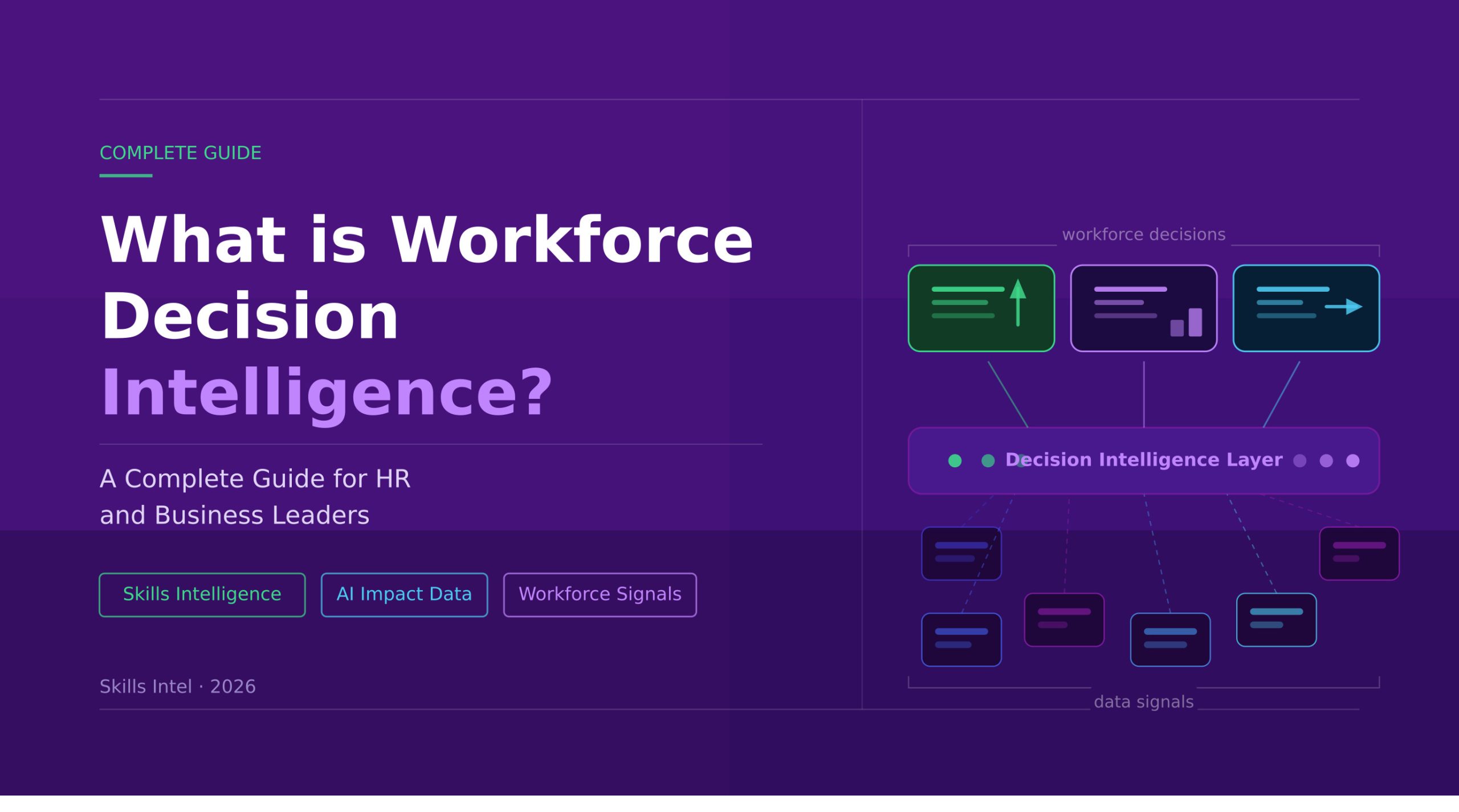
Workforce Decision Intelligence (WDI) is the systematic application of advanced analytics, artificial intelligence, and decision science to improve how organizations make decisions about their workforce. It goes beyond collecting HR data or building reporting dashboards. Instead, it focuses on translating complex, multi-source workforce information into clear, actionable guidance, guidance that drives better outcomes across hiring, retention, workforce planning, talent development, role design, and organizational structure.
Crucially, WDI is not just about understanding people. It’s about understanding the intersection of your workforce with your strategy, your finances, your market context, and your automation risk, all at once. That intersection is where decisions get made with real confidence.
At its core, WDI is built to answer questions like:
- Which roles are most at risk of turnover in the next six months, and what does it cost to leave that risk unaddressed?
- Where is the organization over-invested or under-invested in headcount relative to its strategic priorities?
- What combination of skills does the workforce need in three years, and how much of that can realistically be built internally?
- Which roles are candidates for automation, and what is the financial impact of acting now versus in 24 months?
- Where are misaligned role structures quietly leaking value, before it shows up on the balance sheet?
These aren’t simple questions. Answering them requires integrating data from multiple systems, HRIS platforms, performance management tools, labor market databases, financial systems, and external economic signals, and applying models that surface meaningful patterns, quantify financial consequences, and simulate future scenarios across short, medium, and long-term time horizons.
The “intelligence” in Workforce Decision Intelligence is not just about having data. It’s about building the organizational capability to interpret that data in context, trust it, and act on it decisively.
The Three Pillars of Workforce Decision Intelligence
WDI rests on three interconnected layers that distinguish it from simpler approaches to workforce analytics:
Descriptive and Diagnostic Intelligence tells you what happened and why. It answers questions like: Why did attrition spike last quarter? Which teams are underperforming, and what are the structural drivers? This layer forms the foundation, without it, everything else is guesswork.
Predictive Intelligence tells you what is likely to happen next. Using historical patterns, machine learning models, and external labor market data, it forecasts future workforce risks and opportunities. For example, a predictive model might identify that employees in a specific role who haven’t received a promotion within 18 months carry an 82% probability of leaving within the next year, giving leadership time to act before the departure happens.
Prescriptive Intelligence goes further: it recommends what you should do, in what order, and models the financial impact of each option. Rather than simply flagging a risk, it surfaces specific interventions, build, buy, redeploy, automate, and quantifies what each choice will deliver against your financial constraints and strategic timeline. This is where WDI moves from insight to decision.
Workforce Decision Intelligence vs. Traditional Workforce Analytics
Many organizations already invest in people analytics or workforce analytics to some degree. So what makes Workforce Decision Intelligence meaningfully different? The distinction matters, and it’s more than a rebranding exercise.
Traditional workforce analytics typically focuses on reporting: headcount summaries, turnover rates, time-to-fill metrics, engagement scores. These reports are useful, but they describe the past. They are backward-looking, siloed within HR, and often disconnected from the financial and strategic outcomes that business leaders actually care about.
Workforce Decision Intelligence is designed to operate differently across every dimension:
| Dimension | Traditional Workforce Analytics | Workforce Decision Intelligence |
|---|---|---|
| Orientation | Backward-looking | Forward-looking + scenario-based |
| Data scope | HR systems only | HR + Finance + Market + AI/Automation risk |
| Output | Reports and dashboards | Prioritized decisions with modelled impact |
| Update frequency | Annual or quarterly | Continuous / real-time |
| Business integration | HR-siloed | Connected to financial and strategic outcomes |
| Decision support | Describes what happened | Recommends what to do and quantifies the impact |
To make this concrete: traditional workforce analytics tells you that voluntary turnover was 18% last year. Workforce Decision Intelligence tells you that turnover in a specific critical role cluster is projected to reach 24% in the next 12 months, identifies the top three drivers, surfaces the 40 employees at highest flight risk, attaches a financial cost to the exposure, and recommends targeted interventions — along with the expected ROI of acting now rather than in six months.
The difference isn’t just analytical sophistication. It’s the shift from describing a problem to making a decision about it.
The Role of AI and Machine Learning in Workforce Decision Intelligence
Artificial intelligence is the engine that makes Workforce Decision Intelligence scalable and sophisticated enough to be genuinely useful at the enterprise level. Without AI, even well-structured workforce data requires enormous human effort to analyze at speed. With AI, organizations can process millions of data points, from performance reviews and engagement surveys to labor market signals and automation trajectories — and surface actionable patterns in days rather than months.
Predictive Attrition Modeling
One of the most widely adopted AI applications in WDI is attrition prediction. By training machine learning models on historical patterns, performance scores, tenure, compensation relative to market, manager feedback, promotion timelines, engagement data, organizations can predict, with meaningful accuracy, which employees are likely to leave and when.
A large financial services firm used a predictive attrition model to identify that one of its key analyst populations carried a 65% 12-month turnover risk. By intervening with targeted development programs and compensation adjustments for the at-risk segment, the firm reduced voluntary turnover by 31% within a year, translating to an estimated $4.2 million in avoided replacement costs.
Skills Gap Analysis and Future Workforce Modeling
AI-powered skills mapping allows organizations to assess current workforce capabilities and model what they’ll need in the future. This is particularly critical in industries undergoing rapid technological change. A manufacturer adopting automation needs to understand not just how many jobs may be displaced, but what retraining pathways exist, what new roles will emerge, and whether those capabilities can be built internally or must be acquired externally, and on what timeline.
Role Health and Structural Analysis
Beyond skills, WDI surfaces structural issues that traditional analytics miss: which roles are critical to value creation and which are not; where the organization is over- or under-invested in headcount relative to strategic priority; and where misaligned role structures are quietly degrading performance. When this structural lens is combined with capability analysis, leadership gets a complete picture of workforce health — not just what people can do, but whether the right roles exist, are resourced correctly, and are oriented toward the right problems.
Organizational Network Analysis
Some of the most powerful WDI applications analyze how work actually flows through an organization, not how the org chart says it should. Organizational Network Analysis (ONA) uses data from collaboration platforms and communication tools to map informal influence networks, identify knowledge bottlenecks, and detect early signs of team dysfunction. This gives leaders an honest picture of organizational dynamics that formal structures consistently obscure.
Workforce Decision Intelligence and Strategic Workforce Planning
Workforce Decision Intelligence doesn’t exist in isolation. It functions as the intelligence layer underneath strategic workforce planning, the process by which organizations align their talent supply with long-term business strategy.
Strategic workforce planning asks: what kind of workforce do we need in three to five years, and what steps must we take today to get there? WDI provides the data infrastructure, analytical models, and financial quantification that make that planning rigorous and adaptive rather than aspirational and static.
Without WDI feeding into the planning process, strategic workforce planning often becomes a projection exercise built on historical ratios and leadership assumptions. With it, organizations can make decisions grounded in what the data actually shows, and adjust those decisions dynamically as the business context changes.
The connection between WDI and strategic workforce planning is not just conceptual. It’s operational. The models that predict attrition, surface skills gaps, and quantify role misalignment are the same models that power scenario planning, investment prioritization, and workforce roadmap development. You cannot have genuinely strategic workforce planning without the intelligence layer that tells you what your current workforce position actually is, and what it’s likely to become.
How INOP Operationalises Workforce Decision Intelligence
Understanding the concept of Workforce Decision Intelligence is one thing. Making it work inside a real organization, with real data, real constraints, and real decisions on the line, is another. That’s what INOP is built for.
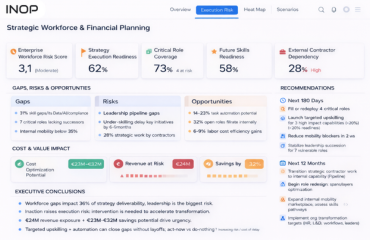
Most workforce tools analyze people data in isolation. INOP examines your workforce through five lenses simultaneously, Strategy, Finance, People, Market, and AI/Automation risk, because a gap means something very different when you understand its financial cost, its external market scarcity, and its automation trajectory at the same time. That intersection is where decisions get made with real confidence.
The gaps INOP surfaces go beyond skills. At the role level, INOP identifies which roles are critical to value creation and which are not, where the organization is over- or under-invested in headcount relative to strategic priority, and where misaligned role structures are quietly leaking value. Combined with capability and skills analysis, this gives leadership a complete picture of workforce health, not just what people can do, but whether the right roles exist, are resourced correctly, and are oriented toward the right problems.
From there, INOP quantifies what each gap costs to leave open and what closing it will deliver. Through the BBRA framework, Build, Buy, Redeploy, Automate every intervention pathway is modelled against your financial constraints and strategic timeline. Each choice comes with a financial consequence attached, not just a strategic rationale. Governance is embedded throughout, tracking ownership, progress, and where commitments are drifting before they reach the board as surprises.
All of this is accessible continuously on the INOP platform. Leaders can interrogate their workforce position at any level, enterprise, business unit, department, or individual role and see execution risk, capability gaps, role health, and skills in real time. Critically, INOP doesn’t just surface what’s happening now. It operates across short, medium, and long-term time horizons, so leadership can see where the workforce stands today, where it’s heading, and what actions are needed at each stage.
Every insight comes with prioritised recommendations and modelled impact, so the conversation moves immediately from what’s the problem to what do we do, in what order, and what will it deliver.
If your organization is ready to move from workforce reporting to genuine workforce decision intelligence, explore what INOP can do for your team.
Key Use Cases: Where Workforce Decision Intelligence Makes the Biggest Impact
Talent Acquisition and Workforce Supply Planning
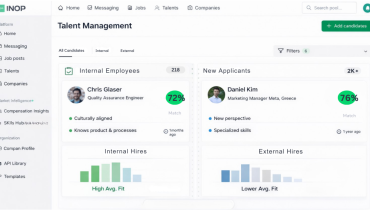
WDI enables organizations to look beyond immediate hiring needs and understand the external talent landscape with precision. How competitive is the talent market for a specific skill set in a given geography? What is the realistic time-to-hire for a critical role, and what does that lag cost operationally? What is the likely retention rate of candidates from different sourcing channels?
When informed by this kind of intelligence, recruiters and workforce planners make dramatically better decisions, from where to open new offices to how to structure compensation offers to whether to hire externally or reskill internally.
Leadership Pipeline and Succession Planning
One of the most expensive workforce failures is the sudden loss of a senior leader with no clear successor. Traditional succession planning often relies on annual talent reviews that are subjective, quickly outdated, and disconnected from real performance data. WDI approaches succession differently, using performance trajectories, 360-degree feedback, development milestones, and flight risk scores to maintain a continuously updated picture of leadership readiness across the organization.
Diversity, Equity, and Inclusion Decision-Making
WDI plays a transformative role in DEI strategy by surfacing patterns that aggregate data conceals. Which stages of the hiring funnel show the largest demographic drop-off? Are certain groups systematically underrepresented in high-performance ratings, and is that a reflection of actual performance or of measurement bias in the rating system? Are pay gaps persisting despite stated commitments to equity?
When DEI decisions are grounded in intelligence rather than intentions, they become more precise, more impactful, and more accountable to both employees and stakeholders.
Workforce Cost Optimization
Labor is typically the largest cost driver in most organizations. WDI helps finance and HR leaders understand the true cost drivers of their workforce, not just base salaries, but the hidden costs of turnover, productivity loss, overtime dependency, and skill misalignment. Organizations using workforce intelligence have reported identifying 10 to 20% in potential labor cost savings simply by optimizing workforce composition and deployment strategies.
Building a Workforce Decision Intelligence Capability: A Practical Roadmap
For most organizations, building WDI capability is a journey with distinct stages. Here’s a pragmatic way to think about it.
Establishing a Reliable Data Foundation
Before any meaningful intelligence can be generated, the underlying data must be reliable, integrated, and accessible. This means breaking down silos between your HRIS, payroll system, learning management platform, performance tool, and financial systems. Data quality is non-negotiable, and the integration doesn’t need to be perfect on day one. Prioritize the data that powers your most critical decisions first.
Building Analytical Literacy Across HR and Finance
Technology alone is insufficient. Organizations that extract the most value from WDI invest in building analytical capability within their HR and finance teams. This doesn’t mean everyone needs to become a data scientist. It means leaders need to understand how to ask the right questions, interpret model outputs critically, and communicate data-driven insights to business stakeholders in language that connects to business performance.
Identifying High-Value Decision Domains First
Rather than applying WDI to every workforce question simultaneously, start with the decisions where stakes are highest and data is most available. Common starting points include attrition risk in critical roles, workforce cost drivers, and strategic headcount alignment. Success in these early use cases builds organizational trust and creates momentum for broader adoption.
Embedding Intelligence into Decision Workflows
The most overlooked step is ensuring workforce intelligence is actually embedded into the decision-making processes where it matters, not housed in a separate analytics portal that people have to seek out. Intelligence that isn’t surfaced at the point of decision rarely changes behavior. The goal is to make data-driven judgment the default, not the exception.
The Challenges Organizations Face and How to Navigate Them
Adopting Workforce Decision Intelligence is not without friction. Three challenges appear consistently across organizations of all sizes.
Data privacy and ethical AI concerns are real and must be addressed proactively. Using employee data to inform consequential decisions about people’s careers creates both legal obligations and ethical responsibilities. Organizations need clear governance frameworks that define what data can be used, how it will be protected, and how algorithmic recommendations will be reviewed by humans before being acted upon. Compliance with GDPR in Europe and relevant state-level privacy regulations in the US should be embedded from the start, not retrofitted later.
Change management and cultural resistance are equally significant. HR leaders and business managers accustomed to making decisions through experience and intuition may initially resist data-driven approaches. The most effective response is demonstrating value quickly through early wins, building trust in the models incrementally, and positioning WDI as a capability that sharpens human judgment, not one that replaces it.
Data integration complexity is a persistent technical challenge, particularly in large organizations with legacy systems and fragmented HR technology estates. A realistic data strategy, one that accepts imperfection and sequences integration based on decision priority rather than technical completeness, consistently outperforms waiting for a perfect data environment that never fully materializes.
The Future of Workforce Decision Intelligence
The trajectory of Workforce Decision Intelligence is toward greater real-time responsiveness, deeper financial integration, and broader organizational access. Several developments are shaping what WDI will look like over the next five years.
Generative AI is making workforce intelligence accessible to non-technical users, enabling managers and HR business partners to query workforce data in natural language and receive nuanced, contextualized responses without needing analytical expertise. This dramatically lowers the barrier to evidence-based workforce decisions across an organization.
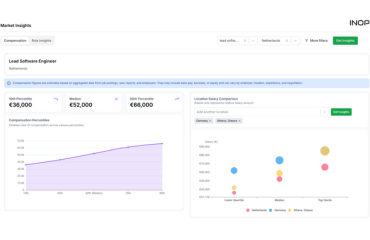
External labor market data is becoming richer and more granular, giving organizations a far clearer view of the talent landscape they’re competing in. Data on compensation benchmarks, skills scarcity, employer brand perception, and competitive hiring activity is now available at a level of detail that was inconceivable five years ago.
Real-time workforce sensing through continuous listening tools, pulse surveys, and behavioral analytics, is enabling organizations to detect workforce trends as they emerge rather than months after the fact. Combined with predictive models, this creates genuinely proactive workforce management: the ability to see a problem forming and intervene before it becomes a crisis.
Automation risk modeling is becoming a core component of workforce intelligence, as the pace of AI adoption accelerates. Organizations increasingly need to understand not just their current workforce health, but how automation will reshape their role landscape over the next three to seven years, and what that means for where they invest in people today.
Conclusion: The Organizations That Decide Better, Win
Workforce Decision Intelligence represents a fundamental shift in how organizations relate to their people data. It elevates HR from a reporting function to a genuine strategic capability, one that anticipates problems before they occur, models the consequences of strategic choices before they’re made, and continuously improves as it learns from outcomes.
The organizations that will win the talent challenges of the next decade are not necessarily those with the largest HR teams or the most generous compensation packages. They are the ones that make better decisions, faster, with greater confidence, because they’ve built the intelligence infrastructure to support it.
If you’re ready to move beyond workforce reporting and start making decisions with real intelligence behind them, explore INOP’s strategic workforce planning platform. See how organizations are using it to understand their workforce position across every dimension, strategy, finance, people, market, and automation risk, and take action with confidence.
Have thoughts or questions after reading this? Drop a comment below, share it with a colleague who leads workforce or talent strategy, or reach out to the INOP team directly. The shift to Workforce Decision Intelligence is already underway, the question is where your organization sits on that journey.
Frequently Asked Questions
What is the difference between Workforce Decision Intelligence and workforce analytics? Workforce analytics is primarily focused on measuring and reporting on workforce data, headcount, turnover, engagement, and similar metrics. Workforce Decision Intelligence goes further: it integrates workforce data with financial, strategic, and market data, applies predictive and prescriptive models, and produces specific recommendations with quantified impact. The distinction is the difference between knowing what happened and knowing what to do next.
What types of organizations benefit most from Workforce Decision Intelligence? WDI delivers the most value in organizations where talent decisions carry significant financial consequences, large enterprises, fast-growing companies, PE-backed businesses focused on workforce value creation, and organizations in industries undergoing rapid technological change. That said, mid-sized companies facing competitive talent markets or strategic transformation can benefit substantially as well, especially when the cost of workforce misalignment is high relative to the organization’s margin structure.
How does Workforce Decision Intelligence connect to strategic workforce planning? WDI is the intelligence layer that makes strategic workforce planning rigorous rather than aspirational. It provides the predictive models, financial quantification, and scenario simulation capabilities that allow planners to move beyond historical extrapolation and build dynamic, continuously updated workforce strategies aligned to business objectives. Without WDI, strategic workforce planning is often a planning exercise. With it, it becomes a decision system.
What is the BBRA framework in workforce planning? BBRA stands for Build, Buy, Redeploy, Automate, the four primary pathways for closing a workforce gap. Build means developing capability internally through training and upskilling. Buy means acquiring talent externally through hiring. Redeploy means moving existing employees from lower-priority areas to higher-priority ones. Automate means replacing a task or role with technology. WDI platforms like INOP model each pathway against financial constraints and strategic timelines to identify the optimal combination for each gap.
How much data does an organization need to start using Workforce Decision Intelligence? You don’t need perfect data to start, you need prioritized data. Most organizations can begin generating meaningful workforce intelligence with HRIS data, performance records, compensation data, and engagement survey results. A good WDI implementation identifies which data assets already exist, which gaps are most consequential, and how to sequence integration work based on decision priority rather than technical completeness.
Is Workforce Decision Intelligence the same as workforce automation? No, these are distinct concepts. Workforce automation refers to replacing human tasks with technology. Workforce Decision Intelligence is about helping humans make better decisions about their workforce. In fact, WDI is often used to inform automation decisions, identifying which roles have high automation potential, modeling the financial impact of automating them, and planning the workforce transitions that follow.
How do organizations ensure the ethical use of workforce data within WDI? Ethical use requires governance by design: clear policies on what data can be collected and used, transparency with employees about how data informs decisions, human review processes for algorithmic recommendations, and regular audits of models for bias, particularly in performance assessment, compensation, and succession contexts. Compliance with applicable privacy frameworks, including GDPR and relevant US state regulations, should be embedded from the start. Good WDI providers will have governance frameworks built into their platforms, not bolted on afterward.
Book a Demo
Make confident workforce decisions that support strategy and value creation.