Your HRIS cannot tell you if your workforce is ready for AI transformation and that is now a governance problem.
Executive Perspective
AI investment is accelerating. Workforce readiness is not.
Most organisations can describe their AI ambition clearly. Far fewer can evidence whether their workforce can execute it. The limiting factor is not intent. It is visibility.
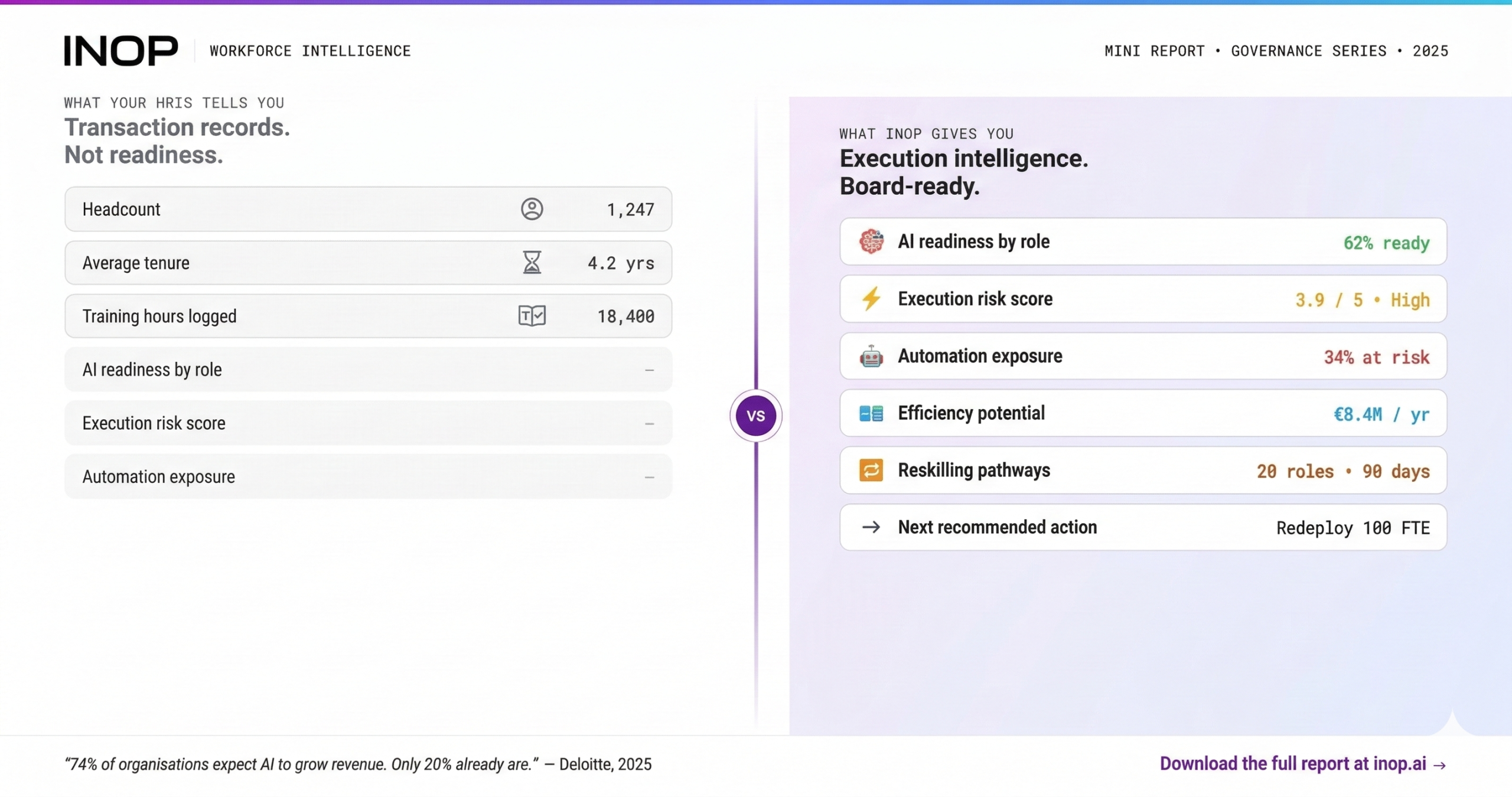
Legacy HR systems were not designed to answer readiness questions. They were designed to record employment transactions. That gap has become material.
Investor insight: When boards cannot quantify workforce capability, markets cannot price execution risk.
The Measurement Gap
HRIS platforms typically provide high-integrity data on:
- Headcount and workforce cost
- Tenure and organisational structure
- Job titles and grades
- Compliance and administrative events
They do not provide decision-useful visibility on:
- Skills composition and proficiency
- Capability gaps against strategic priorities
- Internal mobility capacity and succession readiness
- Automation exposure by job family
- Reskilling pathways, timelines, and outcomes
- AI readiness at role, function, and region level
This is the difference between running workforce operations and governing workforce risk
Data Exists. Insight Doesn’t.
Most companies have multiple workforce systems, each optimised for a narrow purpose: HRIS records employee events, ATS records hiring flow, learning systems record training activity, compensation systems record cost.
The stack is comprehensive. But it is not integrated around the questions that now matter.
Boards and executives are increasingly asked:
- Do we have the skills to execute AI transformation?
- Which roles are most exposed to automation?
- How quickly can we redeploy and reskill at scale?
- Where are the critical capability gaps?
- What is the workforce ROI of transformation spend?
These are not HR questions. They are capital allocation and execution questions.
Why HRIS Is Structurally Unfit for Readiness Governance
HRIS is not failing. It is performing its original mandate. The problem is that the mandate has changed.
Compliance metrics are not readiness metrics
Legal reporting does not reveal strategic capability.
Transactions do not equal transformation capacity
Hiring volume and training completion do not indicate deployable capability.
Job titles conceal capability variance
Identical titles frequently represent different skill portfolios and AI relevance.
Learning activity is not proficiency
Recorded hours do not show skill gain, application, or readiness.
Org charts do not model mobility
Redeployment requires adjacency at the skill level, not reporting lines.
Executive consequence: Organisations can look stable on HR dashboards while being fragile on execution readiness
Five Risk Zones Created by HRIS Dependence
When HRIS is treated as the primary source of workforce intelligence, five recurring risk zones emerge:
| Skills Visibility Risk |
Capability is invisible behind job titles. What the workforce can actually do remains unmeasured. |
| Readiness Risk |
Transformation capacity cannot be quantified. Organisations invest without knowing if execution is possible. |
| Mobility Risk |
Internal redeployment cannot be modelled reliably. Redeployment requires adjacency at skill level, not reporting lines. |
| Investment Risk |
Workforce spend cannot be tied to outcomes or ROI. Capital allocation decisions are made without capability evidence. |
| Governance Risk |
Boards and investors cannot price human capital exposure. What cannot be measured cannot be governed. |
Board implication: Transformation risk accumulates silently when capability cannot be measured in a comparable, forward-looking way
AI Increases the Penalty for Poor Visibility
AI-era operating models require skills mapping at scale, capability forecasting against strategic priorities, sequenced role transformation plans, automation impact analysis, and measurable reskilling pathways and outcomes.
Legacy systems cannot deliver this as an integrated, decision-useful view. As AI ambition rises, the cost of operating without workforce intelligence rises with it.
Research confirms the gap. 74% of organisations expect AI to grow revenue. Only 20% already are. (Deloitte, 2025). The difference is not budget or technology; it is knowing where in the workforce AI land will actually and whether the capability exists to execute.
The organisations that close this gap first will have a measurable governance and execution advantage. The question is not whether to act. It is how quickly
Where INOP Fits
INOP is the workforce intelligence layer that sits above HRIS, purpose-built to answer the readiness, risk, and governance questions legacy systems cannot.
Where HRIS records what happened, INOP reveals what is true now, what the risk is, and what leadership needs to do next.
Most platforms manage workforce operations. INOP manages workforce as strategic capital
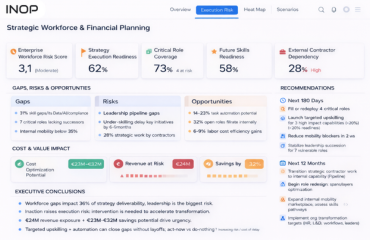
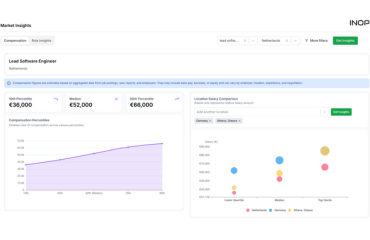
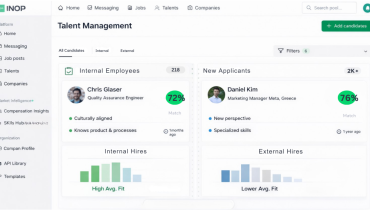
INOP connects HR, financial, market, and AI/automation data across five unified lenses; Strategy, Finance, People, Market, and AI & Automation into a single source of workforce decision intelligence.
| Legacy HRIS |
INOP |
| Records employment transactions |
Maps capability, readiness, and execution risk in real time |
| Single-lens view (HR only) |
5 unified lenses: Strategy | Finance | People | Market | AI & Automation |
| Tracks skills and headcount |
Quantifies execution risk and readiness |
| Forecasts hiring needs |
Models scenarios: growth, M&A, automation, restructuring |
| Supports HR operations |
Optimises workforce as strategic capital |
| Reports metrics |
Provides board-level intelligence and investor-grade disclosure |
| Annual planning cycles |
Real-time, scenario-based decisions with ROI modelled across 180-day, 1-year, and 3-year horizons |