When companies talk about employee performance, two terms often appear side by side: skill gap and knowledge gap. At first glance, they may seem interchangeable. After all, both affect how well employees perform at work. But in reality, the distinction between the two is critical. Understanding skill gap vs knowledge gap helps leaders make smarter decisions about training, workforce planning, and long-term business growth.
In this guide, we’ll explore what each term means, the difference between skill gap and knowledge gap, why it matters for your organization, and how to address both effectively.
What is a Knowledge Gap? (Definition & Meaning)
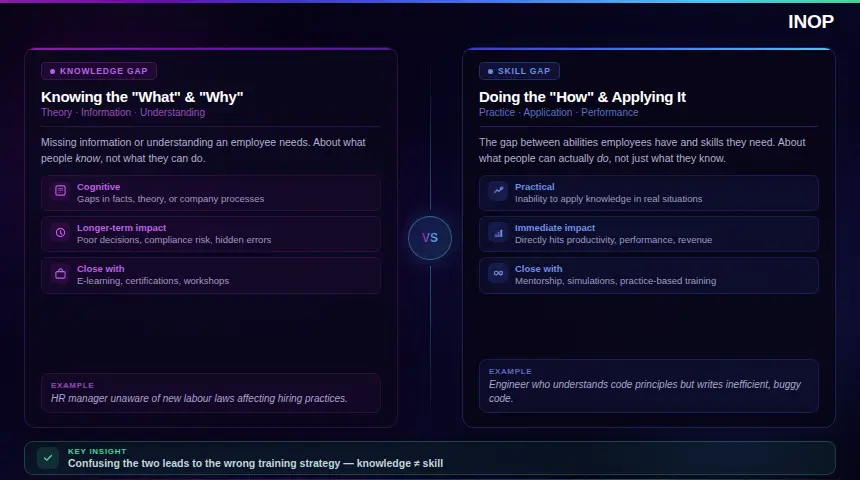
The true meaning of a knowledge gap is the discrepancy between the information an employee currently possesses and the information they actually need to perform their role successfully. Unlike a skill gap, which is about action, a knowledge gap is a foundational blind spot in theory, facts, or company processes.
A knowledge gap occurs when employees lack the information, concepts, or understanding necessary to perform their work. Unlike skills, knowledge represents the foundation of what people know, not how they act on it.
For example:
- An HR manager may lack knowledge about new labor laws that affect hiring practices.
- A project manager might not understand the latest methodologies in agile project management.
While knowledge gaps don’t always translate immediately into poor performance, they create hidden risks. Without the right information, employees may make decisions that cost time, compliance, or even revenue.
Understanding What a Skill Gap Really Means
A skill gap refers to the difference between the abilities employees currently have and the skills they need to perform their roles successfully. Unlike knowledge, skills are about application. They represent what an individual can actually do rather than just what they know.
For example:
- A software engineer may understand the principles of coding but struggle to write efficient, bug-free code (a skill gap).
- A sales professional might know negotiation theory but fail to apply persuasive techniques during live client meetings (a skill gap).
Skill gaps are especially concerning because they directly impact productivity, performance, and ultimately, profitability. According to LinkedIn’s Workplace Learning Report, 46% of employers say the skills gap is widening in their organizations — a clear sign that leaders must address it urgently.
Skill vs. Knowledge: What is the Fundamental Difference?
Before diving into the gaps that disrupt business performance, it is crucial to understand the fundamental difference between skill and knowledge. While these terms are often used interchangeably in corporate training, they refer to entirely different cognitive processes.
- Knowledge is theoretical (The “What” and “Why”): Knowledge refers to the information, facts, theories, and concepts an employee acquires through education, reading, or observation. It is cognitive. For example, reading a manual on how a combustion engine works gives you knowledge of the engine.
- Skill is practical (The “How”): A skill is the physical or applied ability to perform a specific task successfully. It is developed through hands-on practice, repetition, and experience. Using the previous example, actually taking the engine apart and rebuilding it requires skill.
In short: Knowledge is knowing what to do. Skill is having the ability to actually do it.
Key Differences Between Skill Gap and Knowledge Gap
Although they often overlap, there are crucial distinctions between the two:
| Aspect | Skill Gap | Knowledge Gap |
|---|---|---|
| Focus | Practical ability to apply knowledge in real situations | Information, theory, or concepts employees need to know |
| Example | Can’t operate new machinery effectively | Doesn’t know how the machinery works |
| Impact | Immediate effect on job performance and productivity | Longer-term effect, often leading to mistakes or inefficiency |
| Measurement | Assessed through hands-on tests, simulations, or performance reviews | Assessed through quizzes, certifications, or training modules |
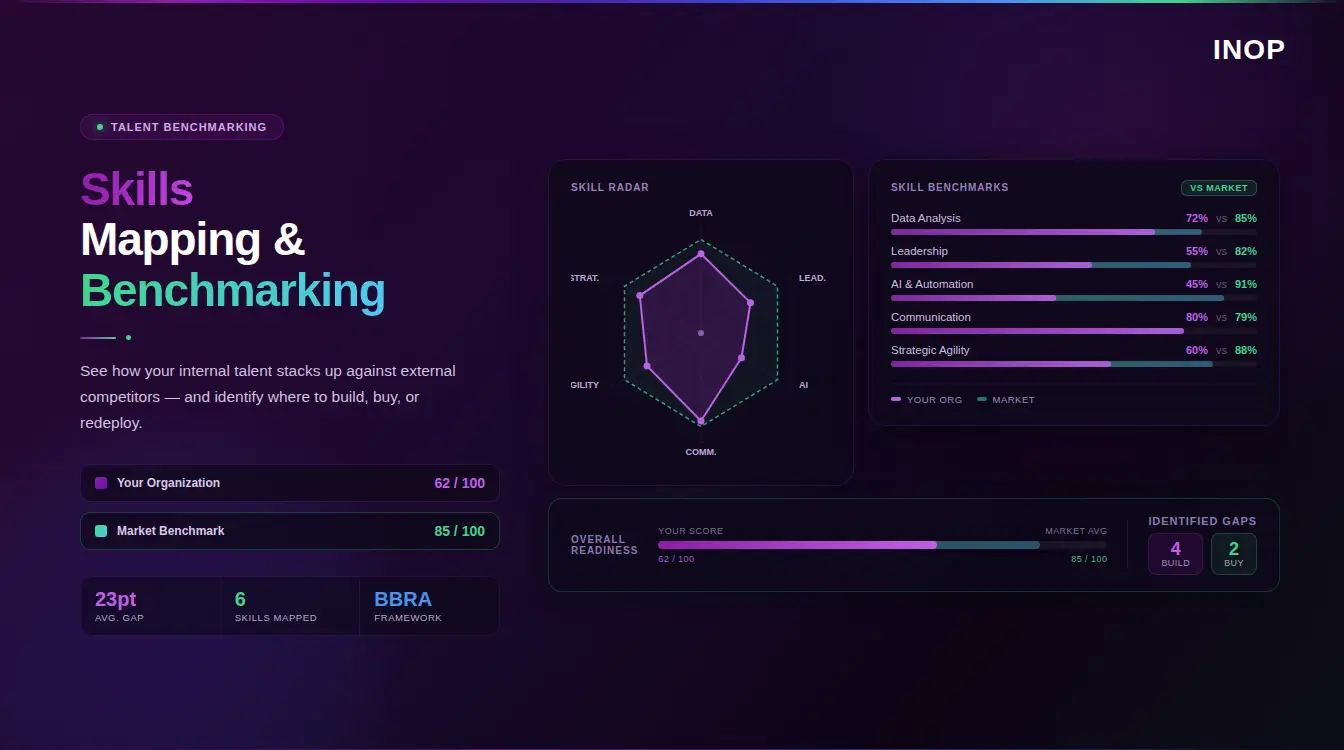
Organizations that confuse the two may end up investing in the wrong solutions, for instance, providing knowledge-based training when what employees actually need is hands-on practice. That’s where a skill-based workforce planning tool can provide clarity by identifying both categories and suggesting tailored interventions.
For organizations ready to act on both gap types simultaneously, using top skills assessment tools for hiring 2026 provides a structured, scalable way to measure practical skill gaps and validate knowledge gaps in one process, without relying on self-assessment or manager observation alone.
A Real Example: How IBM Distinguished Between the Two During Its AI Transition
When IBM began its transition toward AI-augmented consulting and software delivery, it faced a gap landscape that could not be addressed through a single training strategy because the gaps were not all the same type.
A significant portion of the workforce had a knowledge gap around what large language models were, how they worked, what their limitations were, and how to interpret their outputs responsibly. These employees could not yet form a mental model of where AI judgment was reliable and where it required human verification. The right intervention for this group was informational: structured learning about how the models worked, what training data limitations meant for accuracy, and how to evaluate outputs critically.
A separate and distinct population already held that conceptual understanding, they had read the papers, attended internal briefings, and passed knowledge checks, but could not translate it into reliable execution inside client-facing workflows. They knew what to do. They could not consistently do it under the time pressure, ambiguity, and accountability conditions of a real engagement. That is a skill gap. The right intervention was practice-based: structured simulations, supervised application in lower-stakes internal projects, and structured feedback on output quality.
IBM’s “SkillsBuild” programme and its broader AI upskilling initiative, which the company committed to running for 30 million learners by 2030 in partnership with educational institutions, succeeded where similar programmes failed because it separated these two problems at the design stage rather than treating AI capability as a single undifferentiated training objective. Employees who needed conceptual grounding got learning tracks built around that. Employees who needed applied practice got role-specific simulations rather than more information they already had.
The cost of conflating the two is not just wasted training spend. It is the specific failure mode your article correctly identifies in the introduction: organizations end up investing in the wrong solution because they have not diagnosed which gap they are actually looking at.
Why investors can’t price human capital risk and what boards must do to regain workforce visibility in the AI era.
Why Closing Skill and Knowledge Gaps Matters
Failing to address these gaps can hurt business performance in several ways:
- Reduced productivity: Employees with skill gaps underperform, slowing down projects and frustrating teams.
- Compliance and risk issues: Knowledge gaps, especially around laws and regulations, can expose organizations to fines or legal trouble.
- Poor employee experience: Workers feel frustrated when they lack either the know-how or the ability to do their jobs well.
- Competitive disadvantage: In industries where innovation is key, companies with unaddressed gaps fall behind faster.
By identifying whether an issue stems from knowledge or skills, HR leaders can design more effective development strategies. For instance, offering e-learning to close knowledge gaps and mentorship or hands-on training to tackle skill gaps.
Is a Skill Gap Safe for Your Business?
A common question among executives is whether a skill gap is safe to leave unaddressed in the short term. The definitive answer is no. A skill gap is never safe; it introduces immediate human capital execution risk into your organization.
When employees lack the practical abilities to execute their roles, the business faces severe vulnerabilities:
- Operational Bottlenecks: Tasks take twice as long to complete, leading to delayed product launches and frustrated clients.
- Safety and Compliance Risks: In industries like manufacturing, healthcare, or finance, lacking the skill to operate machinery or apply compliance protocols safely can lead to physical injuries or massive legal fines.
- Employee Burnout: When high-performing employees have to constantly pick up the slack for team members with skill gaps, it leads to rapid burnout and costly turnover.
When the Skill Gap Is Specifically an AI Capability Gap
The distinction between skill gaps and knowledge gaps becomes especially consequential in one area of the workforce right now: AI capability. Unlike most skill categories, where the gap between what employees know and what they can do closes gradually through practice and training, AI-related gaps are moving faster than most development cycles can follow. The skills considered current today may be partially obsolete within months, and the gap between an employee’s self-reported AI confidence and their verified AI capability tends to be wider than in almost any other domain.
This is why an ai skills gap analysis requires a different approach than a standard skill or knowledge gap assessment. A general gap analysis can often rely on manager observation, annual reviews, and periodic surveys. For AI capability specifically, self-reported data consistently overstates readiness, because employees tend to conflate casual familiarity with an AI tool with the ability to use it reliably inside regulated, high-stakes workflows. The result is a workforce that reports AI competence while the underlying verified capability tells a different story.
The framework for running this analysis correctly starts by separating what employees know about AI tools from what they can demonstrably do with them, which maps directly to the skill versus knowledge distinction covered above. A knowledge gap around AI means an employee lacks the conceptual understanding of how a model works, what its limitations are, or how to interpret its outputs. A skill gap means they cannot translate that understanding into consistent, accurate application inside their actual role. Both exist in parallel across most organizations today, and closing one without addressing the other produces training programs that look complete but leave execution risk in place.
Strategies to Identify and Close Gaps
Identifying Gaps
The first step is clear assessment. Businesses should:
- Conduct performance reviews that distinguish between “knows what” and “knows how.”
- Use surveys or self-assessments to gauge employee confidence.
- Leverage analytics in a skill gap management system to identify missing competencies.
By distinguishing between theoretical knowledge and practical application, these assessments can uncover gaps while simultaneously revealing signs of hidden talents in areas where an employee’s hands-on abilities exceed their formal training.
Closing Knowledge Gaps
- Provide e-learning modules, knowledge libraries, or workshops.
- Encourage continuous education and certification programs.
- Develop knowledge-sharing cultures with peer-to-peer learning.
Closing Skill Gaps
- Offer simulations, apprenticeships, and practice-based training.
- Pair employees with mentors who demonstrate strong skills.
- Use real-world projects to provide “learning by doing” opportunities.
Here, modern HR technology plays a big role. Implementing a skill-based workforce planning tool ensures companies map skills effectively, align training with business priorities, and continuously update competencies as industries evolve.
Explore more: Cost of ignoring Skills gap in Business
The Overlap Between Skill and Knowledge Gaps
It’s important to note that skill and knowledge gaps often overlap. For instance:
- A nurse may lack the knowledge of a new medical procedure and also the skill to perform it safely.
- A data analyst may not understand the concepts behind a new AI tool (knowledge) and may also fail to apply it in practice (skill).
This overlap means HR teams must adopt a holistic approach. Instead of treating gaps in isolation, they should design integrated learning programs that address both theory and practice.
Building a Future-Ready Workforce
Closing skill and knowledge gaps is not just about fixing today’s challenges — it’s about future-proofing the organization. Workforce studies show that by 2030, more than 375 million workers worldwide may need to reskill or upskill to keep pace with technological change.
Businesses that invest early in identifying gaps, adopting workforce planning software, and integrating training strategies will be better equipped to adapt, grow, and compete.
Building a “Self-Stabilizing” Learning Culture
One of the most advanced — and most overlooked — strategies for managing knowledge gaps at scale is designing what organizational psychologists call a self-stabilizing learning environment.
Most companies operate in a reactive mode when it comes to knowledge gaps. A compliance issue surfaces, a project fails, or a performance review flags a problem — and only then does HR scramble to design a training intervention. This cycle is expensive, slow, and always one step behind the actual problem.
A self-stabilizing workforce breaks this pattern entirely.
By 2030, more than 375 million workers worldwide may need to reskill or upskill to keep pace with technological change. Organizations that wait for gaps to surface before acting won’t close them fast enough. The ones that will adapt are those that build systems designed to self-correct continuously.
What “Self-Stabilizing” Actually Means
In a traditional organization, knowledge gap management depends on top-down visibility. A manager notices their team doesn’t understand a new regulation. HR designs a course. The course gets scheduled for next quarter. By the time employees complete it, the business has already absorbed the cost of the gap.
In a self-stabilizing system, the feedback loop is continuous and embedded in daily work. Employees are equipped — through culture, process, and technology — to identify their own knowledge gaps in real time and access resources to close them without waiting for a formal intervention. The organization’s knowledge base effectively corrects itself, the way a thermostat regulates temperature without human input.
This isn’t a theoretical concept. It’s a structural design choice that forward-thinking HR teams are actively building into their organizations.
What It Looks Like in Practice
Consider two HR teams handling the same challenge: a new AI-powered performance management tool has just been rolled out, and employees lack the knowledge to use it effectively.
Traditional approach: HR notices adoption is low after 60 days. They commission a training needs assessment, build an e-learning module, schedule live sessions, and track completion rates. The knowledge gap existed for months before it was addressed. Productivity and adoption suffered throughout.
Self-stabilizing approach: The platform itself flags low engagement patterns by team. Managers receive automated prompts identifying which specific features their teams haven’t used, paired with short contextual guides. Peer champions — employees who adopted quickly — are surfaced automatically and connected with struggling colleagues. Knowledge gaps are closed in days, not months, without a formal HR intervention.
The difference isn’t the quality of the training content. It’s the architecture of how gaps get detected and addressed.
The Three Conditions That Make It Work
A self-stabilizing learning culture doesn’t happen by accident. It requires three things to function:
1. Continuous skills and knowledge visibility. You can’t self-correct what you can’t see. Organizations need a live picture of what their workforce knows — not an annual snapshot from a performance review. This is where modern talent intelligence platforms like INOP’s Skills Intelligence become operational infrastructure rather than just reporting tools. When knowledge gaps are visible in real time, the entire system can respond faster.
2. Psychological safety to flag gaps. Employees will only self-identify knowledge gaps if the culture makes it safe to do so. In organizations where admitting you don’t know something is perceived as weakness, gaps go underground — and grow. Building psychological safety isn’t a soft HR initiative; it’s a structural prerequisite for self-stabilization.
3. On-demand, contextual learning resources. The correction mechanism only works if resources are accessible at the moment the gap is identified. Long e-learning modules that require scheduling don’t fit this model. Short, role-specific, searchable knowledge assets — accessible within the flow of work — are what actually close gaps at the speed a self-stabilizing system requires.
Why This Matters More as AI Changes Job Requirements
The case for self-stabilizing learning has never been stronger than it is right now. As AI tools reshape roles faster than traditional training cycles can keep up, the half-life of workplace knowledge is shrinking. A knowledge base that was accurate 18 months ago may already have significant gaps today — in AI literacy, regulatory compliance, new tooling, or revised processes.
Organizations that rely on annual training cycles to manage this will fall permanently behind. Those that build self-stabilizing systems — where gaps are detected early, surfaced automatically, and closed continuously — will adapt faster, retain better, and execute with fewer costly blind spots.
The goal isn’t to eliminate knowledge gaps entirely. That’s impossible in a fast-moving business environment. The goal is to build an organization that closes them faster than they accumulate.
Conclusion
When comparing skill gap vs knowledge gap, the distinction may seem subtle but carries massive implications for organizational success. Skills are about doing, knowledge is about knowing. Both are vital, and both must be managed with the right mix of technology, training, and leadership commitment.
The key takeaway: don’t confuse the two. By recognizing their differences, investing in the right solutions, and leveraging modern tools, organizations can close gaps faster, build stronger teams, and unlock long-term growth.
Frequently Asked Questions
What is a knowledge gap?
A knowledge gap is the discrepancy between the information an employee currently possesses and the information they need to perform their role successfully. It represents theoretical understanding, facts, concepts, or rules—the “what” and “why”—rather than practical execution.
What is a skill gap?
A skill gap is the difference between the practical abilities employees currently have and the abilities they need to execute their tasks effectively. While knowledge is cognitive, skills are operational—representing “how” to apply information in real-world scenarios through practice and experience.
What is the fundamental difference between a skill gap and a knowledge gap?
Knowledge is theoretical and cognitive, acquired through study or observation. Skill is practical and actionable, developed through hands-on practice. A knowledge gap means an employee doesn’t know what to do or how something works, whereas a skill gap means an employee understands the concept but lacks the ability to execute it efficiently.
Is leaving a skill gap unaddressed safe for a business?
No, a skill gap is never safe because it introduces immediate execution risks into an organization. Unaddressed skill gaps lead to operational bottlenecks, increased safety and compliance risks, poor productivity, and employee burnout as top performers overcompensate for struggling team members.
How do you close knowledge gaps versus skill gaps?
Knowledge gaps are best addressed through theoretical and informational resources like e-learning modules, workshops, certifications, and documentation. Skill gaps require hands-on application strategies such as simulations, apprenticeships, mentorship programs, and real-world project assignments.
Why are AI skill gaps different from standard skill gaps?
AI skill gaps move faster than traditional development cycles, and employee self-reported confidence often vastly overstates verified capability. An AI knowledge gap involves a lack of conceptual understanding regarding how models work, while an AI skill gap means an employee cannot reliably translate AI tools into regulated, high-stakes workflows.
Book a Demo
Make confident workforce decisions that support strategy and value creation.