An AI transformation framework is the decision structure your leadership team uses to choose which AI changes to make, in what order, at what cost, and under whose oversight. Most AI programs stall because leaders approve initiatives one at a time with no shared basis for comparison. A usable framework prices workforce impact at the task level, compares options across short and long time horizons, and builds governance in before agents reach production. INOP’s BBRA model (Build, Buy, Redeploy, Automate) applies that discipline to workforce decisions.
An AI transformation framework is the decision structure a leadership team uses to choose which AI-driven changes to make to roles, workflows, and technology, how to fund them, and who stays accountable once they go live. CHROs, CFO partners, and PE operating partners need that structure before they need another pilot. Without it, each AI initiative gets judged on its own terms by the team that proposed it, and you have no way to weigh one bet against another.
Four questions sit at the center of any credible framework: which work changes, which pathway handles the change, what each pathway costs over time, and who owns the result.
What Is an AI Transformation Framework?
An AI transformation framework gives your organization a repeatable method for deciding which AI changes to pursue, in which sequence, and through which pathway. It covers decision criteria, financial modeling, governance, and the measure you will use to call an initiative a success.
The framework sits above the tools. A platform licence gives your teams new capability, and the framework tells them where to point it. A set of pilots gives you evidence, and the framework tells you which ones to scale, which to redesign, and which to stop.
How Does an AI Transformation Framework Differ From an AI Maturity Model?
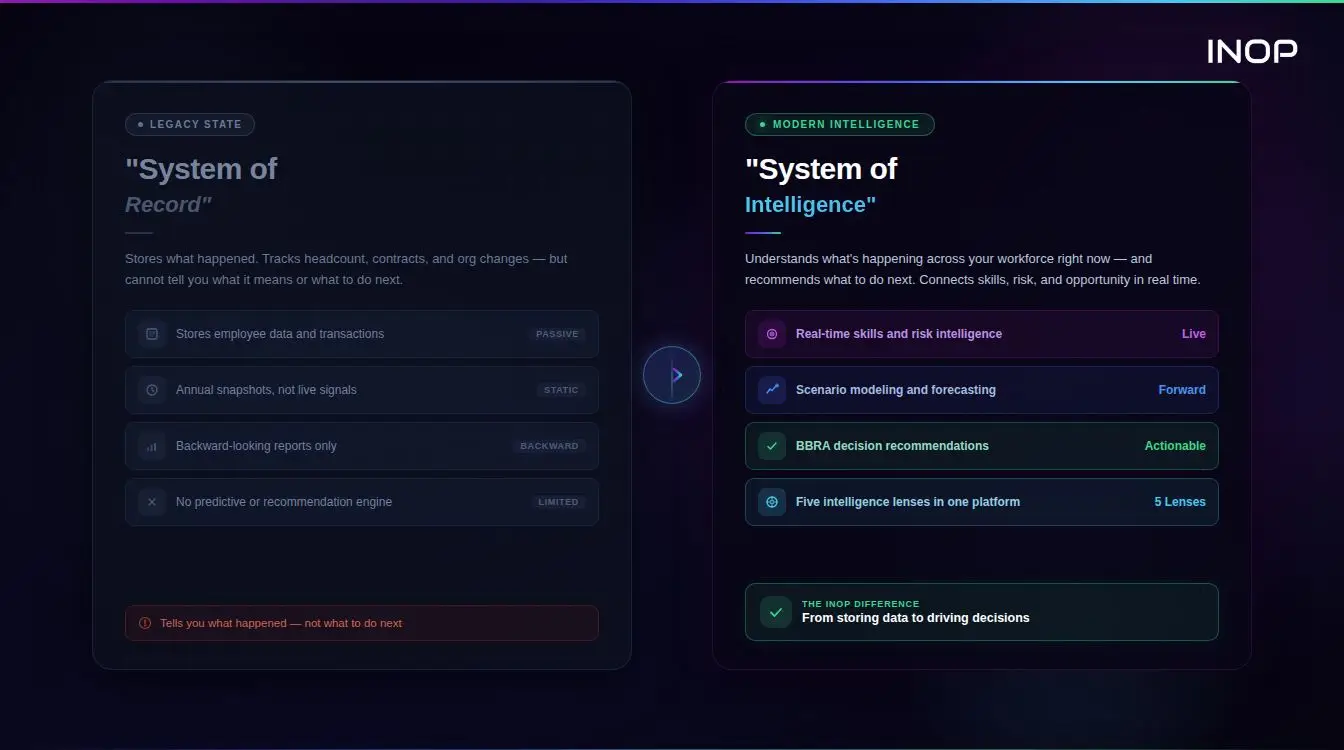
An AI maturity model scores where your organization stands today, on a scale that runs from early experimentation to AI embedded across core operations. An AI transformation framework is the method you use to move up that scale. It sets how your team selects initiatives, prices them, governs them, and checks the results.
Use the maturity model as the diagnosis and the framework as the plan. Most leadership teams need both, and they run into trouble when a maturity score gets presented as a strategy. AI decisions also sit inside a wider program of change: INOP’s definition of workforce transformation covers the dimensions that program has to move together.
Why Do AI Transformation Programs Stall Before They Pay Off?
AI programs stall when leaders approve initiatives one at a time, with no shared basis for comparing them and no agreed definition of success. Data quality and cost overruns play a part, but the decision gap comes first.
Researchers at RAND interviewed 65 experienced data scientists and engineers for their study of why AI projects fail. The report cites estimates that more than 80 percent of AI projects fail, about twice the rate of IT projects that do not involve AI. The interviewees named one root cause more than any other: business leaders misunderstanding how to set a project on a path to success. Poor data quality came second.
Agentic AI is repeating the pattern. Gartner predicts that over 40 percent of agentic AI projects will be canceled by the end of 2027, citing escalating costs, unclear business value, and inadequate risk controls.
Read those causes as a list of missing framework parts. Unclear value means nobody set a success metric before approval. Escalating cost means nobody modeled the three-year cost next to the pilot budget. Weak risk controls mean governance arrived after the agents did.
Why Does Workflow Redesign Decide AI Returns?
Workflow redesign has the largest effect on whether AI produces a financial return. McKinsey’s research on the state of AI tested 25 organizational attributes and found that redesigning workflows mattered more to earnings impact than budget, talent, or the choice of model.
For workforce leaders, that finding moves the work down to tasks. Your framework has to show which tasks inside each role change, how much capacity the change frees, and where that capacity goes next: to higher-value work, to a redeployment path, or out of the cost base. INOP’s guide to automation potential covers the gap between what AI can do in a role and what your organization should automate.
What Should an AI Transformation Framework Include?
A usable AI transformation framework has four components: shared decision criteria, financial modeling across time horizons, governance for autonomous systems, and a named owner for each outcome. Leave one out and the framework produces activity that nobody can defend at board level.
| Component | Question It Answers | Common Gap |
|---|---|---|
| Decision criteria | Can we compare this initiative with the others on the same basis? | Each team scores its own pilot with its own measures |
| Financial modeling | What does this cost and return at 30 days, 180 days, one year, and three years? | Business cases stop at the pilot budget |
| Governance | What can an agent decide alone, who monitors it, and where is the audit trail? | Controls get written after deployment |
| Ownership | Who answers for the outcome once the initiative is live? | Ownership defaults to whichever team ran the pilot |
Resource allocation belongs in the framework too. BCG’s 10-20-70 rule holds that about 10 percent of AI value comes from the technology, 20 percent from data and algorithms, and 70 percent from changes to people, process, and operating model. A framework that spends most of its attention on vendor selection is working on the smallest share of the outcome.
How Should AI Governance Fit Into the Framework?
Build governance into each decision before an agent reaches production. The framework should record three things for every AI initiative: the decisions an agent may make without human approval, the monitoring that flags unexpected behavior, and the audit trail that captures each chain of agent actions.
Most organizations have not reached that point yet. Deloitte’s State of AI in the Enterprise research found that about 80 percent of surveyed organizations lack mature governance capabilities for agentic AI, while 74 percent of respondents expect their companies to use AI agents at least moderately by 2027. Adoption is outrunning control, and a framework is where you close that gap.
How Do You Evaluate an AI Transformation Framework Before Adopting It?
Test any framework, whether you build it in-house, license it, or develop it with an advisory firm, against six criteria before you commit. If it fails two or more, expect the same stalled pilots under a new name.
| Criterion | Question to Ask | What Good Looks Like |
|---|---|---|
| Comparability | Does it score different initiatives on one basis? | One method across functions and business units |
| Time horizons | Does it model cost and return beyond the pilot? | Near-term and three-year views side by side |
| Task-level granularity | Does it assess work below the job title? | Exposure scored per task within each role |
| Pathway coverage | Does it compare reskilling, redeployment, external capability, and automation? | All options priced, so automation is one choice among several |
| Governance | Does it define agent decision limits, monitoring, and audit trails? | Controls attached to each approved initiative |
| Explainability | Can a board member trace how a recommendation was reached? | Source attribution and confidence levels on outputs |
How Does INOP’s BBRA Framework Work for AI-Driven Workforce Decisions?
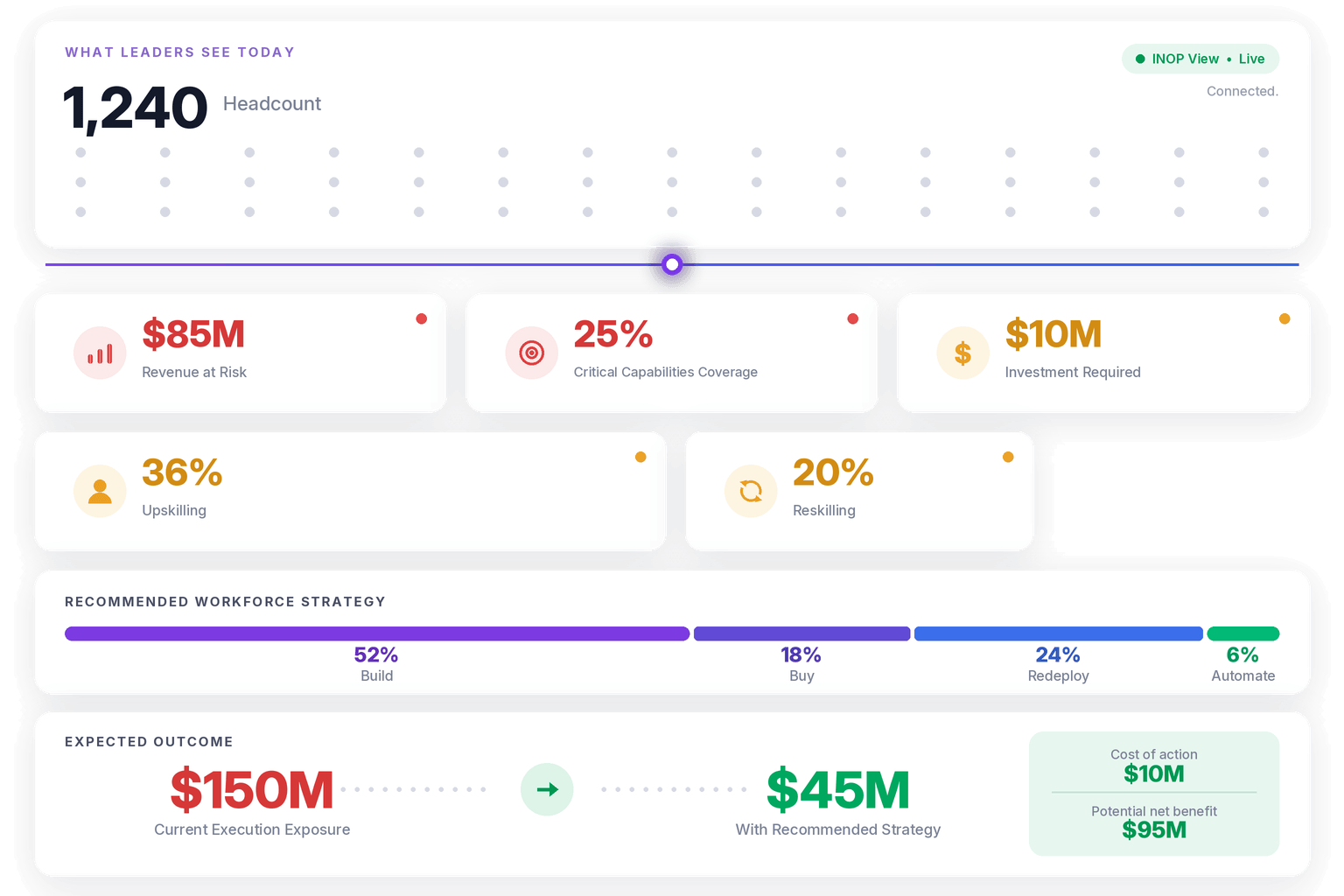
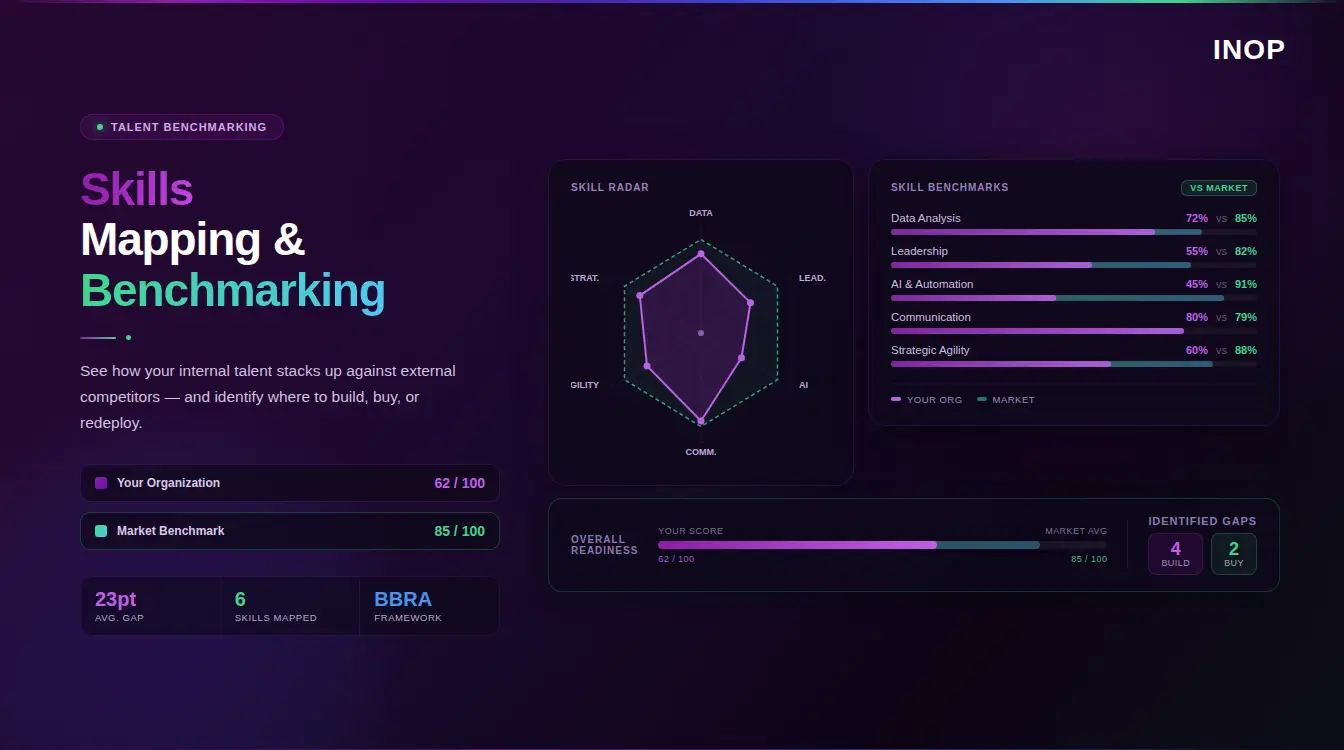
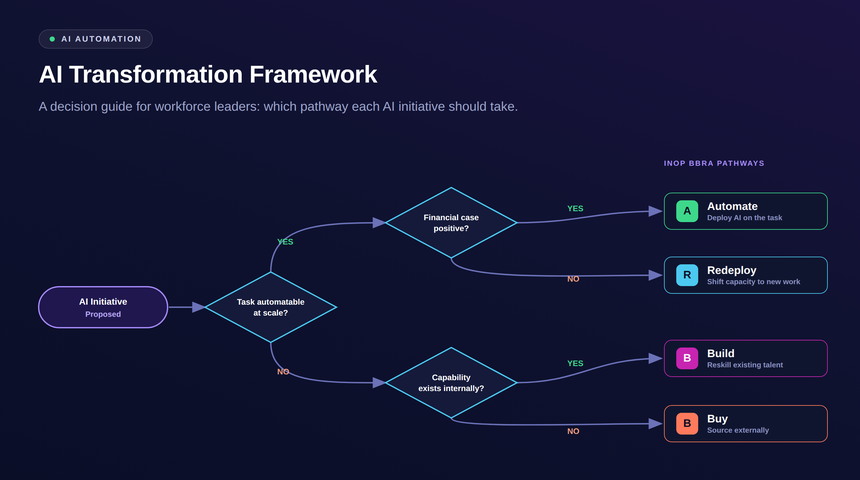
INOP built BBRA (Build, Buy, Redeploy, Automate) as its proprietary decision architecture for workforce and technology choices. For each capability gap, INOP models all four pathways and prices them across four time horizons: 30 days, 180 days, one year, and three years.
- Build: upskilling pathways, with time-to-competency and cost modeled for each.
- Buy: external capability for cases where speed or scarcity rules out building, with market availability and compensation benchmarks included.
- Redeploy: skills adjacency scored across your workforce, with a sequenced mobility plan.
- Automate: task-level AI scoring, FTE impact per role, and the automation investment case.
INOP draws each recommendation from five intelligence lenses: Strategy, Finance, People, Market, and AI and Automation. A capability gap viewed through the People lens alone reads as an HR observation. The same gap connected to financial exposure, market signals, and automation trajectory becomes a decision your board can act on.
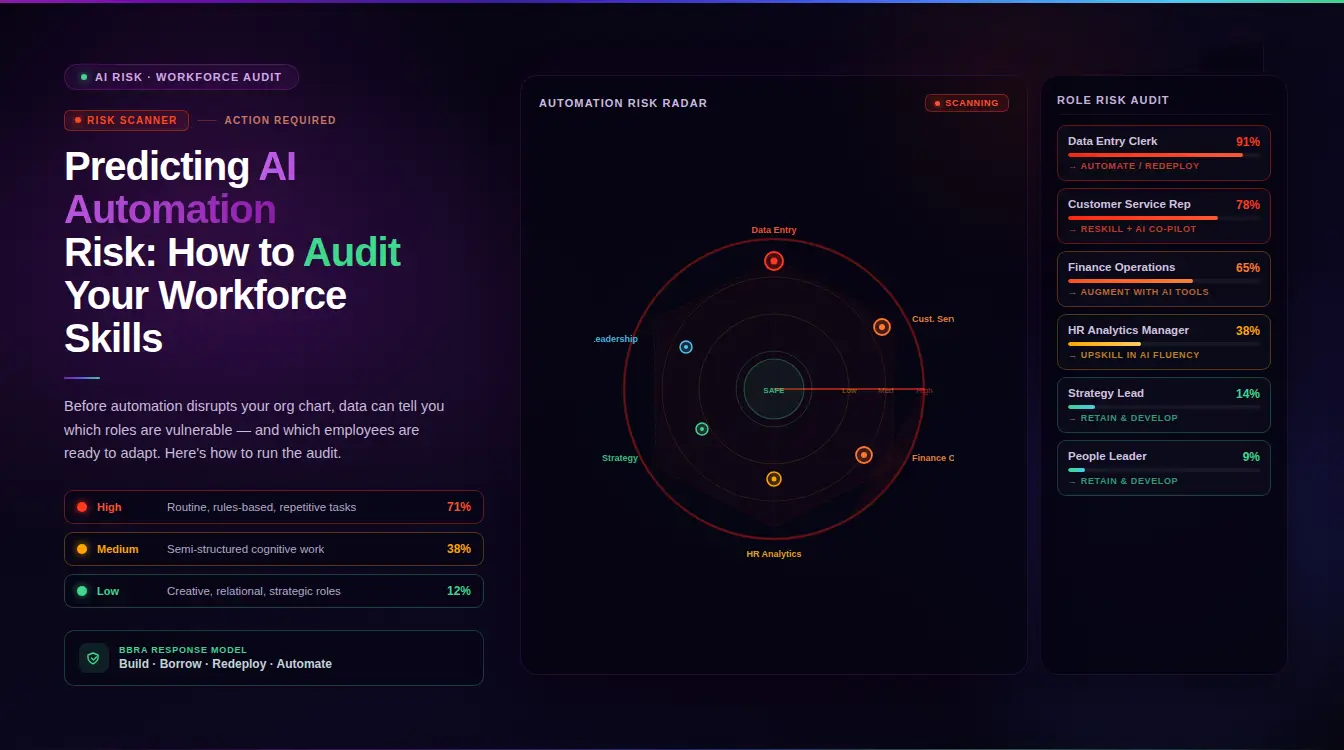
On the automation side, INOP scores each task in each role as not impacted, partially augmented, or fully automatable. For partially augmented tasks, INOP models time savings of 40 to 70 percent and the capacity that frees up. The model applies task-level analysis across more than 40,000 roles using seven published research frameworks, and it scores six connected risk domains: Capability, Leadership, Mobility, Role-Value, Culture, and Strategic Execution Risk.
INOP’s strategic workforce planning platform runs this analysis as a live decision layer. INOP delivers initial analysis within 48 hours of complete data submission, attaches confidence scores and source attribution to its outputs, and updates the intelligence as market and internal data change.
See BBRA applied to your own AI decisions. INOP will model Build, Buy, Redeploy, and Automate pathways for your capability gaps, priced across four time horizons. Book a demo
How Should Skills and Compensation Data Feed the Framework?
Treat skills demand and pay benchmarks as inputs to the framework. If you bring them in after the decision, your pathway costs rest on last year’s assumptions.
Which Skills Data Keeps an AI Transformation Framework Current?
Your AI transformation framework needs two views of skills: what your people can do today, and where external demand for each skill is heading. INOP’s skills intelligence maps external demand signals to your own taxonomy, INOP’s taxonomy, or a blend of both, and assigns each skill one of four states: Emerging, In Demand, Stable, or Declining. INOP models AI and automation impact for each skill and delivers the feed by API or secure download.
That signal changes BBRA outcomes. A declining skill in a role with high automation exposure points toward Automate or Redeploy. An emerging skill with thin internal supply points toward Build. For a step-by-step method to set your baseline, INOP’s AI skills gap analysis framework uses verified workforce data in place of self-reported surveys.
How Do Compensation Benchmarks Change the Cost of Each Pathway?
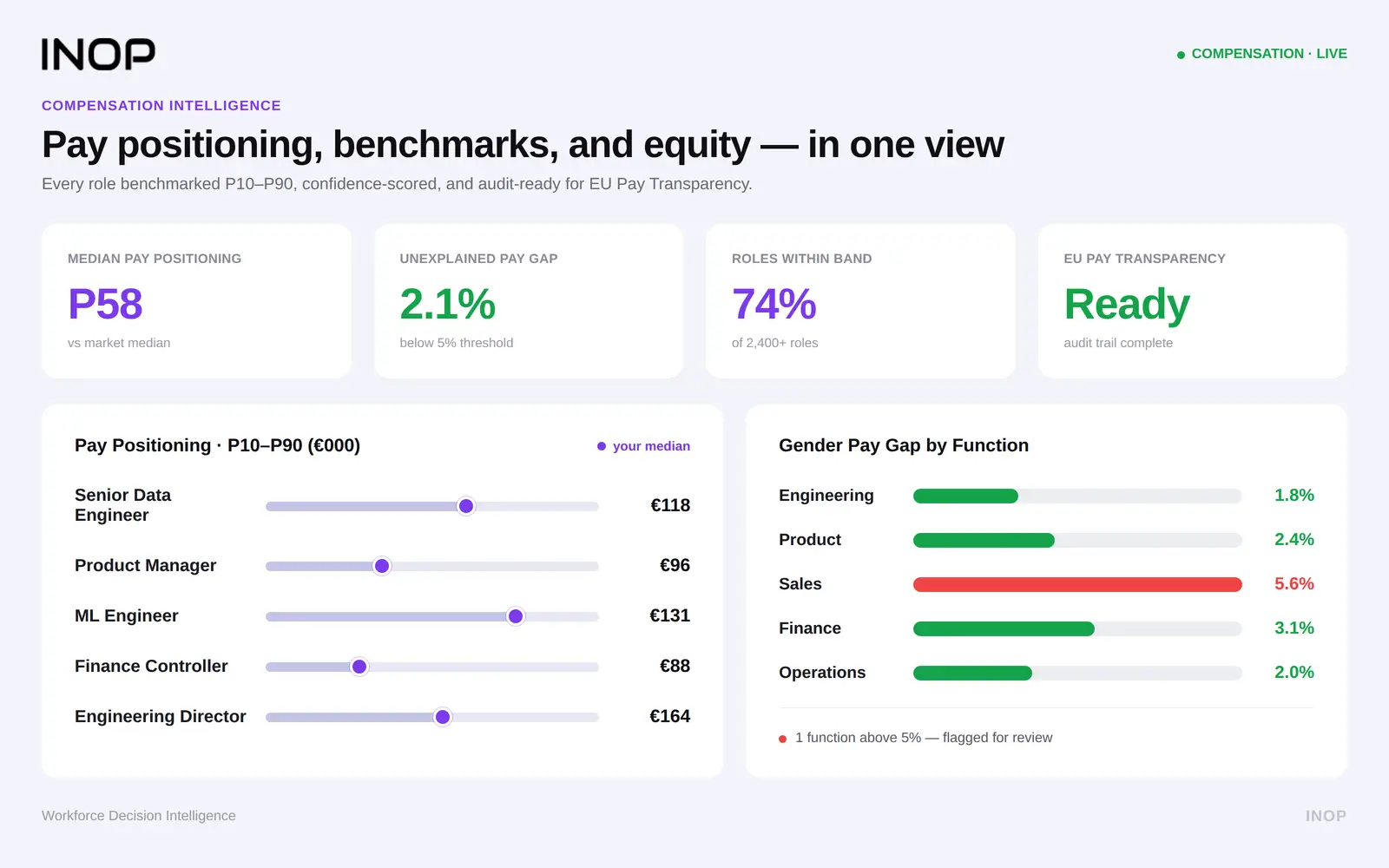
BBRA needs cost inputs that match today’s market to compare pathways on equal terms. INOP prices each pathway with real-time compensation benchmarks from its compensation analytics platform, which draws on more than 3.5 million global job postings across 16 countries, a 2,400-role jobs taxonomy, and a 22,700-skill taxonomy.
When AI reshapes a role, the same benchmarks show how pay for the redesigned role compares with the old one. Your Build and Redeploy costs then reflect the market you will pay in, and your compensation team can adjust bands as roles change instead of a cycle later.
What Should PE Operating Partners Ask of an AI Transformation Framework?
PE operating partners should ask whether a framework produces readings they can compare across portfolio companies. Each company arrives with different data, different AI maturity, and a different hundred-day plan, so a framework that works inside one company can still leave you blind at fund level.
Put four questions to any framework before you roll it out across a portfolio:
- Does it score AI readiness and workforce exposure the same way in every portfolio company?
- Does it price each workforce pathway across the holding period, from the first 30 days to three years?
- Does it show governance maturity for any agents already in production?
- Can your deal team trace each recommendation back to its data sources?
INOP applies the same BBRA pathways, time horizons, and five intelligence lenses in each company you assess. That consistency lets you see which portfolio companies can turn AI spending into margin, which are still running pilots, and where a Redeploy decision protects value that a headcount cut would destroy.
Compare AI readiness across your portfolio. See how INOP scores workforce exposure and prices BBRA pathways company by company. Book a demo
Frequently Asked Questions
What is an AI transformation framework?
An AI transformation framework is the decision structure a leadership team uses to choose which AI-driven changes to make to roles, workflows, and technology, in what order, at what cost, and under whose oversight. It combines decision criteria, financial modeling across time horizons, governance for autonomous systems, and a named owner for each outcome.
How is an AI transformation framework different from an AI maturity model?
An AI maturity model scores where your organization stands today, on a scale from early experimentation to AI embedded across the business. An AI transformation framework is the method you use to move up that scale: it sets how your team chooses initiatives, prices them, governs them, and measures whether they worked.
Why do AI transformation programs fail?
RAND researchers estimate that more than 80 percent of AI projects fail, about twice the rate of non-AI IT projects, with leadership misunderstanding how to set projects up for success as the most common root cause. Gartner expects over 40 percent of agentic AI projects to be canceled by the end of 2027.
What should an AI transformation framework include?
A usable AI transformation framework includes four components: shared decision criteria so initiatives can be compared, financial modeling across short and long horizons, governance that sets agent decision limits, monitoring, and audit trails, and a named owner accountable for each outcome once the initiative goes live.
What is INOP’s BBRA framework?
BBRA (Build, Buy, Redeploy, Automate) is INOP’s proprietary decision architecture for workforce and technology choices. For each capability gap, INOP models all four pathways and prices them across 30-day, 180-day, one-year, and three-year horizons, drawing on five intelligence lenses: Strategy, Finance, People, Market, and AI and Automation.
How should PE operating partners use an AI transformation framework?
PE operating partners should apply one framework across every portfolio company so readiness scores, pathway costs, and time horizons can be compared side by side. The framework should price workforce impact at the task level, show governance maturity, and tie each recommendation to value creation plan milestones.