The cost of a bad hire is the total financial loss an organization absorbs when a new employee fails to perform and has to be replaced: acquisition and onboarding costs, salary paid, lost productivity, management time and the cost of starting again. Gallup estimates that replacing an employee costs one-half to two times annual salary, and a CareerBuilder survey put the average loss at $14,900 per bad hire, with senior and executive roles costing far more. This guide brings together the most cited cost of a bad hire statistics with their original sources, shows the cost as a percentage of salary by role level, gives a formula with two worked examples and explains how to lower the risk by testing internal options before going to the external market.
How Much Does a Bad Hire Cost? Key Statistics
- One-half to two times salary: Gallup estimates that replacing an employee costs one-half to two times the employee’s annual salary.
- Up to 213 percent for executives: a 2012 Center for American Progress review found that senior and executive roles carry turnover costs of up to 213 percent of salary.
- $14,900 per bad hire: a 2017 CareerBuilder survey found employers lost an average of $14,900 on every bad hire, and 74 percent admitted to hiring the wrong person for a position.
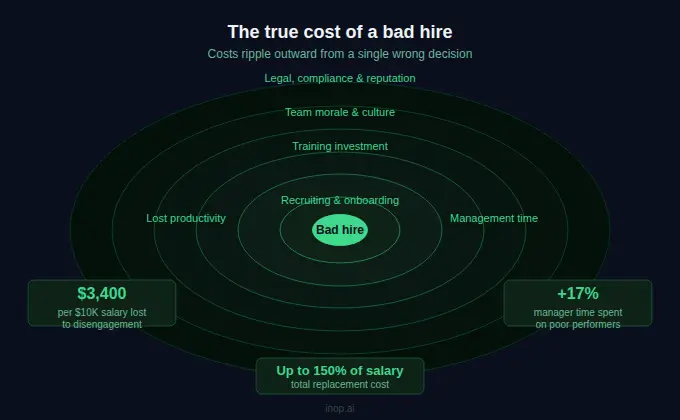
- Nearly one day a week: Robert Half research from 2012 found supervisors spend about 17 percent of their time overseeing poorly performing employees.
- At least 30 percent of first-year earnings: a rule of thumb widely attributed to the US Department of Labor.

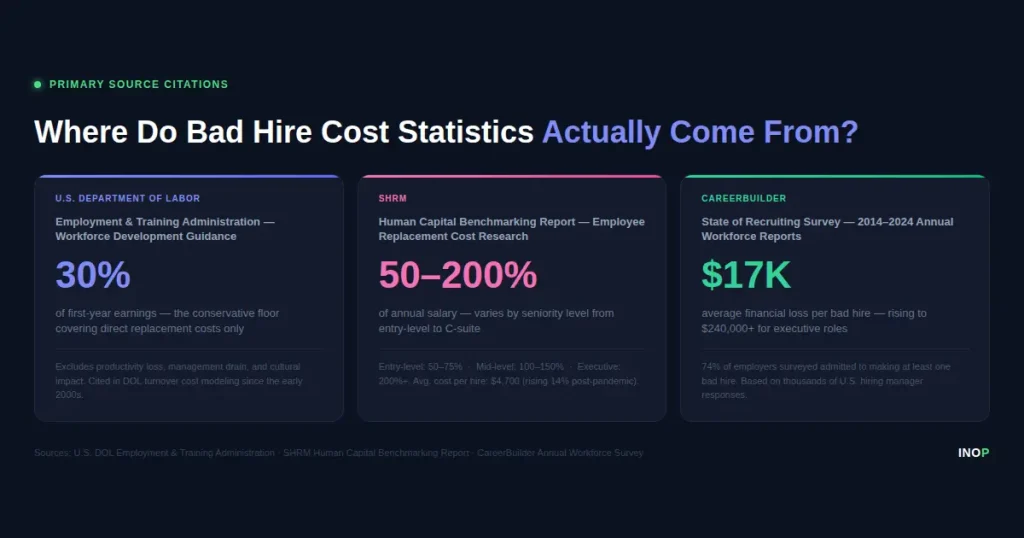
Where the Cost of a Bad Hire Statistics Come From
Many figures on this topic are repeated without their source, so it helps to know where each comes from and what it covers:
- The thirty percent rule: widely attributed to the US Department of Labor, but we could not find it in a current Department of Labor publication. Treat it as a floor for direct replacement costs only.
- CareerBuilder (2017): the survey, conducted by Harris Poll among more than 2,200 managers and HR professionals, reported the $14,900 average and the 74 percent figure. It also found that losing a good employee cost about twice as much as a bad hire.
- Gallup and the Center for American Progress (2012): both measure the cost of replacing an employee. Replacement is only one part of the cost of a bad hire, which is why full estimates that add salary paid, lost productivity and management time run higher.
Cost of a Bad Hire as a Percentage of Salary
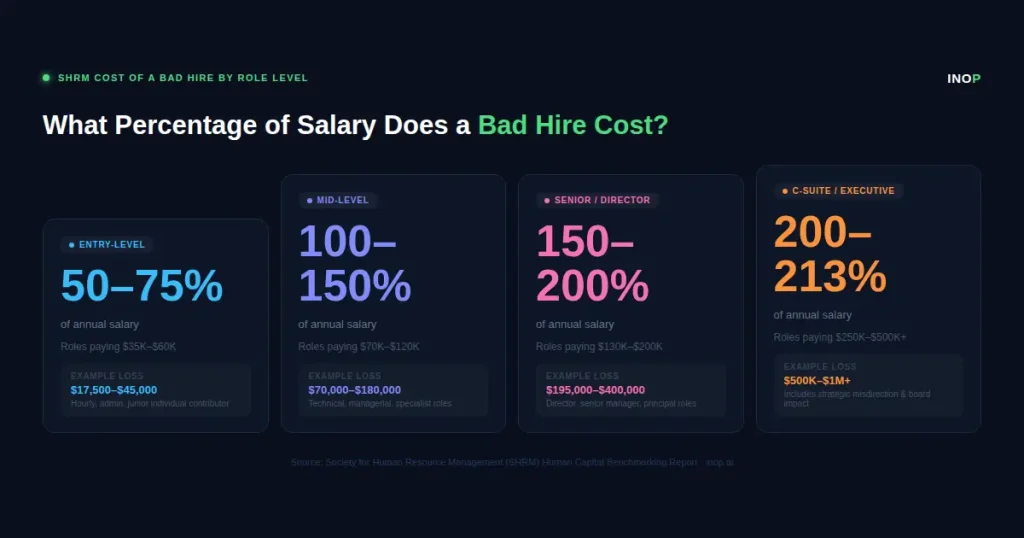
The cost rises with seniority, because senior roles take longer to fill, take longer to reach full productivity and affect more people and decisions. The ranges below are widely cited industry estimates of the full cost, including salary paid, lost productivity and management time. Replacement cost alone is lower: the 2012 Center for American Progress review found a typical (median) turnover cost of 21 percent of salary for roles other than executives and physicians. The upper bound for executives comes from the Center for American Progress, which found turnover costs ranging from 5.8 percent up to 213 percent of salary depending on the job and the skills involved. Across roles, Gallup estimates that replacing an employee costs one-half to two times the employee’s annual salary.
| Role level | Widely cited full cost as a percentage of salary |
|---|---|
| Entry-level | 50 to 75 percent |
| Mid-level and technical | 100 to 150 percent |
| Senior and director | 150 to 200 percent |
| C-suite | 200 to 213 percent |
The Cost of a Bad Executive Hire
A leadership mis-hire costs far more than the replacement itself. It adds strategic misdirection, delayed decisions, departures of strong team members and, in some cases, a loss of confidence among investors or the board. The full cost of a senior leadership mis-hire often runs well beyond two times salary once these effects are counted.
What Counts as a Bad Hire?
A bad hire is a new employee who does not meet the expectations set when the decision was made. In the 2017 CareerBuilder survey, employers described a bad hire as someone who did not produce quality work, had a negative attitude, did not work well with others, had immediate attendance problems or lacked abilities they claimed to have, which 45 percent of employers cited. That last point matters: many bad hires are a skills verification problem, not a character problem.
Breaking Down the True Cost of a Bad Hire
Acquisition and Onboarding Costs
Advertising, agency fees (often around 20 percent of first-year salary), background checks, selection time, equipment and onboarding. These are the easiest costs to see and usually the smallest part of the total.
Compensation Paid
Salary, benefits and any sign-on bonus paid for the months the person stays, while delivering less than the role requires.
Lost Productivity and Opportunity Cost
The gap between what the role should deliver and what it does deliver, plus the projects, sales or improvements that do not happen while the gap lasts.
Management Time
Coaching, correcting and documenting performance takes time away from planning and from supporting strong performers. Robert Half research published in 2012 found that supervisors spend about 17 percent of their time, nearly one day a week, overseeing poorly performing employees.
Team Morale and Lost Good Employees
Colleagues pick up extra work and lose confidence in decisions. In a 2015 Robert Half survey of CFOs reported by SHRM, 95 percent said “a poor hiring decision at least somewhat impacts the morale of the team”. The bigger risk is that strong performers leave, and replacing them costs more again.
External Costs
In client-facing roles, a bad hire can damage relationships, delay delivery and cost accounts. These costs rarely appear in any calculation but can be the largest of all.
The Cost of a Bad Hire Formula
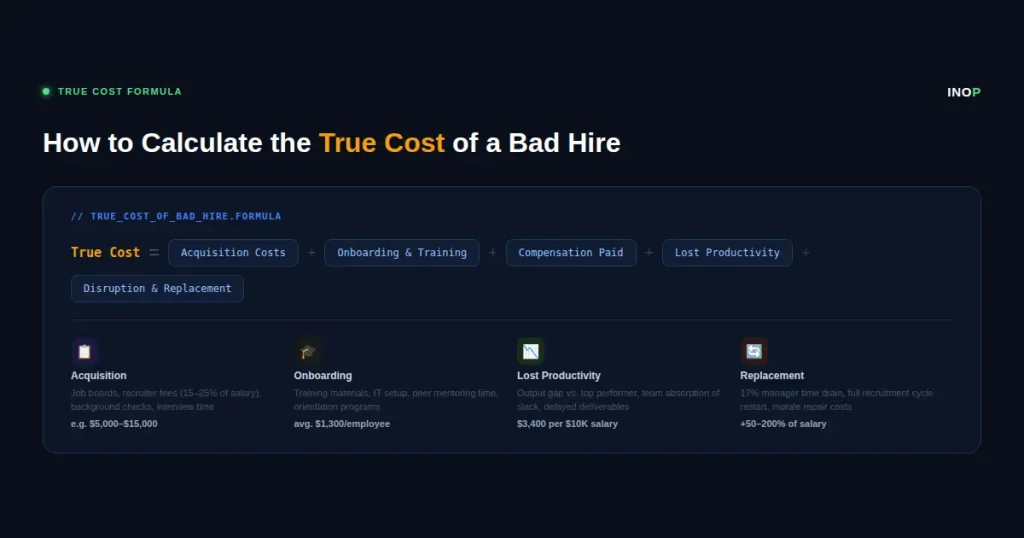
Use this formula to calculate the cost of a bad hire for your own organization:
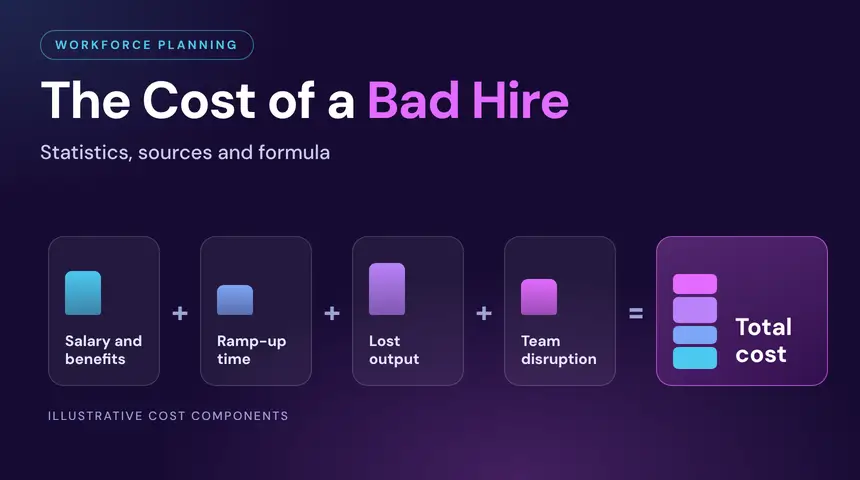
True cost of a bad hire = Acquisition and onboarding costs + Compensation paid + Lost productivity + Management time + Replacement costs
- Acquisition and onboarding: agency fees, advertising, selection time, equipment and onboarding.
- Compensation paid: salary plus benefits for the months the person stays.
- Lost productivity: the output gap against what the role should deliver.
- Management time: the share of the manager’s time spent correcting performance.
- Replacement: repeating acquisition and onboarding for the replacement.
Worked Example: Mid-Level Marketing Manager
An illustrative example. Salary $85,000, stays five months, with a 20 percent agency fee.
| Component | Calculation | Cost |
|---|---|---|
| Acquisition | $17,000 agency fee plus $990 selection time | $17,990 |
| Onboarding | Equipment, setup and training | $2,550 |
| Compensation paid | Five months of salary plus benefits | $43,900 |
| Lost productivity | Output gap over five months | $11,900 |
| Management time | Manager time spent correcting performance | $5,313 |
| Replacement | Repeat acquisition | $17,990 |
| Total | $99,643 (about 117 percent of salary) |
Worked Example: Senior Data Engineer
An illustrative example. Salary $145,000, stays seven months. Assumptions: a 20 percent agency fee, benefits at 25 percent, a 40 percent output gap, a manager earning $180,000 spending 17 percent of their time on the problem and a $40,000 project delay.
| Component | Calculation | Cost |
|---|---|---|
| Acquisition | $29,000 agency fee plus $2,000 selection time | $31,000 |
| Onboarding | Equipment, setup and training | $6,000 |
| Compensation paid | Seven months of salary plus benefits | $105,729 |
| Lost productivity | 40 percent of seven months of salary | $33,833 |
| Management time | 17 percent of seven months of manager salary | $17,850 |
| Project delay | Delayed delivery | $40,000 |
| Replacement | Repeat acquisition | $31,000 |
| Total | $265,412 (about 183 percent of salary) |

Price every workforce decision before you make it. INOP compares building, buying, redeploying and automating capability with the cost and risk of each. Book a demo
Cost of a Bad Hire by Company Size and Role
The same mistake weighs differently depending on the organization. In a large enterprise, one bad hire is absorbed by the wider team. In a small business or startup, where one person may own an entire function, the cost of a bad hire can threaten the business itself.
The Cost of a Bad Hire for a Mid-Sized Company
Mid-sized companies feel the cost sharply. Teams are lean enough that one underperformer in a key role affects delivery, but the organization is large enough that a mismatch can go unnoticed for months. A single mis-hire in a team lead, product or client role can delay a launch or a major client program, and the replacement often costs more than the original appointment because the role is now urgent.
The Cost of a Bad Sales Hire
Sales roles add unrealized revenue to the calculation. An illustrative example: a salesperson with a $1,000,000 annual quota who underperforms for six months leaves up to $500,000 in revenue unrealized, before counting lost client relationships and pipeline that must be rebuilt.
Why Bad Hires Happen: Skills Are Assumed, Not Verified
Most bad hires trace back to decisions made on incomplete information. In the CareerBuilder survey, the most cited reason was that the person did not have all the needed skills but the manager thought they could learn quickly, followed by people misrepresenting their qualifications. Pressure to fill roles fast, vague role requirements and reliance on resumes and impressions all make it worse. Verifying skills against a clear role profile removes much of that risk. See our guide to the best skills assessment tools.
Pay structures can add to the problem. When pay is set by title and negotiation rather than verified capability, it can reward people who negotiate well rather than people who perform well. Read about skill-based pay advantages and disadvantages.
How to Reduce the Cost of a Bad Hire
The most reliable way to lower the cost of a bad hire is to make fewer external bets on unverified capability. That means testing internal options first and verifying skills whatever the source.
Test Build and Redeploy Before Buy
Internal people come with a performance history, known skills and cultural fit, so the risk of a mismatch is lower. Many organizations have hidden talent with adjacent skills who could step into a role faster and at lower cost than an external appointment. Internal moves also support retention: read about the link between internal mobility and employee retention.
Detect a Mis-Hire Early
The longer a mismatch runs, the higher the cost. Robert Half found that 40 percent of managers say it can take more than a month to recognize the signs of a bad hire. Set clear 30, 60 and 90 day expectations, check progress against them and act early when the gap is fundamental rather than fixable. For a wider view of talent risk, see our guide to workforce risk management.
The Prevention ROI Formula
Prevention ROI = (Cost of bad hire avoided minus Cost of better process) divided by Cost of better process, times 100
An illustrative example: if better skills verification costs $8,000 a year and prevents one bad hire costing $90,000, the return is ($90,000 minus $8,000) divided by $8,000, or 1,025 percent.
How INOP Lowers the Cost of a Bad Hire
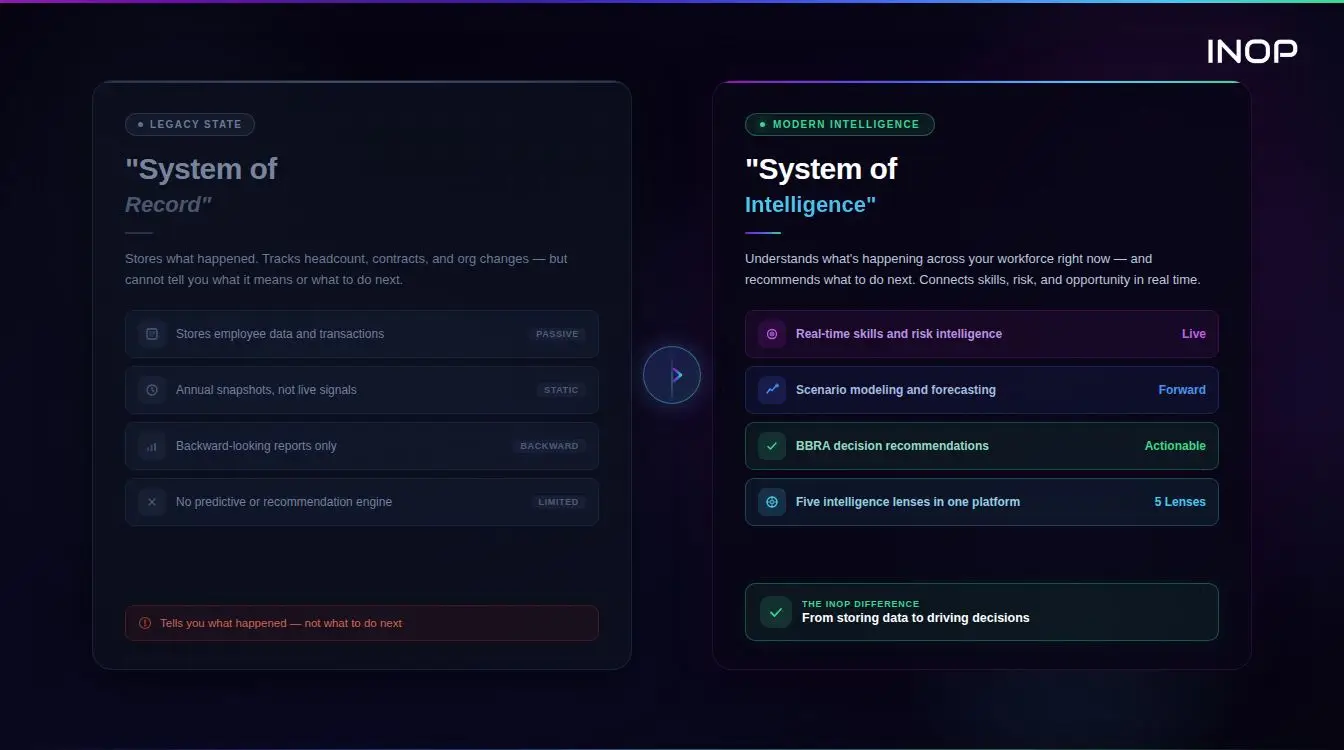
INOP answers whether leaders have the capabilities to execute their strategy today and stay AI-ready. It never assesses AI in isolation and tests every decision against five intelligence lenses: Strategy, Finance, People, Market, and AI and Automation. When a capability gap appears, INOP’s proprietary BBRA decision architecture compares Build, Buy, Redeploy and Automate options with financial trade-offs across 30-day, 180-day, one-year and three-year horizons, so the external route is chosen deliberately rather than by default.
- INOP’s skills intelligence verifies the skills people hold, so internal options are visible and external capability can be checked against the same standard.
- The strategic workforce planning platform shows which roles need to be filled and when, connected to headcount planning.
- The compensation analytics platform prices each option against the market, so pay rewards verified capability rather than negotiation.
Cost of a Bad Hire in PE Portfolio Companies
For private equity operating partners, a leadership mis-hire in a portfolio company delays the value creation plan during a limited hold period. Replacing a functional leader can cost months of momentum on top of the direct cost. Testing internal options, verifying capability and pricing each leadership decision before it is made protects both the timeline and the exit multiple.
Conclusion
The cost of a bad hire ranges from a fraction of salary for direct costs to more than two times salary once productivity, management time, morale and replacement are counted. Calculate it with the formula above, and lower it by verifying skills, testing Build and Redeploy before Buy, detecting mismatches early and pricing every option before committing.
Make fewer costly workforce bets. INOP verifies skills and prices Build, Buy, Redeploy and Automate options before you commit. Book a demo
Cost of a Bad Hire FAQs
How much does a bad hire cost?
Gallup estimates that replacing an employee costs one-half to two times annual salary, and a CareerBuilder survey put the average loss at $14,900 per bad hire. Senior and executive roles can reach up to 213 percent of salary.
What percentage of salary does a bad hire cost?
Gallup estimates that replacing an employee costs one-half to two times annual salary, and the Center for American Progress found costs of up to 213 percent for senior and executive roles. Widely cited full-cost estimates range from 50 to 75 percent of salary for entry-level roles to 100 to 150 percent for mid-level roles and 150 to 200 percent for senior roles.
How do you calculate the cost of a bad hire?
Add acquisition and onboarding costs, compensation paid, lost productivity, management time and replacement costs. In the worked examples above, the total reaches about 117 percent of salary for a mid-level manager and about 183 percent for a senior engineer.
What is the cost of a bad executive hire?
Up to 213 percent of salary in direct turnover cost, according to the Center for American Progress, plus strategic misdirection, delayed decisions and the departure of strong team members.
How do PE operating partners reduce the cost of a bad hire?
By testing internal options first, verifying leadership capability against a consistent standard across the portfolio and pricing each leadership decision against the value creation plan before committing.