HR professionals in 2026 broadly believe their organizations pay fairly. Their employees are not so sure. Salary.com’s 2026 Pay Practices Report, drawn from 525 HR and compensation professionals, found that while HR teams rated their pay practices as equitable, a significant share lacked confidence that employees shared that assessment. Nearly 21% of organizations still rely mostly or entirely on manager discretion for pay decisions. Only 51.6% provide formal training on how to discuss compensation — despite 69.2% training managers on performance evaluations. The gap between intention and execution runs through compensation at most organizations, and it is costing them retention, trust, and competitive positioning.
Building a fair pay strategy requires more than good intentions and a benchmarking subscription. It requires a structural foundation of job architecture, real-time market data, continuous equity scanning, and managers equipped to talk about pay without defaulting to vague assurances. This guide covers each layer in sequence, grounded in 2026 data from Salary.com, Payscale, JobsPikr, and the EU Pay Transparency Directive that took effect in June 2026.
Want compensation benchmarking connected to real-time market data instead of last year’s survey? Book a 20-minute demo with INOP.
What a Fair Pay Strategy Actually Requires
A fair pay strategy ensures employees receive compensation that reflects their role, skills, and contributions equitably, benchmarked against the external market, and free from the demographic bias that discretionary pay decisions routinely introduce. The three components are internal equity, external competitiveness, and transparent communication. Most organizations have stated commitments to all three. Fewer have the data infrastructure and process discipline to deliver on any of them consistently.
The distinction between pay parity and pay equity matters here. Pay parity addresses equal pay for substantially similar work — the same role, same level, comparable performance. Pay equity addresses fair compensation across different jobs of comparable organizational value, regardless of whether they share a title. A compensation strategy that achieves parity without addressing equity can still systematically undervalue functions that are dominated by specific demographic groups. For a complete treatment of how internal and external salary parity connect, INOP’s guide on pay parity meaning covers the analytical framework in full.
Build Job Architecture First — Everything Else Depends on It
Salary.com’s 2026 Pay Practices Report identifies job architecture and consistent job leveling as the prerequisite for every downstream effort toward pay transparency and equity. 22% of organizations have no job leveling structure, which makes it nearly impossible to apply pay equitably across comparable roles or explain to employees why their pay sits where it does.
Job architecture defines role families, career levels within each family, and the expectations that distinguish one level from the next. Without it, two employees with the same title but different scopes, team sizes, or strategic impact sit in the same pay band with no documented basis for differentiating their compensation. When a pay equity audit later identifies a gap between them, the organization cannot explain whether it reflects legitimate differences in scope or illegitimate differences in how their managers calibrated their offers.
The sequence is non-negotiable: define job levels before benchmarking against the market, because you cannot match an internal level to an external market percentile if your internal levels are not clearly defined. Benchmark before setting bands. Set bands before communicating them to employees. Skipping job architecture and going straight to benchmarking produces ranges that look precise and are applied inconsistently, because the roles they apply to are not consistently defined. For guidance on how role-level calibration connects to skills-based compensation, INOP’s guide on building skills-based pay bands covers the construction methodology.
What Real-Time Salary Intelligence Is and What It Is Not
Real-time salary intelligence draws from live data sources — job posting aggregators, HRIS and ATS integrations, anonymized employee compensation databases — to reflect what employers are currently paying rather than what they reported paying 14 months ago when a survey was collected. The key distinction from a pay audit is temporal. A pay audit reviews internal data to identify existing gaps. Compensation intelligence combines live external market data with internal pay information to identify gaps before they generate attrition. Audits look backward. Compensation intelligence works in real time.
JobsPikr’s Compensation Intelligence Report 2026, which draws from over 100 million live job postings, documents that job posting data in 2026 is significantly more useful for real-time benchmarking than two years prior because employers now routinely include salary ranges in postings — partly from regulatory pressure and partly from candidate expectation. This creates a live market signal that traditional survey data cannot provide: what employers are currently advertising, not what they reported paying in the prior year.
Mercer’s 2025 research found companies using real-time compensation data achieve 24% higher employee retention compared to those relying on static benchmarks. The mechanism is straightforward. Real-time data catches market drift when it happens, not 12 months later when your retention data shows attrition spiking in a specific role family. An organization whose machine learning engineers shifted from the 60th to the 40th market percentile over six months because the market moved and internal bands did not knows that in month two. One using annual surveys discovers it in December, having lost three engineers in August, September, and October to offers that the real-time market would have predicted.
Compensation Intelligence vs. a Pay Audit: Knowing Which You Need
These two tools answer different questions and the distinction determines which you should prioritize.
A pay audit examines your existing compensation data to identify gaps that have already developed. It is backward-looking and event-triggered — typically conducted annually or in response to a regulatory requirement or complaint. It tells you what went wrong and where, after it has already affected employees.
Compensation intelligence is forward-looking and continuous. It combines your internal pay data with live market benchmarks to flag roles where the gap between what you pay and what the market pays is widening in real time. It identifies compression before a new hire offer creates it. It surfaces flight risk before an employee tests the market and accepts a competing offer.
Both are necessary. A pay audit without real-time benchmarking closes historical gaps while new ones form. Real-time benchmarking without periodic structured audits can miss the demographic patterns that aggregate data analysis reveals. For a complete walkthrough of how salary benchmarking with real-time data works step by step, INOP’s guide on how to benchmark salaries with real-time compensation data covers the seven-step process.
The Pay Compression Problem Real-Time Data Prevents
Pay compression happens when new hire offers are made at current market rates while existing employee salaries lag behind because merit increases have not kept pace with market movement. A software engineer with three years of tenure earns $105,000. A new hire for the same role comes in at $118,000 because that is where the market moved over the past 18 months. The tenured engineer discovers this, correctly identifies it as unfair, and begins interviewing externally within 90 days.
Annual benchmarking catches this pattern during the next review cycle — after the engineer has left. Real-time benchmarking catches it when the new hire offer is being calibrated, before the compression is created. An automated alert that flags when a proposed offer would place the new hire above the 75th percentile of current incumbents in the same level gives the compensation team the information to either adjust the offer, adjust existing salaries, or document the legitimate reason for the differential before it becomes a grievance.
Salary Atlas’s 2026 compensation analysis identifies compression detection as one of the highest-value applications of real-time market data precisely because the financial cost of compression — losing a tenured employee and replacing them — consistently exceeds the cost of the pay adjustment that would have prevented the departure. For a fuller treatment of how pay equity audits and compression detection interact with the EU Pay Transparency Directive, INOP’s guide on executive compensation benchmarking covers the compliance requirements that apply to documented pay differences.
The Regulatory Layer: EU Pay Transparency Directive and US State Laws
Fair pay strategy in 2026 operates inside a compliance framework that did not exist three years ago. EU member states were required to transpose the EU Pay Transparency Directive into national law by June 2026. In the US, pay transparency legislation continues to expand at the state level. Oregon SB 908, effective January 1, 2026, requires employers to provide employees with detailed explanations of payroll codes, itemized deductions, and pay rates at the time of hire. Several states already require salary ranges in job postings. More are expected to follow.
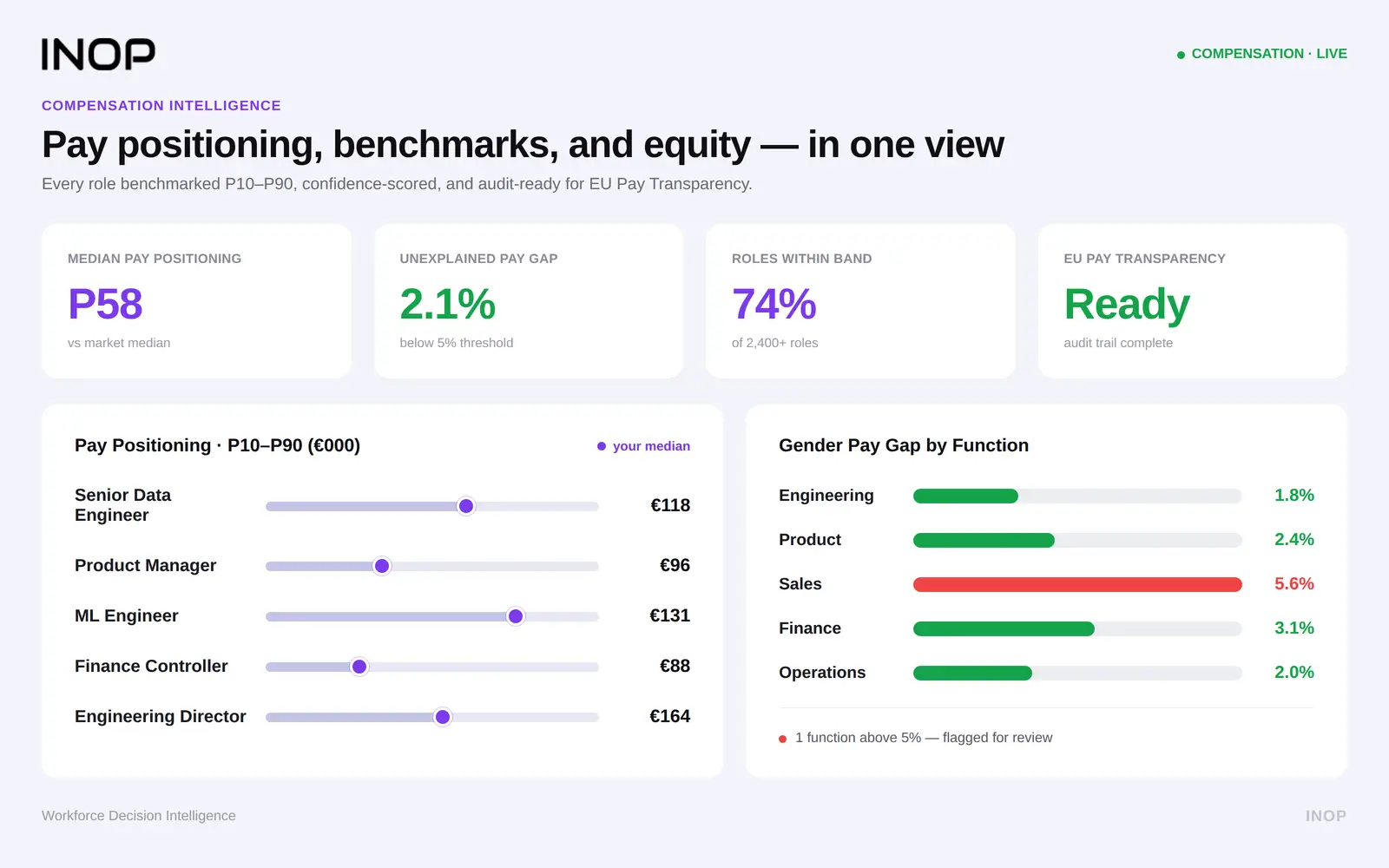
The Directive’s most practically significant provision for compensation strategy is the 5% threshold: any gender pay gap in a job category that exceeds 5% and cannot be justified by objective criteria requires a mandatory joint pay assessment and remediation plan. The phrase “objective criteria” is the operative one. Pay differences between employees in the same job category must trace to documented, consistently applied criteria — verified skills, performance ratings, or market benchmarks. Manager discretion that produced different offers to different candidates is not an objective criterion.
Real-time salary intelligence supports compliance in a specific way: it provides the market benchmark documentation that justifies pay differences based on role-specific demand rather than individual manager judgment. A pay decision that reads “this employee’s salary reflects market benchmarking data showing demand for their specific combination of cloud infrastructure and security skills at the 68th percentile” is defensible. One that reads “their manager advocated strongly for them during the annual review” is not. For a full treatment of how the Directive’s requirements connect to compensation benchmarking methodology, INOP’s guide on pay parity covers the legal and analytical dimensions together.
Skills-Based Differentiation in a Fair Pay Framework
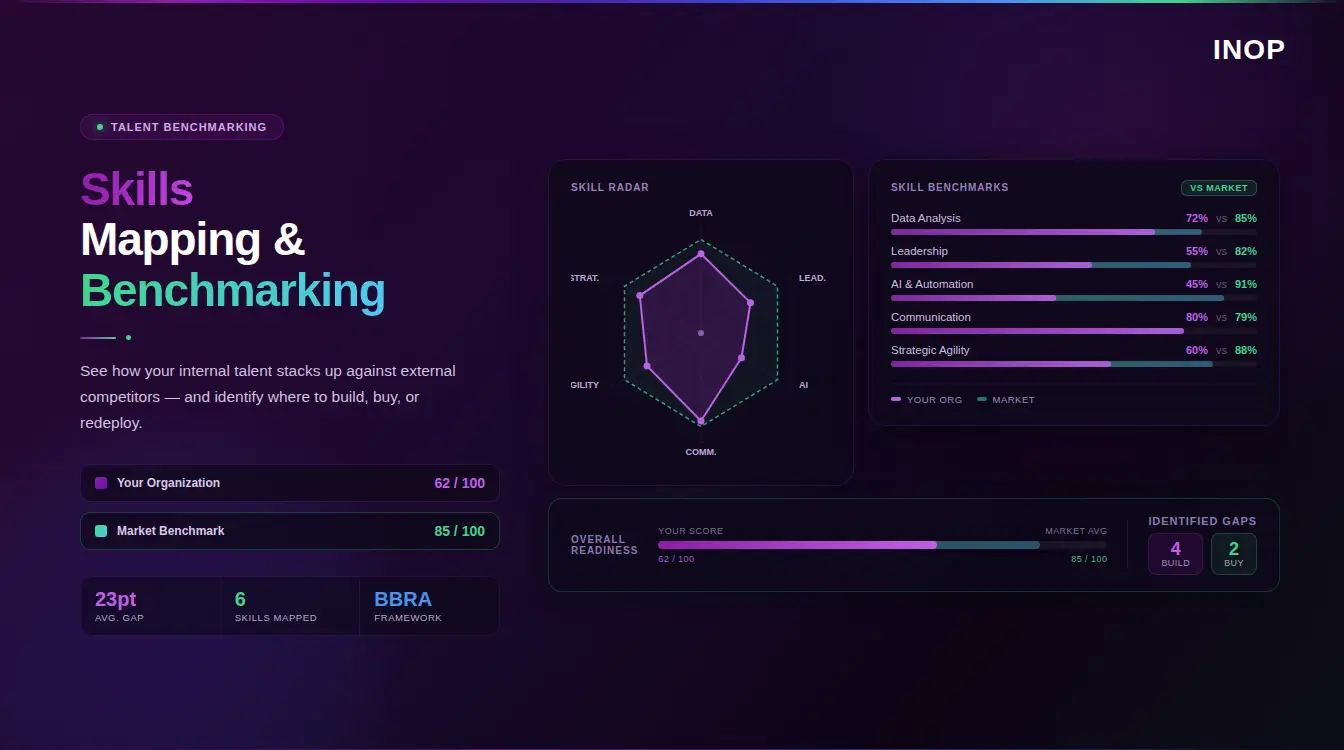
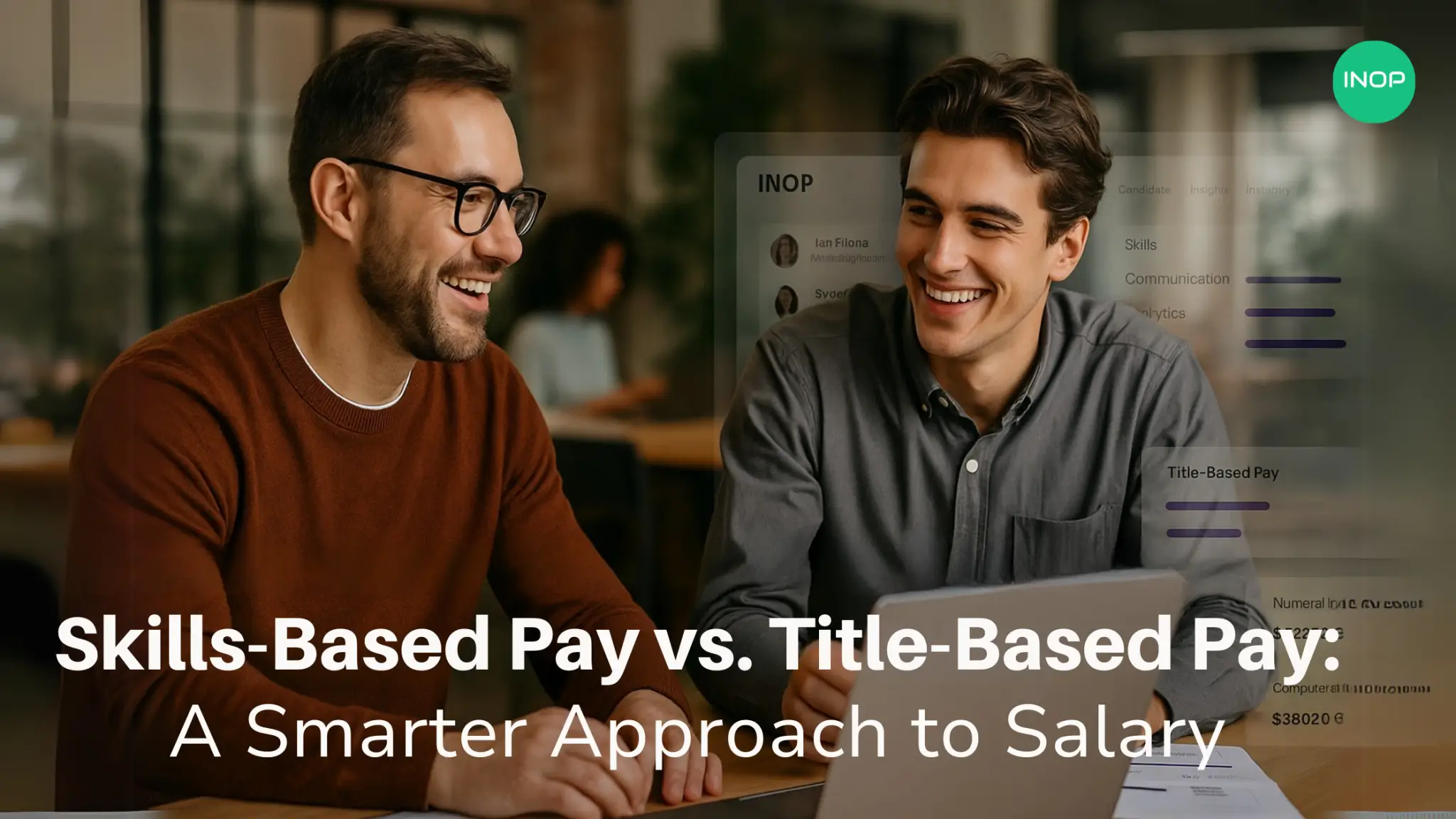
Traditional compensation benchmarks by title. Real-time salary intelligence benchmarks by verified capability combination. The difference is significant for roles where the same title covers a wide range of skill profiles.
Two product managers at the same level in the same company might have very different market rates depending on whether one holds deep technical discovery and data analysis skills alongside their product expertise, while the other operates primarily in stakeholder coordination and roadmap communication. A title-level benchmark treats them identically. A skills-level benchmark surfaces the market premium for the first profile and identifies whether the organization is paying to retain that premium or inadvertently leaving it exposed to competitors who will.
Skills-based differentiation within a fair pay framework requires three things to work equitably. The skills assessment must be validated rather than self-reported alone, because self-assessed proficiency systematically varies by demographic in ways that recreate the bias the system was designed to eliminate. The premium must be documented as applying to the skill, not to the person, so it carries across demographic groups. And the skills progression pathway must be transparent so employees know which capabilities to develop to earn higher pay positioning. For a complete treatment of how skills-based pay design handles equity specifically, INOP’s guide on skill-based pay advantages and disadvantages covers the design requirements in detail.
Train Managers Before You Launch Anything Else
Salary.com’s 2026 data surfaces a specific implementation failure: organizations train managers on performance evaluations at a rate 17 percentage points higher than they train them on compensation conversations. The moment a performance review ends, the employee typically asks about pay. The manager, trained to evaluate performance but not to discuss compensation, either deflects or improvises. Both produce distrust.
Manager training for fair pay has three specific components. First, managers need to understand how pay is determined — the job architecture, the market benchmarking methodology, and the factors that move someone within a band. Second, they need language for explaining a pay decision they did not make. “Your salary sits at the 52nd percentile of the external market for your role and level, and here is what determines movement within the band” is defensible. “I submitted the highest increase I could and got back what they approved” is not. Third, they need to know when to escalate — when an employee’s compensation concern involves potential equity issues that belong with HR rather than being resolved in a one-on-one conversation.
Organizations that invest in manager compensation training consistently report lower pay-related grievances than those that build sophisticated compensation infrastructure and then rely on undertrained managers to communicate it. The analytics are not what employees experience. The conversation with their manager is.
Total Rewards Transparency: Beyond Base Salary
Salary.com’s 2026 recommendations include deploying total rewards statements as a trust-building mechanism that gives employees a full view of compensation value. Base salary is the most visible component of compensation but rarely the largest when healthcare, pension contributions, equity, flexible working, learning allowances, and other benefits are included.
An employee who earns $85,000 in base salary and receives $12,000 in employer healthcare contribution, $6,500 in pension matching, $3,000 in annual learning budget, and equity valued at $8,000 in annual vesting is earning total compensation closer to $115,000. If they compare only their base salary to an external offer of $95,000 in base with no visible benefits context, the offer looks more attractive than the full comparison would support.
Total rewards statements make the full picture explicit. They reduce the risk of employees undervaluing their compensation relative to competing offers, and they demonstrate transparency in a form employees can reference rather than having to reconstruct from memory. Payscale’s 2026 research identifies transparent pay communication as reducing compensation-driven attrition more consistently than small pay increases alone, because the trust dimension of compensation is as important as the quantum dimension for retention.
Steps to Build a Fair Pay Strategy with Real-Time Data
Step 1: Define Job Architecture and Leveling First
Before touching benchmarking data, define your role families and levels with documented criteria distinguishing each level from the next. Every downstream compensation decision depends on being able to match an internal level to an external market benchmark consistently. Without this foundation, the benchmarking is accurate in the abstract and inapplicable in practice.
Step 2: Establish a Written Compensation Philosophy
Document where the organization intends to position itself relative to the external market, for which role families, at what percentile, and why. Include how skills differentiation works within bands, what factors drive movement within a range, and what the organization will communicate to employees about how pay is determined. Leadership alignment on this document prevents the manager-discretion variability that produces unexplained pay gaps and difficult audit findings.
Step 3: Connect Real-Time Benchmarking to Your Internal Data
Replace or supplement annual survey data with live market intelligence for the role families where market rates shift most quickly. Configure automated alerts for roles where the gap between internal pay and the live external benchmark is widening beyond a defined threshold. This converts compensation from a periodic review exercise into a continuous monitoring function.
Step 4: Run Continuous Equity Scans at Every Compensation Event
Configure automated pay equity analysis to run after every merit cycle, cohort of new hire offers, and promotion round. Set thresholds that flag gaps for review before they reach the scale that requires formal remediation. A 3% gap discovered in March is a correction. The same gap discovered in December, having compounded across six months of new decisions, is a remediation plan with potential regulatory implications.
Step 5: Train Managers as Compensation Communicators
Train managers on compensation as part of performance review preparation, not as a separate module. Give them the language to explain the job architecture, the benchmarking methodology, and the factors that determine movement within a band. Build escalation protocols for conversations that reveal potential equity concerns.
Step 6: Deploy Total Rewards Statements
Issue total rewards statements at least annually, timed before open enrollment or annual review conversations when employees are actively evaluating their compensation. Include all components: base salary, variable pay, equity, employer benefit contributions, learning investment, and flexibility value where it can be quantified. The statement replaces an incomplete picture with a complete one before employees fill in the gaps themselves.
Step 7: Communicate the Framework to Employees
Explain how pay is determined in language employees can understand and reference. This does not require disclosing individual salaries. It requires explaining the job levels, the market positioning philosophy, the factors that drive movement within a band, and the pathway for employees who want to understand or challenge their pay position. Employees who understand how pay is determined are consistently more tolerant of outcomes they disagree with than those who receive unexplained results from an opaque process.
Fair Pay Strategy in PE Portfolio Companies
Private equity operating partners face fair pay as a value creation issue, not only an HR governance issue. Portfolio companies acquired from founder-led or private ownership backgrounds frequently have compensation structures that accumulated through individual negotiation rather than documented methodology. The result is pay dispersion within the same role and level that reflects negotiating leverage, hiring timeline, and manager preference rather than market position or contribution.
This dispersion creates two specific risks during a hold period. Employees who discover they are paid below peers in comparable roles become active flight risks in a talent market where competing offers are easy to generate. The departures concentrate among the most marketable — the employees most likely to discover the gap because they are also most likely to be contacted by external recruiters. And the unexplained pay dispersion creates legal exposure under EU Pay Transparency requirements and expanding US state transparency laws that increasingly apply to businesses of the size PE firms typically acquire.
A compensation audit in the first 90 days post-acquisition, benchmarked against real-time market data rather than inherited internal bands, identifies both the retention risk and the equity exposure before either materializes in a departure or a complaint. The remediation cost is almost always lower than the replacement cost it prevents. For portfolio companies where the value creation plan depends on retaining specific capabilities through the transformation period, INOP’s compensation analytics platform connects real-time benchmarking to skills-level market intelligence in a format operating partners and portfolio company boards can act on directly. Book a demo to see how INOP approaches fair pay strategy for PE portfolio environments.
Ready to replace annual survey benchmarks with real-time salary intelligence that Finance and employees can both trust? See INOP’s compensation analytics platform in a 20-minute demo.
Frequently Asked Questions
What is a fair pay strategy?
A fair pay strategy ensures employees receive compensation that reflects their role, skills, and contributions equitably — benchmarked against the external market, applied consistently across demographic groups, and communicated transparently enough for employees to understand how their pay was determined. It rests on three foundations: internal equity (employees in comparable roles and levels are compensated comparably), external competitiveness (salaries reflect live market conditions rather than outdated benchmarks), and transparency (the methodology is documented and communicable, not dependent on manager discretion).
What is the difference between pay equity and pay parity?
Pay parity addresses equal pay for substantially similar work — the same role, same level, comparable performance and scope. Pay equity is broader: it addresses fair compensation across different jobs of comparable organizational value, regardless of title. An organization that achieves parity without addressing equity can still systematically undervalue functions dominated by specific demographic groups, which is why both dimensions require distinct analysis and distinct remediation strategies. For a deeper treatment of both concepts, INOP’s guide on pay parity meaning covers the full framework.
What is the difference between compensation intelligence and a pay audit?
A pay audit reviews your existing internal data to identify gaps that have already developed. It is backward-looking. Compensation intelligence combines live external market data with internal pay information to identify gaps before they cause attrition — it works in real time. Both are necessary. An audit without real-time intelligence closes historical gaps while new ones form silently. Real-time intelligence without periodic structured audits can miss the demographic patterns that aggregate analysis surfaces. The 2026 standard uses both: continuous real-time monitoring as the primary tool and structured annual audits as the systematic check.
How does the EU Pay Transparency Directive affect compensation strategy?
The Directive, operative across EU member states from June 2026, requires annual gender pay gap reporting disaggregated by job category, a mandatory joint pay assessment when any gap exceeds 5% without objective justification, and a ban on asking candidates about salary history before an offer is made. Pay differences between employees in the same job category must trace to documented, consistently applied objective criteria: verified skills, performance ratings, or market benchmarks. Manager discretion does not qualify. The compliance path requires the same infrastructure a fair pay strategy needs anyway: documented job architecture, market-benchmarked salary bands, and audit-ready records connecting each pay decision to its objective criteria.
Why is manager training critical to a fair pay strategy?
Salary.com’s 2026 Pay Practices Report found that 69.2% of organizations train managers on performance evaluations but only 51.6% train them on compensation conversations. Performance reviews end and employees immediately ask about pay. A manager trained on evaluation but not compensation either deflects or improvises — both create distrust. Managers need the language to explain the job architecture, the market positioning methodology, and the factors that drive movement within a band. They also need to know when to escalate equity concerns to HR rather than resolving them in a one-on-one conversation. The analytics infrastructure behind a fair pay strategy is invisible to employees. The manager conversation is not.
What are total rewards statements and why do they matter?
Total rewards statements document every component of an employee’s compensation: base salary, variable pay, equity, employer healthcare and pension contributions, learning budget, and flexible working value where quantifiable. Base salary is typically the most visible component but rarely the largest in total. An employee who earns $85,000 in base and $30,000 in employer contributions across benefits, equity vesting, and development investment has total compensation of $115,000 — but sees only $85,000 unless the full picture is explicitly communicated. Total rewards statements reduce the risk of employees undervaluing their compensation relative to competing offers that show only a higher base salary, and they demonstrate a transparency commitment in a concrete, annual reference document.