An internal talent marketplace is a structured platform or system within your organization that connects employees with internal job opportunities, short-term projects, mentorships, skill development programs, or stretch assignments. It flips the traditional top-down career model by putting employees in control of their growth and allowing managers to tap into talent dynamically.
Unlike static org charts or rigid succession plans, a true talent marketplace is agile, skills-driven, and transparent — enabling better alignment between people’s potential and business needs.
Why Internal Talent Marketplaces Are Gaining Traction
There’s a reason why companies like Unilever, Schneider Electric, and IBM are heavily investing in internal talent platforms:
- Cost-effective talent mobility: It’s 6x cheaper to upskill a current employee than to hire externally.
- Faster time-to-productivity: Internal hires hit the ground running — they already understand company systems and culture.
- Increased retention: Employees are more likely to stay when they see clear growth paths and feel valued.
- Diversity and inclusion: A marketplace approach can reduce bias by opening opportunities to a broader internal audience.
- Strategic agility: In today’s volatile environment, being able to shift talent quickly where it’s needed is a massive competitive advantage.
Key Ingredients of a Successful Talent Marketplace
Not all internal marketplaces are created equal. To be effective, your system must go beyond simply listing internal job openings. Here’s what matters most:
Skills-Based Architecture
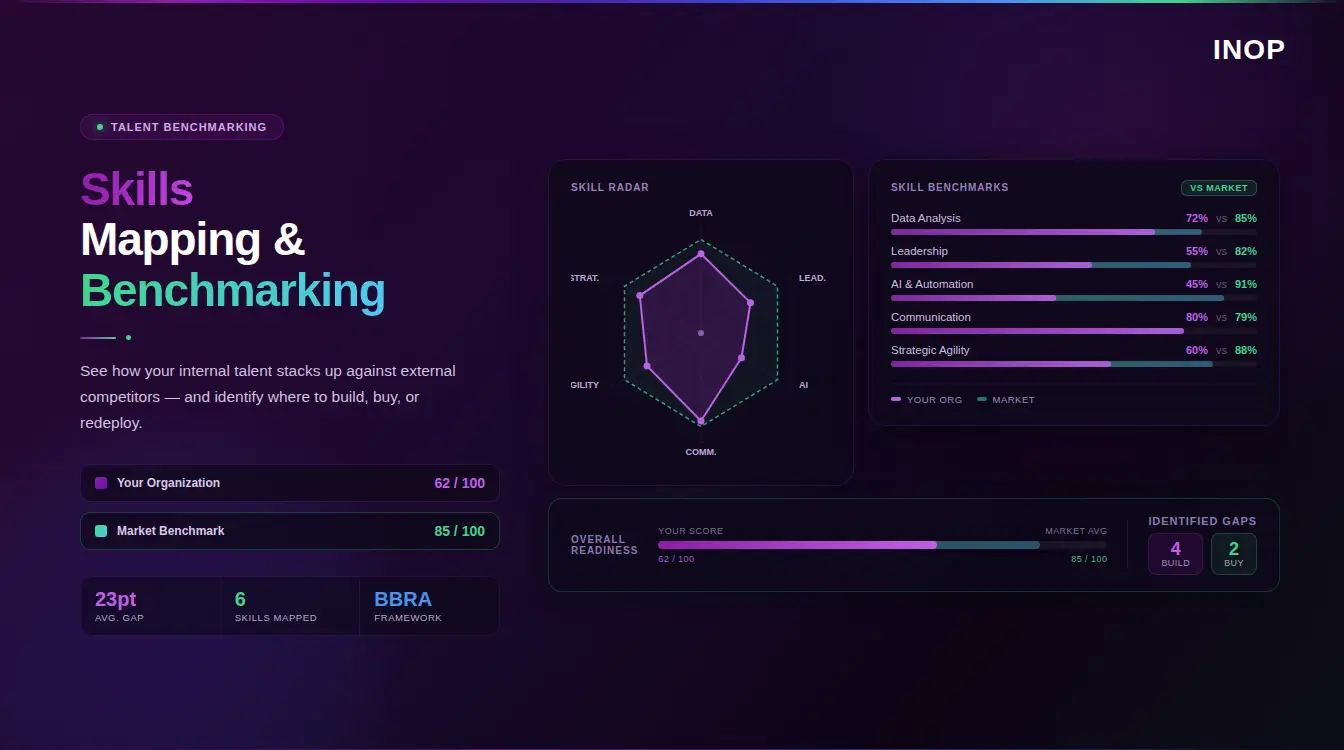
The foundation of a talent marketplace is a dynamic skills taxonomy — a living map of what skills exist, are emerging, or are in demand. Without this, matching people to opportunities is guesswork.
Use technology (like AI-powered matching engines) to infer and validate skills from employee profiles, performance data, and learning platforms.
Transparent Opportunities
Employees need visibility into what’s available — not just full-time jobs, but also:
- Part-time or project-based roles
- Temporary gigs in other departments
- Cross-functional collaboration invites
- Mentorship or reverse mentorship opportunities
These listings should be browsable, filterable, and ideally personalized based on employee interests and goals.
Talent Screening for Fit
Internal mobility shouldn’t bypass quality control. Talent screening remains essential to ensure candidates have the baseline readiness or potential to thrive in the new role or project. But the screening criteria can (and should) focus more on growth potential, soft skills, and learning agility — not just past job titles.
This is also where objective assessment tools and manager endorsements play a role.
Integrated Learning & Development
Employees may not be ready yet for certain opportunities, but they might be after the right training.
Link your marketplace to your L&D ecosystem so that employees can see not only where they are qualified today, but also what skills or credentials they need to grow into new roles. Think of it as a GPS for internal career development.
How to Build an Internal Talent Marketplace: A Six-Step Implementation Process
Step 1: Define Your Strategic Objectives Before Selecting Technology
The most common implementation failure is purchasing a platform before defining what problem it is solving. Organizations that deploy talent marketplace technology without first establishing clear strategic objectives end up with an expensive tool that nobody uses because it was not designed around a specific organizational need.
Before evaluating any platform, answer three questions. What specific talent challenge is the marketplace meant to solve, reducing external hiring costs, improving retention of high performers, accelerating digital transformation by redeploying existing capability, or all three? Which employee population will use it first (all employees organization-wide, or a specific function or business unit for a pilot? And what does success look like in 12 months) a specific internal fill rate target, a reduction in time-to-fill, an improvement in employee engagement scores on career development questions?
These answers determine the platform requirements, the governance design, the change management scope, and the metrics you will track. Organizations that start with technology and work backward to objectives consistently underperform those that start with objectives and select technology to serve them.
Step 2: Build Your Skills Taxonomy Before Launching the Marketplace
An internal talent marketplace that matches employees to opportunities without verified skills data is matching job titles to role descriptions, which is what the internal job board already does and why the internal job board fails to surface hidden capability. The marketplace’s value comes from skills-based matching, and skills-based matching requires a validated skills taxonomy before the platform launches.
Build the taxonomy collaboratively with input from business leaders and subject matter experts across the functions you plan to include in the pilot. Define proficiency levels with behavioral anchors, not just skill labels. Determine how skills will be validated, through self-assessment, manager validation, assessment tools, certification records, or a combination. And establish the governance process for keeping the taxonomy current as role requirements evolve. A taxonomy built in 2025 that has not been updated by 2027 will produce match recommendations that do not reflect current business needs.
Step 3: Design the Employee and Manager Experience Explicitly
Most marketplace implementations focus on the back-end matching engine and underinvest in the front-end experience that determines whether employees and managers actually use the system. Two user experiences must be designed deliberately.
For employees, the experience should answer: how do I build or verify my skills profile, how do I find opportunities that match my profile and aspirations, how do I apply for an internal opportunity without risking my current manager relationship, and how do I see a development path toward roles I aspire to rather than only roles I am currently qualified for?
For managers, the experience should answer: how do I find internal candidates for my open role or project, how do I assess internal applicants fairly relative to external ones, what happens to my team’s performance plan if my best analyst takes an internal secondment for three months, and how is my contribution to talent development recognized in my own performance evaluation?
Neither of these experiences is automatically provided by platform deployment. Both require deliberate design, communication, and training before the marketplace launches.
Step 4: Address Manager Incentives Before Launch
This step cannot be done in parallel with others, it must be resolved before the marketplace opens to employees. If managers are evaluated and compensated based on their team’s output metrics, and internal mobility reduces their team’s short-term output, they will block transfers regardless of what the policy says. This is not a failure of individual managers. It is a structural incentive misalignment that will systematically undermine a marketplace that the organization has invested significantly to build.
The governance changes required are specific. Add talent development and internal mobility contribution as named criteria in manager performance evaluations, with explicit weighting. Establish a formal replacement guarantee for managers who release employees to internal opportunities, the receiving team, not the releasing manager, bears the backfill cost. Celebrate managers publicly who develop and share talent rather than only recognizing those who retain it. Without these structural changes, the cultural shift that an internal talent marketplace requires will not occur regardless of how well the platform is designed.
Step 5: Launch With a Pilot, Measure Everything, Then Expand
The organizations that achieve the most durable internal talent marketplace outcomes start with a bounded pilot: one business unit, one function, or one geographic region, for three to six months. The pilot serves two purposes. It generates real outcome data — internal fill rates, employee engagement with the platform, manager satisfaction, time-to-fill, that builds the internal business case for expansion. And it surfaces the implementation problems that no amount of planning anticipates: skills data quality gaps, manager resistance patterns, employee uncertainty about how to navigate the system, or technology integration issues that the vendor did not surface during implementation.
Set three to five specific, measurable success criteria for the pilot before it launches, with the explicit agreement that expansion decisions will be based on those criteria rather than on executive enthusiasm. This protects the programme from being declared a success before it has been tested and from being cancelled if early metrics are mixed but trending in the right direction.
Step 6: Build a Continuous Improvement Cadence from Day One
An internal talent marketplace is not a project with a launch date and a completion date. It is an operating capability that requires continuous maintenance, governance, and iteration. Build the following disciplines from the first week the marketplace is live: a quarterly skills taxonomy review that updates proficiency definitions as role requirements evolve, a monthly metrics review that tracks the KPIs established in Step 1, a biannual manager training refresh that addresses the new resistance patterns and process questions that emerge as the marketplace matures, and an annual employee experience review that surfaces what is working and what is creating friction from the people who use the system every day.
Why Internal Talent Marketplaces Fail: The Five Most Common Reasons
Understanding the failure modes before implementation is worth more than the equivalent time spent on feature evaluation. These five patterns appear consistently across failed or underperforming marketplace implementations.
- The technology-first fallacy. Organizations that select and deploy a marketplace platform before establishing a skills taxonomy, defining success metrics, and resolving manager incentive alignment consistently report low utilization within 18 months. The platform becomes an expensive internal job board that HR manages and employees ignore. The fix is sequencing: objectives and governance before platform selection, skills data before platform launch.
- Skills data that nobody trusts. If the skills profiles populating the marketplace are primarily self-reported and unvalidated, managers will not rely on the matching outputs for real hiring decisions. They will continue sourcing through their networks because they trust their own knowledge of candidates more than a system recommending people they have never heard of. The fix is multi-source validation: self-assessment as the starting point, manager validation and objective assessment to confirm, and project history as the ongoing update mechanism.
- The manager veto problem. Even with policy changes and communication campaigns, managers who are evaluated on team output metrics will find ways to block or delay internal transfers. The most common manifestation is the “just wait three more months” conversation — the manager who always has a good reason why now is not the right time for the employee to move. The fix is structural, not cultural: explicit mobility performance criteria in manager evaluation, replacement guarantees that remove the backfill cost from the releasing manager, and senior leadership visibility into which managers are facilitating versus blocking mobility.
- Employee fear of visibility. Many employees are reluctant to express interest in internal opportunities because they fear their current manager will interpret it as disloyalty or a signal that they are already planning to leave. In organizations without a strong culture of transparent career conversation, the marketplace goes unused not because employees lack ambition but because they lack psychological safety to express it. The fix is a combination of clear policy communication that browsing the marketplace is encouraged and not tracked at the manager level, and investment in manager training that reframes employee development interest as a positive signal rather than a retention threat.
- No connection to business strategy. Internal talent marketplaces that are designed as retention and engagement tools but not connected to the business’s strategic capability needs will always struggle to demonstrate ROI in the language that CFOs and CEOs understand. When the marketplace fills a role faster, engagement improves — that is a people metric. When the marketplace identifies that the data science capability required to execute the digital transformation plan exists internally and can be redeployed in time, avoiding six months of failed external search, that is a business metric. The fix is building strategic workforce planning as the demand input to the marketplace, so that the opportunities listed in the system reflect what the business actually needs, not just what managers happen to have open.
Cultural and Operational Shifts You’ll Need
Even the best-designed platforms will fail if your culture and processes don’t support internal mobility. Here’s what often holds companies back — and how to address it.
Manager Mindset
Many managers resist talent mobility because they fear losing top performers. You’ll need to reframe internal mobility as a win for all — and even reward managers for developing and sharing talent.
Include talent mobility KPIs in leadership evaluations, and celebrate success stories.
Employee Confidence
Employees often hold back from applying internally due to fear of rejection or lack of clarity. Your marketplace should provide coaching, career pathing tools, and clear guidance on how to spot internal hidden talent especially for employees unsure of where they fit.
Internal communications and talent champions can also help normalize internal movement.
Fairness and Equity
Without guardrails, internal marketplaces can perpetuate bias or favoritism. Use standardized matching processes, anonymized first-round evaluations, and clear feedback loops to build trust in the system.
How Technology Supports (But Doesn’t Replace) Human Insight
Platforms like INOP, Gloat, Fuel50, and Eightfold.ai offer AI-powered talent marketplaces. These tools can:
- Auto-match people to roles or gigs
- Identify skill gaps
- Suggest personalized learning
- Track mobility trends and talent pools
- Identify Hidden Talents
But don’t over-automate. Human oversight is critical for nuance — such as assessing culture fit, emotional intelligence, or ambition.
Real-World Example: Schneider Electric’s Open Talent Market
Schneider Electric launched an internal talent marketplace that led to:
- 80,000+ employees onboarded globally
- 26% reduction in time-to-fill for internal roles
- 90% satisfaction with growth visibility
Their success stemmed from treating the marketplace as a strategic platform — not just an HR initiative — and aligning it with business goals, manager training, and performance data.
Internal Talent Marketplace Examples: What Success Looks Like in Practice
Schneider Electric: Treating the Marketplace as a Strategic Platform
Schneider Electric’s Open Talent Market is one of the most documented internal talent marketplace implementations available. Following the launch, 80,000 employees were onboarded globally, internal time-to-fill for roles dropped by 26%, and employee satisfaction with career visibility reached 90%. The critical factor in Schneider’s success was not the technology. It was the organizational decision to treat the marketplace as a strategic business platform rather than an HR initiative, which secured executive sponsorship, manager training investment, and business unit accountability for mobility outcomes.
Unilever: The Flex Experiences Model
Unilever built its internal talent marketplace around what the company calls Flex Experiences, a system that allows employees to take on cross-functional project assignments based on their verified skills rather than their job title. A finance analyst with project management experience and multilingual capability can be matched to a global product launch project without a formal transfer or title change. Unilever has reported significant increases in internal mobility rates and improved engagement scores in functions where cross-functional movement was previously constrained by siloed job architecture. The Flex Experiences model illustrates a specific marketplace design choice: rather than focusing exclusively on full-time role moves, Unilever built the marketplace around project-based participation that allows employees to develop skills and visibility without requiring a permanent organizational change.
IBM: Internal Marketplace as Skills Infrastructure
IBM restructured its internal mobility approach around skills profiles after eliminating degree requirements for over 50% of its US positions. The company’s internal marketplace now surfaces employees for project assignments and role opportunities based on verified competency profiles rather than title proximity. IBM reports that internal candidates identified through skills-based matching consistently outperformed externally hired credential-matched candidates on performance metrics within the first year, evidence that the skills-based matching is producing better selection quality, not just faster selection speed. IBM’s case also illustrates the talent access dimension of internal marketplaces: skills-based matching surfaces employees who would never be nominated through a manager network approach, consistently producing a more diverse candidate pool for internal opportunities.
Nestlé: Connecting Marketplace to Succession Planning
Nestlé uses its internal talent marketplace as the operational layer of its succession planning programme. Rather than relying on manager nominations for succession candidates, the marketplace identifies employees whose verified skills profiles most closely match the requirements of leadership roles, then connects them to the development assignments and mentorship opportunities that close the remaining gaps. The practical outcome is a succession bench that is grounded in capability evidence rather than visibility, which has produced measurably more diverse succession pools across the organization’s global leadership levels. Nestlé’s approach demonstrates one of the highest-value but least-utilized use cases for internal talent marketplaces: connecting day-to-day opportunity matching to long-range succession planning in a single skills data layer.
Measuring ROI and Building the Business Case for an Internal Talent Marketplace
The Financial Case: What Quantified Outcomes Look Like
The financial return from an internal talent marketplace compounds across three budget lines simultaneously, which is what makes the investment case compelling when built correctly.
The external hiring cost reduction is the most directly calculable. Organizations with mature internal talent marketplaces consistently report internal fill rates of 40% to 60% for roles previously filled exclusively through external search. At an average external recruitment cost of $4,700 per hire plus agency fees of 15% to 25% of first-year salary for professional roles, each internal fill at an average salary of $80,000 saves between $16,700 and $24,700 per hire. For an organization making 200 professional hires annually where 40% shift to internal, the annual saving is $1.3 million to $2.0 million in direct recruitment cost alone.
The attrition reduction compounds this. Research from LinkedIn’s 2025 Workforce Mobility Report shows that employees are nearly twice as likely to stay with an employer long-term when they can see internal growth opportunities. At an average replacement cost of 100% of annual salary for mid-level professional roles, retaining five additional employees per year who would otherwise have left for external opportunities recovers $400,000 in avoided replacement cost for an organization with an average salary of $80,000.
The productivity gain from faster time-to-productivity for internal versus external hires adds a third layer. Internal candidates typically reach full productivity in 30 to 60 days versus 90 to 180 days for external hires, because they already understand the organizational context, culture, and systems. For roles where full productivity represents $200,000 to $300,000 in annual output, the productivity gain from 60 fewer days to effectiveness represents $33,000 to $49,000 per internal hire over an external one.
KPIs to Track From Day One
Establish these specific metrics before the marketplace launches, not after. Organizations that define KPIs at launch can demonstrate ROI within two to three quarters. Those that define them retrospectively produce metrics that look like reporting rather than evidence.
Internal fill rate is the primary metric: what percentage of open roles and projects were filled by internal candidates identified through the marketplace? Track this separately from internal fills that happened through manager networks, so that the marketplace’s contribution is visible.
Skills coverage rate measures what percentage of employees have a complete, validated skills profile in the system. Below 60% coverage, the matching engine cannot produce reliable recommendations. Above 80%, the system starts generating the talent visibility that makes meaningful mobility possible.
Time-to-fill for internal versus external hires validates whether the marketplace is actually accelerating the staffing process for internal candidates. If internal and external time-to-fill are similar, the marketplace is not providing the pipeline advantage that justifies the investment.
Employee net promoter score on career development, captured through quarterly pulse surveys, tracks whether the marketplace is changing how employees experience career opportunity at the organization. This leading indicator typically moves before retention metrics do, giving you early warning of whether the programme is working before attrition data confirms it.
Manager participation rate measures the percentage of open opportunities posted to the marketplace by their hiring manager rather than going directly to external posting. Low manager participation rates signal that the manager incentive changes from implementation Step 4 above have not taken effect and require intervention.
Conclusion: Your Best Talent May Already Be on the Payroll
An internal talent marketplace is more than a tool — it’s a shift in how organizations value and grow their people. When built and supported properly, it boosts retention, accelerates learning, reduces hiring costs, and empowers employees to own their careers.
The key is to focus on transparency, skills intelligence, and culture change — not just platform deployment.
Ready to unlock the potential of your internal talent? Start by mapping your current skills, setting clear mobility goals, and helping managers and employees see opportunity everywhere — not just outside.
FAQs About Internal Talent Marketplaces
What are the best internal talent marketplace platforms and tools?
The leading platforms in the internal talent marketplace category include Gloat, which combines skills inference with an internal opportunity marketplace and has the broadest enterprise reference base; 365Talents, which is particularly strong for multilingual and geographically distributed workforces; Eightfold AI, which uses deep learning for skills inference and is strong on connecting internal mobility to talent acquisition data; and Fuel50, which focuses on career pathing and internal mobility with strong L&D integration. For organizations that need skills intelligence connected to strategic workforce planning and financial scenario modeling rather than a standalone marketplace, INOP’s skills intelligence platform connects internal mobility data to broader workforce planning decisions. The right platform depends on your primary use case: full-time role mobility, project-based gig matching, career pathing, or strategic capability planning.
How long does it take to build an internal talent marketplace?
A bounded pilot in one function or business unit with clean skills data can be operational within 60 to 90 days. An organization-wide implementation with skills taxonomy development, HRIS integration, change management, and manager training typically takes 9 to 18 months to reach the point where the system is producing reliable, trusted match recommendations across the full workforce. The most common mistake is attempting an organization-wide launch before the pilot has validated the skills data quality, manager adoption model, and employee experience design in a real operating context.
How do we measure whether our internal talent marketplace is actually working?
The five metrics that most directly reflect marketplace effectiveness are: internal fill rate for roles where the marketplace was used versus external search; time-to-fill comparison for internal versus external hires; employee engagement scores on career development items in pulse surveys; manager participation rate in posting opportunities to the marketplace; and skills coverage rate showing what percentage of employees have a validated, current skills profile. The internal fill rate and manager participation rate are the two most actionable early indicators — if internal fill rates are rising and manager participation is high, the marketplace is creating value. If manager participation is low, the incentive alignment problem from implementation Step 4 has not been solved regardless of employee demand for the system.
What’s the difference between a talent marketplace and an internal job board?
An internal job board typically lists open roles. A talent marketplace includes project gigs, development opportunities, mentoring, and skill-building paths — matched dynamically to employee profiles.
How do we prevent managers from hoarding talent?
Incentivize and recognize managers who develop and share talent. Include mobility in their KPIs and make it part of performance conversations.
Can smaller companies build a talent marketplace?
Yes — you don’t need fancy software. Start with spreadsheets, simple platforms, and a culture that supports internal movement.
How often should we update our skills database?
Continuously. Skills evolve rapidly. Use tech to update automatically where possible and encourage employees to refresh their profiles regularly.
How do we ensure fairness in internal hiring?
Use standardized screening processes, structured interviews, and anonymized applications for early stages. Transparency and consistency are key.