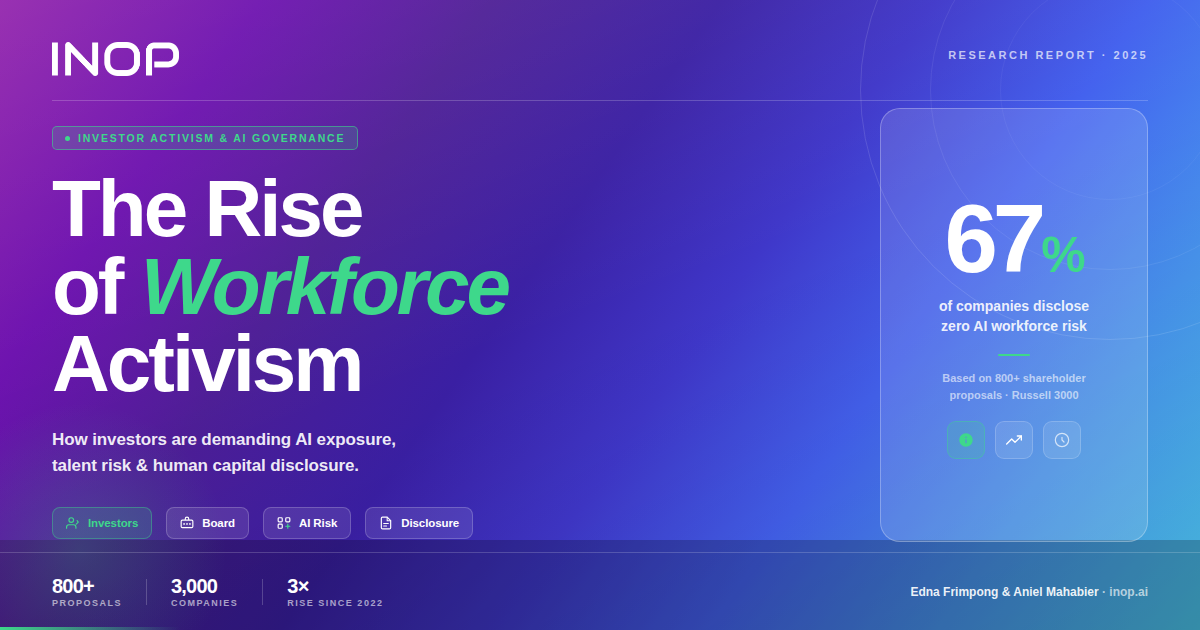
Workforce transparency is becoming a governance issue. For years, investor scrutiny focused primarily on climate risk, executive pay, and diversity reporting. Those topics remain important, but the focus is expanding. Investors are beginning to ask a different set of questions: Is the workforce capable of executing the strategy? Is the organization prepared for AI and automation? Are capability gaps creating hidden financial risk?
According to The Workforce Disclosure Gap: Why Investors Still Can’t Price Human Capital Risk, investors increasingly view workforce capability, AI governance, and talent readiness as material risk factors. This represents a structural shift in how execution risk is evaluated.
Execution Confidence Requires Workforce Visibility
Investors allocate capital based on execution confidence. In the AI era, execution increasingly depends on workforce capability. Yet most companies still disclose workforce information through legacy metrics: headcount, turnover, and training hours. These indicators describe workforce activity, not workforce readiness. They provide no visibility into whether a company can deploy AI responsibly, reskill at scale, absorb automation, maintain productivity during transformation, or protect margins under capability pressure.
This creates a material information gap. Boards approve AI investments and transformation budgets without visibility into whether their workforce can execute. Investors model growth and margin assumptions without understanding capability constraints. The result: execution risk gets mispriced, transformation timelines prove unrealistic, and workforce constraints surprise markets.
Capital markets cannot price workforce risk when capability data is invisible.
Investors are beginning to close that gap themselves through shareholder proposals, earnings call pressure, and direct board engagement.
Three Forces Accelerating Workforce Activism
Organizations are investing heavily in AI infrastructure and automation technologies, but investors have limited visibility into whether the workforce can actually deploy these capabilities. 92% of companies are investing in AI, yet only 1% consider themselves “AI mature.” That gap represents billions in capital deployed with unclear execution capability. When investors can’t assess workforce readiness across the five critical domains, Strategy alignment, Financial impact, People capability, Market dynamics, and AI/Automation exposure, they can’t price transformation risk with confidence. The question boards increasingly face: Do we have the skills to execute our AI strategy? Most cannot answer with data that connects people capabilities to strategic priorities, automation exposure to financial planning, or market talent availability to execution timelines.
Disclosure requirements are evolving from voluntary to mandatory. EU CSRD and ESRS S2 require detailed workforce metrics with third-party assurance. SEC human capital disclosure guidance emphasizes material workforce risks. The EU AI Act classifies workforce AI as “high-risk,” requiring human oversight and bias audits. Proxy advisors (ISS, Glass Lewis) are flagging weak AI governance oversight as governance failures. Regulators and governance authorities increasingly expect companies to explain not just workforce structure, but workforce readiness. This requires integrating data across traditionally siloed functions: HR systems showing people data, finance systems showing cost implications, strategy documents outlining priorities, market intelligence revealing talent availability, and automation assessments quantifying displacement risk. Without this integrated view, companies cannot credibly disclose workforce readiness to investors or regulators.
Skills shortages, mobility constraints, and weak succession pipelines directly influence transformation speed, operational resilience, and competitive positioning. These are no longer HR concerns, they’re drivers of enterprise value. Investors recognize that workforce capability affects transformation execution timelines (and whether ROI materializes), wage inflation and margin pressure in skill-scarce markets, ability to adapt when market conditions shift, and competitive advantage in talent-intensive sectors. Yet this risk remains largely invisible because workforce intelligence is fragmented. People teams see skills and roles. Finance sees costs and headcount. Strategy teams see objectives and timelines. Market analysts see external talent availability. Automation planners see task-level displacement risk. No single function connects these perspectives into decision-useful intelligence. Investors need this integrated view to assess whether companies can execute, and they’re demanding it through activism when voluntary disclosure falls short.
Why Proposals Don’t Need to Pass to Matter
Workforce-related shareholder proposals rarely receive majority support, most draw 10-25% shareholder votes, but that doesn’t limit their influence. NEXT plc faced a ShareAction proposal on pay transparency and workforce disclosure that received 27% support. The board recommended against it, but the vote triggered direct investor engagement and new reporting commitments. Chipotle’s proposal requesting automation impact disclosure failed but drew double-digit support, signaling investor appetite for workforce transition visibility that connects automation decisions to people impact and financial consequences. Meta and Amazon faced proposals on AI governance oversight and warehouse working conditions that received 10-23% support. While failing to pass, both companies now face sustained investor engagement and proxy advisor scrutiny. Investors want visibility into how AI deployment decisions affect workforce strategy, how automation exposure translates to financial risk, and how people capabilities enable or constrain technology adoption.
The pattern is clear: even “failed” proposals create board-level conversations, governance committee reviews, and multi-year stewardship pressure. The threshold for “material investor concern” has shifted; boards can’t dismiss 15-20% support as insignificant. The underlying message from investors is consistent: disclose workforce risk before it becomes financial risk.
The New Frontiers of Investor Attention
Investor scrutiny is moving decisively toward forward-looking workforce indicators that traditional HR reporting doesn’t capture. On AI workforce governance, investors want to understand how boards oversee AI deployment decisions, algorithmic bias in workforce systems, workforce transition planning for automation, and ethical AI use in hiring and performance management. They want to understand the connection between AI strategy and people readiness: whether the organization has assessed which roles face automation exposure, what the financial impact of workforce transition will be, and whether talent exists in the market to backfill critical capabilities.
On automation exposure and transition planning, investors are asking which roles and tasks face displacement risk, what reskilling investment and timelines look like, what internal mobility capacity exists, and what workforce transition costs mean for margins. This requires connecting people data (who has which skills), financial data (what transition costs), market intelligence (where talent exists externally), and automation assessments (which tasks are vulnerable), the exact integration most companies lack.
On skills readiness for strategic execution, the questions are whether the workforce has capabilities to deliver stated strategy, where critical skill gaps could delay transformation, what succession depth exists for mission-critical roles, and what the internal vs. external talent dependency is. Answering these questions requires seeing workforce capabilities through multiple lenses simultaneously: strategic priorities, financial constraints, people capabilities, market realities, and automation impacts.
On workforce resilience metrics, investors want to see internal mobility rates, retention of high performers vs. average performers, ability to redeploy talent when priorities shift, and workforce cost optimization under margin pressure. Resilience depends on understanding not just current capabilities but also adjacency potential (can people move to new roles), market alternatives (can we hire externally if needed), automation options (can technology substitute), and financial flexibility (can we afford the transition).
These aren’t operational HR topics, they’re governance issues that affect valuation, execution risk, and investor confidence. They require the multi-lens integration that most organizations lack: Strategy (what we need to deliver), Finance (what we can afford), People (what capabilities exist), Market (what’s available externally), and AI/Automation (what technology can substitute or augment).
How Workforce Activism Escalates
Modern investor pressure around workforce transparency follows a recognizable sequence. At Stage 1, analysts begin asking about AI readiness, automation impact, or skills gaps on earnings calls. Vague answers or “we’ll get back to you” responses signal weak visibility. At Stage 2, major institutional investors (BlackRock, State Street, CalPERS) request meetings with board members to discuss workforce governance and oversight structures, asking whether boards have integrated workforce intelligence across strategy, finance, people, market, and automation dimensions. At Stage 3, activist investors file formal shareholder proposals requesting specific workforce disclosures on automation risk, AI governance, pay transparency, or succession planning. These proposals demand the multi-dimensional view investors need. At Stage 4, proxy advisors ISS or Glass Lewis flag weak workforce oversight in voting recommendations, influencing institutional investor voting on director elections. At Stage 5, withhold campaigns target specific directors on governance or compensation committees for inadequate oversight of workforce risk. At Stage 6, multiple investor groups coordinate, media coverage intensifies, and employee activism aligns with investor demands, creating reputational pressure that extends beyond shareholder votes.
The pattern: boards that address workforce disclosure proactively (Stages 1-2) avoid the reputational and governance costs of later stages. Those that wait until formal proposals face sustained multi-year pressure even when votes fail.
What Leading Companies Are Doing
Organizations responding effectively to workforce activism share several characteristics. They’ve moved workforce oversight from HR committees to governance or audit committees, signaling board-level accountability for workforce risk alongside financial and operational risk. These boards recognize that workforce intelligence isn’t an HR data problem, it’s a strategic integration challenge that requires seeing people capabilities through strategy, finance, market, and automation lenses simultaneously.
They disclose skills composition mapped to strategic priorities, internal mobility rates and succession depth for critical roles, reskilling investments with measurable outcomes tied to business objectives, and automation exposure and workforce transition plans with financial impact assessments, not just headcount and turnover. This requires integrating data: people capabilities + strategic needs + financial constraints + market availability + automation potential = decision-useful workforce intelligence.
Workforce metrics are tied directly to business strategy and financial performance in investor materials, not isolated in sustainability or HR reports. IR teams are equipped with credible workforce data to answer analyst questions on earnings calls. Boards engage with institutional investors on workforce strategy before proposals are filed, demonstrating integrated workforce intelligence across all five critical dimensions. They maintain clear oversight structures for AI deployment decisions, documentation of algorithmic decision-making in workforce systems, workforce impact assessments for automation initiatives, and public commitments to responsible AI use, explicitly connecting AI/automation decisions to people impact, strategic priorities, financial consequences, and market talent dynamics.
Unilever publishes workforce safety, turnover, and reskilling KPIs in investor materials, connecting people metrics to operational performance and strategic execution. Microsoft integrates AI governance and workforce readiness metrics into investor briefings, showing how people capabilities enable technology strategy. Leading tech companies now include “human capital” sections in annual reports with forward-looking capability assessments that connect workforce readiness to strategic priorities and competitive positioning. These companies recognize that workforce intelligence isn’t an ESG checkbox, it’s infrastructure for investor confidence and execution credibility.
The Era of Workforce Opacity Is Ending
Workforce risk is one of the fastest-growing themes in shareholder activism, and AI adoption is accelerating the shift. Investors are signaling a clear expectation: human capital is material, and markets require better visibility into whether organizations can execute their strategies. The choice for boards is no longer whether to disclose workforce intelligence, but whether to lead or follow.
Companies that invest early in integrated workforce intelligence, connecting Strategy, Finance, People, Market, and AI/Automation data into a single decision layer, will strengthen governance credibility, reduce execution risk, and command investor confidence. Companies that rely on outdated workforce metrics, fragmented across HR, finance, and strategy silos, will face sustained pressure from investors, proxy advisors, and regulators. The question isn’t if workforce transparency becomes standard, it’s who captures the advantage of moving first.
Where INOP Fits
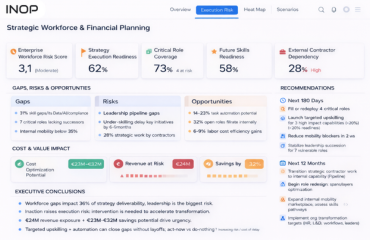
NOP is a multi-lens workforce decision intelligence platform that gives organizations a unified, real-time view of their workforce by connecting Strategy, Finance, People, Market, and AI/Automation intelligence in a single system.
Specifically, INOP enables leaders to:
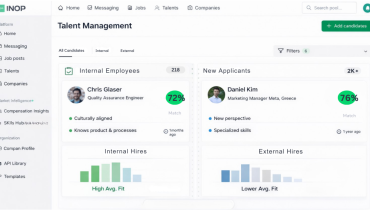
- See current workforce capabilities through validated skills data mapped to strategic priorities
- Identify critical capability gaps and execution risk tied to business objectives and financial constraints
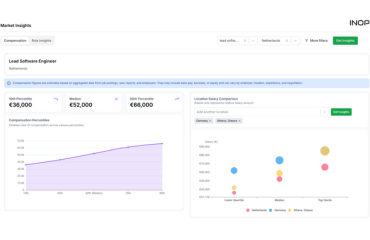
- Assess market talent availability and compare internal vs. external talent economics
- Model automation exposure at task and role level and plan workforce transitions
- Produce investor-grade workforce intelligence that answers the questions boards and investors ask about execution capability across all five dimensions
INOP connects these fragmented perspectives into a single strategic workforce intelligence layer, enabling the integrated view that investors are demanding and boards need to demonstrate credible oversight.
Where traditional workforce reporting describes the workforce, INOP reveals what the workforce can actually deliver.
Book a Demo
Make confident workforce decisions that support strategy and value creation.