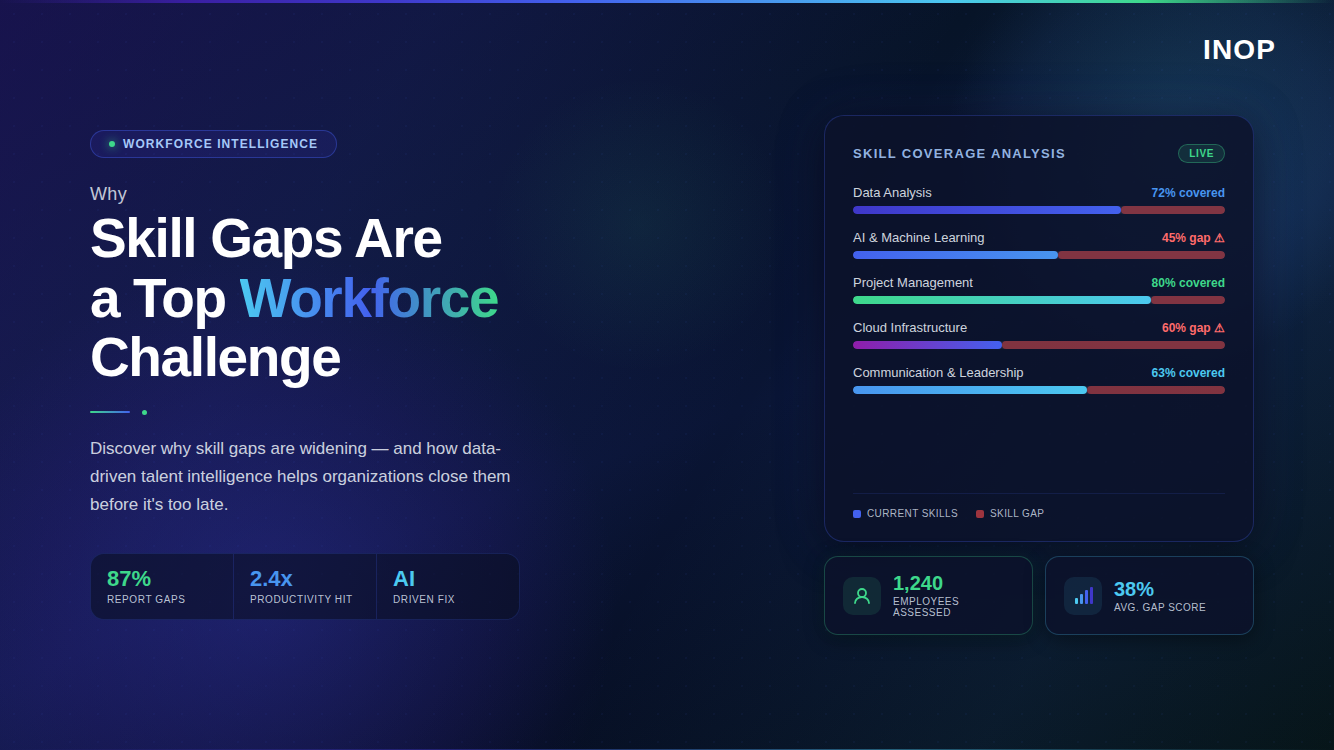
Did you know that 87% of executives say their organizations are already experiencing a skills gap or expect to within the next five years? This isn’t just a passing concern. The importance of skill gap in shaping business outcomes has never been more pressing, as companies across industries face mounting challenges in aligning talent with the demands of the future workplace.
In this article, we’ll explore why skill gaps represent a critical workforce challenge, how they contribute to ongoing talent shortages, and what organizations can do to identify, measure, and close them effectively.
Understanding the Concept of Skill Gaps
A skill gap occurs when the abilities employees currently possess do not match the competencies required to perform their jobs successfully. This misalignment can arise from several factors: rapid technological change, evolving business models, or even outdated education and training systems.
For example, a software developer may have strong programming knowledge but lack expertise in AI-driven frameworks that their company now requires. Similarly, a sales professional might excel in face-to-face relationship building but fall short in digital sales platforms that dominate the modern landscape.
The impact of such gaps goes beyond individual performance, it affects organizational productivity, customer satisfaction, and ultimately profitability.
Why Skill Gaps Exist? The Six Root Causes
Understanding why skill gaps develop is as important as understanding what they cost. Different causes require different interventions, and organizations that treat all skill gaps as training problems will consistently underfund hiring solutions and consistently underfund development solutions when training is the right answer.
Rapid Technological Change Outpacing Adaptation
Technology is evolving faster than most organizations’ development programmes can track. Skills that were current when an employee was hired may already be outdated by the time they are most needed. The specific problem is compounding: each new technology requires multiple adjacent skills, deployment timelines are shorter than training cycles, and the organizations that adopt technology earliest create competitive pressure that forces others to follow before their workforces are ready.
AI is the clearest current example. 70% of professionals now use AI weekly, yet the skills required to use AI tools effectively are not yet embedded in most formal education or organizational training programmes. The result is an adoption-capability gap that widens every quarter as AI capabilities expand faster than AI literacy does.
Education Systems Lagging Behind Market Demand
A combination of rapid technological advancements, outdated educational systems, and changing workforce dynamics has fueled the skills shortage challenge. The structural problem is the lag time inherent in formal education: curriculum development, regulatory approval, and delivery infrastructure mean that university and vocational programmes typically reflect market demands of three to five years ago rather than today’s. For fast-moving skill domains like AI, cloud architecture, and data science, this lag means that recent graduates arrive with foundational knowledge in domains that employers need advanced practitioners in.
The AI Reality Gap Between Employers and Talent
One of the most specifically quantified skill gap causes in 2026 research is the disconnect between how employers and employees perceive AI’s impact on work. In Germany, 75% of employers estimate that AI will affect a high proportion of work tasks, but only 49% of German talent agrees. In the Netherlands, 70% of employers hold this view while only 39% of talent concurs. This perception gap creates a preparation gap: employees who do not believe AI will materially affect their roles are not investing in AI fluency, while employers who know it will are not investing adequately in closing the readiness gap.
Demographic Shifts and Aging Workforce
Demographic shifts including an aging workforce and declining labor force participation compound skills gap pressures in 2026. As experienced workers retire, they carry institutional knowledge, technical expertise, and relationship capital that is not automatically transferred to successors. The succession planning gap is a specific form of skill gap where the knowledge at risk is not available in any training programme because it was developed over decades of practice in organizational context. Manufacturing, engineering, healthcare, and financial services are particularly exposed because the expertise most at risk of loss through retirement is the most technically specialized and the least codified in transferable form.
Under-Investment in Learning and Development
Most organizations’ L&D budgets have not kept pace with the rate of skill change required. The common failure mode is spending training budgets on programmes that address the gaps of two years ago rather than the gaps emerging in the next 12 to 18 months. Without a skills gap analysis that identifies future-facing capability needs, L&D investment defaults to historical demand patterns rather than forward-looking strategic requirements.
Hiring Practices That Filter Out Available Capability
Employers often make two linked hiring mistakes: they want to attract ready-made candidates who tick all boxes but struggle to assess talent competencies during recruitment, and they overemphasize hard skill requirements while completely passing on candidates’ soft skills. By focusing on outdated measures like degree type or years of experience, they overlook otherwise qualified people or those who could thrive with targeted training. These hiring practices create apparent skill gaps that are actually visibility gaps, the capability exists in the available talent pool but is filtered out before it can be accessed.
Why Skill Gaps Pose a Serious Workforce Challenge
Skill gaps aren’t just an HR issue; they’re a business problem with strategic implications.
- Reduced productivity: Teams without the right skills take longer to complete tasks, often producing less innovative results.
- Increased costs: Companies spend heavily on recruiting external talent to fill gaps rather than upskilling their existing workforce.
- Talent shortages: When demand for certain skills outpaces supply, open roles remain vacant for months, delaying growth initiatives.
- Employee disengagement: Workers who feel unprepared for their roles often report higher stress levels and lower job satisfaction.
To stay competitive, organizations must treat skill gaps not as isolated problems but as systemic risks that require structured solutions. This is where tools such as a skill-based workforce planning tool can play a transformative role, helping leaders anticipate needs and align strategies with workforce capabilities.
Catching Skill Gaps Before They Cost You
Closing a skill gap is only half the challenge. The more consequential question is how long the gap existed before anyone noticed it. Most organizations identify workforce capability shortfalls through lagging indicators: turnover spikes, missed deadlines, declining output quality, or disengagement scores that have already been falling for months. By the time those signals surface, the business has been absorbing the cost of the gap for a while.
Effective skill gap identification is the earlier step that changes this dynamic. Rather than waiting for performance data to confirm a problem, a structured identification process tracks leading signals: role concentration risk, output pattern shifts at the team level, and divergence between internal capability baselines and external market demand. These signals appear well before a gap becomes visible in aggregate metrics, and catching them early is what separates organizations that close gaps proactively from those that respond to them after the damage is already measurable.
For HR leaders building a skill gap strategy, identification is where that strategy has to start. The fulfilment approaches outlined above, upskilling, reskilling, targeted acquisition, and smarter workforce data, all depend on knowing where the gaps are and how long the organization has to address them before they constrain execution.
The Link Between Skill Gaps and Talent Shortages
One of the biggest ripple effects of skill gaps is the persistent talent shortage across industries. When businesses cannot find candidates with the right skills, projects stall, and innovation slows down.
Take healthcare as an example: according to the World Health Organization, there will be a shortage of 10 million health workers globally by 2030. Similarly, in the tech sector, specialized roles in cybersecurity and data science remain unfilled because demand has outpaced training pipelines.
This shortage creates a vicious cycle. Employers compete fiercely for scarce talent, driving up compensation costs, while employees feel pressured to continuously reskill to remain relevant.
When an Organizational Gap Becomes a Market Shortage
The progression from organizational skill gap to market skill shortage follows a recognizable pattern that strategic workforce planning can identify (and respond to) before the shortage phase arrives.
In the early stage, a gap exists within specific organizations: Company A needs 50 cloud architects and does not have them internally, but can hire from the market. This is an organizational gap with market solutions available.
In the middle stage, multiple organizations in the same sector recognize the same gap simultaneously and compete for the same limited external supply. Compensation premiums rise, time-to-fill extends, and organizations begin investing in internal development to reduce external market dependency. This is the shortage warning stage.
In the shortage stage, aggregate demand for a skill has outpaced aggregate supply across the entire market. No amount of compensation premium will fill all the open roles because the qualified individuals do not exist in sufficient numbers. Organizations facing genuine shortage conditions must prioritize internal development and academic partnership over external hiring, because external hiring simply redistributes the scarce supply rather than growing it.
Organizations that conduct systematic skills gap analysis and skills intelligence monitoring can identify which of their current gaps are organizational (solvable through hiring) versus proto-shortage (requiring internal development investment now) versus already at shortage stage (requiring alternative solution architecture). This distinction shapes not just the closure pathway but the timeline and budget required.
The Largest Skill Gap in Tech (And How It Impacts Every Industry)
When discussing the workforce skills gap, the technology sector is often the canary in the coal mine. Currently, the largest skill gap in tech lies in the intersection of Artificial Intelligence (AI) orchestration, advanced cybersecurity, and cloud data architecture.
However, this is no longer just a “tech company” problem. Because every organization is undergoing digital transformation, this massive tech skill gap impacts everyone. A retail chain cannot optimize its supply chain without data scientists. A healthcare provider cannot secure patient records without cybersecurity experts. As the demand for these specialized tech skills outpaces the global supply, companies must begin planning for the emerging skills of 2030 today. Otherwise, they will be forced into fierce talent wars, heavily driving up compensation costs and delaying critical strategic projects.
Healthcare: A 10 Million Worker Deficit by 2030
The World Health Organization projects a shortage of 10 million health workers globally by 2030. This is not primarily a supply problem, the shortage of doctors, nurses, and allied health professionals is compounded by a skill composition problem. The healthcare workforce being trained today is largely being trained for the healthcare delivery model of 2015, not 2030. Digital health literacy, AI-assisted diagnostics, telemedicine delivery, and genomic medicine all require capabilities that most current clinical education programmes do not adequately develop. Healthcare organizations that wait for the education system to close this gap will face a double shortfall: insufficient headcount and insufficient digital capability in the available headcount.
Manufacturing and Engineering: The Automation Skills Paradox
Manufacturing faces a specific form of skill gap that is simultaneously caused by automation and required by it. Automation reduces demand for routine manual assembly tasks while dramatically increasing demand for the technical skills required to program, operate, and maintain automated systems. The workers displaced by automation are frequently the ones who need to develop the skills to run the automation — but the skill requirements for operating advanced manufacturing technology are meaningfully higher than those for the tasks being automated. The result is a workforce transition challenge that cannot be solved through retraining alone without significant investment in technical education and hands-on certification programmes.
Why Closing Skill Gaps Is Critical for Business Growth
Addressing the importance of skill gap isn’t just about solving immediate hiring problems—it’s about ensuring long-term sustainability.
Improved agility
Organizations that actively close skill gaps can adapt more quickly to changes in technology, regulation, or consumer behavior.
Stronger competitive advantage
When employees have up-to-date skills, they deliver innovative products and services faster than competitors.
Better employee retention
Investing in training demonstrates commitment to employees’ careers, reducing turnover and increasing engagement.
The connection between skill investment and retention is well evidenced among the workforce generations most at risk of disengagement. The Deloitte 2025 Gen Z and Millennial Survey found that learning and development opportunities rank among the top reasons Gen Z and millennials choose to stay with their current employers, while 42% of Gen Z respondents report struggling to perform at their best due to burnout. For organizations treating skill gap closure as purely a productivity initiative, this data reframes it as a retention imperative.
Lower costs over time
While upskilling requires investment, it is generally more cost-effective than repeatedly recruiting external talent.
These benefits highlight why skill gap management must be embedded in overall workforce strategies rather than treated as a one-off initiative.
How Workforce Skill Shortage Impacts Strategic Planning
A persistent workforce skill shortage is one of the most disruptive challenges businesses face today. It directly impacts capacity planning, succession strategies, and even customer satisfaction. Leaders can no longer rely on reactive hiring alone, they must adopt proactive approaches that integrate training, reskilling, and smarter use of workforce analytics.
By leveraging modern solutions, organizations can map future skills, build internal talent pipelines, and create clear pathways for employees to grow alongside business needs. This isn’t just operational planning—it’s a vital component of strategic workforce management.
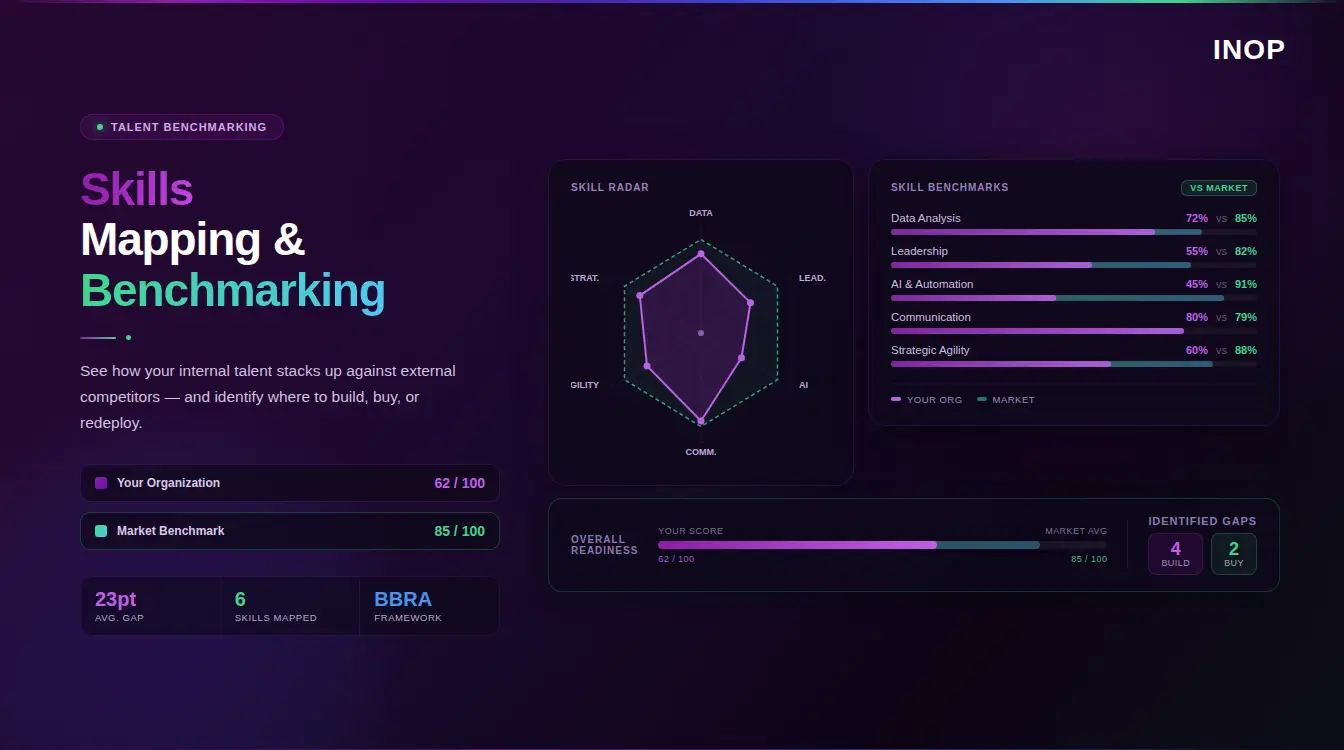
Effective skill gap management starts with a clear picture of what capabilities currently exist inside the organisation. Skills mapping provides exactly that: a systematic process for identifying, cataloguing, and benchmarking your workforce’s capabilities against both internal role requirements and external competitor talent. Without it, skill gap analysis is based on assumption rather than evidence — and the resulting training and hiring decisions inherit that same unreliability.
The Strategy for Skill Gap Fulfilment
Once an organization understands the scope of its workforce skill gap, the next phase is skill gap fulfilment. This is the strategic execution of bringing the required competencies into the organization. To effectively achieve skill gap fulfilment, organizations must adopt a multi-pronged approach:
- Conduct dynamic skills assessments: Benchmark current employee skills against future business goals.
- Prioritize critical roles: Identify positions where gaps could have the largest negative impact on productivity and customer outcomes.
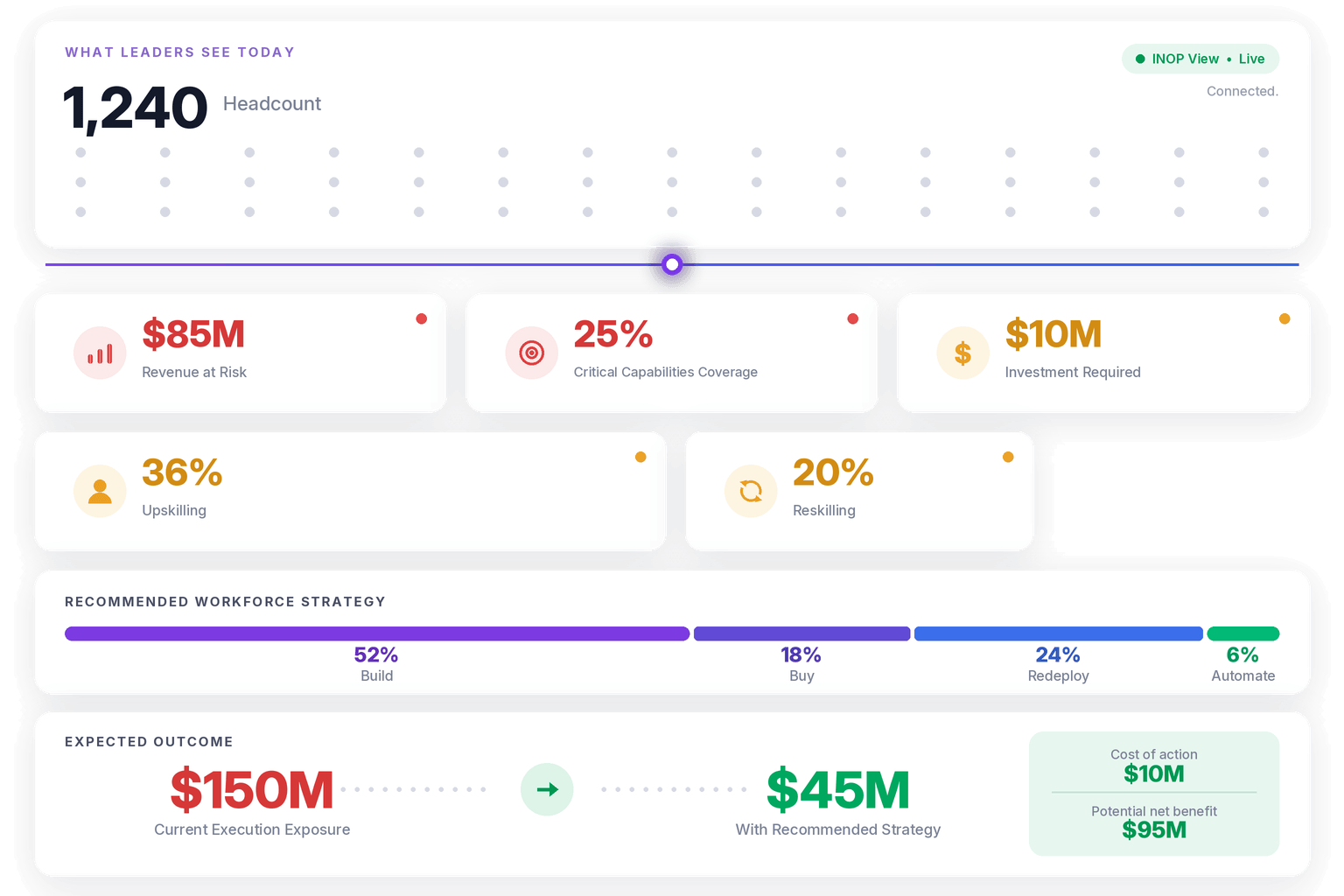
- Invest in upskilling and reskilling (Build): Create targeted learning programs that align with evolving business needs. The distinction between a generic training rollout and genuinely AI driven upskilling lies in whether the program starts from a verified gap or a course catalog, and whether it confirms that the gap closed rather than just that the module was completed.
- Anticipate Future Needs: Regularly forecast future skill requirements based on business goals, industry trends, and technological advancements. workforce demand forecasting translates this from a periodic exercise into a continuous, data-driven process that surfaces skill supply gaps months before they become critical bottlenecks.
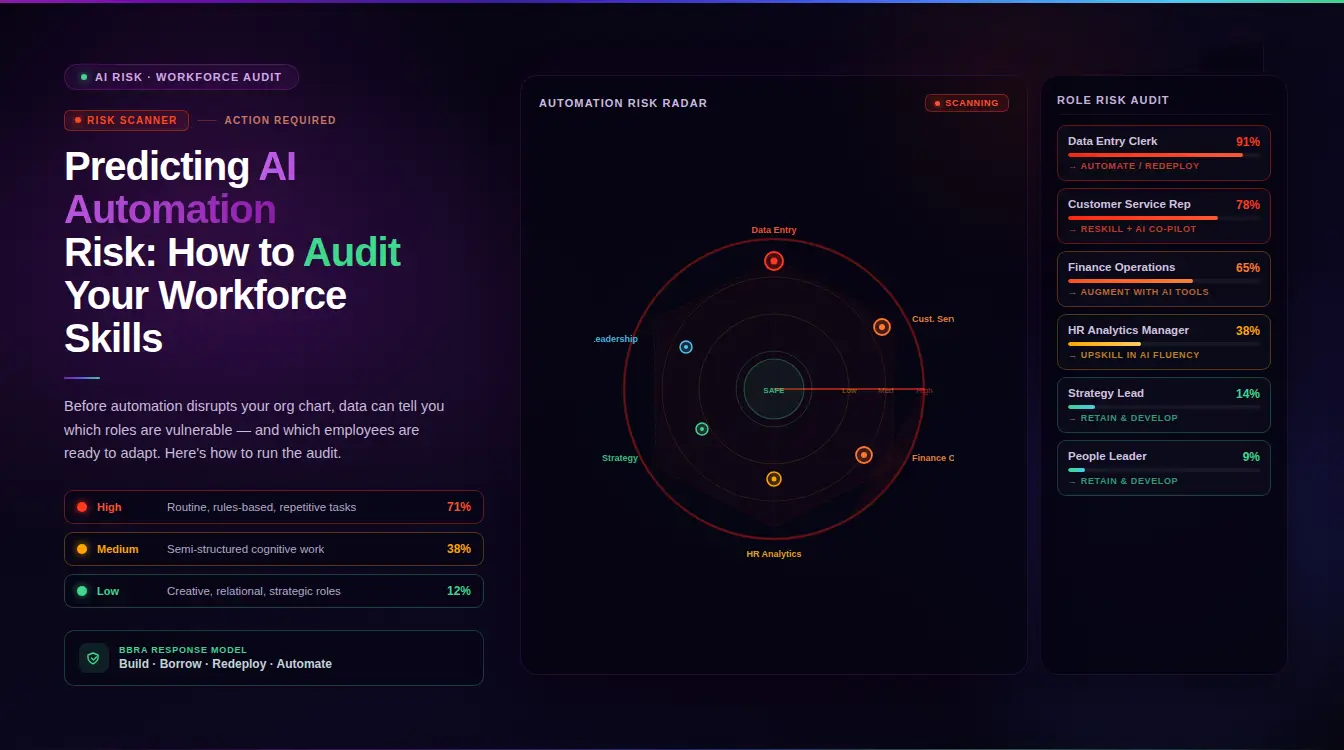
- Strategic Talent Acquisition (Buy & Borrow): Use workforce analytics to determine when to hire full-time external talent (Buy) versus when to use specialized contractors or consultants (Borrow).
The Impact of Workforce Data Gaps on Training Coordination
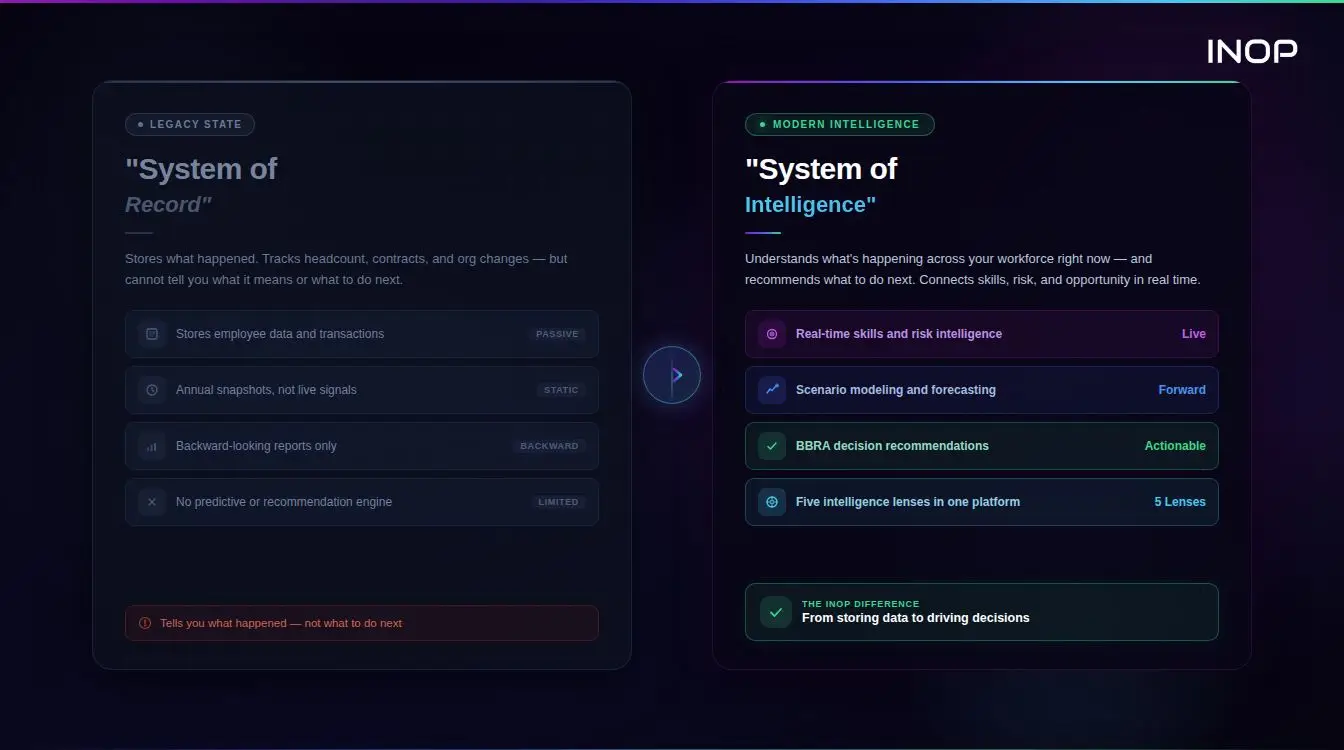
A major obstacle to skill gap fulfilment is a lack of accurate employee data. The impact of workforce data gaps on training coordination is severe: when HR and L&D (Learning & Development) teams cannot see what skills their employees currently possess, they end up designing the wrong training programs.
Without a centralized skills inventory, training coordination becomes reactive. Companies waste millions of dollars rolling out generic training modules to employees who already possess those skills, while critical capability gaps go completely ignored. To coordinate training effectively, organizations must deploy a Strategic Workforce Planning tool to gain real-time data visibility into their talent pool.
How Hiring Practices Perpetuate the Gaps They Are Trying to Fill
A frequently overlooked contributor to persistent skill gaps is the hiring process itself. Organizations that default to degree requirements, years-of-experience filters, and title-matching in their external sourcing are systematically filtering out candidates who hold the skills they need but lack the credentials that trigger automatic shortlisting.
The gap between credential and capability is significant and growing. As skills evolve faster than formal education programmes can update, recent graduates often arrive with current credentials but outdated skills, while candidates from non-traditional backgrounds frequently hold current skills without the conventional credentials. Organizations that insist on the credential are filtering for the past, not the capability they need for the future.
The solution is not credential elimination but credential recalibration. Defining job requirements as specific skill proficiencies at defined levels, assessed through structured evaluation rather than inferred from proxies, opens the talent pool to candidates who would otherwise be filtered out while also reducing the probability of hiring candidates who hold the right credential but lack the right capability. IBM’s decision to eliminate degree requirements for over 50% of US positions and replace them with skills-based hiring criteria produced measurably better first-year performance outcomes and significantly broader demographic diversity in the candidate pool. That outcome is a natural result of measuring capability directly rather than measuring it through credential proxies that correlate imperfectly with what the organization actually needs.
Conclusion
Skill gaps are no longer just HR buzzwords—they are a top workforce challenge that directly influences business growth, innovation, and competitiveness. Left unaddressed, they fuel talent shortages and undermine organizational success.
The key to overcoming these obstacles lies in adopting proactive strategies: conducting regular assessments, investing in employee training, and leveraging modern tools to align workforce capabilities with business needs.
Organizations that act now will not only close today’s skill gaps but also future-proof their workforce against tomorrow’s uncertainties.
FAQs on Skill Gaps
What is the importance of skill gap in the workplace?
Skill gaps highlight the difference between current workforce capabilities and what’s required to achieve business goals. Addressing them ensures productivity, competitiveness, and growth.
How do skill gaps cause talent shortages?
When employees lack the necessary skills, businesses struggle to fill roles, leading to vacancies and delays in strategic initiatives.
What industries face the largest skill gaps?
Technology, healthcare, and manufacturing are among the hardest hit, often due to rapid innovation and evolving job requirements.
How can companies measure skill gaps effectively?
Through skills assessments, workforce analytics, and alignment of employee competencies with organizational goals.
What role do planning tools play in closing skill gaps?
Solutions like a skill-based workforce planning tool enable HR leaders to forecast future needs, identify gaps, and implement targeted training or hiring strategies.