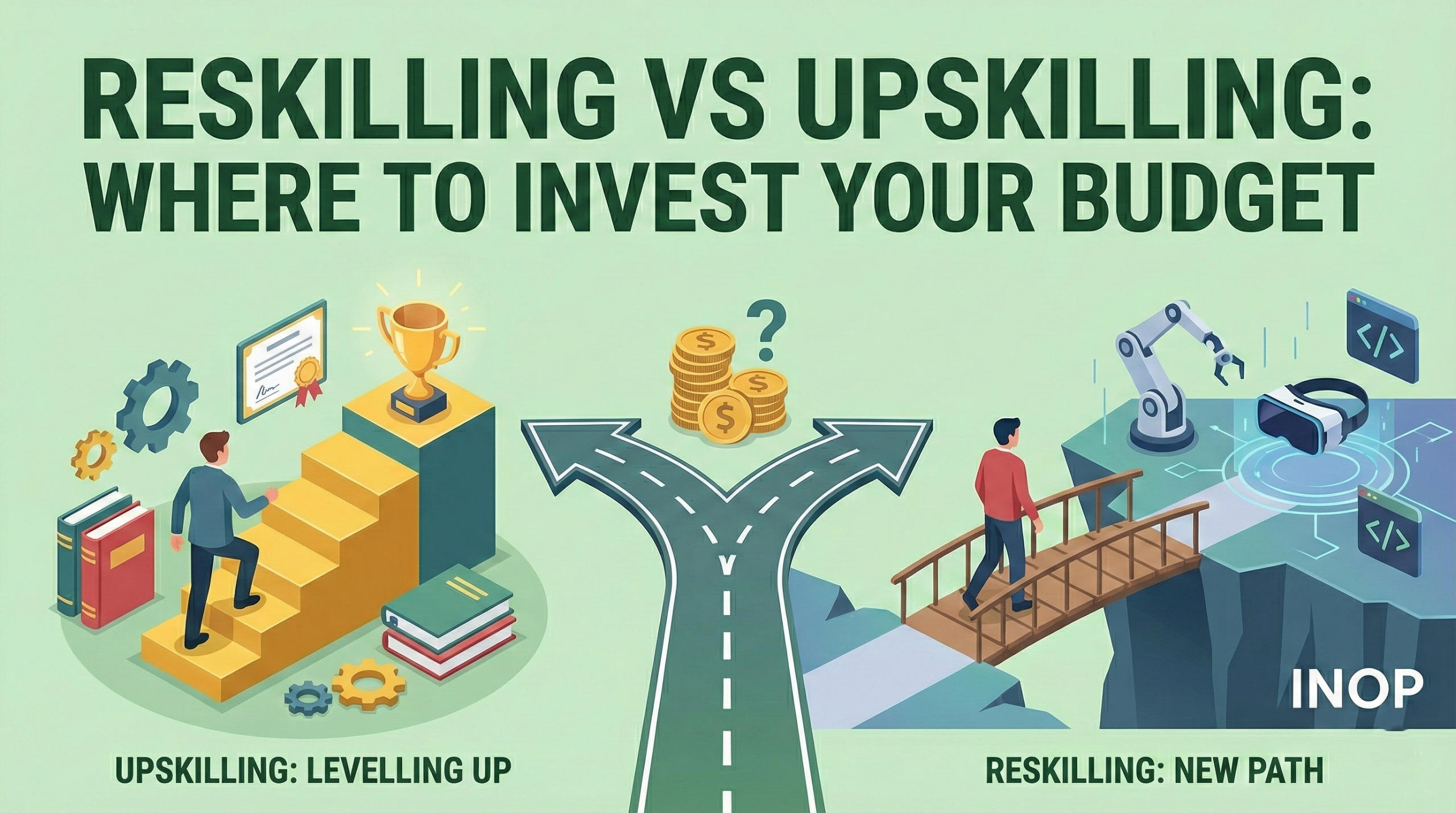
Reskilling vs upskilling comes down to one question: is the employee getting better at their current job, or preparing for a different one? Upskilling teaches employees new skills to do their current role better. Reskilling trains employees for a different role. Both build capability without starting over, and the right mix depends on your strategy, how fast your market is changing and what your people can realistically learn. This guide explains the difference, shows examples, and gives a framework for deciding where to invest your skills budget.
What Is Upskilling?
To upskill means to deepen or extend the skills a person needs in their current role, or in a close step up from it. The job stays the same, and the person does it better, faster or with new tools. Learning a new analytics tool, moving from basic to advanced use of AI in daily work, or earning a certification in a current specialty are all upskilling.
Upskilling is usually shorter and lower risk than reskilling, because the starting point is close to the target. It suits stable roles that need to keep pace with change. For a closer look at one common form, read AI driven upskilling.
What Is Reskilling?
To reskill means to train a person in a different set of skills so they can move into a different role. The target is further from the starting point, so reskilling takes longer and carries more risk. A customer support agent who learns data analysis and moves into an analyst role is reskilling. So is an employee in a shrinking function who trains for a growing one.
Reskilling is how an organization changes direction without losing the knowledge its people already have. It is most useful when work is changing shape, for example because automation reduces demand for some tasks and raises it for others.
Reskilling vs Upskilling Comparison Table
| Factor | Upskilling | Reskilling |
|---|---|---|
| Focus | Improve performance in the current role | Prepare for a different role |
| Distance from today | Short, adjacent skills | Longer, new skill families |
| Time horizon | Shorter | Longer |
| Primary goal | Efficiency and keeping pace with change | Mobility and transformation |
| Risk | Lower | Higher, since the move may not work |
| Business impact | Incremental gains in productivity and quality | Changes the shape of the workforce |
| Best suited to | Stable roles that need to keep up | Roles that are shrinking, merging or changing |
Reskilling vs Upskilling Examples
| Starting role | Change | Type |
|---|---|---|
| Marketing manager | Learns AI-assisted campaign analysis for the same role | Upskilling |
| Financial analyst | Moves from basic to advanced forecasting tools | Upskilling |
| Customer support agent | Trains in data analysis and moves into an analyst role | Reskilling |
| Operations coordinator | Trains in workflow automation and moves into process design | Reskilling |
The line is a matter of degree. When the gap between today’s skills and the target is small, treat it as upskilling. When the target role needs a new skill family, treat it as reskilling and plan accordingly.
Why Skills Investment Matters Now
Skill gaps are the main obstacle for most employers. The World Economic Forum’s Future of Jobs Report 2025 found that 63 percent of employers cite skill gaps in the labor market as the primary barrier to business transformation between 2025 and 2030. The same report shows that 85 percent of employers plan to upskill their workforce, and 51 percent plan to move staff from declining roles to growing ones. Both approaches are on the agenda, so the practical question is the mix.
Support often lags use. In Microsoft and LinkedIn’s 2024 Work Trend Index, 75 percent of knowledge workers reported using AI at work, but only 39 percent of AI users had received AI training from their company. Those figures are from 2024, so check for a newer edition before you quote them elsewhere. For the skills most likely to matter next, see emerging skills of 2030.
When Upskilling Pays Off
Upskilling is the efficiency play. It raises performance in roles the business already needs, and it is usually the faster way to move a result.
The Business Case for Upskilling
- Faster impact. Employees apply new skills in the role they already hold.
- Lower risk. The step is small, and the person keeps their context and relationships.
- Retention. Visible development gives people a reason to stay.
- Quality. Better tools and methods reduce errors and rework.
Where Your Upskilling Budget Should Go
- Roles that drive the strategy and are changing with new tools.
- Skills with a clear link to a business metric, such as quality or cycle time.
- Managers, since they shape how teams apply new skills.
- Verified skill gaps found through an analysis, not assumed needs. See what a skill gap is and how to measure one.
When Reskilling Pays Off
Reskilling is the transformation play. It moves capability from where the business needs less to where it needs more, and it keeps institutional knowledge that would otherwise leave.
The Trigger Points for Reskilling
- Automation or AI reduces demand for a task set.
- A product, market or operating model change creates new roles.
- A restructure leaves capacity in one area and gaps in another.
- A skill is scarce outside the organization and expensive to bring in.
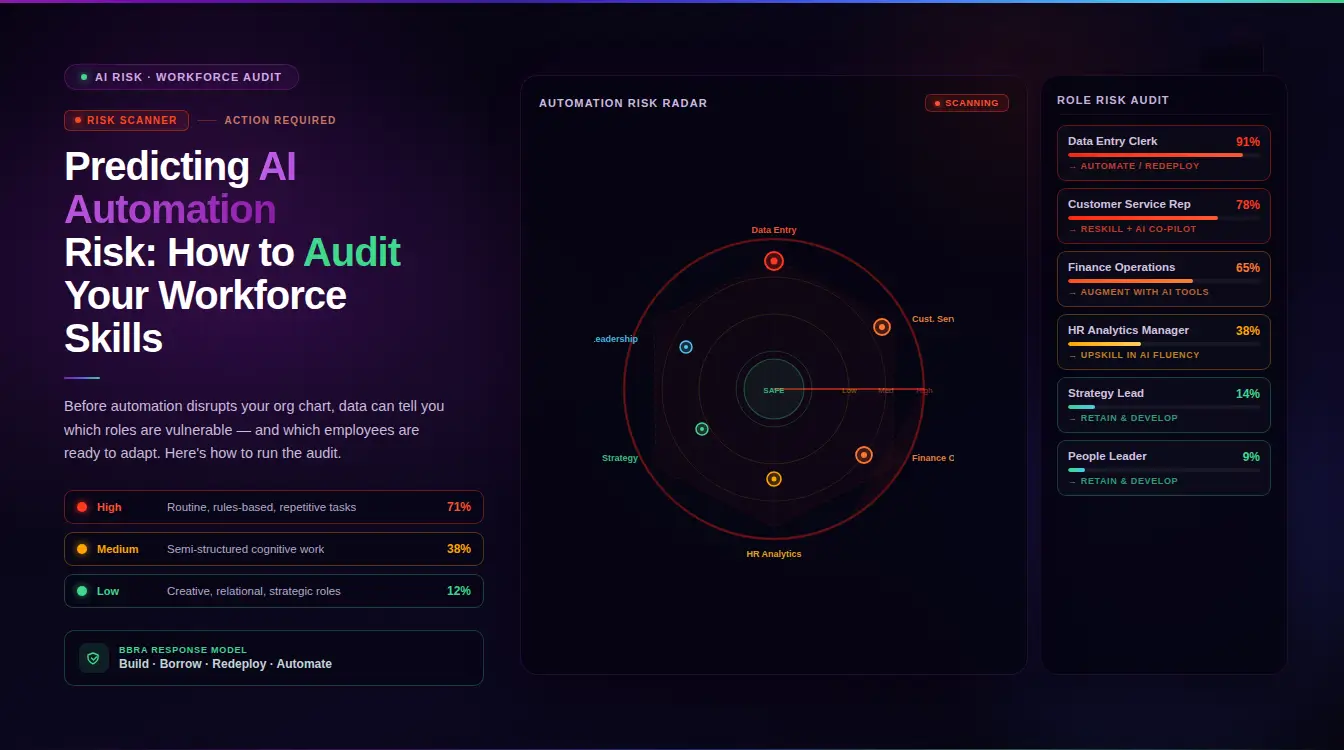
To find which roles are exposed, read predicting AI automation risk.
Build, Buy, Redeploy or Automate: The Business Case for Reskilling
Reskilling is one form of Build, and it competes with three alternatives. Bringing capability in from outside is fastest to start but carries the highest recurring cost. Redeploying people who already have the skills is quick when the skills transfer. Automation can reduce the work itself. A reskilling plan should be compared against all three before it is approved.
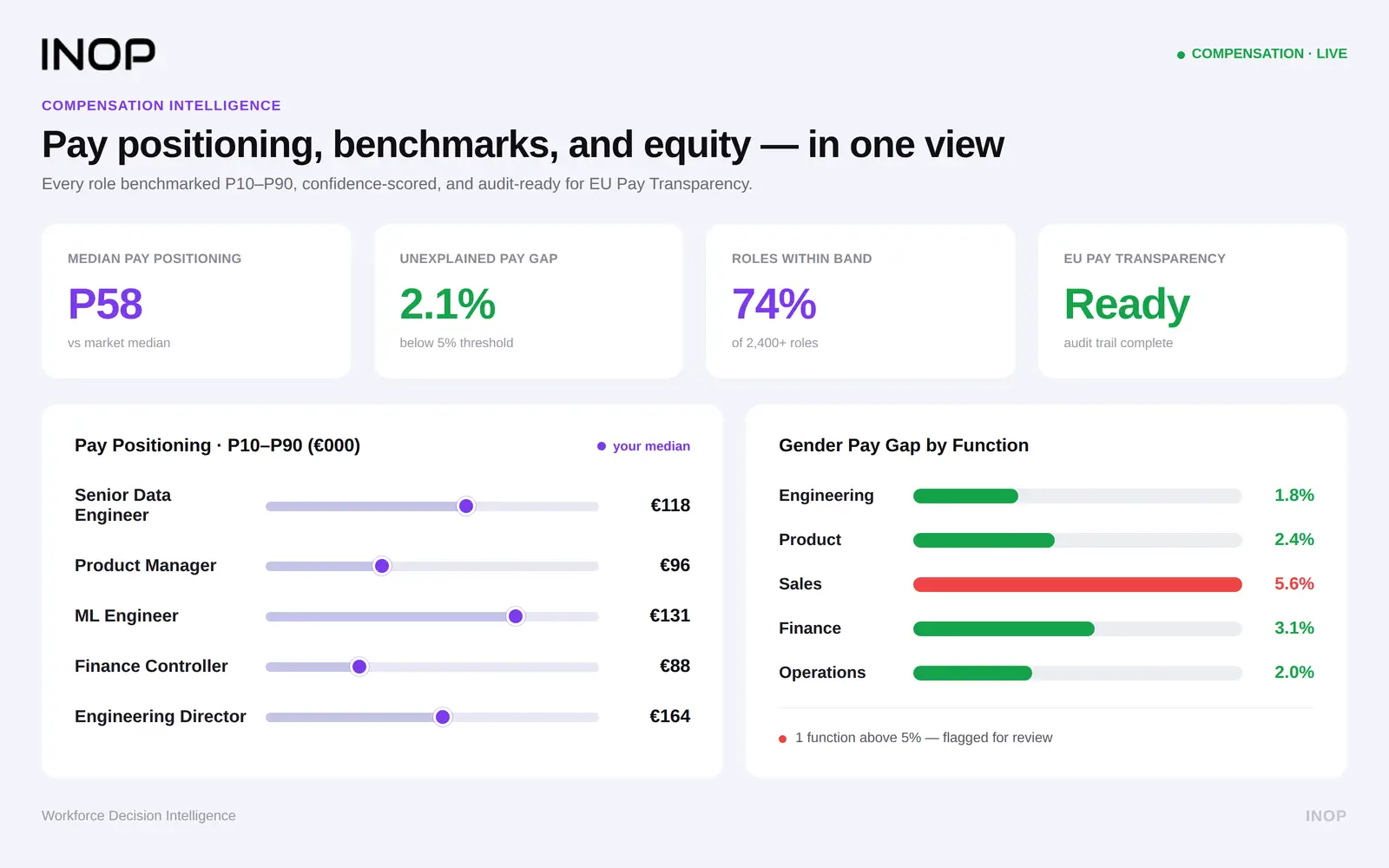
Pay deserves a check too. A reskilled employee moving into a scarcer skill set may be worth more to the market. INOP’s compensation analytics platform shows how the new role is priced, so retention does not become a surprise later. For the pay models involved, see skills-based pay vs job-based pay.
Where Your Reskilling Budget Should Go
- Employees whose current skills sit close to a target role and whose proficiency is verified.
- Roles the business will need for years, not for a single project.
- Support during the move: coaching, a trial period, and a clear path into the new role.
- Careers that show people where they can go, which reduces the risk that trained employees leave.
The Budget Split: A Framework for Skills Investment
There is no universal ratio. The right split follows your strategy, the pace of change in your market, and the distance between your workforce and the capabilities you need. Treat any fixed percentage you read online as a starting hypothesis, not a benchmark, and test it against your own data.
How to Set the Baseline Ratio
- List the capabilities the strategy needs over the planning period.
- Measure current proficiency with verified signals, not self-ratings.
- Size the gap by role and skill.
- Sort gaps by distance. Small gaps in stable roles go to upskilling; large gaps or shrinking roles go to reskilling.
- Price each response and compare it with the other pathways.
- Set the split from the result, and review it on a fixed cycle.
Reskilling vs Upskilling Ratio by Situation
| Situation | Lean toward | Why |
|---|---|---|
| Stable roles, tools changing gradually | Upskilling | Small gaps, fast return |
| Growth in a new product or market | A balanced mix | Upskill core teams, reskill for new roles |
| Roles shrinking through automation | Reskilling | Capacity needs a new destination |
| Scarce skill, expensive outside | Reskilling with a Build plan | Cost of buying the skill is high |
| Tight budget, urgent gap | Upskilling first, then reskilling in stages | Lower cost and lower risk to start |
Industry-specific ratios need a source you can check. Do not adopt one from a blog post without finding where the number came from.
How INOP Models Reskilling vs Upskilling Decisions
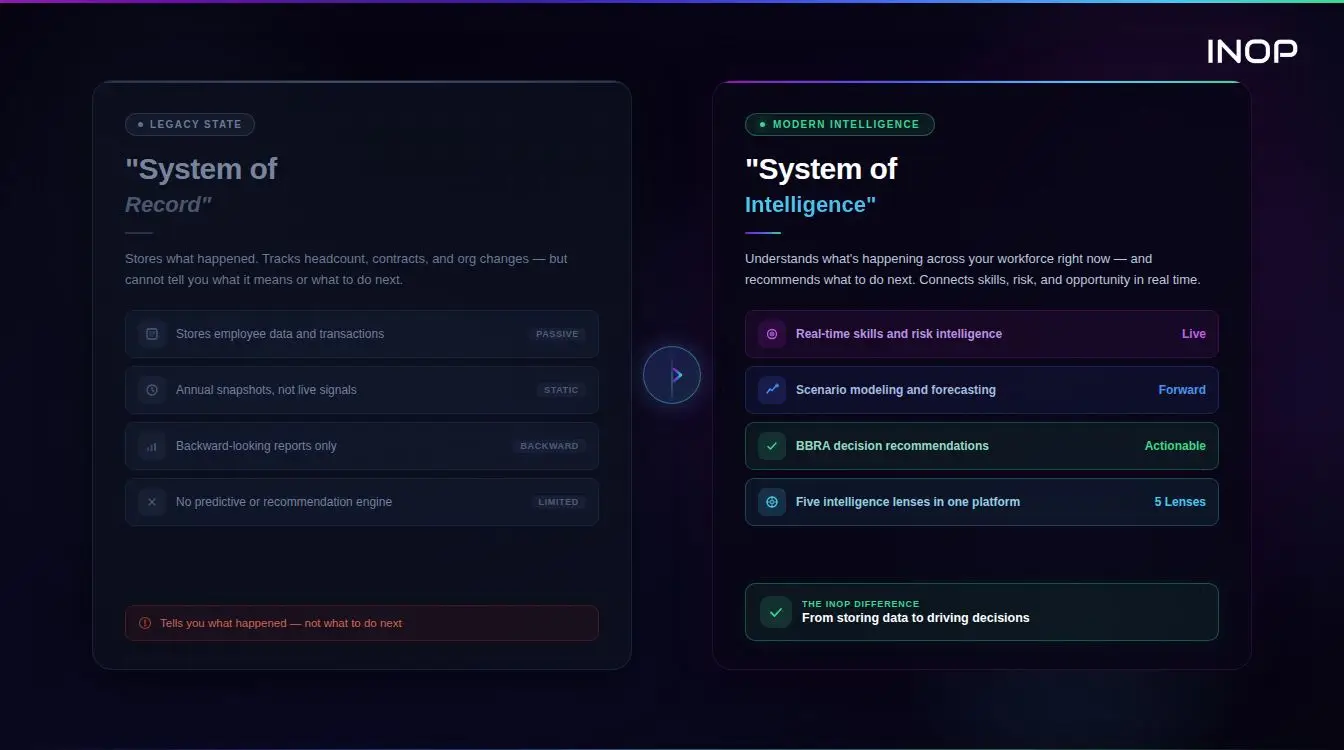
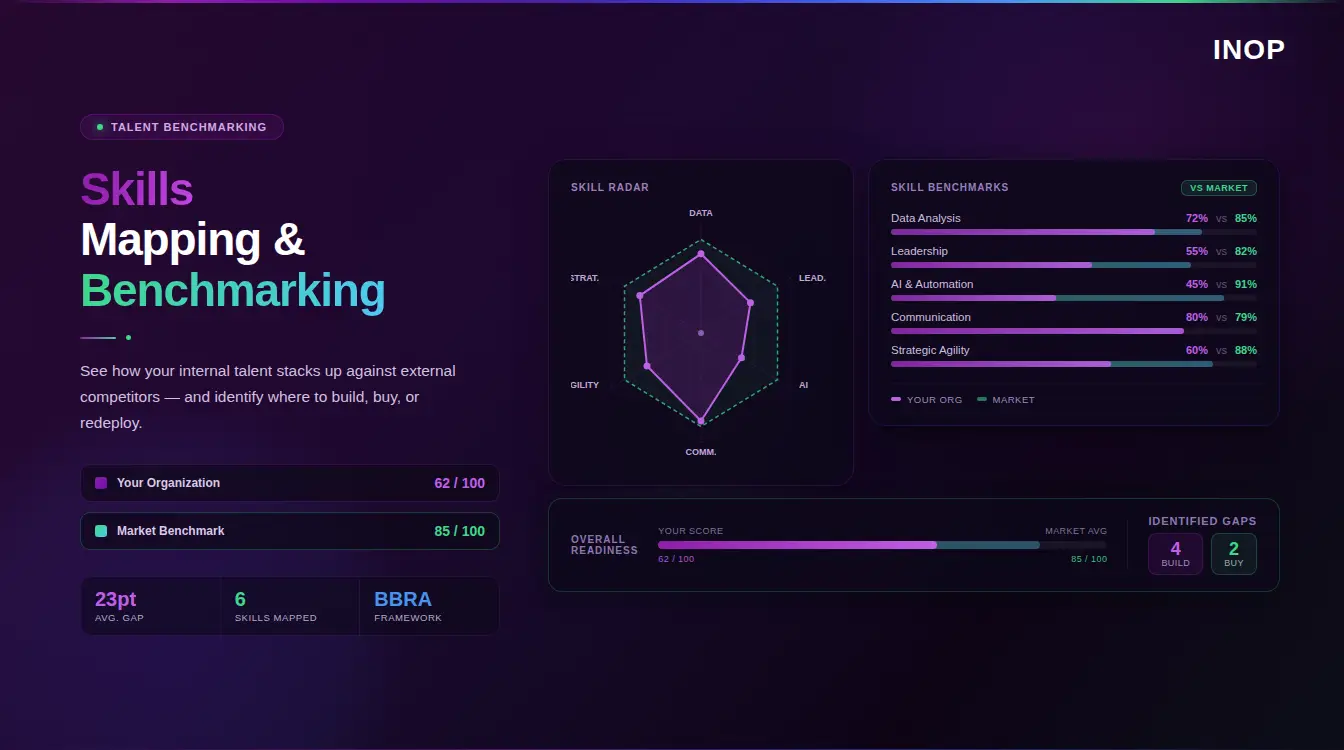
INOP answers whether leaders have the capabilities to execute their strategy today and stay AI-ready. It never assesses AI in isolation. It tests every skills investment against five intelligence lenses.
- Strategy: is the capability tied to a priority that justifies the spend?
- Finance: what does each pathway cost over time?
- People: which adjacent skills does the organization already hold?
- Market: how available and how expensive is the skill outside?
- AI and Automation: can automation reduce the work the skill would cover?
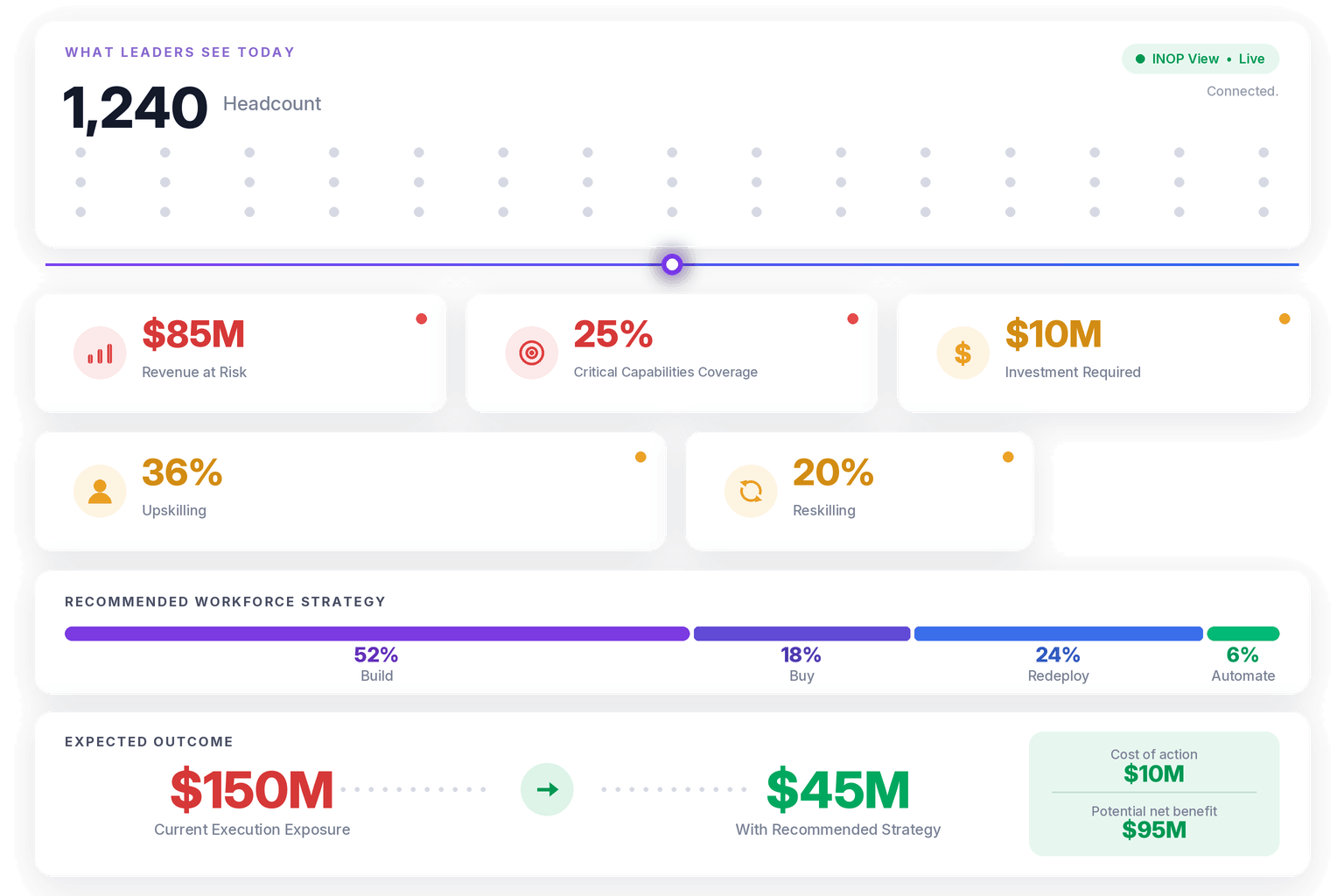
BBRA is INOP’s proprietary decision architecture: Build, Buy, Redeploy, Automate. Upskilling and reskilling both sit under Build. BBRA models all four pathways with their financial trade-offs across 30-day, 180-day, one-year and three-year horizons, so a reskilling plan is compared with the alternatives before money is committed.
INOP’s skills intelligence supplies the verified view of who holds which skills, and its strategic workforce planning platform links each gap to a priced response. For the planning method behind it, see strategic workforce planning frameworks.
See upskilling and reskilling compared with every other pathway. INOP models Build, Buy, Redeploy and Automate across four time horizons. Book a demo
Measuring ROI: Proving Your Investment Works
Set the metrics before the program starts, and compare against a baseline. Avoid quoting generic benchmark figures from outside sources unless you can trace them to their origin.
Upskilling Metrics That Matter
- Proficiency change against the required level for the role.
- Business metrics the skill should move, such as quality, cycle time or output per person.
- Adoption of the tools or methods taught.
- Participation and completion, as a supporting measure only.
Reskilling Metrics That Matter
- Share of reskilled employees who reach the required level in the new role.
- Time from the start of training to productive work in the new role.
- Retention of reskilled employees after the move.
- Cost of the program compared with the cost of the other pathways.
For a method to measure the starting point, read AI skills gap analysis.
Reskilling vs Upskilling for Private Equity Operating Partners
For private equity operating partners, the question is whether a portfolio company can deliver its plan with the workforce it has, and what closing the gap costs. Upskilling and reskilling are the two lowest-disruption ways to add capability inside a hundred-day plan, and they are easy to overlook if the company defaults to bringing people in from outside.
Apply the same ratio-setting method across the portfolio, with one proficiency scale and one set of pathway comparisons. Partners can then see where capability exists, where it must be built, and what each option costs.
Conclusion: Set the Ratio From Your Strategy
Upskilling improves performance in the current role. Reskilling prepares people for a different one. Neither is better in general. The right mix follows the capabilities your strategy needs, the size of each gap, and the cost of every pathway compared on the same basis. Start by measuring proficiency with verified data, then set the ratio from the result and review it on a fixed cycle. For related work, read addressing the skills gap and the guide to a skills-based organization.
Set your skills budget from verified data. INOP connects proficiency, cost and pathways in one decision view. Book a demo
Reskilling vs Upskilling FAQs
What is the difference between reskilling and upskilling?
Upskilling teaches employees new skills to do their current role better. Reskilling trains employees for a different role. The difference is the distance between the starting skills and the target: small for upskilling, larger for reskilling.
How do you choose which employees to reskill?
Start with verified proficiency in skills adjacent to the target role, then look at the business need for the role and the employee’s interest. Avoid vague criteria; define them in advance and apply them the same way to everyone, so the process is fair and can be explained.
Can small businesses with limited budgets afford reskilling?
Yes, if they stage it. Start with upskilling for the roles that matter most, reskill a small number of people into roles the business will need, and compare the cost with the other pathways. Use existing tools and internal coaching before paid programs.
How often should we reassess our upskilling and reskilling budget?
Review it on a fixed cycle, such as quarterly, and after any event that changes the plan, such as a new product, an automation project or a restructure. Refresh proficiency data as people complete training so the split reflects current gaps.
How should private equity operating partners compare upskilling and reskilling across a portfolio?
Use one proficiency scale and one pathway comparison for every company. Measure each company’s gaps against its growth plan, price the options, and compare. That shows where building capability internally beats bringing it in from outside, and where it does not.