The half-life of a learned skill today is just five years. That statistic should make every business leader pause. It means that half of what your employees know now will be outdated or irrelevant by 2030. In a world where standing still equals falling behind, the question isn’t whether to invest in employee development, it’s how. Should you sharpen the tools your team already has through upskilling, or equip them with entirely new toolkits through reskilling? The choice between reskilling vs upskilling often feels like a zero-sum game, especially when budgets are tight and every dollar counts. But here’s the reality: it’s not an either-or decision. It’s about finding the right ratio based on your business goals, industry dynamics, and workforce needs. This article will guide you through that calculation, helping you allocate your learning and development budget in a way that drives both immediate efficiency and long-term transformation.
Understanding the Core difference between upskilling and reskilling
Before you can make smart investment decisions, you need crystal-clear definitions. The confusion between upskilling and reskilling costs companies millions in misdirected training budgets every year.
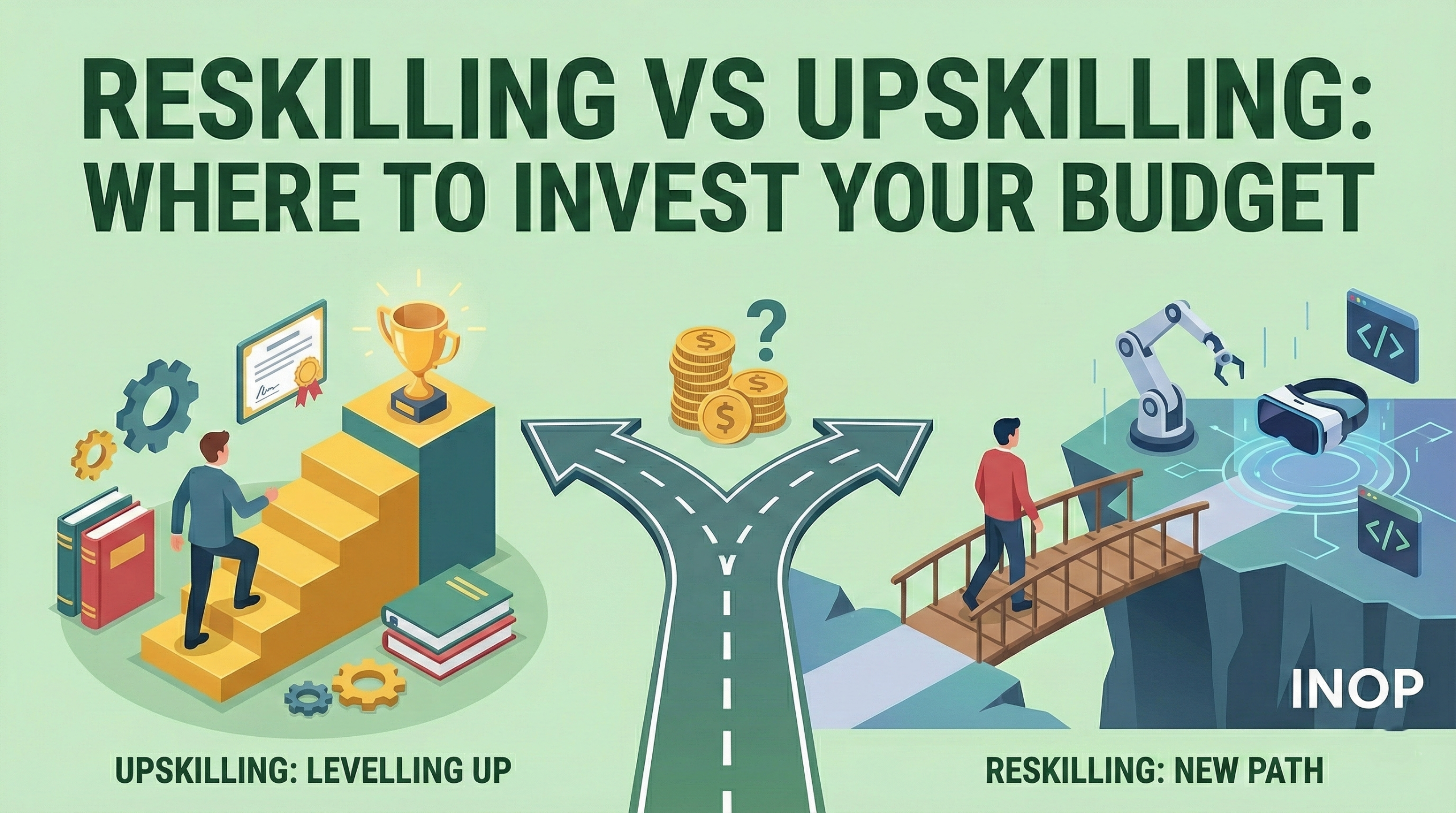
Upskilling means teaching employees new competencies that enhance their performance in their current role. Think of it as linear growth, you’re making someone better at what they already do. When a graphic designer learns to use AI-powered image generation tools like Midjourney or DALL-E, that’s upskilling. They’re still a designer, but now they’re faster, more creative, and more aligned with modern workflows.
Reskilling, on the other hand, involves teaching employees entirely new skill sets to transition them into a different role altogether. This is lateral growth, moving someone from one career path to another within your organization. When a customer support agent learns Python, SQL, and test automation frameworks to become a QA tester, that’s reskilling. The job function changes completely, even though the employee stays with the company.
This distinction matters because the investment strategy, timeline, and expected outcomes differ dramatically between the two approaches.
The Comparison Matrix
To visualize how reskilling vs upskilling differ across key business dimensions, consider this comparison:
| Dimension | Upskilling | Reskilling |
|---|---|---|
| Focus | Enhance current role | Transition to new role |
| Time Horizon | Short-term (weeks to months) | Long-term (months to years) |
| Investment Level | Low to medium ($500–$3,000 per employee) | High ($5,000–$25,000 per employee) |
| Primary Goal | Efficiency and retention | Mobility and transformation |
| Risk Level | Low (builds on existing foundation) | Medium (employee may fail or leave) |
| Business Impact | Incremental productivity gains | Strategic workforce restructuring |
Understanding these differences helps you match your training investment to your actual business need rather than following trends or guesswork.
When to Invest in Upskilling: The Efficiency Play
Upskilling becomes your strategic priority when technology changes how a job is done, but not whether the job needs to be done at all. This is the efficiency play, you’re optimizing existing roles to meet evolving demands.
The Business Case for Upskilling
Retention advantage: According to LinkedIn’s Workplace Learning Report, 94% of employees say they would stay at a company longer if it invested in their learning and development. Upskilling sends a clear message: “We see a future for you here.” In an era where replacing an employee can cost 50-200% of their annual salary, retention alone justifies upskilling investments.
Speed to value: It’s significantly faster to upgrade a current employee than to recruit, hire, and onboard a new one. Consider a marketing team that needs to adopt marketing automation platforms. Training your existing content marketers on HubSpot or Marketo might take 4-6 weeks. Hiring someone with that expertise could take 3-6 months, plus another 2-3 months for them to understand your brand, audience, and processes.
Morale and engagement: Employees who participate in upskilling programs report higher job satisfaction scores. They feel valued, challenged, and equipped to handle their responsibilities with confidence. This translates directly into better customer experiences and team dynamics.
Where Your Upskilling Budget Should Go
Effective upskilling investments typically include:
- Micro-learning platforms like LinkedIn Learning, Udemy for Business, or Coursera for Teams ($300-$600 per employee annually)
- Industry conferences and workshops that expose employees to latest trends and best practices ($1,000-$3,000 per event)
- Professional certifications relevant to current roles, such as PMP for project managers or Google Analytics certification for marketers ($500-$2,000)
- Internal mentorship programs that pair junior employees with senior practitioners (time investment with minimal financial cost)
- Lunch-and-learn sessions where team members share new knowledge with peers (builds culture while spreading skills)
The key is consistency. Upskilling works best as an ongoing commitment, not a one-time event. Allocate quarterly or annual budgets that employees can use to pursue relevant learning opportunities.
When to Invest in Reskilling: The Survival Play
Reskilling becomes critical when entire departments face obsolescence or when massive talent shortages exist in areas crucial to your future. This is the survival play, you’re fundamentally transforming your workforce to match market realities.
The Trigger Points for Reskilling
Watch for these signals:
- Technology displacement: Automation is eliminating tasks faster than new ones are being created in certain departments
- Strategic pivots: Your company is shifting business models (e.g., from product to SaaS)
- Critical talent gaps: You can’t hire enough people in emerging fields like cybersecurity, data science, or AI engineering
- Department consolidation: Mergers or restructuring are making certain roles redundant
The Business Case: Build vs. Buy
Here’s where numbers tell a compelling story. Let’s say you need to fill five senior software developer positions:
The “Buy” Approach (External Hiring):
- Recruitment fees (typically 20-30% of salary): $30,000 per hire
- Time to hire: 4-6 months per position
- Onboarding and lost productivity: 3-6 months before full contribution
- Cultural fit risk: 20-30% of external hires fail in the first 18 months
- Total cost for 5 hires: $150,000+ in fees alone, plus 1-2 years to full productivity
The “Build” Approach (Internal Reskilling):
- Intensive coding bootcamp or training program: $10,000-$15,000 per employee
- Dedicated learning time: 3-6 months at reduced productivity
- Mentorship and support: Internal resource allocation
- Cultural fit risk: Near zero (they already know your systems and values)
- Total cost for 5 reskilled employees: $50,000-$75,000, plus 6-9 months to full productivity
The math alone makes reskilling attractive. But the real advantage is institutional knowledge. A customer support specialist who reskills into a product manager already understands your customers’ pain points, your product’s quirks, and your company’s values. An external hire starts from zero on all of those dimensions.
Where Your Reskilling Budget Should Go
Serious reskilling requires substantial, focused investments:
- Intensive bootcamps (coding, data analytics, UX design) that run 12-24 weeks full-time ($8,000-$20,000 per participant)
- Degree or certificate programs through university partnerships, often subsidized ($5,000-$25,000)
- Internal academies where you build curriculum specific to your needs (high upfront cost, lower per-employee cost at scale)
- Dedicated learning time: Google’s famous “20% time” policy, where employees can spend one day a week on new projects (salary cost, but builds innovation culture)
- Apprenticeship programs that pair reskilling candidates with experienced practitioners (time investment from senior staff)
Reskilling works best when you commit fully. Half-measures, like expecting someone to learn data science via 30-minute weekly webinars, rarely succeed. The learning needs to be immersive, supported, and treated as a legitimate job responsibility during the transition period.
The Budget Split: A Framework for Skills Investment
Decision paralysis is common when leaders face the reskilling vs upskilling question. Here’s a practical starting framework: the 70/20/10 rule for skills development budgets.
The 70/20/10 Model
70% Upskilling: Invest the majority of your budget in keeping your core workforce sharp and efficient. This is your operational excellence fund. It keeps the engine running smoothly and prevents skill decay in critical functions. For a $100,000 annual learning budget, that means $70,000 goes toward improving performance in current roles.
20% Reskilling: Dedicate this portion to preparing for tomorrow’s roles and filling critical gaps through internal mobility. This is your transformation fund. It creates career pathways, reduces dependency on external hiring, and builds organizational resilience. In our example, that’s $20,000 for strategic career transitions.
10% Exploration: Reserve a small slice for experimental learning, emerging skills that don’t have clear ROI yet but might become critical. Think blockchain, quantum computing, or advanced AI applications. This is your innovation insurance. It ensures you’re not caught completely flat-footed by the next technological shift. That’s $10,000 for forward-looking bets.
Adjusting the Ratio by Industry
This 70/20/10 split is a starting point, not a rigid rule. Your industry context should shape your final allocation:
Technology and software companies might shift to 60/30/10 because disruption happens faster and reskilling needs are more urgent. If you’re in AI, cloud computing, or cybersecurity, transformation is constant.
Manufacturing and logistics might prefer 75/15/10 because core operational roles remain stable longer, though automation is steadily increasing reskilling needs in these sectors too.
Healthcare organizations often need 65/25/10 as medical technology evolves rapidly (upskilling for new equipment and procedures) while roles like telehealth coordinators require reskilling from other clinical or administrative positions.
Financial services increasingly lean toward 60/30/10 as fintech disruption, regulatory technology, and data analytics transform traditional banking and insurance roles.
The key is to review and adjust your ratio annually based on workforce planning data, industry trends, and your strategic direction.
Measuring ROI: Proving Your Investment Works
Training budgets face constant scrutiny. To protect and grow your skills investment, you need clear metrics that demonstrate value.
Upskilling Metrics That Matter
Productivity increases: Track output metrics before and after training. If your sales team completes CRM training, measure deal cycle time, lead conversion rates, and revenue per rep over the following 6-12 months. Typical upskilling programs show 15-25% productivity gains in targeted areas.
Error reduction: For technical roles, monitor defect rates, customer complaints, or rework percentages. When your QA team upskills on new testing methodologies, bug escape rates to production should decline. A 20-30% reduction in errors often pays for the training within months.
Employee engagement scores: Use pulse surveys before and after upskilling initiatives. Employees who feel they’re growing typically show 10-15 point improvements in engagement metrics. Gallup research links highly engaged teams to 21% greater profitability.
Certification achievement rates: If your upskilling includes formal credentials, track completion and pass rates. High completion signals both program quality and employee commitment.
Time to competency: Measure how quickly employees reach proficiency with new tools or methods. Effective upskilling should shorten learning curves by 30-40% compared to informal, on-the-job learning.
Reskilling Metrics That Matter
Internal mobility rate: Track what percentage of open positions are filled by reskilled internal candidates versus external hires. Best-in-class organizations achieve 30-40% internal fill rates for critical roles. A Skills-Based Organization (one that prioritizes capabilities over job titles) can reach even higher mobility rates.
Reduction in recruitment costs: Calculate your cost per hire (recruitment fees, job board expenses, interviewer time, etc.) and multiply by the number of positions filled internally through reskilling. If you reskill 10 people instead of hiring externally, and external hiring costs $25,000 per position, you’ve saved $250,000 minus your reskilling investment.
Retention of reskilled employees: Monitor how many employees who complete reskilling programs remain with the company 1, 2, and 3 years later. Retention rates above 85% indicate successful programs.
Time to productivity in new role: Measure how long reskilled employees take to reach full effectiveness compared to external hires in similar roles. Internal candidates typically reach productivity 30-50% faster because they already understand your company.
Succession pipeline strength: Track how reskilling fills gaps in your succession plans for leadership or specialized technical roles. Strong programs should identify and develop 2-3 internal candidates for every critical position.
Building Your Custom Strategy
By now, the answer to “reskilling vs upskilling” should be clear: you need both, calibrated to your specific situation. Here’s how to build your custom approach:
Step 1: Conduct a skills gap analysis. Map current capabilities against future needs based on your 3-5 year business strategy. Identify roles at risk of obsolescence and emerging roles you’ll need to fill.
Step 2: Assess your hiring market. If critical skills are scarce or expensive to recruit externally, reskilling becomes more attractive. If they’re abundant, you might buy some while building others.
Step 3: Survey employee appetite. Not everyone wants to reskill into a different role. Identify which employees are interested in career transitions and which prefer to deepen their current expertise.
Step 4: Calculate your baseline budget. Total your current learning and development spend, recruitment costs, and productivity losses from unfilled positions. This is your starting investment pool.
Step 5: Apply and adjust the 70/20/10 framework based on your industry, competitive pressures, and workforce demographics.
Step 6: Establish metrics and review cycles. Set quarterly check-ins to assess program effectiveness and annual reviews to adjust budget allocations.
Step 7: Communicate the strategy. Employees need to understand that both upskilling and reskilling opportunities exist, how to access them, and what the company expects in return.
Preparing for What’s Next
The workforce landscape will continue to shift rapidly. Artificial intelligence, automation, climate technology, and biotechnology are creating roles that didn’t exist five years ago while making others obsolete. Your organization’s ability to adapt, to upskill efficiently and reskill strategically, will determine whether you lead your industry or struggle to keep up.
The most successful companies won’t be those that simply choose upskilling or reskilling. They’ll be the ones that master both, creating learning cultures where growth is continuous and career paths are dynamic. They’ll treat their employees’ skills as living assets that require constant investment and renewal, not static credentials that depreciate over time.
When you invest wisely in the right mix of upskilling and reskilling, you’re not just filling today’s positions or preparing for tomorrow’s roles. You’re building an adaptable, resilient organization that can weather whatever changes the next decade brings.
Frequently Asked Questions
How long does it typically take to reskill an employee into a completely new role?
The timeline varies significantly based on the complexity of the new role and the employee’s starting point. For lateral moves with some skill overlap (like marketing coordinator to UX writer), expect 3-6 months. For more dramatic transitions (like customer service to data analyst), plan for 6-12 months of intensive learning followed by 3-6 months of on-the-job application. Technical reskilling into software development or data science typically requires 12-18 months for someone with no prior coding experience to reach professional competency.
What if an employee completes reskilling training but then leaves the company?
This is a common concern, but data shows reskilled employees typically have higher retention rates than the general workforce. To protect your investment, consider implementing retention agreements where employees commit to staying 12-24 months after completing expensive reskilling programs, or they repay a portion of the training costs. More importantly, create career pathways that give reskilled employees compelling reasons to stay, challenging work, competitive compensation, and continued growth opportunities.
Can small businesses with limited budgets afford reskilling programs?
Absolutely. Small companies actually have advantages in reskilling: closer relationships with employees, more flexibility in role design, and less bureaucracy. Focus on micro-reskilling, teaching adjacent skills that expand someone’s role incrementally rather than completely transforming it. Leverage free or low-cost resources like YouTube tutorials, free coding platforms, and industry associations. Consider partnering with local community colleges or technical schools that offer subsidized training. Even $2,000-$5,000 per employee can fund meaningful skill transitions when combined with mentorship from your existing team.
How do you choose which employees to reskill versus hiring new talent?
Prioritize employees who demonstrate strong learning agility, cultural fit, and commitment to your organization. Look for people who have successfully learned new things in the past, who ask good questions, and who show genuine interest in the destination role. Also consider business knowledge, someone who already understands your customers, products, and processes brings value that no external hire can match immediately. Run pilot programs or assessments before committing to full reskilling investments. Not every willing employee will succeed in a dramatic career transition, so test aptitude early.
Should upskilling and reskilling programs be mandatory or voluntary?
Most successful programs are voluntary but strongly encouraged. Making them mandatory can create resentment and result in low-quality learning outcomes. Instead, create clear incentives: tie learning to promotion opportunities, recognize completions publicly, and demonstrate that leaders also participate in ongoing development. For critical business needs, you might require specific upskilling (like cybersecurity training for all employees handling customer data), but frame it as a professional expectation rather than punishment. For reskilling, voluntary participation is essential since career transitions require genuine motivation to succeed.
How often should we reassess our upskilling vs reskilling budget allocation?
Conduct a full strategic review annually, aligned with your business planning cycle and workforce forecasting. However, monitor leading indicators quarterly: hiring difficulties, employee turnover in key roles, technology adoption rates, and competitive moves in your industry. If you spot major shifts, like a new competitor using AI to disrupt your market or a sudden exodus of talent in a critical department, be prepared to reallocate mid-year. The 70/20/10 framework should evolve as your business does, not remain static for years.
Take Action on Your Skills Strategy
The debate between reskilling vs upskilling is over. The winners will be organizations that stop choosing and start orchestrating, strategically blending both approaches to build workforces that are simultaneously efficient today and ready for tomorrow. Upskilling keeps your engine running smoothly; reskilling ensures you’re building the right engine for the road ahead.
Your next step is clear: assess where your organization stands today. Not sure which roles are at risk or where your most critical skill gaps exist? Start with a comprehensive skills gap analysis that maps your current capabilities against your future business strategy. Once you understand your landscape, you can allocate your budget with confidence rather than guesswork.
The companies that thrive over the next decade won’t be those with the biggest training budgets. They’ll be the ones that invest those budgets wisely, creating cultures where learning is continuous, career paths are flexible, and every employee has opportunities to grow. That future starts with the decisions you make about your skills investment today.