Choosing between skills intelligence platforms comes down to one question: will the tool tell you which capabilities your strategy needs next, or only which skills your people listed last year? This comparison reviews the top skills intelligence platforms in 2026, from enterprise suites to specialist data providers, and shows where each one fits.
If you need the fundamentals first, start with our guide to skills intelligence, which explains how external demand signals are mapped to an organisation’s own skills taxonomy. This article assumes you know the concept and are building a shortlist.
The pressure behind that shortlist is real. Skills change faster than job architectures do, and a skills profile that was accurate at the last review cycle can be out of date before the next budget round. The platforms below differ mainly in three things: where their skills data comes from, how current it is, and whether it connects to the decisions leaders make about building, buying, redeploying or automating capability.
How we compared skills intelligence platforms
Each platform was assessed on the criteria enterprise buyers raise most often in evaluations:
- Data source: inferred from internal systems, self-reported by employees, assessed, or drawn from external labour market data.
- Taxonomy fit: whether the platform imposes its own taxonomy or maps signals to yours.
- Freshness: how often skills demand data is refreshed.
- Decision linkage: whether insight connects to workforce planning, cost and AI impact, or stops at a dashboard.
- Integration: API, data feeds and fit with existing HCM and learning systems.
No single platform wins on every criterion. The right choice depends on whether your main problem is employee development, internal mobility, or strategy execution.
Top skills intelligence platforms compared
| Platform | Best for | Primary skills data | Links to strategy and cost |
|---|---|---|---|
| INOP | Strategy execution and AI readiness | External demand signals mapped to your taxonomy | Yes, through the BBRA decision model |
| Workday Skills Cloud | Workday HCM customers | Inferred from HCM records | Partial, inside the Workday suite |
| Eightfold AI | Large talent programmes | Inferred from a broad talent dataset | Partial |
| Gloat | Internal talent marketplaces | Employee profiles and opportunities | Limited |
| Degreed | Learning-led upskilling | Learning activity and assessments | Limited |
| Lightcast | Labour market data | Job postings and profiles | No, data only |
| Beamery | Talent lifecycle planning | Inferred profiles | Partial |
| Fuel50 | Career pathing | Employee-validated profiles | Limited |
| Skillsoft | Content-led skill building | Learning and benchmarks | Limited |
| 365Talents | Mid-market skills management | Inferred and declared skills | Limited |
INOP
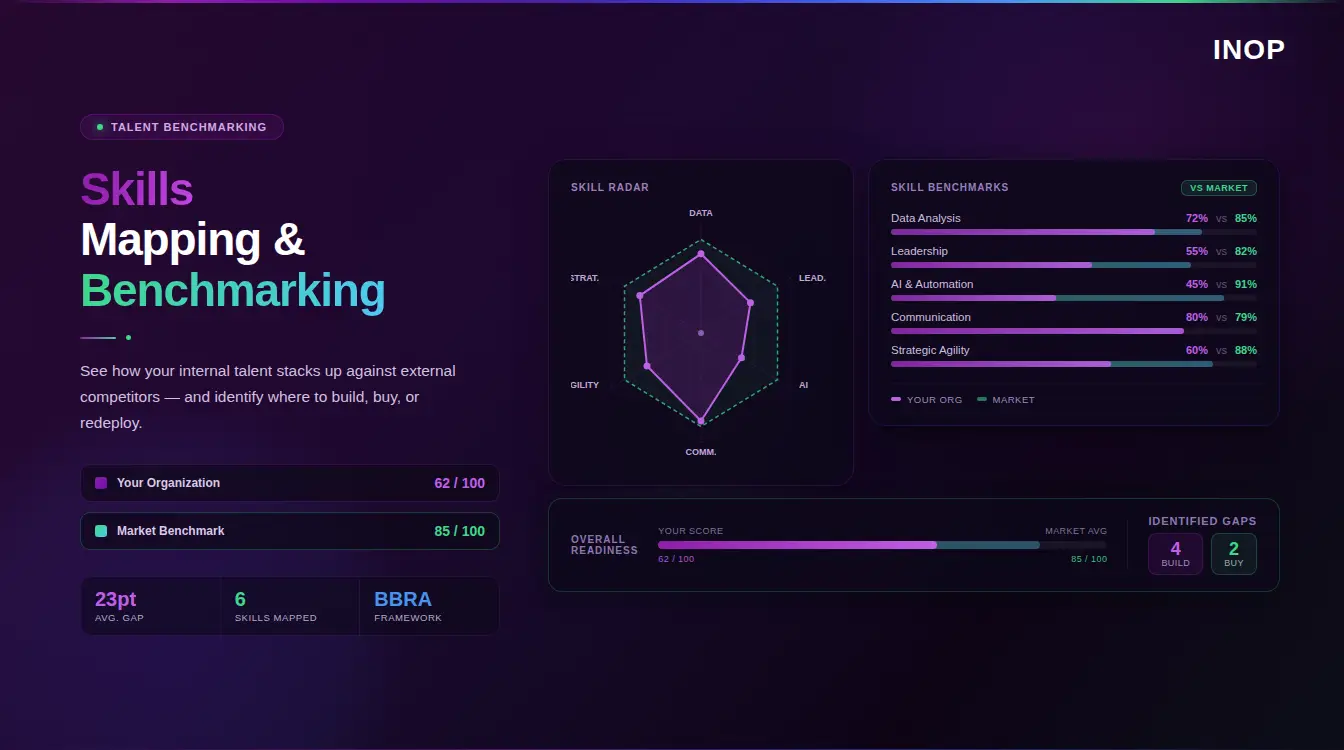
INOP tracks external skills demand and maps it to your own skills taxonomy, so you see how the market is moving against the framework you already use. Every skill carries one of four signal states: Emerging, In Demand, Stable or Declining. Signals can be cut by proficiency level, role family, seniority, industry and location, and each skill includes modelling of AI and automation impact, from partial automation to full replacement.
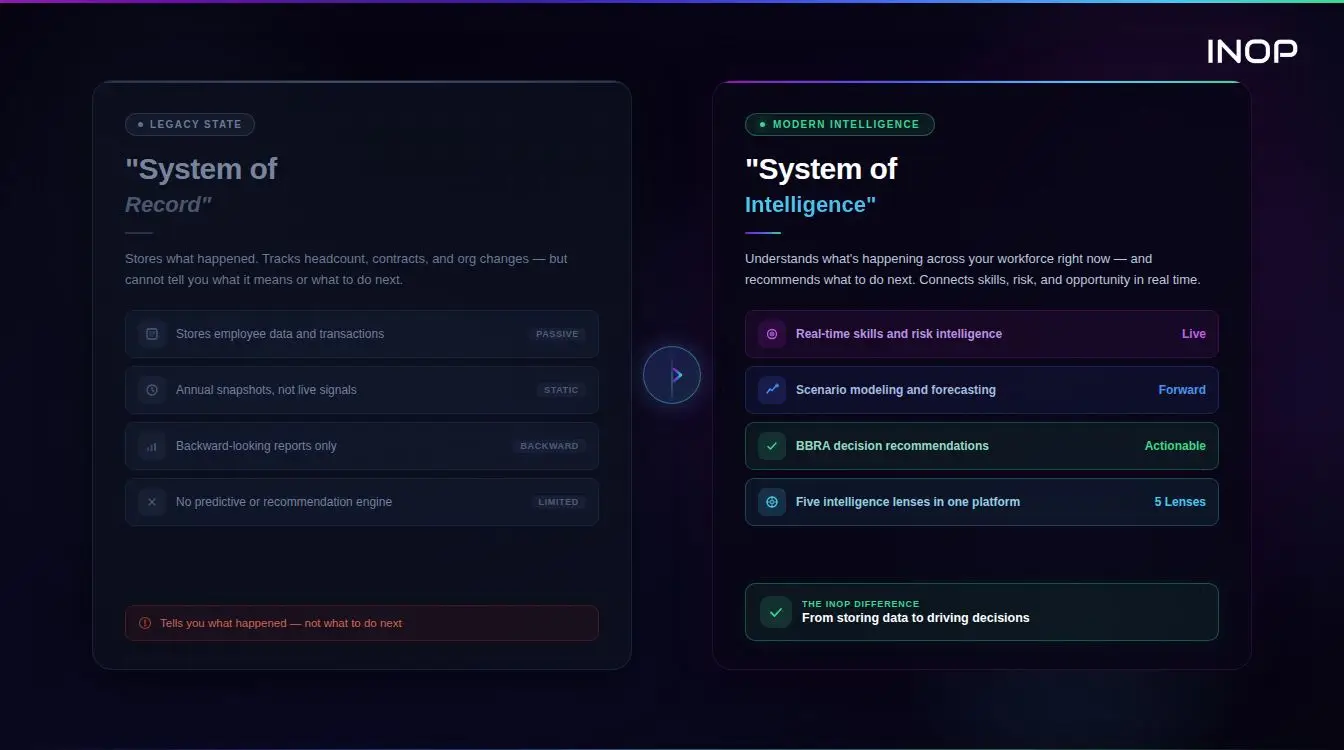
What sets INOP apart is what happens after the signal. INOP never assesses skills or AI in isolation. It reads every capability gap through five intelligence lenses (Strategy, Finance, People, Market, and AI and Automation) and feeds the result into the BBRA framework, INOP’s proprietary decision architecture for choosing whether to Build, Buy, Redeploy or Automate each capability. BBRA models all four pathways with their financial trade-offs at 30 days, 180 days, one year and three years.
Data arrives through an API feed, secure CSV, Excel or JSON downloads, or a custom integration, on a monthly, quarterly or daily cadence. The skills module works on its own or inside INOP’s strategic workforce planning platform.
Best for: CHROs, CFOs and operating partners who need to know whether the organisation has the capabilities to execute its strategy today and stay AI-ready.
See which skills your strategy depends on. Book a 30-minute walkthrough of INOP’s skills intelligence, mapped to your own taxonomy. Book a demo
Workday Skills Cloud
Skills Cloud is the skills layer inside Workday HCM. It uses machine learning to connect skills across worker profiles, learning and job data, and Workday reports that 30% of the Fortune 500 use Workday Skills Cloud. Its strength is native integration for organisations already running Workday. Its limit is that insight stays within the Workday data model, so external demand context depends on what you add.
Eightfold AI
Eightfold positions its product as an agentic talent intelligence platform built on deep learning across a large talent dataset. Its talent management modules cover internal mobility, upskilling and redeployment, and its resource management module matches skills to project work. It suits large enterprises running broad talent programmes. Buyers focused on strategy execution should check how far its outputs connect to cost and workforce planning scenarios.
Gloat
Gloat is best known for its internal talent marketplace, which matches employees to roles, gigs and stretch assignments and surfaces hidden talent that never shows up in HR records. It adds career recommendations and talent supply insight. It is a strong choice when mobility is the main goal. Read our guide to building an internal talent marketplace before you buy one.
Degreed
Degreed started as a learning experience platform and builds skill profiles from learning activity, assessments and manager input. It is a natural fit when upskilling is the main lever. It is less suited to questions about which skills to build, buy or automate.
Lightcast
Lightcast is a labour market data provider rather than a decision platform. Its Open Skills taxonomy covers more than 34,000 skills drawn from job postings and profiles. Many vendors license Lightcast data. Buy it directly when you have an analytics team ready to build the decision layer yourself.
Specialist and mid-market options
Beamery covers the talent lifecycle with inferred skills profiles and workforce planning features. It suits organisations that want one vendor across several talent processes, and it tends to need a larger implementation effort.
Fuel50 focuses on career pathing and internal mobility, with employees validating their own skill profiles. That improves engagement and data accuracy, but coverage depends on participation.
Skillsoft pairs a large learning library with skill benchmarks. It works well where the main need is content to close known gaps, rather than intelligence about which gaps matter most.
365Talents offers skills-based talent management with inferred and declared skills. It is popular with European mid-market organisations that want a lighter deployment than the enterprise suites.
Choosing the right platform for your organisation
Most buying mistakes happen because teams compare feature lists instead of starting from the decision they need to make. Work backwards from that decision.
How to shortlist skills intelligence platforms
- Name the decision. Is the goal better learning recommendations, more internal moves, or a capability plan the board can fund? Each points to a different category in the table above.
- Check where the skills data comes from. Inferred data scales fast but can be wrong; self-reported data is current only while employees keep it updated; assessed data is accurate but slow to collect. Pair any of them with a skills assessment tool where accuracy matters.
- Test taxonomy fit. Ask vendors to map their output to your existing framework during the pilot. A platform that forces you to replace a framework your organisation spent years building adds change cost before it adds insight. Our guide to skills mapping covers how to keep a taxonomy usable.
- Ask how current the external view is. The World Economic Forum expects nearly 40% of the skills required on the job to change by 2030. A taxonomy refreshed once a year cannot keep pace with that.
- Follow the insight to a decision. Ask each vendor to show what a leader does with a gap once it is found: the cost of closing it, the options, and the timeline.
If you are also comparing planning tools, our review of skills-based workforce planning platforms covers that adjacent category.
Why external demand signals matter more than internal profiles
Internal skills profiles describe what your people can do. They do not tell you whether those skills are gaining or losing value in the market, or which emerging skills competitors are already building. Deloitte’s research on creating value with skills found that organisations take very different paths to a skills-based model, which is why one-size-fits-all taxonomies rarely survive contact with a real strategy.
External signals close that blind spot. When a skill moves from Stable to Declining, or from Emerging to In Demand, you can act before the gap shows up in delivery. Pricing those shifts matters too: skills that move into high demand change pay expectations, and a compensation analytics platform shows what a skill premium will cost before you commit to building or buying it.
How INOP turns skills intelligence into workforce decisions
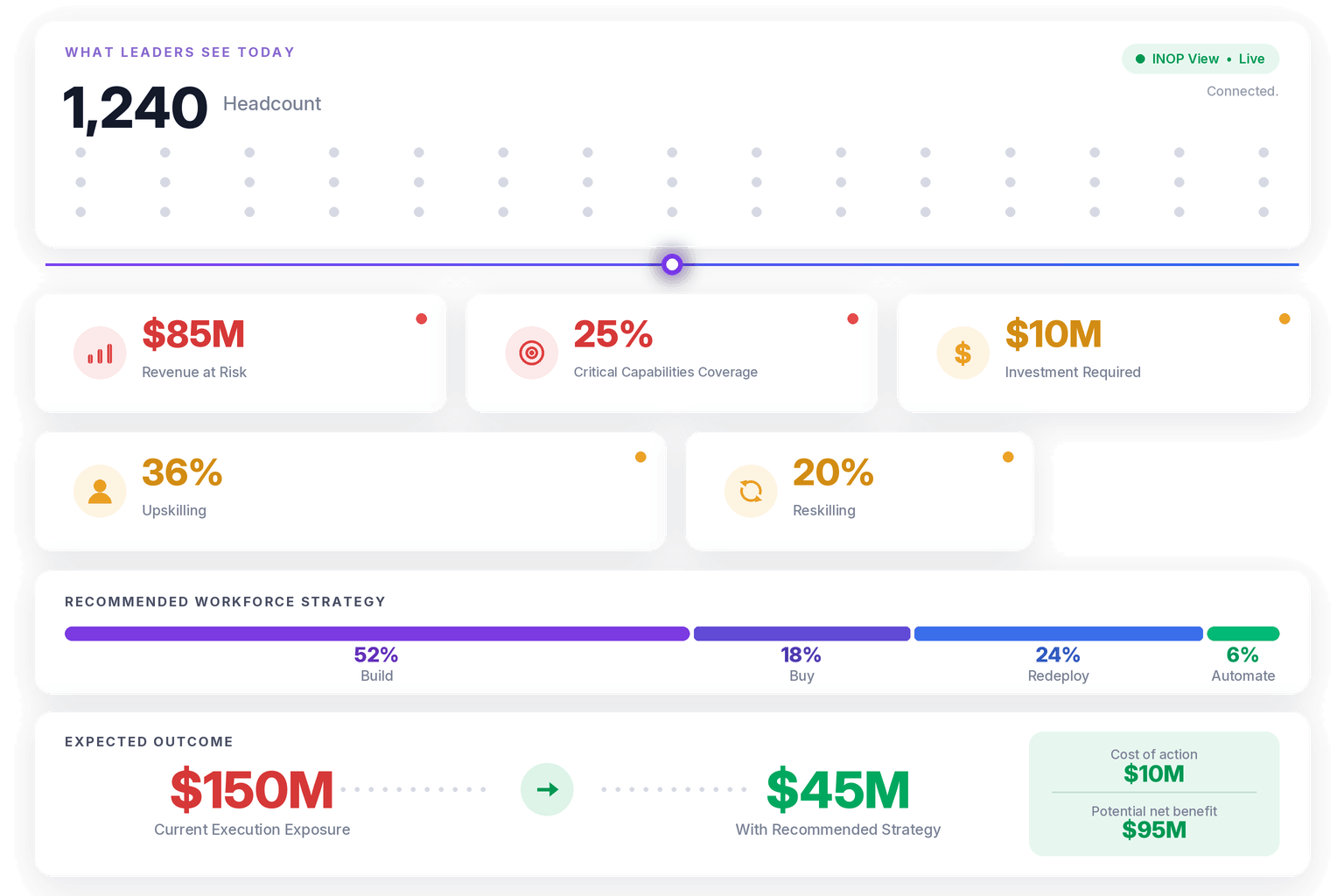
INOP starts with the strategy, not the skills list. The question it answers is whether the organisation has the capabilities to execute its strategy today and to stay AI-ready as AI changes the work.
Each capability gap is read through the five intelligence lenses:
- Strategy: which capabilities the plan depends on, and when.
- Finance: what the gap costs if nothing changes.
- People: who holds adjacent skills and could move.
- Market: how demand and supply for the skill are shifting outside the organisation.
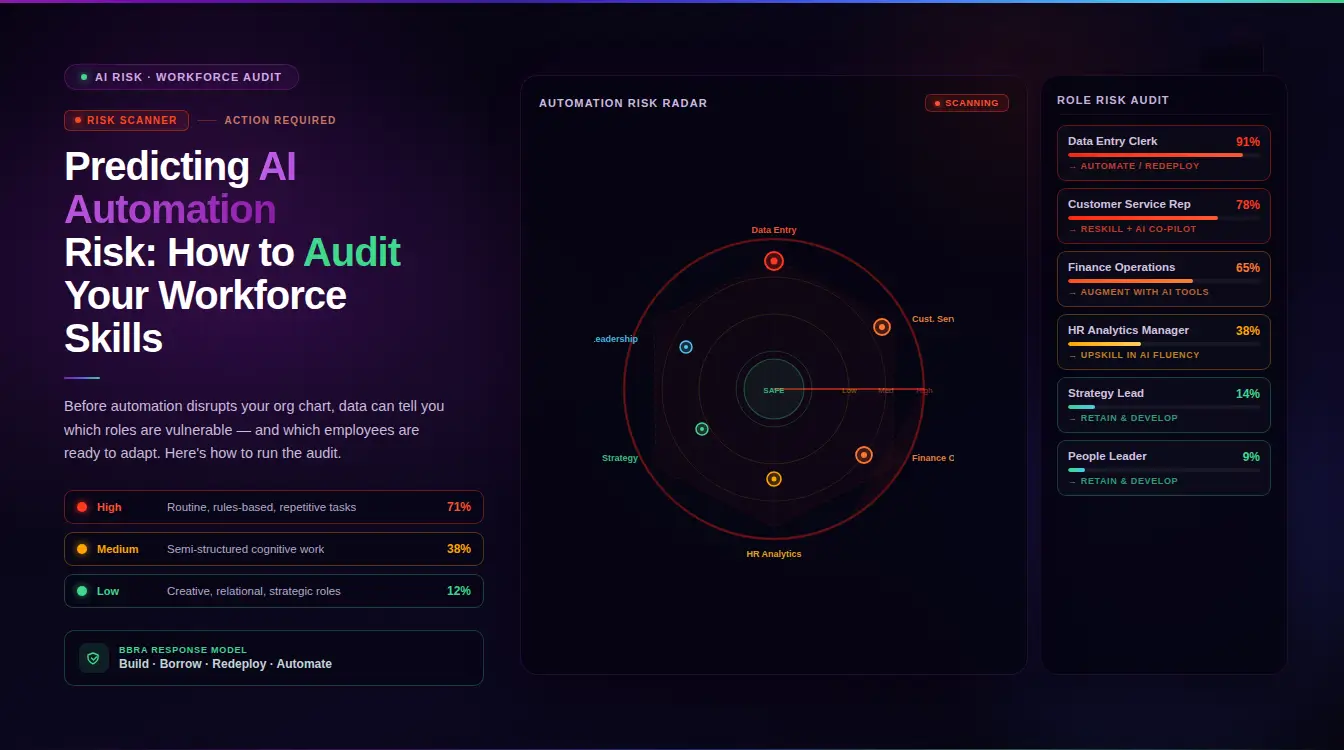
- AI and Automation: which tasks AI will change, and how far.
The BBRA framework then compares the four responses side by side. Build means reskilling people who already hold adjacent skills. Buy means bringing the capability in from outside. Redeploy means moving existing talent to where the strategy needs it. Automate means redesigning the work where AI can take part or all of it. INOP models each pathway’s cost and impact at 30 days, 180 days, one year and three years, so leaders compare options on the same financial footing.
For worked examples, see our business case for an AI skills engine.
Skills intelligence for private equity operating partners
Operating partners need a fast, defensible read on whether a portfolio company’s workforce can deliver the value creation plan. Skills intelligence answers three questions during diligence and the first hundred days: which capabilities the plan depends on, where the gaps sit, and what closing them will cost.
INOP runs the same five-lens analysis at portfolio level, at organisation, business unit, department or country granularity, and works with role and task data where employee-level data is not available. Results feed straight into the BBRA cost comparison, so a capability gap becomes a line in the value creation plan rather than a risk discovered after close. Learn more about INOP for private equity firms.
Frequently asked questions
What is the difference between a skills intelligence platform and a learning management system?
A learning management system delivers and tracks training. A skills intelligence platform tells you which skills matter, where the gaps are, and how demand for each skill is moving. The two work best together: skills intelligence decides what to build, and the learning system delivers it.
How long does it take to implement skills intelligence software?
Timelines depend on data access and taxonomy work. Platforms that map signals to your existing taxonomy through an API or data feed can deliver first insight within weeks. Suites that require a new taxonomy and profile collection across the workforce usually take several months.
How do skills intelligence platforms handle emerging and declining skills?
The stronger platforms track external demand continuously and flag movement. INOP classes every skill as Emerging, In Demand, Stable or Declining, and adds AI and automation impact, so leaders see which skills are rising before job descriptions catch up.
Do employees need to keep their skill profiles updated?
It depends on the data model. Platforms built on self-reported profiles need steady participation. Platforms that infer skills, or that work from role and task data with external demand signals, need far less effort from employees.
How do private equity firms use skills intelligence platforms?
Operating partners use them in diligence and value creation planning to test whether a portfolio company has the capabilities its plan assumes. INOP adds the cost of each gap and compares building, buying, redeploying or automating the capability, so findings translate directly into the value creation plan.
Final thoughts
The best skills intelligence platforms do more than list skills. They show how the market is moving against your own framework and connect each gap to a decision with a cost attached. If employee development or internal mobility is your main goal, a learning or marketplace platform may be enough. If you need to know whether your workforce can deliver the strategy, start with a platform built for that question.
Turn skills data into a capability plan your board can fund. See how INOP connects skills, cost and AI impact in one model. Book a demo