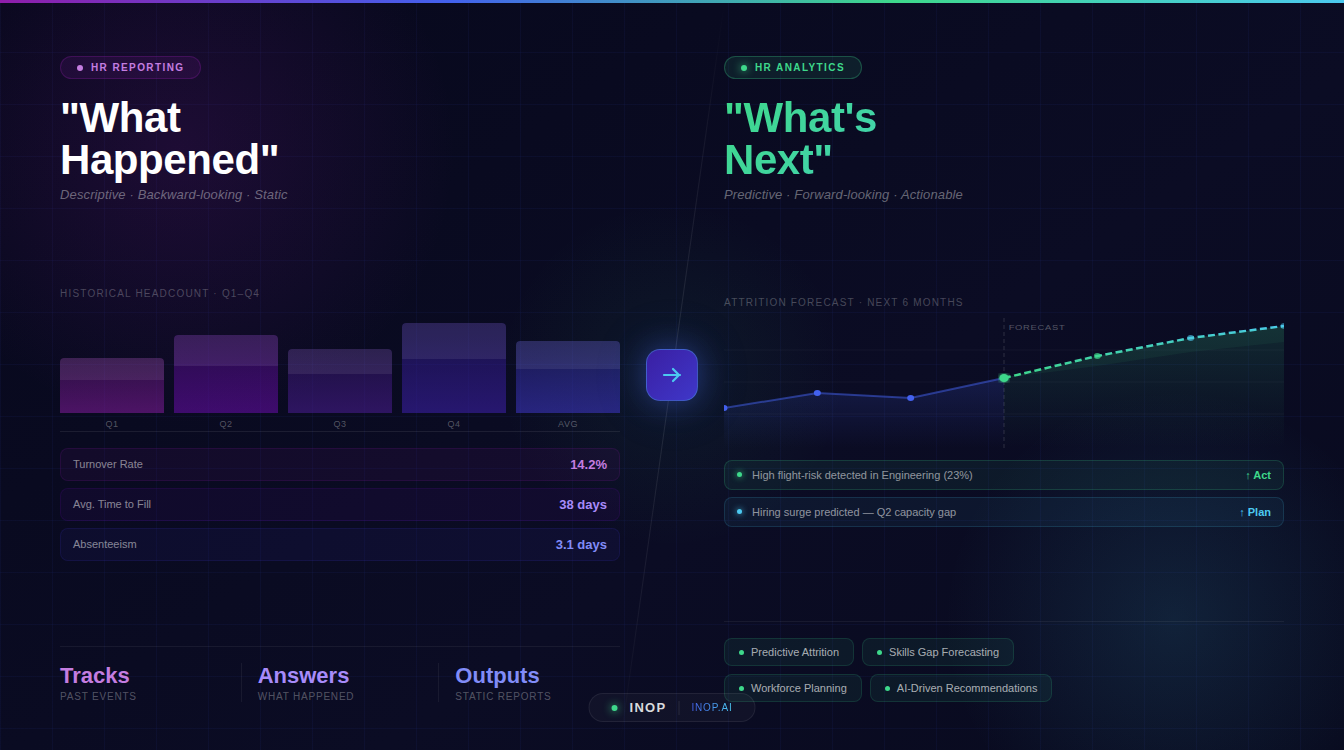
Most HR teams can tell you how many people left last quarter. Far fewer can tell you who is likely to leave next quarter, and why. That gap, the space between looking backward and planning forward, is exactly where Workforce Decision Intelligence becomes a genuine business advantage. And closing it is no longer optional for organizations that want to stay competitive.
This guide covers the full picture: the real difference between HR reporting and HR analytics, why that distinction matters more than ever, and a clear path toward building the kind of evidence-based decision-making capability that separates workforce leaders from workforce followers. If you have been living primarily in dashboards and monthly summaries, what follows will show you what you are missing and exactly how to move forward.
Understanding the Foundation: What Is HR Reporting?
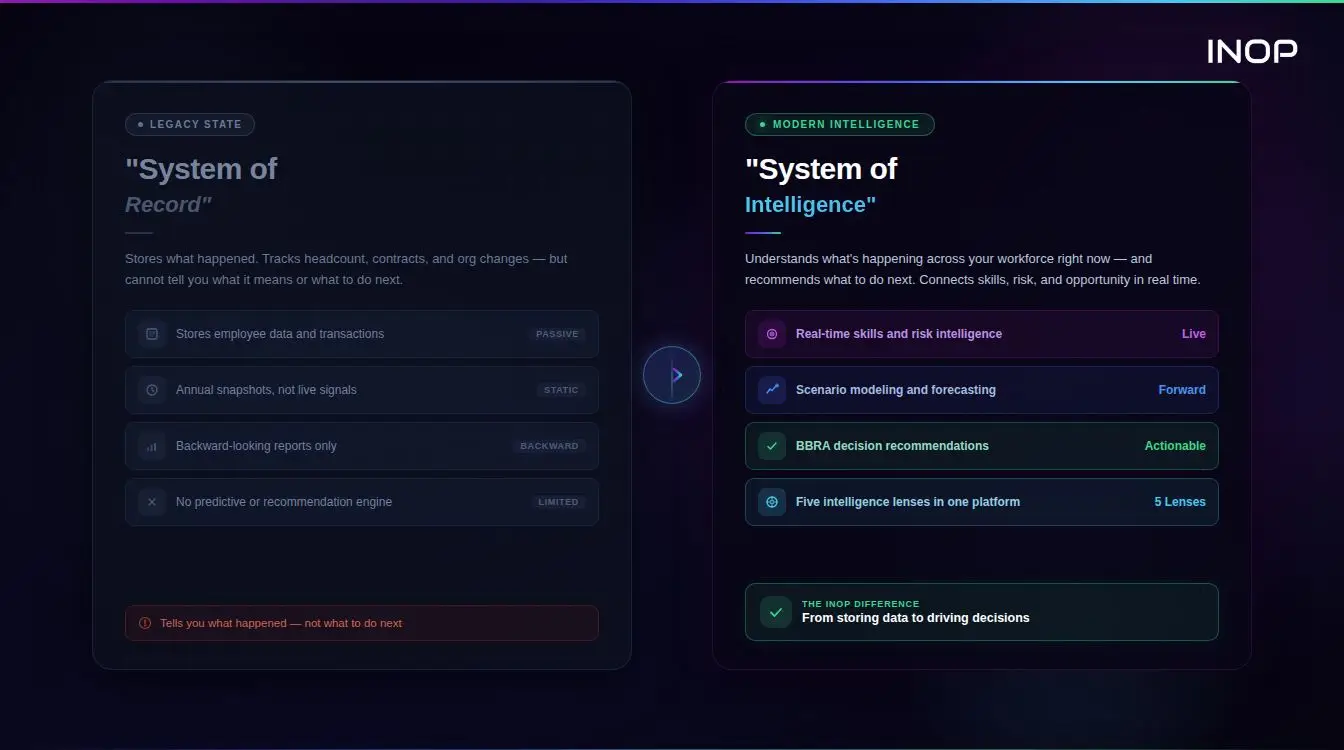
HR reporting is the practice of collecting, organizing, and presenting workforce data in a structured format, usually as dashboards, spreadsheets, or scheduled summaries. It answers a very specific kind of question: what happened?
Think of a monthly headcount report, a quarterly turnover summary, or an annual diversity snapshot. These documents are built on historical data. They are accurate, necessary, and a solid operational foundation for any HR function. Without good reporting, you are flying blind. With only reporting, however, you are permanently stuck looking in the rearview mirror while your workforce challenges accelerate ahead of you.
What HR Reports Typically Include
Standard HR reports cover areas such as headcount and workforce composition (full-time, part-time, contractors), turnover and retention rates over defined periods, absenteeism and attendance trends, compensation summaries by department or role, time-to-hire and cost-per-hire metrics, and training completion rates.
These metrics are meaningful. A CFO who sees that voluntary turnover jumped from 12% to 19% in a single year needs that number. But the same CFO also needs to know whether the trend will continue, which teams carry the most risk, and what is driving the exits in the first place. That is the ceiling of reporting, and it is why so many workforce decisions still rely more on instinct than evidence.
The Limitations of a Pure Reporting Mindset
HR reporting, by design, is reactive. It describes events after they have already occurred, which creates a fundamental lag between what is happening in your workforce and what your data reflects. A spike in turnover within a core engineering team, for example, could take 6 to 12 months of reporting cycles to surface clearly, while the underlying disengagement may have been building far longer.
There is also a depth problem. Traditional reports answer what, but not why or what next. A 22% attrition rate in the sales department is a data point. Understanding that it is concentrated among reps with fewer than 18 months of tenure, in regions where managers have low coaching effectiveness scores, and correlates with compensation misalignment against local market benchmarks, that is actionable intelligence. The distance between those two things is the distance between reporting and analytics.
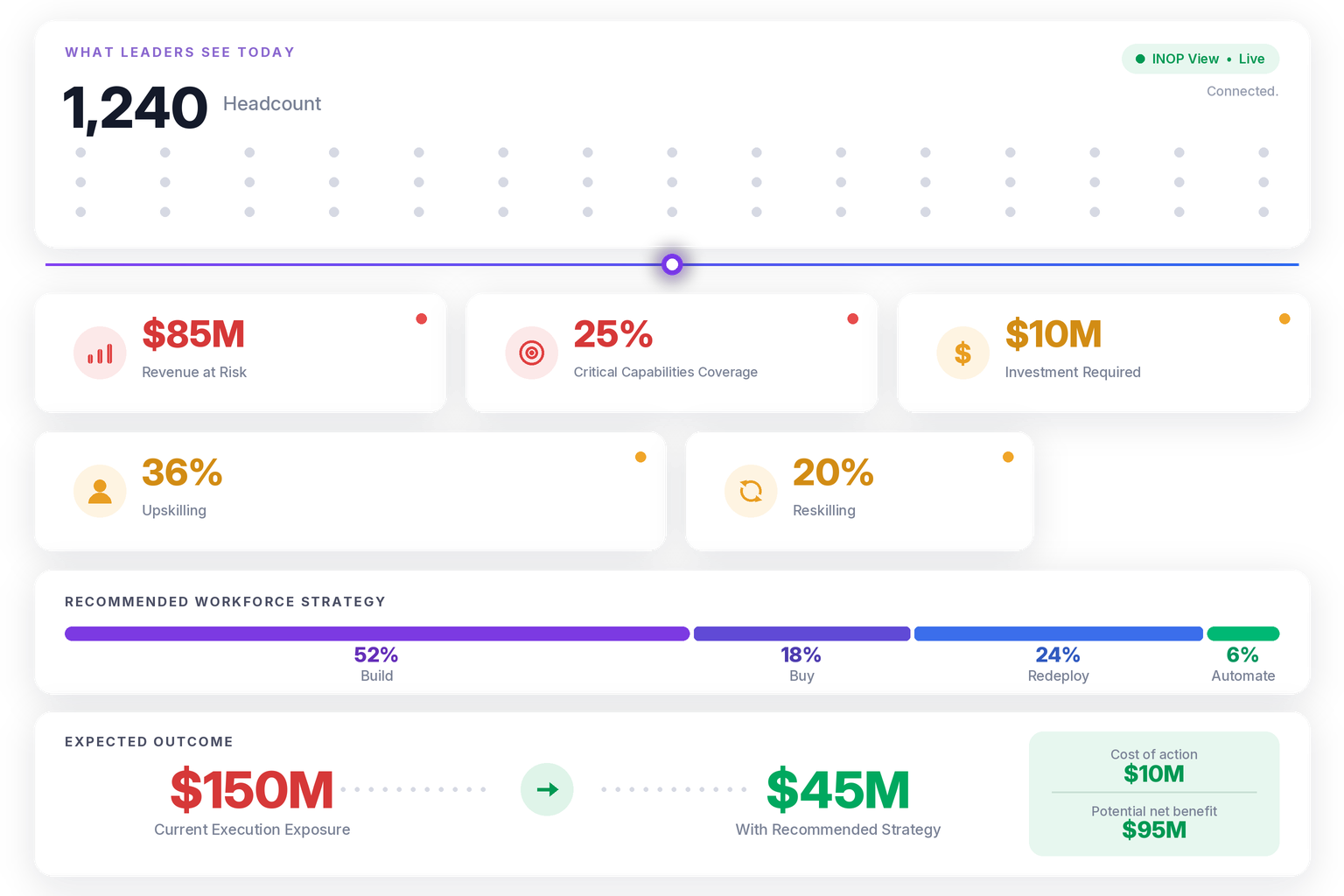
The practical output of making this shift from reporting to analytics is a well-designed HR Analytics Dashboard that surfaces forward-looking workforce intelligence in a format executives can act on. Most organizations have one or several dashboards today; very few have one that is genuinely used at the C-suite level, because most are built around HR activity metrics rather than the cost, risk, and execution questions that matter to the board.
Stepping Up: What Is HR Analytics?
HR analytics, sometimes called people analytics or workforce analytics, goes significantly further than any reporting function can. It uses statistical methods, data modeling, and machine learning to uncover patterns, test hypotheses, and generate predictions about workforce behavior.
Where reporting asks “what happened,” analytics asks “why did it happen,” “what will happen next,” and “what should we do about it?” This is the operating logic of Workforce Decision Intelligence: transforming raw workforce data into decisions grounded in evidence rather than assumption.
The Four Levels of HR Analytics Maturity
Most frameworks describe HR analytics maturity across four stages. Understanding where your organization currently sits is the first honest step toward improvement.
Descriptive Analytics is the starting point and aligns closely with traditional HR reporting. It describes historical events and current states. Most organizations live here. Example: “We hired 142 people last year and lost 38 of them within the first 12 months.”
Diagnostic Analytics moves into root cause exploration. Instead of simply noting that early attrition is high, diagnostic analytics investigates why. Are onboarding programs inconsistent across regions? Are role expectations misrepresented during hiring? Is there a manager effectiveness gap? Example: “Early attrition is 40% higher in teams managed by leaders who joined the company in the last two years without structured onboarding support.”
Predictive Analytics is where the capability becomes genuinely powerful. It uses historical patterns to forecast future outcomes: which employees are most likely to resign in the next 90 days, which candidates are most likely to succeed in a given role, which teams face productivity risk due to clustered retirements. Example: “Our model identifies 17 employees in the product division with elevated flight risk scores based on compensation lag, tenure, and recent engagement signals.”
The distinction between the predictive and prescriptive tiers is where most HR functions lose value. Predictive HR analytics tells you that 17 employees carry elevated flight risk — but without a structured decision framework to act on that forecast, the insight evaporates in a meeting. Understanding how predictive outputs connect to prescribed interventions, and what separates the two analytically, is the gap this article addresses at the tier four level.
Prescriptive Analytics is the most advanced level. It does not just predict; it recommends specific actions. Example: “For the 17 flagged employees, the model recommends targeted retention conversations, personalized development plans, and a compensation review within the next 30 days.”
Most organizations operate somewhere between levels one and two. The ones pulling ahead are those making a deliberate, resourced commitment to reach levels three and four.
HR Reporting vs. HR Analytics: A Direct Comparison
| Dimension | HR Reporting | HR Analytics |
|---|---|---|
| Primary question | What happened? | Why? What will happen? What should we do? |
| Data orientation | Historical | Historical + predictive |
| Output format | Dashboards, tables, summaries | Models, scores, recommendations |
| Main users | HR administrators, compliance teams | HR business partners, executives, strategy leaders |
| Decision type | Operational and administrative | Strategic and proactive |
| Speed to insight | Periodic (monthly, quarterly) | Continuous or near real-time |
| Skill requirements | Data literacy, BI tools | Statistics, data science, business acumen |
| Business impact | Compliance and accountability | Competitive advantage and cost reduction |
The two are not in competition. They are complementary layers of the same data function. You cannot do meaningful analytics without clean, consistent reporting underneath it. But you also cannot drive real workforce strategy on reporting alone.
Why Workforce Decision Intelligence Is the Next Frontier
Workforce Decision Intelligence describes an integrated capability: the combination of data infrastructure, analytical methods, and business context that allows HR leaders to make decisions with the same rigor and speed that finance and supply chain teams have applied for years.
The scale of the problem this capability addresses is not abstract. Gallup’s State of the Global Workplace research, covering 183,000 business units across 90 countries, found that low employee engagement cost the global economy $8.9 trillion in lost productivity in a single year, equivalent to 9% of global GDP. At the organizational level, the same research shows that highly engaged business units experience 51% lower turnover than their disengaged counterparts. That is not a marginal improvement. It is a structural difference in how much talent an organization retains and how much it quietly bleeds.
The replacement cost data reinforces the urgency. According to Gallup, replacing a single employee costs between 50% and 200% of their annual salary, rising to the top of that range for technical and leadership roles. For an organization of 500 people with a 15% annual turnover rate, even a conservative estimate puts the annual cost of attrition well into the millions. That is the financial case for moving from reactive HR reporting to proactive Workforce Decision Intelligence.
What makes this modern capability distinct from earlier generations of HR analytics is the breadth of data integration. It is no longer limited to HRIS records. It draws on engagement survey results, performance data, learning management outputs, compensation benchmarks, skills assessments, and external labor market signals. The result is a multidimensional picture of the workforce that makes genuinely predictive and prescriptive decision-making possible, and that is exactly the gap INOP is built to close.
The INOP Intelligence Framework: Five Lenses on Workforce Data
At INOP.AI, we approach Workforce Decision Intelligence through five integrated lenses, each addressing a distinct dimension of workforce insight:
Workforce composition and supply examines who you have today, how that profile is shifting, and where structural gaps are forming beneath the surface.
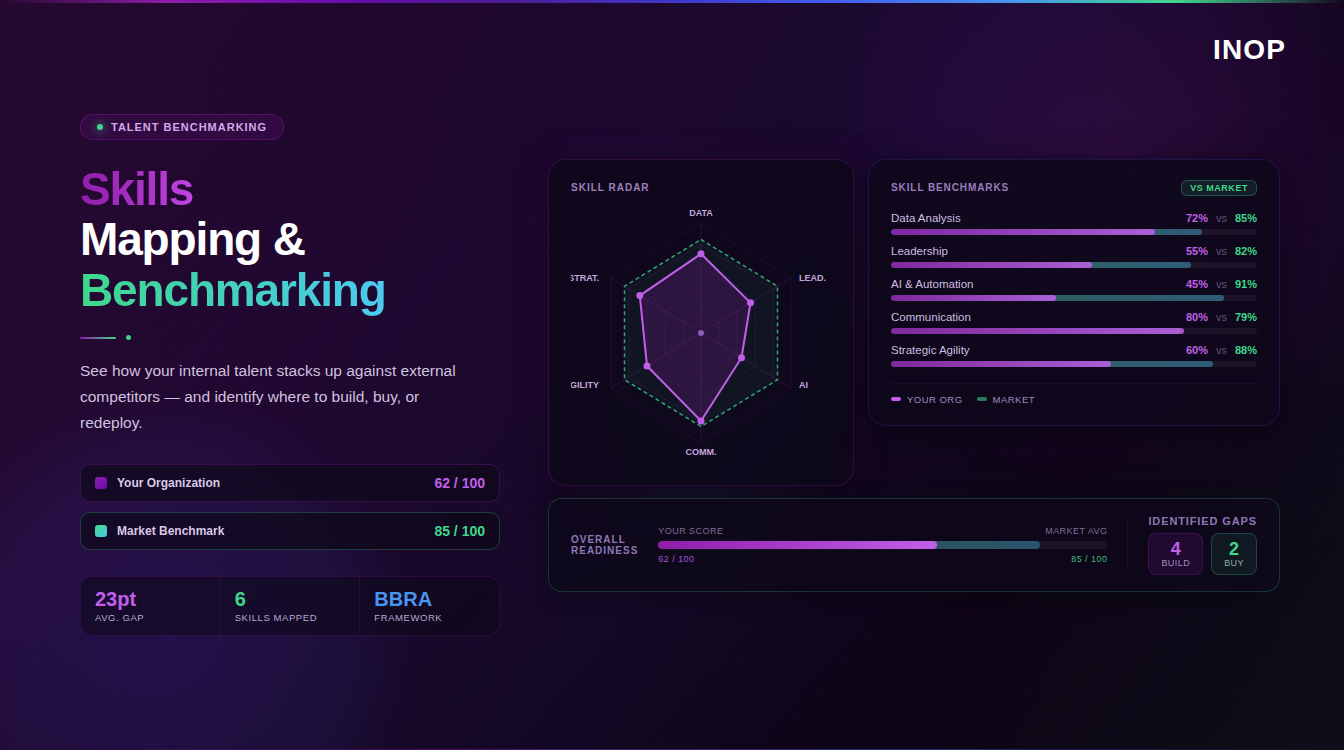
Skills and capability mapping moves beyond job titles to understand the actual competency landscape of your workforce, where depth exists and where critical gaps are emerging.
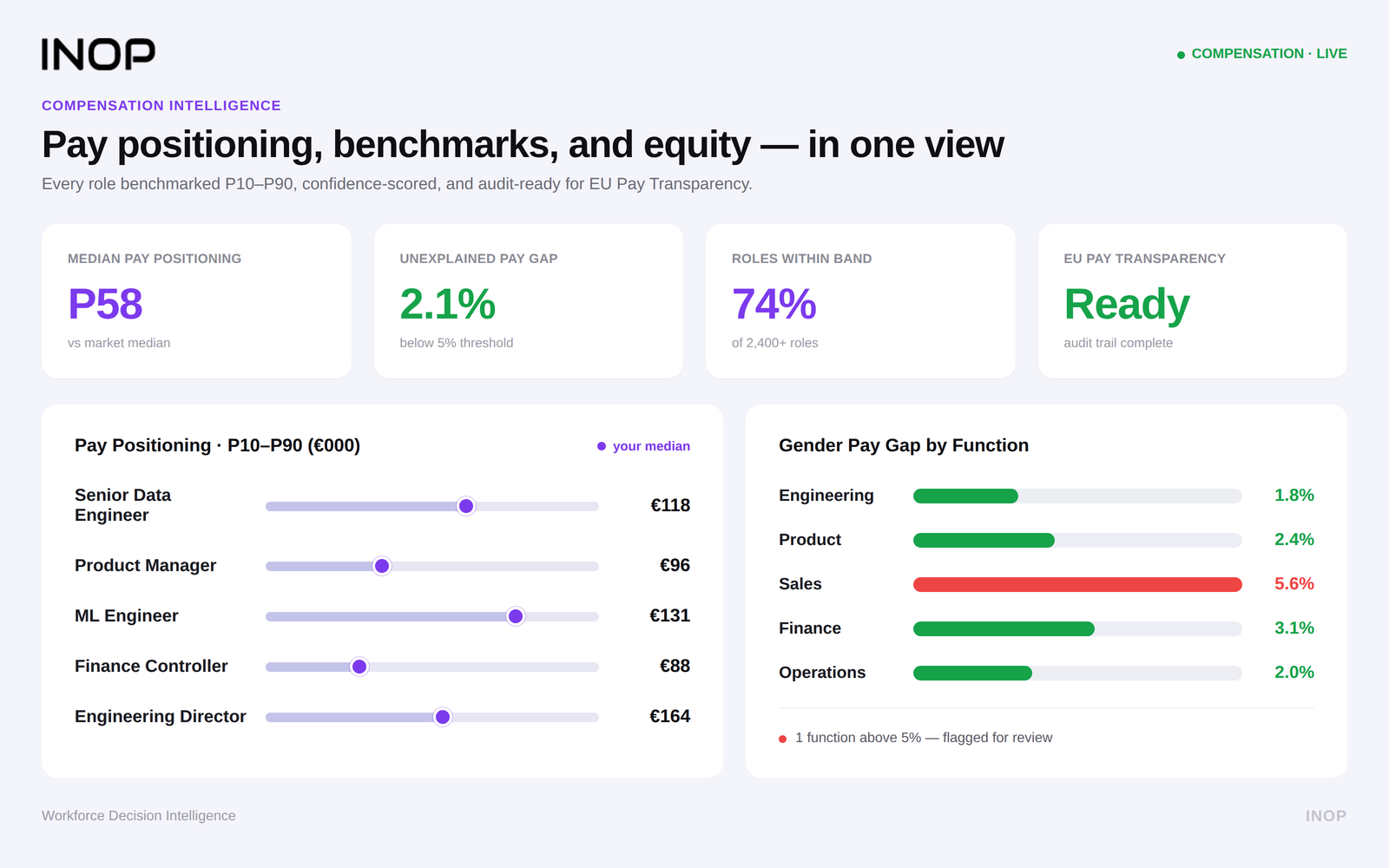
Compensation intelligence positions your pay practices against real-time market benchmarks, identifying equity risks, retention vulnerabilities, and competitive misalignment before they become attrition events.
Talent screening and pipeline quality evaluates whether the talent entering your organization through hiring and development pipelines actually matches the profile your strategy demands over a three to five year horizon.
Strategic workforce planning synthesizes all four lenses into a forward-looking plan that aligns your workforce supply with business demand, not just for next quarter, but across a multi-year strategic horizon.
This five-lens approach is what gives INOP clients something most workforce analytics tools cannot offer: not just insight into what the data says, but a structured, repeatable methodology for acting on it. When you see all five lenses working together, the difference between reactive HR reporting and genuine Workforce Decision Intelligence becomes impossible to ignore.
Where Workforce Decision Intelligence Creates Real Value
Talent Acquisition and Strategic Workforce Planning
When you can model which roles are hardest to fill, which sourcing channels produce the longest-tenured hires, and which skill gaps are likely to emerge within 18 months, you build a hiring strategy that anticipates demand rather than reacting to it.
This is the foundation of strategic workforce planning, the process of aligning your talent pipeline with your business strategy across a multi-year horizon. Without Workforce Decision Intelligence feeding that planning process, you are essentially writing a financial forecast without access to the balance sheet.
Retention and Engagement
The cost of replacing a mid-level employee typically ranges from 50% to 200% of their annual salary, depending on role complexity and seniority. If predictive attrition models can flag at-risk employees weeks or months before they resign and trigger targeted retention interventions, the financial return is direct and measurable. Multiply that across a workforce of several hundred or several thousand people and the case for investment becomes straightforward.
Diversity, Equity, and Inclusion
Moving beyond raw representation numbers requires analytical depth. Understanding promotion rates by demographic group, pay equity at a granular level, or pipeline leakage at specific career stages demands the kind of multi-variable analysis that traditional reporting cannot deliver. Analytics does not just surface these issues; it helps organizations prioritize where intervention will have the greatest impact.
Leadership and Manager Effectiveness
One of the most underutilized applications of people analytics is understanding manager impact. Analytics can surface correlations between specific manager behaviors, team engagement levels, and downstream performance outcomes, giving organizations an evidence base for leadership development investment rather than relying on broad, generic programs that rarely move the needle.
Building the Bridge: How to Move from Reporting to Analytics
Start with Data Quality and Governance
No amount of sophisticated modeling compensates for dirty data. Before investing in analytics tools or specialist talent, ensure your foundational HR data is clean, consistent, and governed. This means standardized job architecture, disciplined data entry practices, integrated systems across HRIS, ATS, LMS, and performance platforms, and clear accountability for data quality ownership.
Define Business Questions Before Touching the Data
The most common mistake HR teams make when launching analytics initiatives is starting with the data rather than the decision. Begin with the problem you need to solve. Are you losing too many people in year two? Are certain roles taking 40% longer to fill than your benchmarks? Is your leadership bench deep enough to absorb planned retirements over the next three years? Sharp questions shape the analytical approach and ensure outputs connect to real decisions.
Build Analytical Capability Incrementally
You do not need a full data science team to start generating value. Many modern HR platforms include built-in analytics modules that support descriptive and basic diagnostic work. Adding a dedicated people analytics specialist, or partnering with a provider who brings both methodology and technology, is a logical and often faster next step. The key is to grow capability in line with organizational readiness to act on what the data reveals.
Build a Culture of Evidence-Based Decision Making
Even the most sophisticated analytics capability stalls if leaders continue making talent decisions on intuition alone. Building organizational habits around data, reviewing workforce intelligence in leadership meetings, expecting evidence when proposals are made, and recognizing decisions that were validated by analysis, creates the environment that analytics needs to produce lasting impact.
Common Misconceptions About HR Analytics
“Analytics is only for large organizations.” The principles of Workforce Decision Intelligence scale. A 200-person company can run meaningful attrition pattern analysis just as effectively as a 20,000-person enterprise. The tools and complexity differ; the value logic does not.
“HR analytics replaces human judgment.” Analytics sharpens judgment; it does not replace it. A predictive model surfaces risk. A skilled HR leader and business partner decide what to do about it. The human remains in the loop, now with substantially better information.
“We need perfect data before we can start.” This belief has paralyzed more analytics programs than any technology or budget constraint. You can extract genuine insight from imperfect data as long as you are transparent about its limitations. Progress over perfection is the only viable path.
“Reporting and analytics are the same thing with different tools.” They are fundamentally different in purpose, methodology, and the quality of decisions they enable. Treating them as interchangeable is precisely how organizations end up with impressive-looking dashboards that still only describe the past.
The Role of Technology in Workforce Decision Intelligence
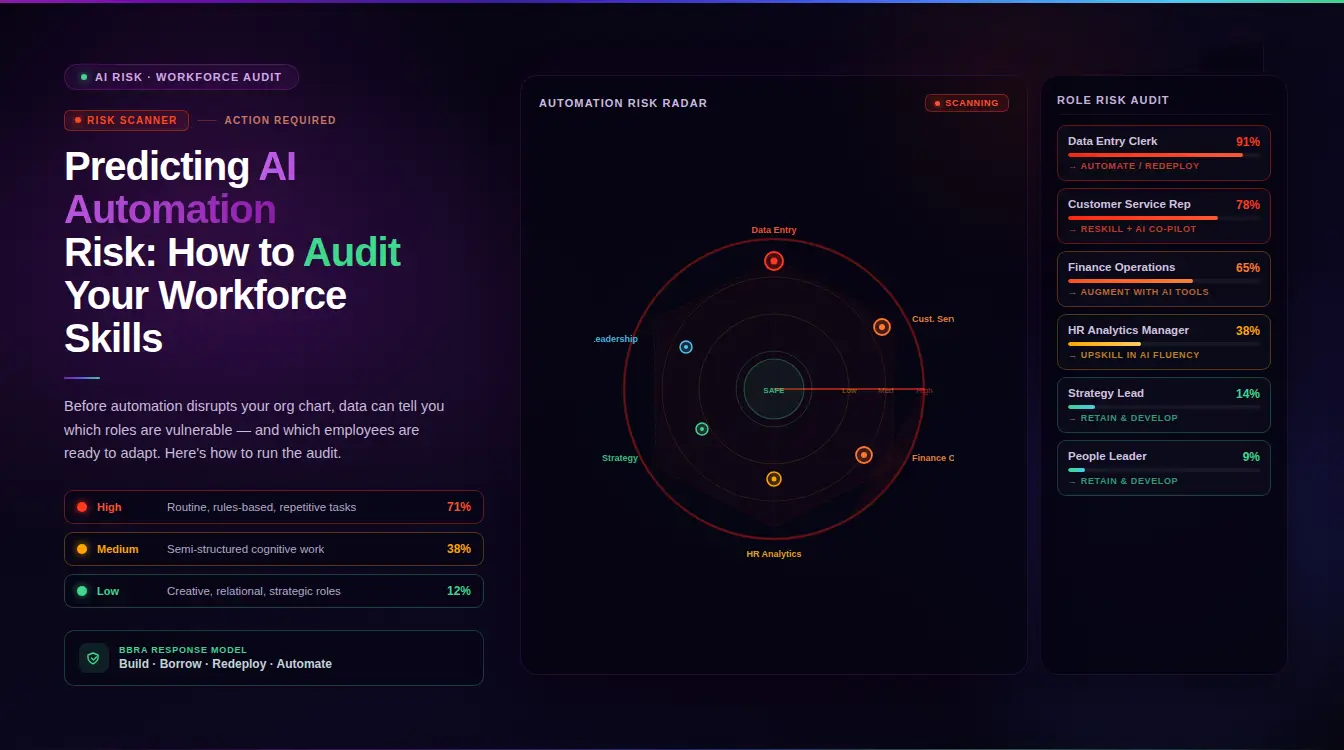
Modern HR technology has dramatically lowered the barrier to analytics capability. Enterprise platforms provide built-in analytical functionality that was previously accessible only to organizations with dedicated data science teams. AI and machine learning are accelerating this shift further, with natural language processing enabling analysis of qualitative engagement data at scale, and predictive algorithms scoring attrition risk across entire workforces in near real-time.
Generative AI is also beginning to close the last-mile problem: translating complex model outputs into clear, actionable narratives that non-technical business leaders can understand and act on immediately.
Technology, however, remains an enabler rather than a strategy. The organizations that achieve durable results with Workforce Decision Intelligence are those that pair the right tools with rigorous methodology, quality data foundations, and leadership that is genuinely committed to evidence-based workforce management. That combination is precisely what the INOP framework is designed to deliver.
Conclusion
The gap between HR reporting and HR analytics is not a technology gap. It is a strategic one. Reporting tells you where your workforce has been. Analytics tells you where it is heading. Workforce Decision Intelligence combines both into a capability that lets you act before problems become crises and plan before talent gaps become emergencies.
If your HR function is still primarily built around periodic summaries and backward-looking metrics, the path forward is clearer than ever: anchor your data foundations, define the decisions that matter most to your business, and build analytical capability that grows with your organizational ambition.
For organizations ready to make that shift with a structured methodology behind them, the INOP.AI Workforce Decision Intelligence platform is built exactly for this purpose. Explore how our five-lens framework connects strategic workforce planning, compensation intelligence, and talent screening into a single, integrated capability.
Ready to see the gap between your current reporting and what genuine workforce intelligence could look like? book a demo with the INOP team to see the framework applied to your own workforce data.
Frequently Asked Questions
What is the main difference between HR reporting and HR analytics?
HR reporting describes historical workforce data such as headcount, turnover rates, and absenteeism figures. HR analytics examines the causes behind those numbers and uses data models to predict future outcomes and recommend actions. Reporting answers “what happened.” Analytics answers “why,” “what will happen,” and “what should we do.”
What does Workforce Decision Intelligence mean in practice?
Workforce Decision Intelligence is an organization’s integrated ability to collect workforce data, analyze it rigorously across multiple dimensions, and translate findings into confident, strategic decisions. It combines data infrastructure, analytical methodology, and business context to give HR and executive teams the same decision-making capability that finance and operations teams have relied on for years.
Do small and mid-sized companies benefit from HR analytics?
Absolutely. While enterprise organizations operate with more complex data environments, the principles of HR analytics apply at any scale. A company with 150 employees can apply attrition pattern analysis, engagement data, or hiring funnel metrics to make substantially better talent decisions than one relying on observation and instinct alone.
How does predictive analytics work in HR?
Predictive HR analytics uses historical workforce data combined with statistical models or machine learning algorithms to forecast future events. A model might analyze engagement scores, tenure, compensation relative to market rates, and manager effectiveness ratings to produce an attrition risk score for each employee, allowing HR teams to intervene proactively rather than after the resignation letter arrives.
What data sources feed into people analytics?
Modern people analytics draws from HRIS platforms, applicant tracking systems, performance management tools, learning management systems, engagement survey platforms, and external labor market benchmarks. The richest and most actionable insights emerge from integrating these sources rather than analyzing each one in isolation.
How long does it take to build a meaningful HR analytics capability?
Most organizations see meaningful results from descriptive and diagnostic analytics within 6 to 12 months of focused effort. Building to a mature predictive and prescriptive capability typically requires 2 to 3 years of sustained investment in data infrastructure, tools, methodology, and talent. Working with a structured framework, such as the INOP five-lens approach, significantly accelerates that timeline.
What is the connection between HR analytics and strategic workforce planning?
Strategic workforce planning uses analytical insight to align talent supply with future business demand. HR analytics provides the evidence base: which skills are growing or declining, which roles face structural hiring challenges, where succession gaps are forming, and how current trends will compound over a three to five year horizon. Without analytics, workforce planning is largely projection. With it, planning becomes a defensible strategic commitment.
Is there a risk of bias in HR analytics models?
Yes, and it deserves serious, ongoing attention. Predictive models trained on historical data can inadvertently encode and amplify existing biases in hiring, promotion, or performance evaluation. Responsible analytics practice requires regular model auditing for disparate impact, full transparency in how algorithms are constructed and applied, and human oversight in any consequential talent decision. Technology amplifies decisions; the quality and ethics of those decisions remain a human responsibility.
Book a Demo
Make confident workforce decisions that support strategy and value creation.