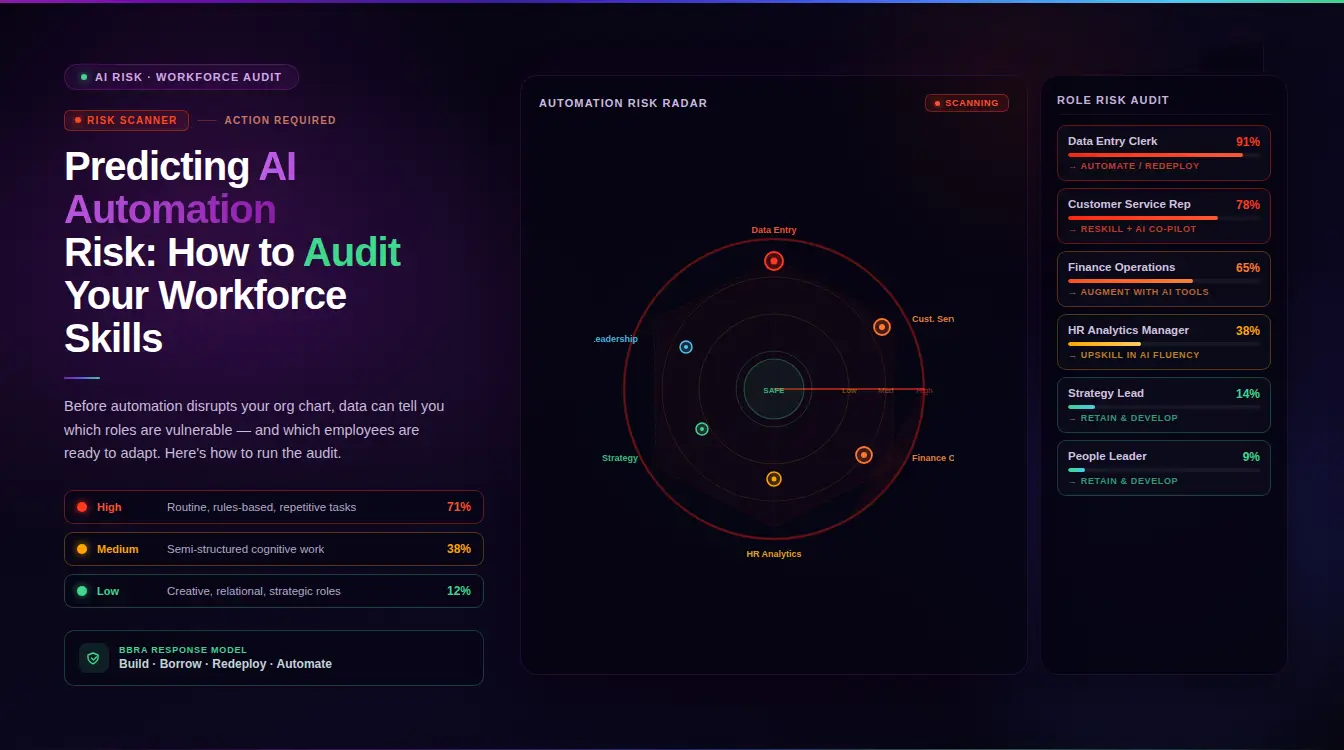
The question used to be theoretical. Which jobs will AI eventually replace? In 2026, it is operational. Which roles in your organization are already facing automation pressure, which capabilities are being partially displaced right now, and what does your workforce need to look like on the other side of that transition? CHROs who are still treating automation risk as a future scenario to monitor are operating at least one planning cycle behind the organizations using it as a live input to workforce decisions today.
The IMF estimates that almost 40% of global employment is exposed to AI capabilities, rising to approximately 60% in advanced economies. Goldman Sachs research puts the equivalent of 300 million full-time jobs globally within the reach of AI automation. The World Economic Forum’s Future of Jobs 2025 report found that 41% of employers plan workforce reductions in areas where AI can automate tasks within the next five years. These figures describe the scale of the shift. They do not tell you where your specific organization sits within it.
That specificity requires an automation risk audit: a systematic assessment of your workforce’s skill profile against the task and capability categories that current AI systems can credibly perform, augment, or are positioned to displace. This article explains how to conduct that audit, how to translate the findings into workforce strategy, and how to use the output to direct reskilling investment and scenario planning with financial precision.
Before running an automation risk audit, it helps to be precise about what the term actually measures. Automation risk meaning is not the probability that a job disappears. It is the exposure a specific task carries to being performed by AI or software instead of a person, and that distinction shapes every phase of the audit process that follows.
Why Automation Risk Is a Workforce Planning Problem, Not Just a Technology Problem
The framing of automation risk as a technology question leads organizations toward the wrong set of decisions. If the question is “what will AI be able to do in five years,” the answer belongs to technology forecasters. If the question is “what is the gap between our current workforce capability and what our strategy will require once automation reshapes our operational model,” that is a workforce planning question, and it belongs to the CHRO.
The distinction matters because the decisions that flow from it are different. Technology forecasting produces a watch list. Workforce planning produces a roadmap: which capabilities to build, which roles to redesign, which functions to restructure, and how to sequence those changes so that the organization does not find itself holding a workforce built for a set of tasks that automation has already absorbed.
The World Economic Forum projects 92 million roles displaced and 170 million new roles created between 2025 and 2030, a net positive at the macro level that is entirely unhelpful at the organizational level unless you know which roles resemble yours. The practical work is identifying where your workforce sits in that distribution, and building a plan to shift it toward the roles that are emerging.
The WEF also estimates that 50% of all employees will need reskilling by 2025 due to AI and automation adoption. For most organizations, that threshold has already arrived. The reskilling investment is not a preparation for a disruption that is coming. It is a response to one that is already reshaping the task composition of roles across functions.
Understanding Automation Risk at the Task Level
The first analytical step in any automation risk audit is moving from role-level exposure to task-level exposure. This distinction is one of the most important and most frequently mishandled aspects of automation risk assessment.
Roles are not automated. Tasks are. A financial analyst role is not replaced by AI. But a significant share of the tasks that a financial analyst currently spends time on, data extraction, report generation, variance analysis against prior periods, and basic narrative summarization, are already automatable at scale. McKinsey’s 2024 automation research found that up to 70% of financial data-processing tasks can be automated by current AI systems. The analyst role persists, but its task composition shifts. The human capability required to perform it well changes substantially.
Goldman Sachs research found that office and administrative support tasks carry the highest automation exposure at 46%, followed by legal functions at 44%, and architecture and engineering at 37%. These are not extinction events for those functions. They are task redistribution events, and organizations that treat them as such will manage the transition far more effectively than those waiting for a binary replacement moment that, for most roles, will never arrive cleanly.
INOP’s AI and Automation intelligence domain applies task-level analysis across 40,000+ roles using seven published research frameworks, including WEF Future of Jobs, Stanford HAI, O*NET/AIOE, McKinsey, ILO, and Eloundou et al., producing automation susceptibility scores for every role in the organization. Each role is assessed across six dimensions and classified as not impacted, partially impacted, or fully impacted across four time horizons: near-term at 180 days, medium at 12 months, structural at 2 years, and transformational at 3 or more years. FTE displacement estimates, cost impact modelling, and transition pathway recommendations are generated for each scenario. This is not a generic automation forecast. It is modelled against your actual workforce composition.
The three impact categories that define the audit output are:
Full displacement tasks. Tasks that current AI systems can perform end-to-end without meaningful human involvement. Data entry, structured document processing, routine query handling, and rules-based compliance checking fall into this category for most organizations today. Human capability invested here is capital being directed at its fastest-depreciating use.
Augmentation tasks. Tasks where AI significantly accelerates or improves human performance but does not replace the human judgment at the center of the work. Analysis, drafting, synthesis, pattern identification, and scenario modeling fall here. The human performing these tasks with AI assistance becomes substantially more productive. The capability required shifts from execution toward interpretation, quality assurance, and strategic direction.
Resilient tasks. Tasks that require physical presence, relational trust, complex contextual judgment, ethical oversight, or creative originality in ways that current AI systems cannot replicate reliably. Leadership, stakeholder management, novel problem-solving, and emotionally nuanced work fall here. These are where human capability is most durably valuable.
Conducting the Automation Risk Audit: A Step-by-Step Framework
The audit has five phases. Each builds on the previous one, and skipping any of them produces a result that is analytically incomplete and strategically unreliable.
Phase One: Establish Your Skills Inventory and Taxonomy
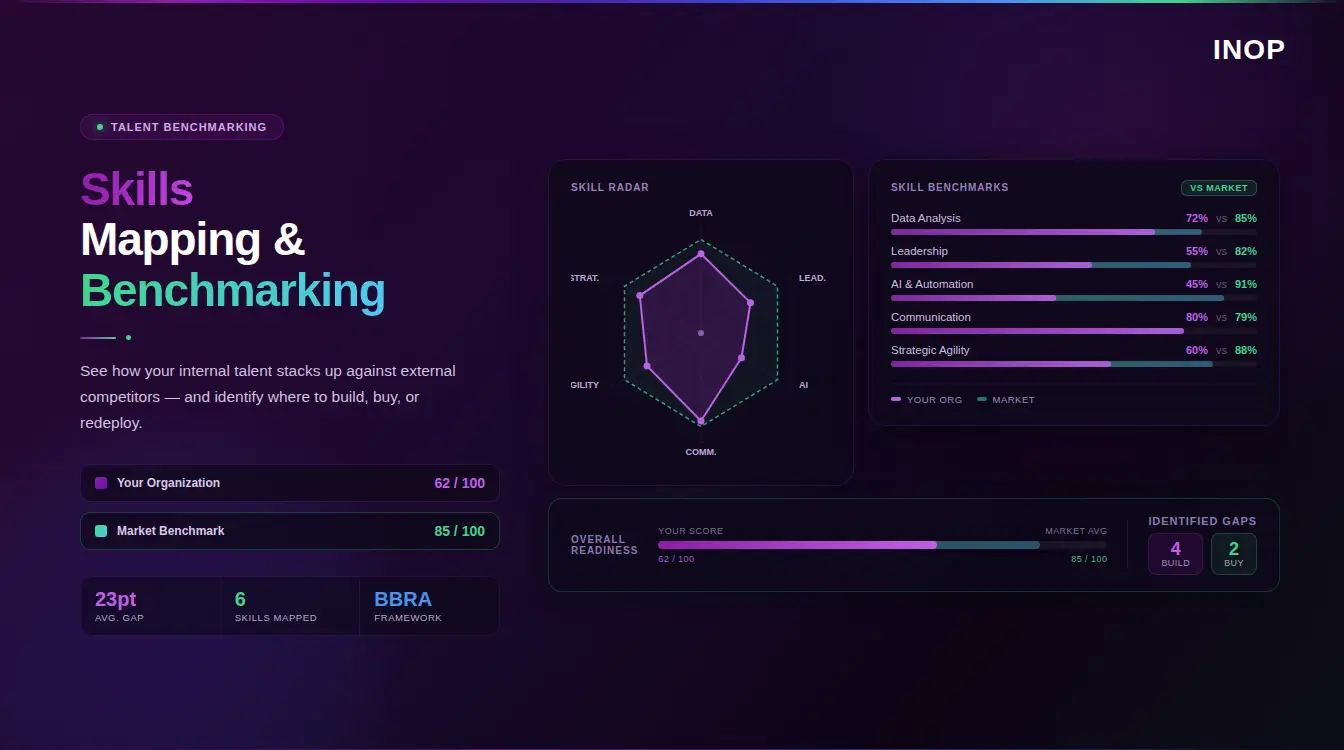
You cannot audit what you have not mapped. The foundation of an automation risk assessment is a current-state skills inventory at sufficient granularity to support task-level analysis. This means capability profiles at the role and, where possible, individual level, capturing not just which skills are present but at what proficiency depth.
Only 26% of HR leaders report having a robust skills taxonomy in place to guide workforce planning, according to Deloitte’s 2024 Human Capital Trends research. For organizations in that majority, building the taxonomy is the prerequisite step. Without it, the automation risk assessment will be conducted at the role level, which produces a coarser and less useful picture than task-level analysis allows.
Once your internal taxonomy exists, INOP’s Skills Intelligence service adds the external validation layer it needs. For each skill in your taxonomy, Skills Intel provides a market demand signal, Emerging, In Demand, Stable, or Declining, contextualized by proficiency level, role family, industry, sector, and AI and automation impact. This tells you not only where your current skills sit relative to market demand, but which of them face partial or full automation within your planning horizon. That combination of internal inventory and external signal is what makes the subsequent phases of the audit financially credible.
Phase Two: Map Tasks to Automation Impact Categories
For each role family in scope, decompose the work into its constituent tasks and assign each to one of the three impact categories: full displacement, augmentation, or resilient. This step is best done in collaboration with function leaders and subject matter experts who understand the actual task composition of the roles, not just their job descriptions.
Job descriptions are rarely accurate reflections of how time is actually spent. The automation risk audit needs to be grounded in task reality, not task documentation. A structured time-use analysis or a facilitated workshop with role incumbents and their managers typically produces a more reliable task decomposition than a document review.
INOP’s AI and Automation intelligence domain, one of the five integrated lenses within the strategic workforce planning platform, applies this analysis systematically across your role portfolio, using its 40,000+ role taxonomy and seven research frameworks to produce automation susceptibility scores at the task level. The output is a structured view of automation exposure weighted by headcount and strategic importance across near-term, medium, structural, and transformational time horizons.
Phase Three: Assess Current Capability Against Future Requirements
Once you know which tasks are shifting and in which direction, the next question is whether your workforce has the capability to perform the work that remains and to take on the new work that augmentation and resilience require.
This is where the skills inventory from Phase One connects to the task mapping from Phase Two. For each role family, the question is: given that automation will absorb a portion of the current task set, what capabilities will the remaining and emerging tasks require, and does the current workforce capability profile match those requirements?
The gaps that surface in this phase are strategic capability requirements for a workforce operating in a more automated environment. The capability shift typically moves in two directions simultaneously: away from the execution tasks that automation is absorbing, and toward the interpretation, judgment, and relational skills that resilient and augmentation tasks require. INOP’s Workforce Risk Engine, part of the strategic workforce planning platform, scores capability risk at the role, team, function, and business unit level, surfacing where these gaps create execution risk before they become delivery failures.
Phase Four: Quantify the Financial Exposure
An automation risk audit that produces a heat map and a gap list without financial translation is an analytical exercise, not a business tool. The fourth phase converts the findings into the language that the CFO and the board can engage with.
INOP’s workforce intelligence architecture organizes this translation across five integrated lenses: Strategy, Finance, People, Market, and AI and Automation. The Finance lens specifically covers workforce cost modelling, ROI on talent investment, and scenario-based financial impact. The AI and Automation lens generates FTE displacement estimates and cost impact models for each scenario. Together, they produce the financial exposure picture that makes automation risk a capital allocation conversation rather than an HR concern.
The financial exposure from unaddressed automation risk runs across several dimensions. Productivity cost captures the drag from human time invested in tasks that automation could perform more efficiently. Transition cost captures the expense of workforce restructuring that delayed action makes inevitable and more expensive. Competitive cost captures the revenue and margin impact of competitors who have already absorbed automation productivity gains into their operating model. And capability obsolescence cost captures the depreciation of skills that the organization has invested in developing but that automation is rapidly devaluing.
Companies that prioritize AI training see 15% higher productivity gains compared to those that do not. The inverse of that figure is a reasonable proxy for the ongoing cost of inaction.
Phase Five: Apply the BBRA Decision Framework
With the gap identified and the financial exposure quantified, the final phase is selecting the right intervention for each gap category. This is where INOP’s BBRA framework, INOP’s proprietary decision architecture for workforce action, provides the structure that prevents automation risk response from defaulting to a generic reskilling program.
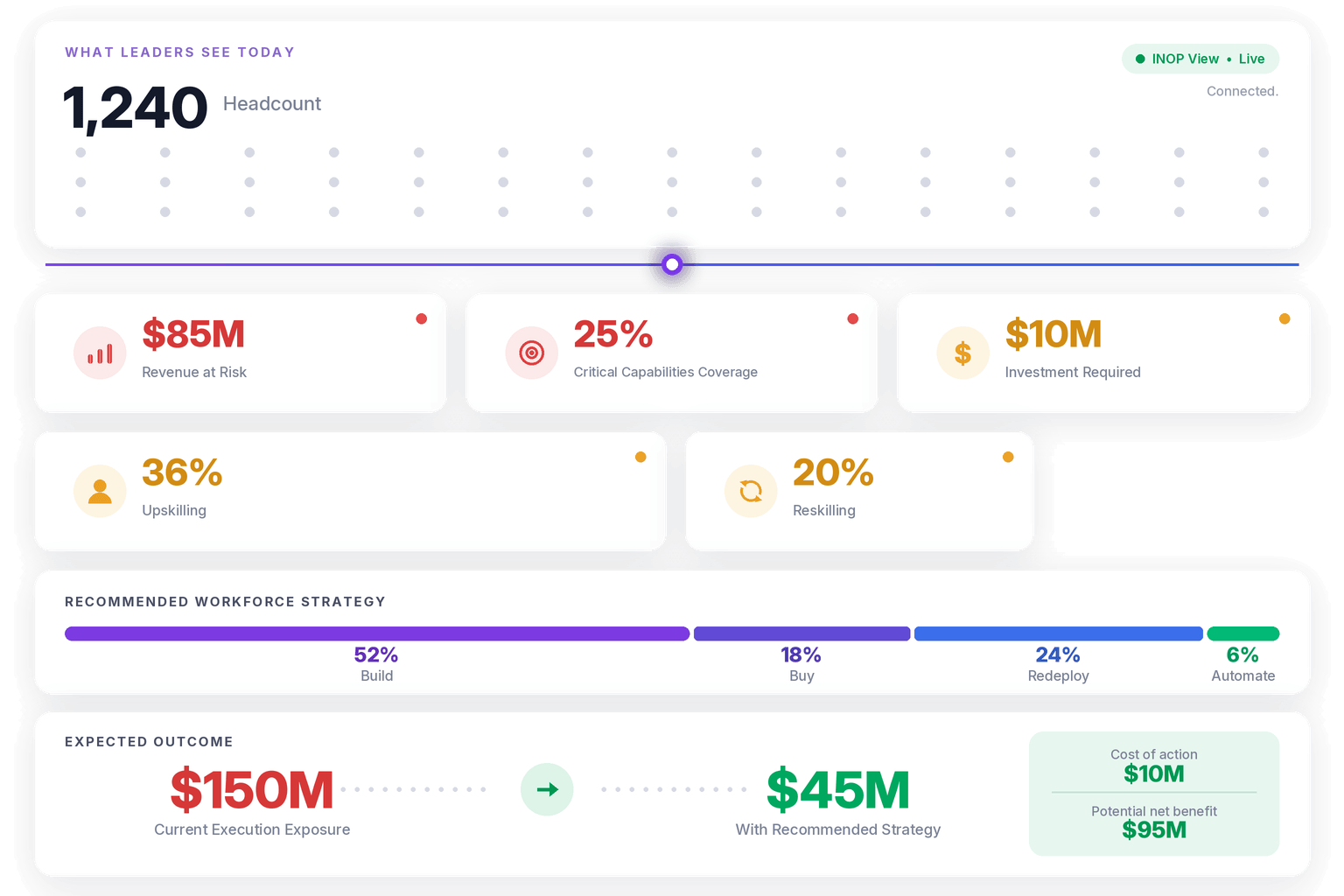
BBRA stands for Build, Buy, Redeploy, and Automate. For any capability gap identified, INOP models all four response pathways with financial trade-offs across 30-day, 180-day, 1-year, and 3-year horizons, so leaders can make investment decisions with the same rigor applied to capital allocation.
Translating the Build decision into a program that actually closes the gap, rather than just producing completion certificates, requires a different approach to how training is designed and measured. AI driven upskilling covers exactly this: how to map verified gaps to role-specific interventions and verify capability gain rather than tracking attendance. Companies investing in employee development report 218% higher income per employee, and AI-driven training programs have demonstrated 250% ROI in accelerated productivity outcomes. Build is appropriate for augmentation gaps where the employee brings domain knowledge that an external hire cannot replicate.
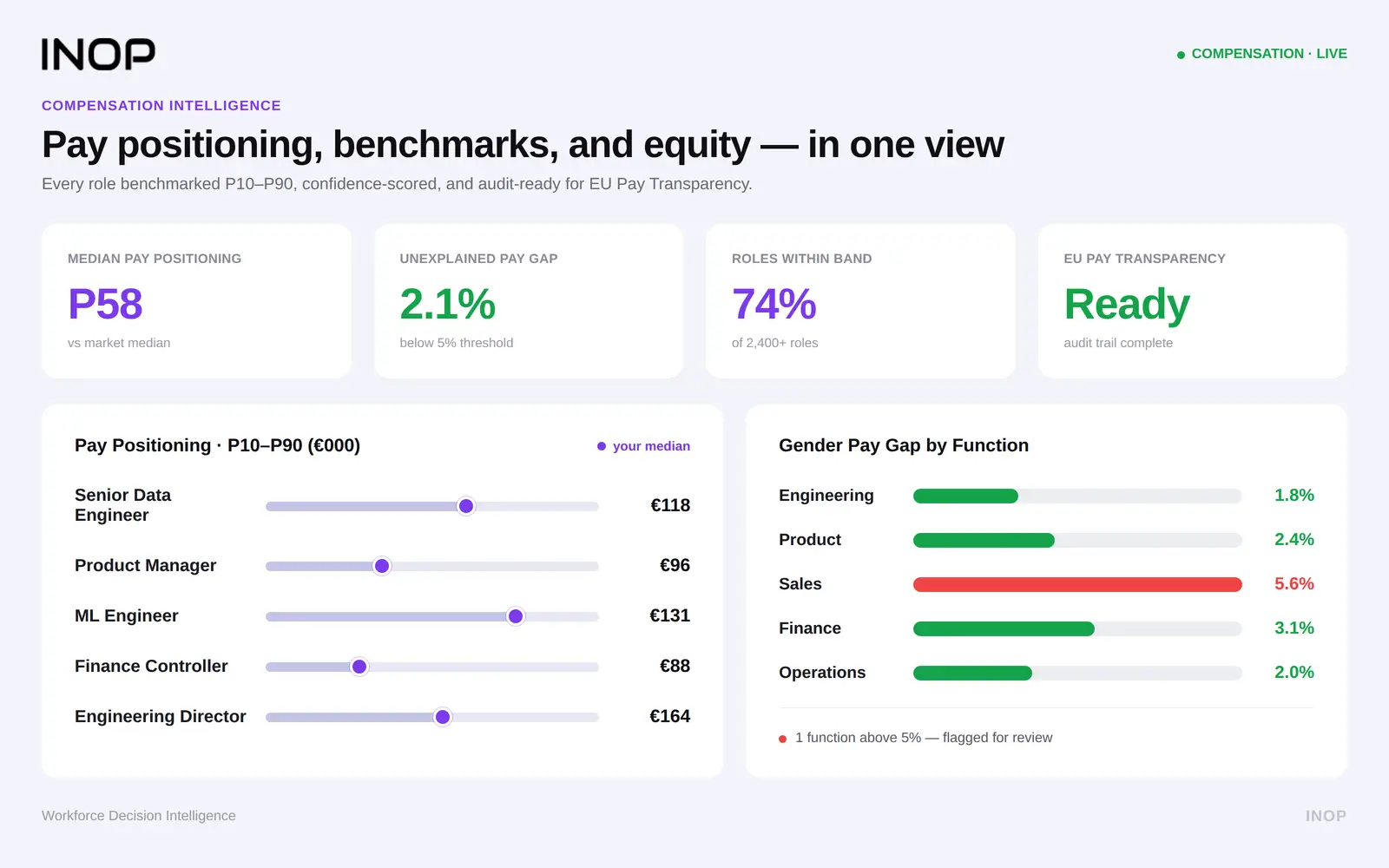
Buy means hiring externally, with market availability, compensation benchmarks, and lead time factored in. INOP’s compensation analytics platform, drawing on 3.5 million global job postings across 16 countries and a skills taxonomy of 22,700 unique skills, provides the real-time salary benchmarks that make the Buy cost model credible rather than assumed. AI and machine learning skill demand grew 40% on a monthly basis in 2025, which means Buy decisions in high-demand capability categories need to be calibrated against realistic market availability and current compensation premiums, not last year’s benchmarks.
Redeploy means identifying internal talent with adjacent skills that can transition into the gap, with reskilling feasibility scored by INOP’s platform. This is the most consistently underused lever in automation risk response. When automation absorbs a significant share of the tasks in one function, the people in that function do not automatically become redundant. They become candidates for redeployment into augmentation-heavy roles where their institutional knowledge and transferable skills can be developed toward new capability requirements. Redeploy depends entirely on having a skills inventory detailed enough to identify adjacency, which is why Phase One is non-negotiable.
Automate means assessing whether the role or task is better addressed through automation entirely, with FTE displacement and cost impact quantified across INOP’s four time horizons. In this context it also means deliberately accelerating the automation of full-displacement tasks rather than allowing it to happen reactively, giving the organization control over the transition timeline and the ability to support affected employees through development and redeployment rather than abrupt redundancy.
Organizations that score a task high for the Automate pathway and move to act on it quickly discover that the operational challenge is not whether an agent can do the task in a demo. AI workforce automation covers exactly why the adoption-to-production gap runs as wide as it does, and what governance architecture is required before an agent runs unsupervised on a task that matters.
Ready to audit your workforce’s automation risk exposure and build a financially grounded response plan?
Book a demo with INOP and see how our platform models automation impact across 40,000+ roles, at the task level, against your actual workforce composition.
The Skills That Survive and Thrive Alongside Automation
An automation risk audit should not produce an exclusively defensive output. Alongside the exposure picture, it should identify the capabilities that become more valuable as automation absorbs routine work, so that reskilling investment can be directed toward building competitive advantage rather than just managing displacement.
The categories of durable human capability that consistently emerge from task-level automation analysis include the following.
Complex judgment and contextual reasoning. AI systems are effective at pattern recognition within defined parameters. They are significantly less effective at navigating situations where the parameters themselves are ambiguous, contested, or rapidly changing. The human capability to exercise judgment in complex, novel, or high-stakes situations becomes more valuable as automation handles the structured decision-making that previously consumed significant human time.
Stakeholder and relational intelligence. Trust, influence, negotiation, and the ability to navigate organizational and interpersonal dynamics are capabilities that automation cannot replicate. As routine work is automated, the proportion of human work that involves stakeholder management and relationship-building increases. INOP’s Culture Risk domain, one of six interconnected risk domains within the strategic workforce planning platform, scores change readiness and transformation sponsorship strength, which are the relational capabilities that determine whether an automation transition succeeds or stalls.
AI oversight and interpretation. The emergence of AI as an operational tool creates a new category of human capability requirement: the ability to configure, evaluate, challenge, and interpret AI outputs. This is not a specialist capability confined to data science teams. It is increasingly a baseline requirement for knowledge workers across functions. 72% of IT decision-makers now prioritize training existing talent in AI-related skills over hiring for them, signaling that organizations have begun to treat AI literacy as a general workforce development priority. INOP’s AI and Automation lens explicitly tracks AI literacy as an emerging skill demand signal within the Skills Intel taxonomy mapping.
Creative and integrative thinking. Tasks that require synthesizing information across domains, generating novel approaches to unstructured problems, or applying creative judgment to open-ended challenges remain firmly in the resilient category. These command increasing compensation premiums as the supply of routine cognitive labor faces downward pressure, a signal that INOP’s compensation analytics platform surfaces directly through its skills-based pay framework.
Connecting the Audit to Strategic Workforce Planning
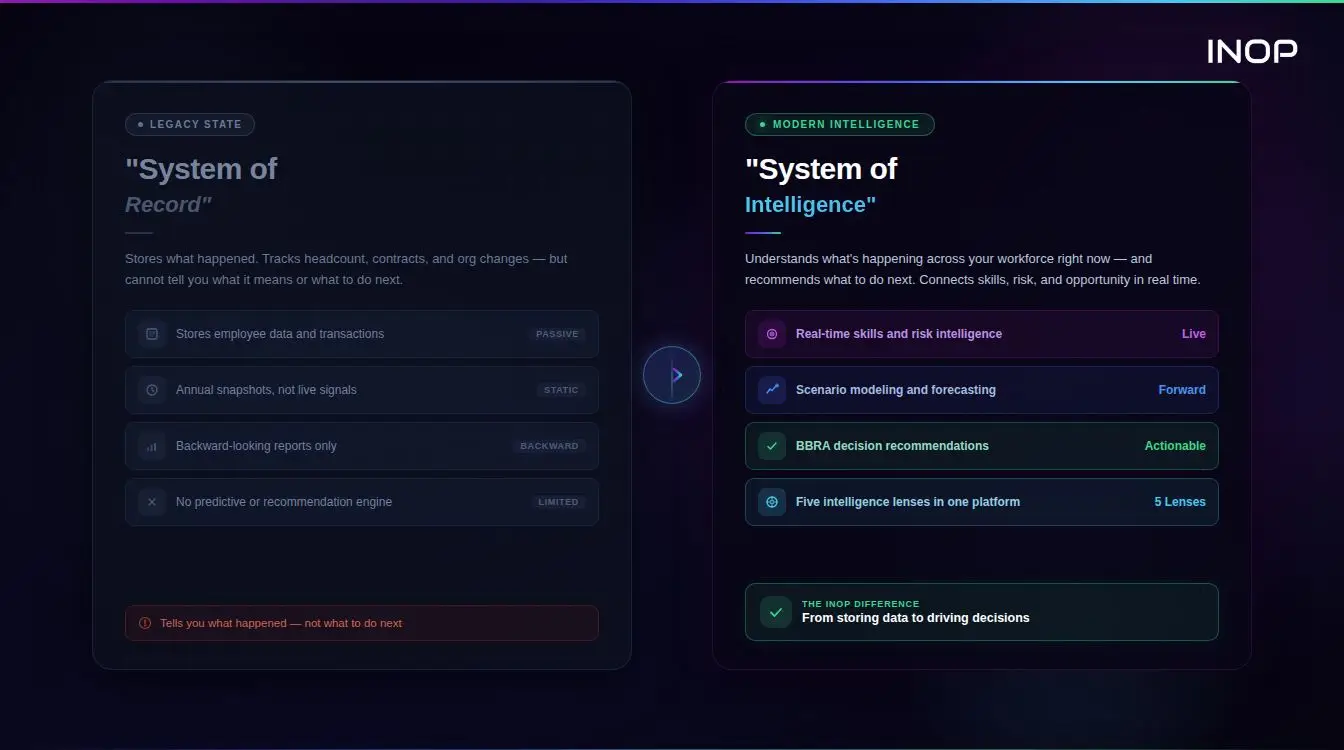
The infrastructure that makes this connection possible is the shift from a system of record to a system of intelligence: an architecture that synthesizes internal workforce data, external market signals, and financial modelling into decisions rather than reports. An automation risk audit conducted inside a system of record produces findings. The same audit conducted inside a system of intelligence produces a board-ready intervention plan with cost and return modelled across time horizons.
An automation risk audit conducted in isolation from strategic workforce planning produces findings that are analytically sound but organizationally stranded. The audit needs to be integrated into the broader workforce planning process to drive decisions.
INOP’s strategic workforce planning platform is built precisely for this integration. Rather than treating automation risk as a separate assessment, INOP embeds it as the AI and Automation lens within a five-lens decision intelligence architecture that simultaneously covers Strategy, Finance, People, and Market. This means the output of the automation risk audit is not a standalone report. It is a live input to the platform’s Strategic Execution Risk score, the composite domain that integrates signals from all five lenses to produce the organization’s overall probability and estimated cost of workforce-driven strategic failure.
The six risk domains within INOP’s Decision Intelligence Layer each carry automation-relevant signals. Capability Risk scores whether the skills required to execute strategy exist at the right proficiency levels after automation reshapes the task landscape. Leadership Risk scores AI literacy and transformation sponsorship strength. Mobility scores internal redeployment capacity and skills adjacency, directly supporting the Redeploy lever of the BBRA framework. Role-Value Risk identifies roles that are declining in strategic relevance as automation absorbs their task content. Culture Risk scores change readiness for the workforce transition. And Strategic Execution Risk integrates all of these into a single board-ready view of what automation is doing to the organization’s ability to deliver on its strategy.
For organizations where compensation is a material lever in the transition, INOP’s compensation analytics capabilities add the market calibration that makes the plan credible. Reskilling investment decisions need to be grounded in what the market pays for the capabilities being developed. If the organization is building AI oversight capability internally, the compensation model needs to reflect current market rates for those skills, drawn from INOP’s real-time data across 16 countries and 3.5 million job postings, to retain the people who develop them and to benchmark the internal investment against the external hire alternative.
See how INOP’s five-lens workforce intelligence model connects automation risk to strategic execution risk, financial exposure, and BBRA-driven action.
Book your demo today and explore what an automation risk audit built against your actual workforce looks like.
What the Audit Looks Like for PE Portfolio Companies
For private equity operating partners, the automation risk audit serves a dual purpose that corporate HR functions do not typically face: it is simultaneously a diligence input and a value creation tool.
During diligence, the audit surfaces the hidden automation liability in a target’s current workforce. A business whose operational model depends heavily on roles with high full-displacement task exposure is carrying a workforce cost structure that automation will erode, but also a transition cost that the value creation plan needs to account for. INOP’s automation susceptibility scoring across 40,000+ roles, modelled against the target’s actual workforce composition across four time horizons, gives operating partners a structured, financially quantified view of that liability before close rather than discovering it during the first 100 days.
During the value creation period, the audit becomes the workforce chapter of the transformation plan. INOP’s BBRA framework models all four intervention pathways with financial trade-offs across 30-day, 180-day, 1-year, and 3-year horizons, giving operating partners the same investment-grade rigor on workforce decisions that they already apply to capital allocation. The five-lens architecture, covering Strategy, Finance, People, Market, and AI and Automation, ensures that the workforce transition plan is not evaluated in isolation but against the financial and strategic parameters of the value creation plan as a whole.
INOP’s dedicated PE workforce intelligence offering is built specifically for this use case, providing operating partners with investor-grade visibility into workforce capability, execution risk, and automation exposure across portfolio companies, in a format designed for the investment committee rather than the HR function.
Common Mistakes in Automation Risk Assessment
Assessing risk at the role level instead of the task level. Role-level automation exposure scores produce a coarse picture that leads to over- or under-response. The precision that drives useful decisions comes from task-level decomposition applied across specific time horizons. A role that appears highly exposed at the aggregate level may have a task profile that is mostly resilient once the analysis is conducted with the granularity that INOP’s 40,000+ role taxonomy and six-dimension scoring provides.
Treating automation risk as binary. The frame of “this role will or will not be automated” misrepresents how automation actually reshapes work. The more accurate frame is: what share of the task composition of this role is moving across the three impact categories, over what timeline, and what does the residual human work require? That question produces a capability development agenda with financial parameters attached. The binary frame produces a redundancy list.
Conducting a one-time audit. Automation risk is not a stable landscape. INOP’s platform treats automation risk monitoring as a continuous live input to strategic workforce planning rather than a periodic project, updating role-level automation susceptibility scores as AI capabilities advance and as your workforce composition changes.
Separating the audit from the financial model. An automation risk finding without a financial translation is an academic exercise. Every material gap in the audit needs a cost-of-inaction figure and a cost-of-intervention figure modelled across time horizons before it can drive a business decision. INOP’s Finance lens and BBRA framework together provide exactly this structure, ensuring the recommendation is defensible at board level.
Underestimating the redeployment opportunity. The default organizational response to automation risk is either to wait for redundancies to become unavoidable or to invest in broad reskilling programs. Both consistently underutilize the Redeploy lever. INOP’s Mobility risk domain scores internal redeployment capacity, skills adjacency, and reskilling pathway availability for every role in the workforce, surfacing the redeployment options that manual analysis would miss.
Conclusion
Automation risk is not a threat to monitor at a distance. It is a live workforce planning variable that is already reshaping the task composition of roles across industries and functions, and organizations that have not yet built the analytical infrastructure to assess and respond to it are accumulating a transition cost that will eventually become unavoidable.
The path from risk to readiness is structured and executable. Build a skills inventory at the granularity that supports task-level analysis. Map the task composition of your role families across full displacement, augmentation, and resilient categories, across near-term and transformational time horizons. Assess current capability against the requirements that the shifting task landscape creates. Quantify the financial exposure of the gaps across the four dimensions that the Finance lens captures. Apply INOP’s BBRA framework to identify the right intervention for each gap, with cost and return modelled across 30-day to 3-year horizons. And integrate the whole exercise into your strategic workforce planning process through INOP’s Decision Intelligence Layer so the findings drive board-ready decisions rather than sitting in a report.
The organizations that will manage this transition well are not the ones with the most sophisticated AI tools. They are the ones with the clearest picture of their workforce capability, the most rigorous analysis of where automation is moving their task landscape, and the financial discipline to make capability investment decisions that the board can stand behind.
INOP’s skills intelligence service and strategic workforce planning platform are built to support every stage of that process, from external skills demand validation through to automation impact modelling, BBRA-driven intervention planning, and Strategic Execution Risk scoring. If you want to explore what an automation risk audit looks like applied to your specific workforce, the most direct path is a conversation with our team.
If you are working through automation risk assessment in your own organization and want to share what you are finding, leave a comment below. The most useful frameworks in this space are being built by practitioners, not by policy reports.
Frequently Asked Questions
What is automation risk in the context of workforce planning?
Automation risk refers to the exposure that individual tasks, roles, and functions carry to being performed or substantially replaced by AI and automation systems. In a workforce planning context, it is the risk that a portion of your workforce is currently invested in capabilities that AI is positioned to absorb, and that the organization will face a transition cost, in retraining, restructuring, or competitive disadvantage, if it does not anticipate and manage that shift proactively. INOP’s Strategic Execution Risk score integrates automation exposure with capability, leadership, mobility, role-value, and culture risk to give organizations a composite view of the workforce-driven threat to strategic delivery.
How does INOP model automation risk at the task level?
INOP applies task-level analysis across 40,000+ roles using seven published research frameworks including WEF Future of Jobs, Stanford HAI, O*NET/AIOE, McKinsey, ILO, and Eloundou et al. Each role is assessed across six dimensions and classified as not impacted, partially impacted, or fully impacted across four time horizons: near-term at 180 days, medium at 12 months, structural at 2 years, and transformational at 3 or more years. FTE displacement estimates, cost impact modelling, and transition pathway recommendations are generated for each scenario, all modelled against your actual workforce composition rather than against generic sector averages.
What is INOP’s BBRA framework and how does it apply to automation risk?
BBRA stands for Build, Buy, Redeploy, and Automate. It is INOP’s proprietary decision framework for translating capability gap analysis into workforce action. For any gap identified through the automation risk audit, INOP models all four response pathways with financial trade-offs across 30-day, 180-day, 1-year, and 3-year horizons. Build models internal development cost and time-to-competency. Buy factors in market availability, compensation benchmarks from INOP’s real-time data across 16 countries, and hiring lead time. Redeploy scores skills adjacency and reskilling feasibility for internal candidates. Automate quantifies FTE displacement and cost impact across time horizons. This gives leaders the same investment rigour on workforce decisions that they apply to capital allocation.
How does INOP’s Skills Intelligence service support an automation risk audit?
INOP’s Skills Intelligence service maps external skills demand signals directly to your internal taxonomy at the proficiency, role, and sector level, with AI and automation impact modelling built in for each skill. For the automation risk audit, this provides the external validation layer that internal-only frameworks cannot supply: which skills in your taxonomy are facing partial or full automation within your planning horizon, which are in growing demand as augmentation capability becomes essential, and which are declining in market relevance as AI absorbs the tasks they support. The signal states are Emerging, In Demand, Stable, and Declining, each contextualized by proficiency level, role family, industry, and sector.
Which types of roles carry the highest automation risk?
Roles with high concentrations of routine, structured, rules-based tasks carry the highest full-displacement exposure. Goldman Sachs research found that office and administrative support carries 46% task automation exposure, followed by legal functions at 44% and architecture and engineering at 37%. However, these figures describe average exposure within broad categories. INOP’s task-level scoring across 40,000+ roles using six assessment dimensions will reveal significant variation within any given role family and across your specific workforce composition, time horizons, and sector context.
How do PE operating partners use automation risk audits?
Operating partners use automation risk audits during diligence to identify the hidden workforce liability in targets whose operational models carry high full-displacement task exposure, quantifying the transition cost the value creation plan must fund and the capability investment required to capture automation productivity gains. During the value creation period, INOP’s BBRA framework with four-horizon financial modelling gives operating partners investment-grade rigour on workforce intervention decisions. INOP’s dedicated PE workforce intelligence offering delivers this analysis in a format designed for the investment committee, not the HR function, connecting workforce capability and automation exposure directly to value creation plan execution risk.
How should the automation risk audit inform reskilling investment?
The audit produces a capability gap profile mapped to the three task impact categories and quantified in financial terms across time horizons. Reskilling investment, corresponding to the Build lever of the BBRA framework, should be directed at augmentation and resilient capability gaps where existing employees have the domain knowledge and adjacency to develop toward the new requirements. INOP models the Build pathway with time-to-competency and cost data, making it straightforward to compare the reskilling investment against the financial exposure of the gap and against the alternative cost of external hiring. Broad reskilling programs launched without this financial anchoring consistently underperform because they are not targeted at the gaps that carry the highest strategic and financial weight.
Make confident workforce decisions that support strategy and value creation.


One reply on “Predicting AI Automation Risk: How to Audit Your Workforce Skills”
[…] the share of working time each one takes, and score each separately. This is the approach behind predicting AI automation risk across a […]