What if your organization could predict skill gaps before they become critical bottlenecks? What if you could redeploy talent faster than hiring externally, saving millions while boosting employee satisfaction? These aren’t hypothetical scenarios, they’re real outcomes from companies that have successfully implemented workforce planning case studies centered on skills-based strategies. In today’s rapidly evolving business landscape, where technological disruption and market volatility have become the norm, traditional workforce planning models focused solely on headcount and job titles are no longer sufficient. This article explores documented workforce planning case studies that demonstrate measurable success, examines the skills planning ROI that convinced leadership teams to invest, and provides actionable insights you can apply to your own organization’s talent strategy.
Why Skills-Based Workforce Planning Matters Now More Than Ever
The shift from role-based to skills-based workforce planning platform represents more than just a semantic change, it’s a fundamental transformation in how organizations view their most valuable asset: people. Traditional workforce planning treated employees as fixed resources tied to specific positions. Skills-based approaches recognize that every employee possesses a dynamic portfolio of capabilities that can be leveraged across multiple contexts.
The workforce data underscores the urgency from the employee side as well. The Deloitte 2025 Gen Z and Millennial Survey found that learning and development opportunities are among the top reasons Gen Z and millennial workers choose to stay with their current employers, ranking alongside work-life balance and clear advancement pathways. For organizations investing in skills-based planning, this is not just an operational case; it is a direct retention lever for the two generations that now make up the majority of the global workforce.
This distinction becomes critical when we consider the World Economic Forum’s projection that 50% of all employees will need reskilling by 2025 due to increased adoption of technology. Organizations that can identify, develop, and redeploy skills strategically will maintain competitive advantages, while those clinging to rigid role-based structures will struggle with talent shortages despite having untapped potential within their existing workforce.
The business case is compelling: skills-based organizations report 98% greater likelihood of retaining high performers and 107% greater likelihood of placing talent effectively, according to recent research. But beyond statistics, real-world examples demonstrate how this approach translates into tangible business outcomes.
Key Takeaways: The Impact of Skills-Based Workforce Planning
- Massive ROI & Rapid Payback: Implementing a skills-based talent strategy delivers a proven 240% to 420% Return on Investment (ROI), with most organizations achieving full payback within just 9 to 18 months.
- 63% Reduction in Time-to-Fill: By leveraging internal talent marketplaces and skill mapping, companies have successfully slashed the time needed to fill critical technical roles from 127 days to just 47 days.
- Multi-Million Dollar Cost Savings: Identifying and utilizing latent employee skills eliminates the reliance on expensive external hires, premium contractors, and recruiting fees, saving tens of millions of dollars annually.
- Unprecedented Organizational Agility: Transitioning from rigid job titles to a dynamic portfolio of skills enables the rapid redeployment of thousands of employees during market shifts or unforeseen crises.
- Dramatically Higher Retention Rates: Establishing transparent, upskilling-driven career pathways boosts employee engagement and can increase the retention of top talent to nearly 100% in targeted development programs.
Workforce Management Case Studies vs. Workforce Planning Case Studies: Understanding the Distinction
“Workforce management” and “workforce planning” are frequently used interchangeably but describe different operational disciplines, and the case studies relevant to each are meaningfully different.
Workforce management (WFM) refers to the operational layer of labor management: scheduling, time-tracking, absence management, and short-range staffing for shift-based organizations. Workforce management case studies in this context typically involve WFM software implementations in retail, hospitality, or healthcare, measuring outcomes like schedule optimization rates, labor cost per hour, and compliance with scheduling regulations.
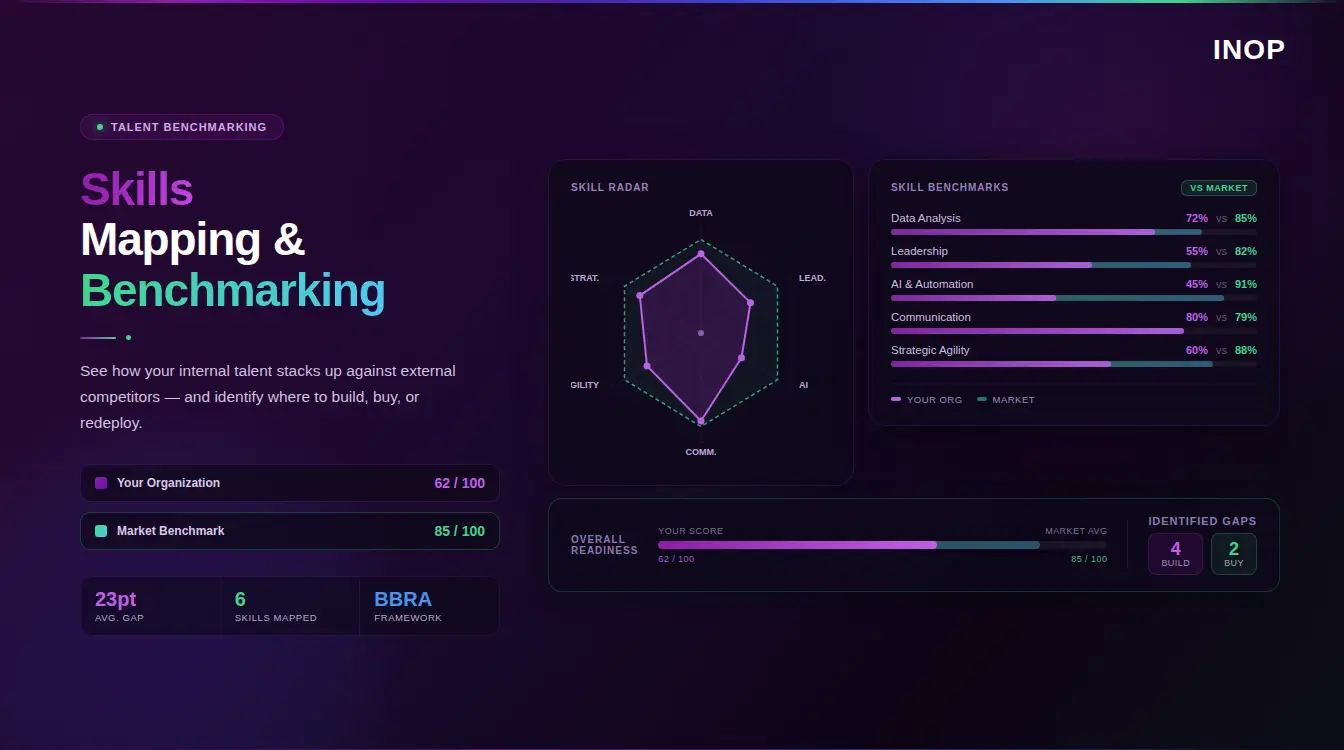
Strategic workforce planning operates at a longer time horizon and a different level of analysis. It addresses questions of organizational capability: what skills does the business need over the next 1–5 years, where are the gaps between current capability and future requirements, and how does the organization build, buy, or borrow the talent it needs to execute its strategy?
The 2026 Data: Where Organizations Actually Stand
The gap between strategic intent and operational reality is the most important context for evaluating the case studies that follow.
Mercer’s 2025/2026 Skills Snapshot Survey found that 55% of organizations now map skills directly to jobs, up from 47% in 2023 — progress, but still a minority. Only 18% of CHROs say their organization consistently uses data analytics to guide people decisions, according to Korn Ferry’s 2025 CHRO Survey. The WEF’s Future of Jobs 2025 Report identified skills gaps as the number one barrier to business transformation globally, cited by 63% of employers as their primary challenge through 2030.
The implication: most of the organizations competing for the same talent and executing against the same market opportunities as your organization are still making workforce decisions from incomplete data. The case studies in this article represent organizations that closed that gap. The competitive advantage they document is not primarily a technology advantage. It is a data advantage built on a foundation that most of their competitors had not yet established at the time these outcomes were produced.
The case studies in this article address strategic workforce planning, specifically the skills-based approaches that have produced 240–420% ROI across technology, healthcare, financial services, and manufacturing organizations. If you are looking for operational workforce management case studies covering scheduling optimization or labor cost reduction in shift-based environments, those are a distinct category with their own vendor ecosystem and benchmark data.
For organizations earlier in this journey who want to understand the full structural shift before examining how others have executed it, the complete guide to building a skills based organization covers the foundational architecture: how to move from job-title-based people management to a capability-driven operating model, how to build and govern a skills taxonomy, and what the transition looks like across hiring, compensation, mobility, and development.
Case Studies at a Glance: Real-World ROI
| Industry | Primary Challenge | The Skills-Based Solution | Key Outcome & ROI |
|---|---|---|---|
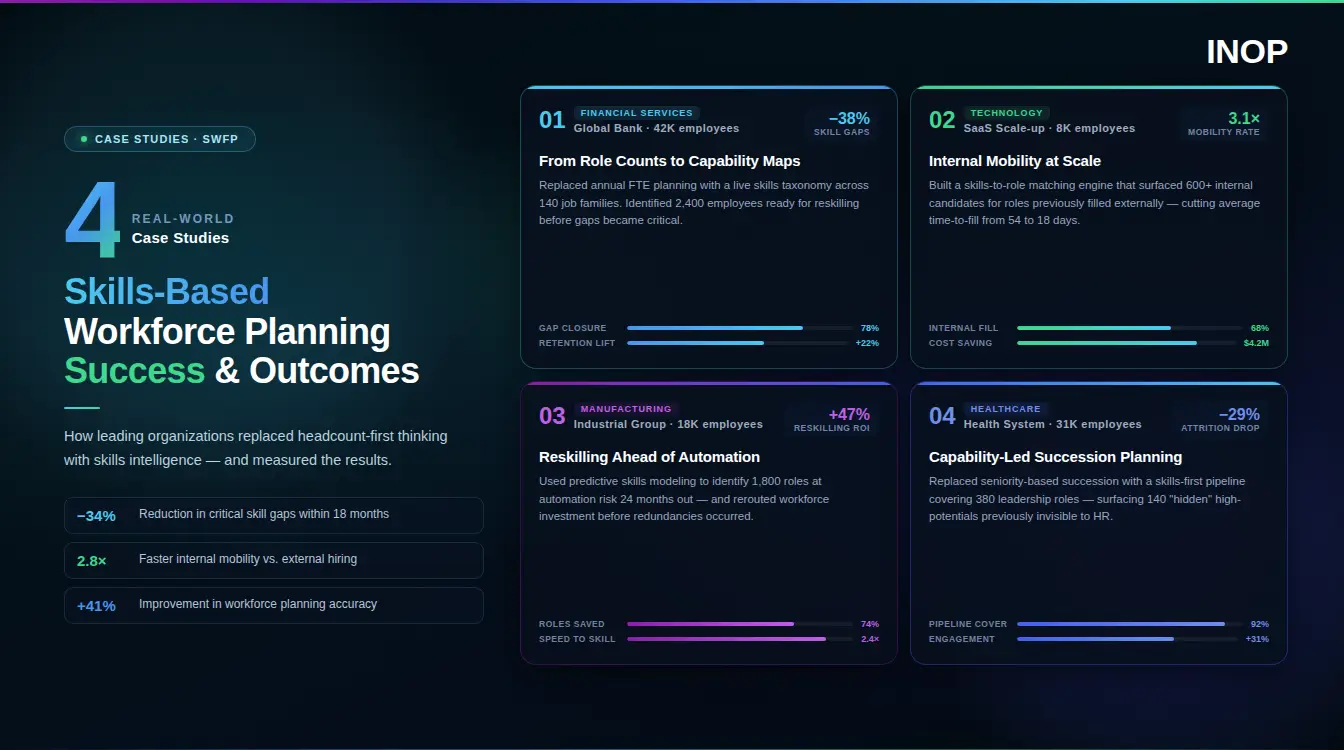
| Global Technology | Critical technical roles sitting vacant for 127 days; external hiring was too slow and costly. | Mapped actual competencies (not just titles) and launched an internal talent marketplace. | 63% faster time-to-fill, $14.3M saved annually, and a 340% ROI within 2 years. |
| Healthcare System | COVID-19 caused surges in some departments and massive drops in others. | Used AI skill mapping to identify transferable capabilities across 23,000 employees. | Redeployed 2,847 staff in 3 weeks, saving $31 million in temporary staffing costs. |
| Financial Services | Desperately needed expensive data science talent but faced fierce market competition. | Found latent quantitative skills in existing financial analysts and created an upskilling track. | Built a data science team at 40% of the cost of external hiring, achieving a 287% ROI. |
| Manufacturing | A traditional workforce lacking the digital/IoT competencies needed for the future. | Conducted a 5-year strategic skills forecast and launched targeted “digital champion” training. | 78% of digital skills developed internally, boosting production efficiency by 34%. |
Named Company Examples: Skills-Based Workforce Planning in Practice
Before examining the detailed case studies below, here are publicly documented examples from named organizations that illustrate specific dimensions of skills-based workforce planning success:
AT&T: The $1 Billion Reskilling Investment
Facing a structural shift from hardware-based to software-defined infrastructure, AT&T recognized in 2013 that approximately half of its 250,000-person workforce lacked the skills the company would need within a decade. Rather than planning for workforce replacement, AT&T invested over $1 billion in a programme called Workforce 2020 — using skills gap analysis to identify which employees had the strongest adjacent potential for reskilling into digital roles. The company built degree pathways with Georgia Tech and Udacity, then connected credential completion directly to internal job postings. By 2020, over 140,000 employees had participated in skills-based development, and internal fill rates for technology roles improved measurably. AT&T’s case demonstrated that strategic skills forecasting on a five-to-ten year horizon — not just the current fiscal year — is what makes workforce transformation financially viable rather than prohibitively expensive.
Unilever: Skills-Based Internal Mobility at Scale
Unilever’s Flex Experiences platform uses a skills taxonomy covering its global workforce to enable employees to take on cross-functional project assignments based on capability rather than job title. The platform surfaces skills that would otherwise be invisible to managers — a finance analyst who speaks three languages and managed projects in a prior career appears as a match for a cross-functional initiative that the traditional staffing process would never have found. Unilever reports increased internal mobility rates and improved engagement scores in functions where movement was previously constrained by siloed job architecture.
Siemens: Skills Intelligence as Digital Transformation Infrastructure
Siemens used skills-based workforce planning as the operational foundation for its Industry 4.0 transformation — identifying which manufacturing employees had adjacent capabilities that could be developed toward digital operations roles rather than planning wholesale external hiring. The approach reduced external recruitment costs for new digital facilities and preserved the institutional knowledge that makes complex manufacturing operations reliable. Siemens has publicly cited skills intelligence as a core enabler of transformation cost reduction, with internally developed capability replacing a significant proportion of planned external hires.
Case Study One: Global Technology Corporation Reduces Time-to-Fill by Sixty-Three Percent
A multinational technology company with approximately 85,000 employees faced a persistent challenge: critical technical positions remained vacant for an average of 127 days, significantly longer than their 60-day target. External hiring was expensive, slow, and often resulted in poor cultural fit. The organization decided to implement a comprehensive skills-based workforce planning tool to address this systemic issue.
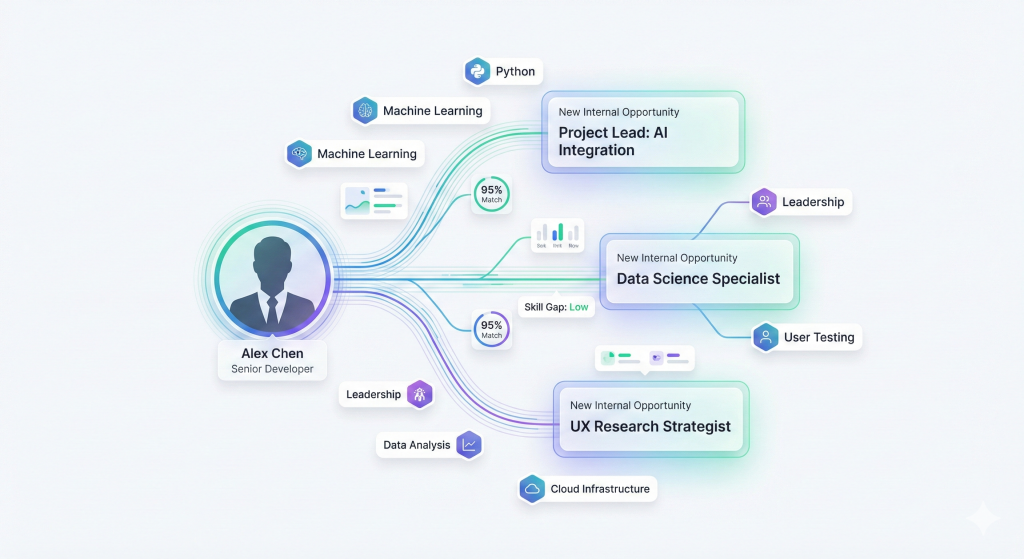
The initiative began with a thorough skills inventory across their technology divisions. Rather than simply cataloging job titles and years of experience, they mapped actual competencies, programming languages, cloud platforms, project management methodologies, and emerging technologies like machine learning and blockchain. This process revealed a surprising insight: nearly 40% of existing employees possessed skills that weren’t being utilized in their current roles.
Armed with this data, the organization established internal talent marketplaces where managers with open positions could search for skills rather than external candidates. They implemented transparent career pathways showing employees exactly which skills they needed to develop for lateral moves or promotions. Within eighteen months, the results were remarkable:
- Time-to-fill for technical positions dropped from 127 days to 47 days, a 63% reduction
- Internal mobility increased by 45%, with employees moving into roles that better utilized their full skill sets
- External hiring costs decreased by $14.3 million annually
- Employee engagement scores improved by 12 percentage points, as staff felt their complete capabilities were finally recognized
Perhaps most significantly, the skills planning ROI was calculated at 340% within the first two years, accounting for reduced hiring costs, improved productivity from better role-fit, and decreased turnover. The CFO noted that the investment in skills mapping technology and process redesign paid for itself within nine months.
Case Study Two: Healthcare System Navigates Pandemic Response Through Skills Agility
When a regional healthcare system comprising fourteen hospitals and numerous outpatient facilities confronted the COVID-19 pandemic, they faced an unprecedented workforce challenge. Certain departments experienced overwhelming demand while others saw sharp decreases in patient volume. Traditional workforce planning would have meant furloughing staff in low-demand areas while scrambling to hire temporary workers for critical needs, an expensive and demoralizing approach.
Instead, this organization leveraged their recently implemented ai skill mapping workforce planning solution to identify transferable capabilities across their 23,000-person workforce. The system analyzed clinical competencies, certifications, soft skills, and even volunteer experiences to find hidden talent pools.
For example, surgical nurses whose elective procedures were postponed possessed critical care skills that could be rapidly refreshed for intensive care unit deployment. Administrative staff with previous EMT training were identified and offered opportunities to support emergency departments. Physical therapists skilled in respiratory rehabilitation were matched with COVID recovery programs.
The outcomes demonstrated the power of skills-based agility:
- The organization redeployed 2,847 employees into new roles within three weeks, maintaining 97% of their workforce while meeting surge demands
- Patient care quality metrics remained stable despite the massive operational disruption
- Employee satisfaction increased during an extraordinarily stressful period, as staff appreciated being utilized rather than furloughed
- The organization saved an estimated $31 million in temporary staffing costs compared to industry peers who relied primarily on travel nurses and contract workers
The Chief Human Resources Officer emphasized that without skills-based planning, they would have made devastating decisions, simultaneously laying off talented employees while paying premium rates for external temporary staff. The ability to see beyond job titles to actual capabilities transformed their crisis response.
The healthcare system redeployed 2,847 employees in three weeks because they could see skills, not just job titles. Book a demo to see how INOP’s skills intelligence surfaces hidden capability across your own workforce.
Case Study Three: Financial Services Firm Closes Critical Skills Gaps Without External Hiring
A mid-sized investment management firm identified a strategic vulnerability: their business increasingly required data science and advanced analytics capabilities, but their workforce was primarily composed of traditional financial analysts and portfolio managers. External market conditions made hiring data scientists extremely competitive and expensive, with average salaries exceeding $180,000 for qualified candidates.
Rather than entering a bidding war for external talent, the organization took a different approach. They conducted a comprehensive skills assessment revealing that many of their financial analysts already possessed strong quantitative foundations, statistics knowledge, programming exposure from business school, and natural analytical thinking. What they lacked were specific technical skills that could be developed through targeted training.
The firm designed a skills development program with clear pathways:
- Identified 34 employees with latent data science potential based on educational background, aptitude assessments, and interest surveys
- Created a six-month intensive training program combining online courses, mentorship from external data science consultants, and hands-on projects with real business applications
- Established a new career track for “quantitative analysts” that bridged traditional finance and data science, with compensation adjusted to reflect new skill sets
- Implemented a skills-based workforce planning tool that continuously tracked capability development and matched emerging skills to business needs
The results exceeded expectations. Within eighteen months:
- Twenty-seven of the thirty-four participants successfully transitioned into hybrid quant-analyst roles
- The organization built a data science capability at approximately 40% of the cost of external hiring
- Retention improved dramatically among participants, with 100% remaining with the firm after two years compared to 68% retention in their prior analyst roles
- Business impact was substantial, with data-driven investment strategies contributing to a 2.3% improvement in risk-adjusted returns
The skills planning ROI calculation factored in training costs, temporary productivity dips during learning phases, and adjusted compensation against the cost of external hires, competitive salary premiums, and onboarding time. The return was calculated at 287% over three years, with ongoing benefits as the internal capability matured.
Case Study Four: Manufacturing Company Prepares for Digital Transformation Through Skills Forecasting
A century-old manufacturing company with 12,000 employees faced an existential challenge: their industry was rapidly digitizing, with competitors implementing IoT sensors, predictive maintenance systems, robotics, and AI-powered quality control. Their workforce, while highly skilled in traditional manufacturing processes, lacked the digital competencies required for the future.
Leadership recognized that simply hiring a new workforce wasn’t feasible, they would lose invaluable institutional knowledge, face community backlash, and struggle to attract digital talent to their non-urban locations. Instead, they implemented a forward-looking skills-based workforce planning initiative with a five-year horizon.
The process began with strategic skills forecasting. Working with industry analysts, technology vendors, and internal strategists, they identified which digital capabilities would be critical at different stages of their transformation roadmap. They then conducted a comprehensive current-state assessment, mapping existing skills across their entire workforce.
The gap analysis revealed both challenges and opportunities. While digital skills were scarce, they discovered significant overlaps between traditional troubleshooting abilities and the diagnostic thinking required for predictive maintenance systems. Mechanical engineers possessed the fundamental understanding needed to program and maintain robotic systems with appropriate training. Quality control specialists had the attention to detail and analytical mindset that could be channeled toward interpreting AI-generated insights.
Their multi-year initiative included:
- Partnerships with local community colleges and online learning platforms to create customized training curricula
- “Digital champion” programs where early adopters received intensive training then became peer mentors
- Job redesign that blended traditional expertise with new digital responsibilities rather than wholesale role replacement
- Transparent communication about the transformation roadmap, skill expectations, and career opportunities in the digital future
- Investment in ai skill mapping workforce planning solutions that dynamically tracked skill development progress against future needs
After four years of implementation, the results demonstrated that proactive skills planning could enable fundamental business transformation:
- Seventy-eight percent of required digital skills were developed internally rather than hired externally
- Workforce anxiety about automation decreased significantly as employees saw clear pathways to valuable futures rather than obsolescence
- Production efficiency improved by 34% through successful implementation of predictive maintenance and process optimization technologies
- The company became an employer of choice in their region, attracting younger talent interested in working for a digitally progressive manufacturer
- Total transformation costs were 52% lower than originally projected, primarily due to reduced external hiring and consulting needs
The CEO credited skills-based workforce planning with making their digital transformation both financially viable and culturally successful. Rather than disrupting their workforce, they evolved it.
Common Success Factors Across Workforce Planning Case Studies
Analyzing these diverse workforce planning case studies reveals several consistent elements that contributed to their success:
Comprehensive Skills Visibility: Each organization invested in truly understanding their workforce capabilities beyond job descriptions. This required sophisticated assessment approaches, not just self-reported skills surveys, but validated competency frameworks, skills demonstrations, and in some cases, ai skill mapping workforce planning solutions that analyzed work samples and project histories.
Leadership Commitment and Cultural Shift: Skills-based workforce planning represents a significant departure from traditional HR practices. Success required executive sponsors who consistently reinforced the strategic importance of skills agility. Organizations that treated this as merely an HR initiative rather than a business transformation saw limited results.
Technology Infrastructure: While culture and process matter immensely, the successful organizations leveraged skills-based workforce planning tools that could handle complex data analysis, pattern recognition, and scenario modeling at scale. Manual spreadsheet approaches simply couldn’t provide the real-time insights needed for dynamic decision-making.
Transparency and Employee Agency: The most successful implementations gave employees visibility into organizational skill needs and clear pathways for development. Internal talent marketplaces, transparent career frameworks, and accessible learning resources created environments where employees felt empowered rather than managed.
Integration with Business Strategy: Skills planning wasn’t treated as a separate workforce exercise but as an integral component of strategic planning. When business leaders identified new market opportunities or competitive threats, the conversation immediately included skills implications and workforce readiness assessments.
The Skills Data Quality Benchmark That Determines Whether It Works
Across the successful case studies examined here, the factor that most consistently separated skills data that drove decisions from skills data that sat unused was validation coverage: the percentage of skills profiles that had been confirmed by a source other than the employee themselves.
The Skills in Practice 2026 Report, drawing on verified operational data from 44,000 users across real-world deployments, found that supervisor validation rates average 41.4% across mature deployments. Leading organizations in the same dataset reached 97%. That 56 percentage point gap between average and leading practice is the operational difference between a skills inventory that produces confident decisions and one that produces interesting-but-not-trustworthy reports.
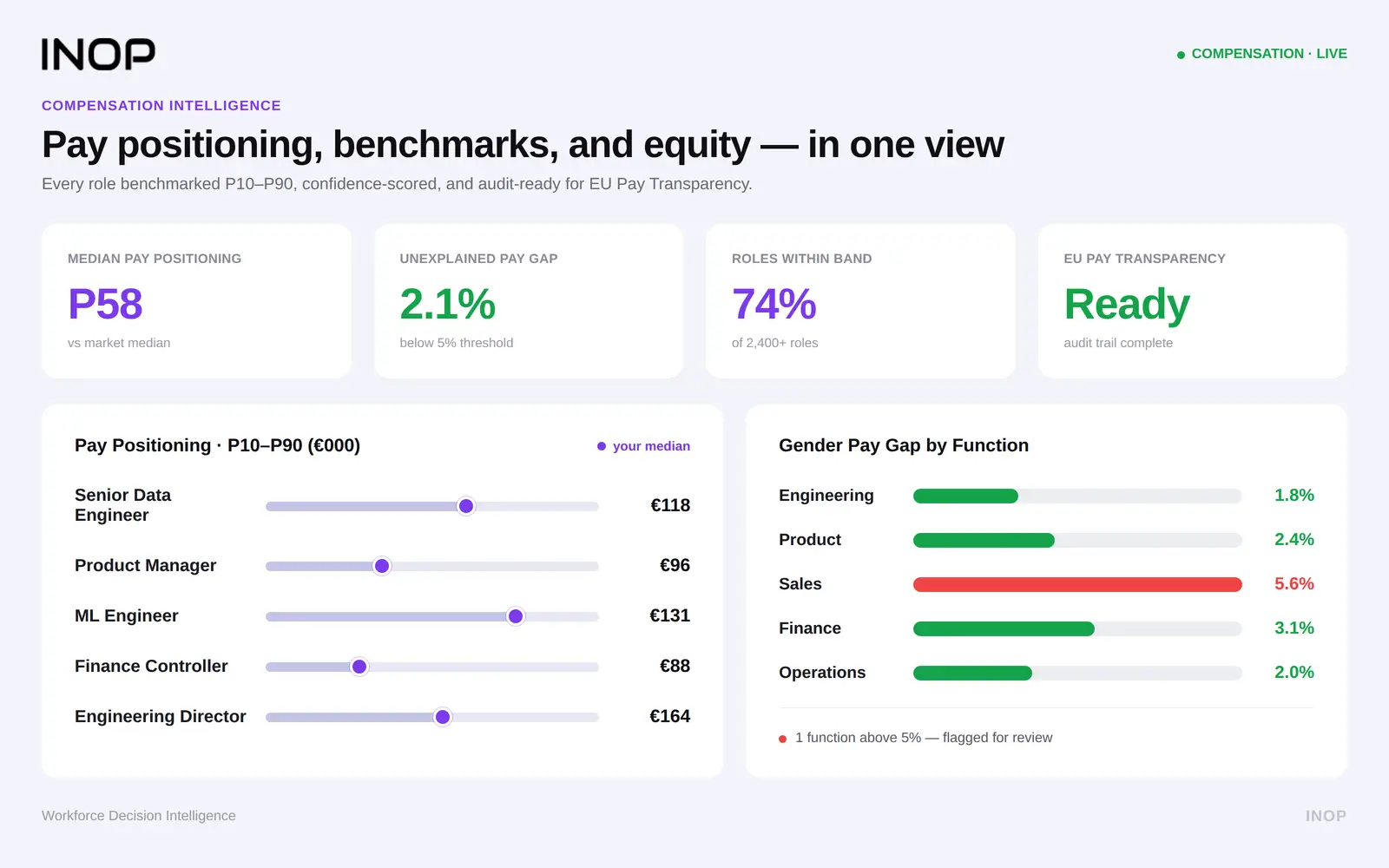
The validation gap matters most for the decisions with the highest stakes: promotion and succession decisions where a skills profile that overstates capability produces a visible, expensive failure; redeployment decisions where an understated profile leaves capability on the table; and compensation decisions where unvalidated skills data creates equity exposure rather than reducing it.
The organizations in the case studies above achieved high validation coverage through three common mechanisms: connecting assessment triggers to existing workflows (project completion, certification, performance review) rather than running standalone assessment campaigns; involving managers in validation as a standard part of team development conversations rather than as a separate HR process; and giving employees direct visibility into their own validated profile, which creates a strong individual incentive to ensure accuracy. The employees most motivated to update their profiles are those who can see that an accurate profile generates better internal opportunities.
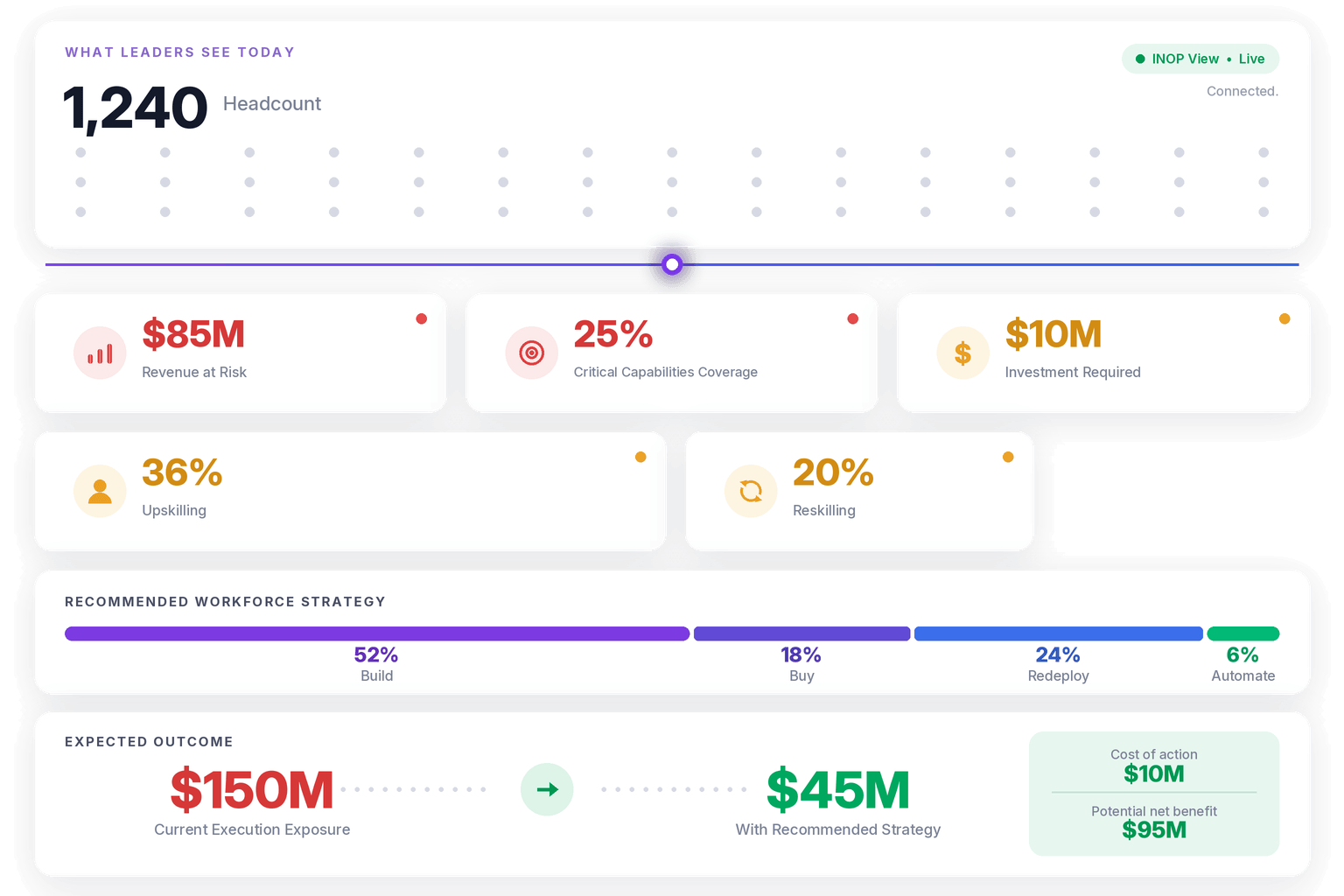
These outcomes started with the same question every workforce planning case study answers first: where are the gaps, and what’s the fastest path to closing them? Book a demo to see how INOP’s strategic workforce planning platform models build, buy, redeploy, and automate pathways for your own organization.
Choosing the Right Technology: What the Case Studies Tell Us About Platform Selection
One pattern visible across all four case studies is that technology was never the hero of the story. The healthcare system did not succeed because it had the most sophisticated AI. The financial services firm did not achieve a 287% ROI because its platform had more features than competitors. In every case, the technology worked because it was matched to a clearly defined business problem and deployed with strong governance, data quality investment, and leadership commitment behind it.
That said, platform selection still matters significantly. The organizations in these case studies that chose tools optimized for their specific use case, whether internal talent marketplaces, AI skill mapping, or strategic scenario modeling, consistently outperformed those that selected platforms based on brand recognition or feature breadth alone. The manufacturing case study in particular illustrated the cost of misalignment: their first platform selection failed because it was designed for knowledge workers and could not handle the equipment certifications and physical competency tracking their environment required. Switching to a purpose-built solution added eighteen months to their timeline.
For organizations at the beginning of this journey, a structured evaluation of top platforms for skills intelligence provides a practical starting point. The landscape in 2026 spans enterprise-grade solutions built for multinational complexity, mid-market platforms optimized for speed of deployment, and specialized tools for industries like manufacturing, healthcare, and financial services where skills taxonomies require domain-specific precision. Understanding which category fits your organization before entering procurement conversations is one of the highest-leverage decisions in a skills-based planning initiative.
Workforce Planning Failure Case Studies: What Goes Wrong and Why
Understanding where workforce planning initiatives fail is as strategically important as studying their successes. For HR and finance leaders building an internal business case, failure patterns often carry more persuasive weight than ROI projections, they make the cost of inaction concrete.
Failure Pattern One: Technology Before Strategy
The most common workforce planning failure pattern documented across multiple enterprise implementations follows a predictable sequence: an organization purchases a sophisticated skills intelligence or workforce planning platform, attempts to deploy it against unclear or poorly defined business questions, and concludes after 12–18 months that “the technology didn’t work.” In most documented cases, the technology was not the failure. The failure was the absence of a defined problem the technology was meant to solve.
Organizations that avoided this pattern shared one characteristic: they spent 3–6 months defining their specific workforce planning questions, which roles are hardest to fill, which skills are disappearing through attrition, which business units are most exposed to workforce risk, before selecting any technology. Those that skipped this phase spent their implementation budget building a data infrastructure nobody used for decisions.
Failure Pattern Two: The Stale Skills Inventory Problem
A specific failure mode documented in manufacturing, healthcare, and financial services organizations is the “one-time mapping” trap. An organization invests significantly in a comprehensive skills inventory, involving manager assessments, employee self-reporting, and external validation, then treats the output as a durable asset rather than a perishable one. Within 12–18 months, role requirements have shifted, employees have developed new skills, and the inventory is materially inaccurate. Decisions made from stale data produce worse outcomes than decisions made with no data, because they create false confidence.
Organizations that avoided this built update triggers into their operating model: skills profiles refreshed at performance review cycles, changes triggered by project completion and certification, and annual strategic reviews that realigned the taxonomy to evolving business priorities.
Failure Pattern Three: Manager Incentive Misalignment
One of the most consistently underestimated failure risks in workforce planning implementations is middle manager resistance to internal mobility. Organizations build internal talent marketplaces and skills matching systems, then discover that managers whose performance metrics are built around team output are actively blocking their best people from moving. A high-performing analyst whose skills match an opening in another division is a talent mobility success story at the organizational level and a loss at the team level.
Several documented implementations stalled because the governance model changed how talent was managed without changing how managers were measured. The organizations that successfully navigated this redesigned manager performance metrics to reward talent development and internal mobility, making it in a manager’s interest to develop people beyond their current role rather than retain them indefinitely.
Workforce Planning Failure Statistics
Workforce planning initiatives have a documented failure rate that organizations rarely discuss publicly. Based on analyst research and post-implementation reviews:
Between 50–70% of large-scale HR technology implementations fail to achieve their stated objectives within the planned timeframe, according to research from Gartner and McKinsey. The primary failure drivers are misaligned stakeholder expectations, insufficient change management investment, and poor data quality, in that order. Skills-based workforce planning initiatives specifically carry a higher-than-average change management burden because they require behavior changes from managers, employees, and executives simultaneously, not just a new system adoption.
Organizations that budget change management at less than 20% of total implementation cost report significantly higher failure rates than those that invest proportionally. The technology is rarely the constraint.
Measuring Skills Planning ROI: What the Data Shows
Organizations naturally want to understand the financial return on workforce planning investments before committing resources. The workforce planning case studies examined here provide concrete frameworks for calculating skills planning ROI.
Hard Cost Savings:
- Reduced external hiring costs, typically ranging from 30-60% depending on role scarcity
- Lower recruiting fees, background checks, and onboarding expenses
- Decreased reliance on expensive contractors and temporary staff
- Reduced turnover costs when employees see clear internal career pathways
Productivity and Performance Gains:
- Faster time-to-productivity when internally mobile employees already understand company culture and systems
- Better role-fit leading to higher performance, typically improving individual productivity by 15-25%
- Reduced vacancy costs when positions can be filled internally within weeks rather than months
- Improved project outcomes when the right skills are available at the right time
Strategic Benefits:
- Increased organizational agility allowing faster response to market opportunities
- Reduced business risk from critical skill shortages
- Enhanced employer brand making future external recruiting more effective and less costly
- Improved employee engagement and retention, with measurable impacts on productivity and customer satisfaction
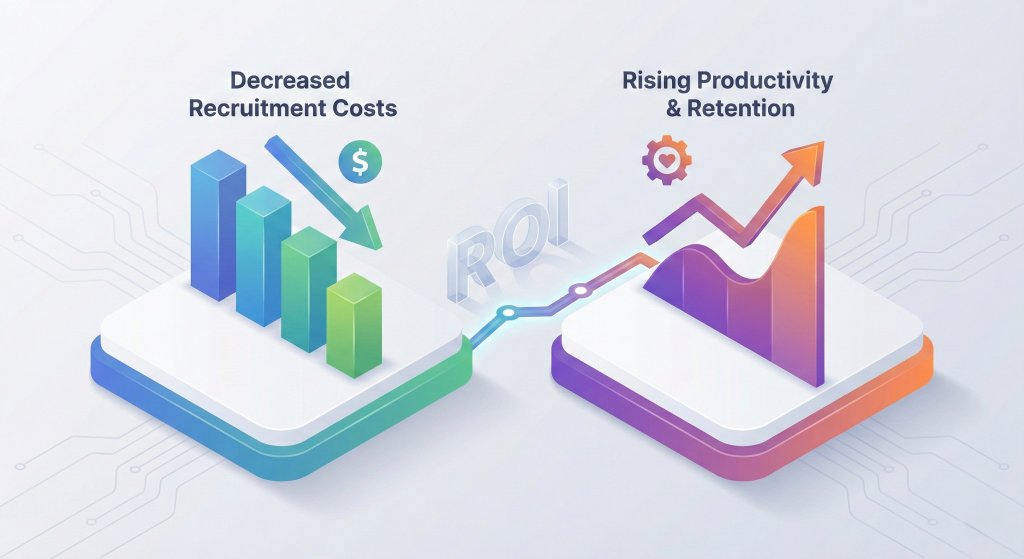
Organizations typically calculate skills planning ROI over a two to three-year period, comparing total investment in technology, process redesign, training, and program management against quantified benefits across these categories. The workforce planning case studies examined here showed ROI ranging from 240% to 420%, with payback periods typically between nine and eighteen months.
Building the Business Case for Skills-Based Workforce Planning: What Gets It Approved
The case studies in this article document outcomes ranging from 240% to 420% ROI. Presenting that data to a CFO or CEO without a structured business case framework rarely produces an investment decision. Here is what the business case needs to contain to move from persuasive to actionable.
Frame the Cost of Inaction First
Most workforce planning investment proposals fail because they present the cost of the solution before establishing the cost of the current state. The CFO’s first instinct when presented with a platform investment is to ask why the current process is insufficient. The business case that gets approved leads with the answer to that question in financial terms.
The current-state cost calculation has three components. First, the external hiring premium: what percentage of your open roles are filled externally that could be filled internally with better skills visibility, and what is the fully loaded cost differential between the two routes at current fill rates? For an organization making 200 professional hires annually where 40% could be internal matches, the premium at $10,000 per external hire differential typically runs $800,000 annually. Second, the vacancy productivity cost: at $500 per day per open role in lost output, a portfolio of 50 concurrent vacancies across an average 60-day cycle costs $1.5 million annually in productivity. Third, the planning error cost: what is the financial impact of workforce planning decisions made on stale or incomplete data in the last 12 months? Delayed initiatives, emergency contractor spend, and skills gaps that surfaced as delivery crises all belong in this calculation.
The business case is won when the CFO can see that the cost of the current state exceeds the investment being proposed before the ROI of the proposed solution is ever discussed.
Connect to Decisions Finance Is Already Making
The investment case for skills-based workforce planning is most compelling when it connects directly to financial planning decisions the CFO is already facing rather than asking Finance to evaluate a new category of investment on its own terms.
If the company is planning a significant product launch that requires capabilities not clearly visible in the current workforce, the skills planning investment is reframed as risk reduction for that specific initiative. If the company is preparing for a restructuring or acquisition where workforce cost optimization is a stated objective, skills-based planning is reframed as the data infrastructure that makes that optimization accurate rather than arbitrary. If the company is facing ESG or human capital disclosure requirements, skills-based planning is reframed as the governance infrastructure that satisfies those requirements at lower manual cost than current approaches.
Finance approves investments that solve problems they already own. The workforce planning business case that connects to a financial problem Finance is actively worried about has a significantly higher approval rate than one that asks Finance to accept HR’s definition of the problem.
The Phased Investment Structure That Reduces Approval Risk
Large platform investments face approval friction even when the ROI case is strong. A phased investment structure that begins with a defined pilot and a pre-agreed decision gate for expansion significantly reduces that friction.
The pilot scope should be one business unit or function where the skills data quality is highest, the leadership sponsor is most engaged, and the business problem the initiative is solving is most acute. Propose a six-month pilot with three defined success metrics agreed in advance with Finance, and a decision gate at month six where expansion funding is approved or declined based on those metrics. This structure converts a large, uncertain investment into a small, bounded one with a defined evaluation process, which is a fundamentally different risk profile for a CFO to approve.
What Business Outcomes Have Organizations Achieved by Operationalizing Workforce Intelligence?
This question surfaces consistently across HR, Finance, and People Analytics leadership — each function framing the same underlying need differently. Here is how the outcomes from these workforce planning case studies map to each audience’s specific priorities.
For VP and Director of Workforce Planning: Scenario Modeling That Reaches the Business
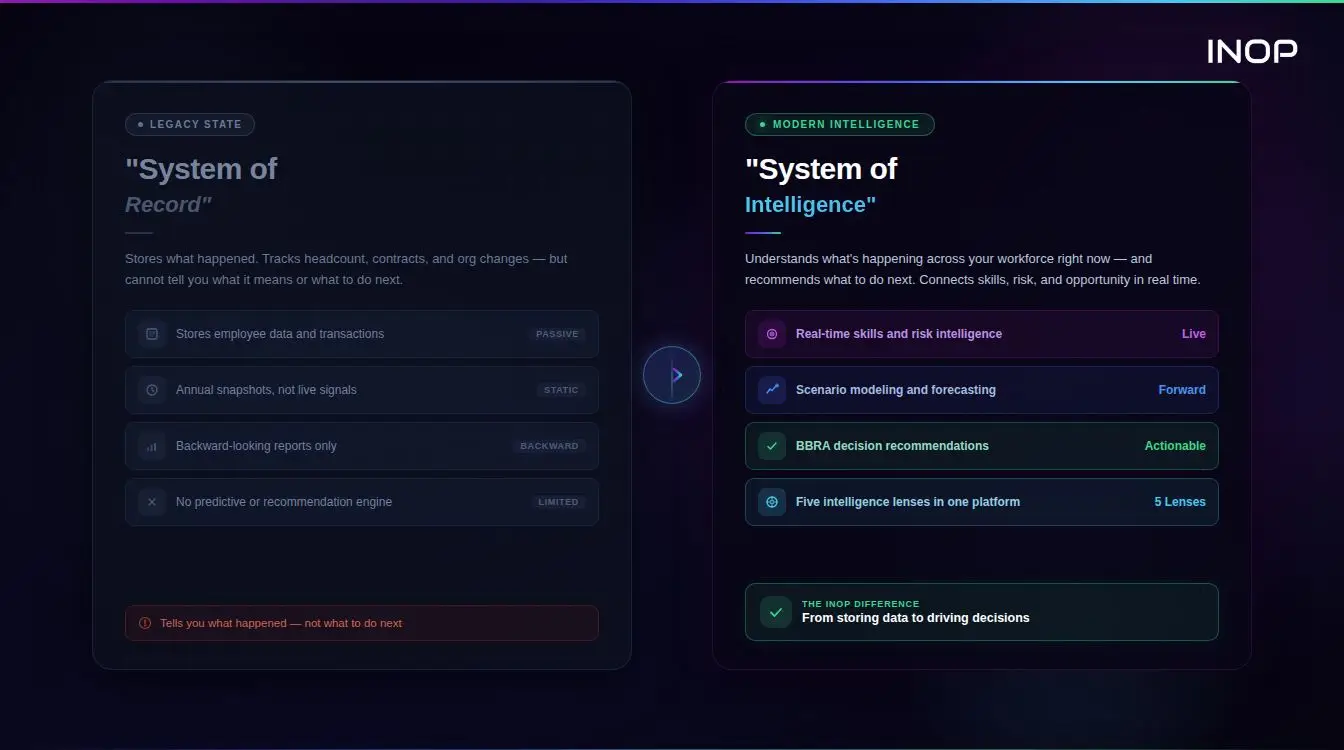
The primary frustration of workforce planning leaders is building models that don’t reach decision-makers in time to matter. The technology company case study above demonstrated what changes when planning infrastructure is current: a 63% reduction in time-to-fill came not from better recruiting, but from scenario modeling that identified internal candidates weeks before a vacancy became critical. The planning team had visibility into role requirements and internal skill proximity in real time — not from a quarterly data export, but from a live skills intelligence layer connected to the business.
The specific outcome for workforce planning functions: the ability to move from annual planning cycles to continuous planning, where headcount and skills forecasts update as business conditions change rather than waiting for the next planning season.
For CHROs and Chief People Officers: Connecting Workforce Strategy to Business Outcomes
The credibility challenge for CHROs is demonstrating that workforce investments produce measurable business results — not HR metrics that finance doesn’t trust. The financial services case study is the clearest example: a 287% ROI calculated in financial terms (not engagement scores), a 2.3% improvement in risk-adjusted investment returns directly attributed to the internal data science capability built through skills-based development, and a retention rate that eliminated a recurring external hiring cost line.
The manufacturing case study demonstrates the board-level outcome: digital transformation delivered at 52% of projected cost, with workforce capability developed internally rather than purchased externally. When the CEO presents this outcome to the board, it is a capital allocation success story — not an HR report.
For CFOs and FP&A Leaders: Audit-Ready Workforce Cost Data
The CFO’s workforce intelligence problem is structural: HR data and financial data live in different systems, update on different cycles, and use different definitions of “headcount.” This makes workforce cost forecasting a manual reconciliation exercise rather than a live financial instrument. The healthcare case study illustrated what audit-ready workforce intelligence looks like in practice: 2,847 employees redeployed in three weeks, with documented skills-to-role matching records that justified every deployment decision. The $31M in avoided temporary staffing costs was not an estimate — it was a line-item comparison against industry peers that appeared in the CFO’s quarterly report.
For PE portfolio companies specifically, this auditability matters beyond operational management: workforce cost governance and skills data integrity are increasingly components of human capital due diligence in transactions, and organizations with structured workforce intelligence infrastructure command higher multiples.
For People Analytics Leaders: Trusted Data That Reaches Decisions
The people analytics credibility problem is data quality: when business leaders don’t trust the skills data, they don’t act on the insights. Every case study examined here succeeded because the organizations invested in multi-source skills validation — not self-assessments alone, but manager confirmation, project evidence, assessment results, and certification records combined. The result was a skills data layer that finance and operations trusted enough to base significant capital decisions on. That trust is not a soft outcome. It is the difference between an analytics function that influences strategy and one that produces reports nobody reads.
Implementing Skills-Based Workforce Planning: Lessons from Successful Organizations
If you’re considering a skills-based approach in your organization, these workforce planning case studies offer practical guidance:
Start with Strategic Skill Priorities: Don’t attempt to map every skill across your entire organization initially. Identify three to five critical skill areas aligned with your business strategy where skills gaps represent the greatest risk or opportunity. Demonstrate success in focused areas before expanding.
Invest in Quality Skills Data: Superficial self-assessments produce unreliable results. Successful organizations used multi-method approaches including validated assessments, manager input, project-based demonstrations, and increasingly, ai skill mapping workforce planning solutions that analyze work artifacts and patterns. Quality data is foundational, decisions are only as good as the skills intelligence they’re based on.
Design for Employee Benefit, Not Just Organizational Efficiency: Skills-based approaches can feel invasive or threatening if positioned poorly. Successful implementations emphasized employee benefits, career development opportunities, recognition for hidden capabilities, and autonomy over career direction. When employees saw personal value, adoption accelerated dramatically.
Build Manager Capability: Middle managers often feel threatened by skills-based approaches, fearing they’ll lose team members to internal mobility. Successful organizations addressed this directly, changing performance metrics to reward managers who developed talent and supported internal movement rather than hoarding high performers.
Create Supporting Systems: Skills visibility alone doesn’t drive change. Organizations needed complementary systems, internal talent marketplaces, skills-based project staffing, transparent career frameworks, accessible learning resources, and compensation approaches that rewarded skills development rather than just tenure and title progression.
Plan for Continuous Evolution: Skills requirements change constantly. One-time mapping exercises become outdated quickly. Successful organizations built ongoing processes for skills refresh, continuous learning, and regular alignment between business strategy and workforce capabilities.
Overcoming Common Implementation Challenges
The workforce planning case studies also revealed common obstacles and how successful organizations addressed them:
Skills Taxonomy Complexity: Creating a consistent, meaningful framework for describing skills proved challenging. Organizations solved this by starting with industry-standard frameworks then customizing based on their specific context, rather than building completely from scratch.
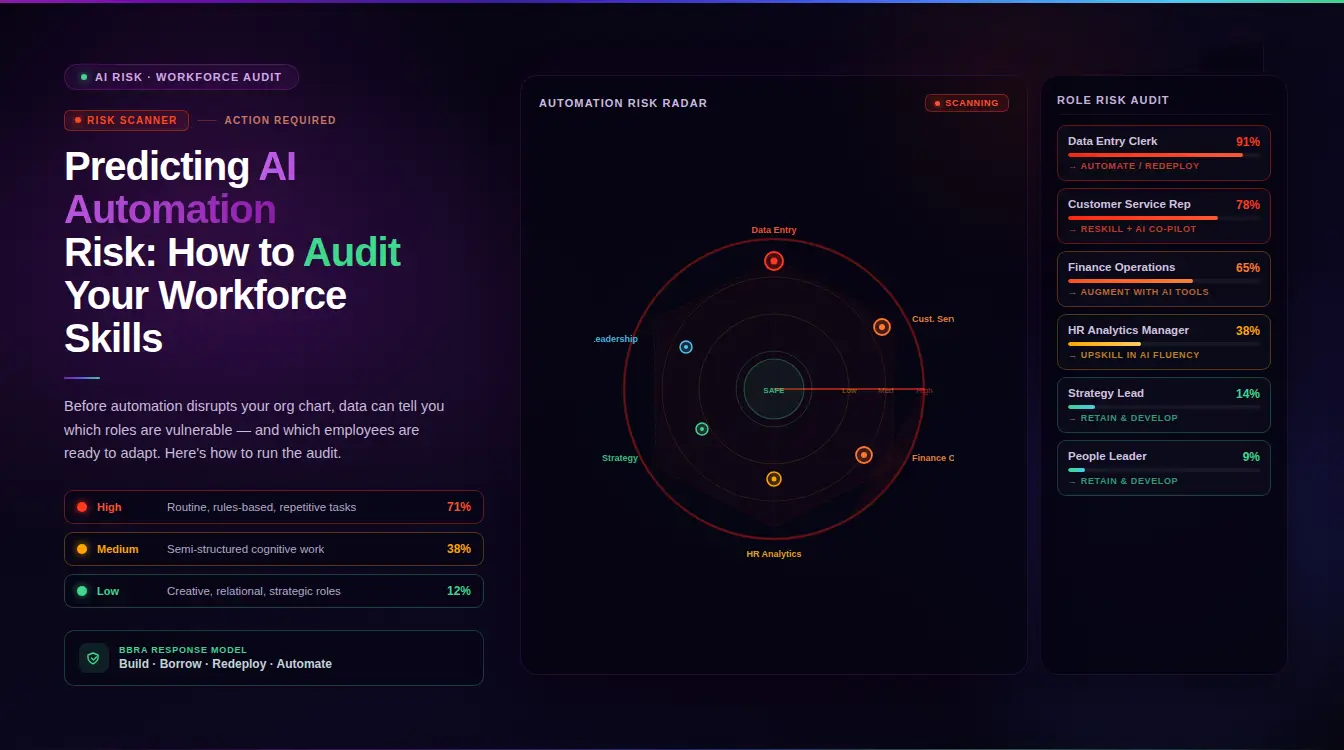
Data Privacy Concerns: Employees worried about how skills data might be used, particularly regarding automation decisions. Transparent governance, clear usage policies, and demonstrable benefits for employees built trust over time.
Manager Resistance: Some managers viewed skills-based planning as threatening their authority or potentially depleting their teams. Change management focused on redefining success, managers who developed talent and supported internal mobility were recognized and rewarded.
Technology Integration: Skills platforms needed to connect with existing HR systems, learning management systems, and business tools. Organizations that approached this as an enterprise integration challenge rather than a standalone HR technology saw smoother implementations.
Maintaining Momentum: Initial enthusiasm sometimes waned as implementation challenges emerged. Successful organizations maintained visible executive sponsorship, celebrated early wins, and continuously communicated progress and impact.
The Future of Skills-Based Workforce Planning
The workforce planning case studies examined here represent early adopters who have realized significant benefits. As technology advances and competitive pressures intensify, skills-based approaches will likely become standard practice rather than innovative experiments.
Emerging trends include:
- Artificial intelligence that continuously maps skills from work artifacts, communications, and project outcomes rather than requiring manual updates
- Real-time skills marketplaces that match people to projects, gigs, and opportunities dynamically
- Skills-based compensation that rewards capabilities and impact rather than titles and tenure
- Predictive analytics that forecast skill supply and demand with increasing accuracy
- External skills credentials and blockchain-verified competencies that increase workforce portability
Organizations investing in skills-based workforce planning tools and processes now are building capabilities that will become increasingly strategic as these trends mature.
Skills-Based Planning for Hourly and Deskless Workforces
Most workforce planning technology is designed around knowledge workers, salaried, white-collar employees with digital work footprints that AI systems can analyze. The deskless and hourly workforce presents a different challenge: employees who don’t use computers in their daily work, whose skills are demonstrated physically rather than digitally, and whose role requirements are defined by certifications, qualifications, and demonstrated task competency rather than knowledge domain proficiency.
Platforms like Kahuna are built specifically for this environment, designed for manufacturing, energy, utilities, and field services organizations where skills mapping must account for equipment qualifications, safety certifications, physical task competencies, and compliance requirements. Kahuna’s gap analysis tools map employee qualifications against role requirements at the task level, identifying which workers are qualified to perform specific operations and which require additional training or certification before deployment.
The manufacturing case study examined earlier in this article illustrates why this precision matters: when 78% of digital skills were developed internally, the success depended on mapping specific technical competencies, IoT sensor configuration, predictive maintenance diagnostics, robotic system operation, to individual employees’ existing mechanical backgrounds. For organizations managing large hourly workforces, skill-to-role mapping at this granularity is not a nice-to-have; it is a compliance and safety requirement as much as a planning one.
suggested Article: Crucial Emerging AI Skills: 2026–2030
Conclusion
The workforce planning case studies explored in this article demonstrate that skills-based approaches deliver measurable business value across diverse industries and organizational contexts. From reducing time-to-fill by more than 60% to enabling crisis response at scale, from building critical capabilities internally to facilitating digital transformation, these real-world examples provide compelling evidence that skills-based workforce planning represents more than theoretical best practice, it’s a proven strategy with quantifiable returns.
The skills planning ROI documented here (ranging from 240% to 420% with payback periods under two years) makes a strong financial case for investment. But beyond the numbers, these workforce planning case studies reveal something more fundamental: organizations that see their people as dynamic portfolios of capabilities rather than fixed resources in job boxes create more resilient, agile, and human-centered workplaces.
Whether you’re facing skills shortages, preparing for technological disruption, seeking to improve internal mobility, or simply looking to maximize the potential of your existing workforce, the evidence from these successful implementations provides a roadmap. Start with clear business priorities, invest in quality skills intelligence through appropriate skills-based workforce planning tools, design with employee benefit in mind, and build the supporting systems that enable skills-based decisions to become embedded in how your organization operates.
The future of work is skills-based. These workforce planning case studies show that future is already delivering results for organizations bold enough to transform how they plan, develop, and deploy their most valuable asset, their people’s capabilities. What will your organization’s skills-based success story look like?
We’d love to hear about your experiences with workforce planning transformation. Have you implemented skills-based approaches in your organization? What challenges and successes have you encountered? Share your thoughts in the comments below, or explore our related resources on building skills-based workforce strategies that deliver measurable business impact.
Frequently Asked Questions
What solutions combine AI skill mapping with workforce planning?
Modern organizations use AI skill mapping workforce planning solutions (like talent intelligence platforms) to automatically analyze, verify, and categorize employee capabilities. AI infers actual skill levels from an employee’s daily work patterns, project histories, and performance data rather than relying solely on subjective self-assessments. The software uses scenario modeling and pattern recognition at scale to forecast which skills will be needed to execute future business strategies, matching an employee’s verified skill profile directly to open internal projects or lateral roles to instantly reduce external hiring.
What are examples of successful strategic workforce planning outcomes?
Transitioning to a skills-based workforce planning model delivers massive, measurable ROI across the entire business. Key outcomes include drastically reduced time-to-fill (e.g., cutting hiring time for critical technical roles from 127 days to 47 days), multi-million dollar cost savings through internal redeployment during operational shifts, and significantly higher retention rates by building transparent upskilling pathways.
What’s an example of a company that’s been successful in skills-first hiring?
A prime example of skills-first success is a mid-sized investment management firm that needed expensive, highly competitive data scientists. Instead of competing in a crowded external hiring market, they mapped internal quantitative skills among financial analysts and built a targeted upskilling track, building their data science capabilities at 40% of the external cost while achieving a 287% ROI.
What is the typical timeframe to see measurable results from skills-based workforce planning?
Most organizations begin seeing initial operational wins—such as faster internal mobility and reduced time-to-fill—within 3 to 6 months of implementing skills mapping. Full financial ROI and significant cost reductions on external recruitment typically materialize within 9 to 18 months.
How do small and medium-sized organizations implement skills-based planning without large technology investments?
Smaller organizations can start by focusing on 3 to 5 critical skill areas aligned with immediate strategic goals rather than mapping the entire workforce at once. They can utilize lightweight skills assessment tools, manager validations, and targeted internal talent marketplaces before scaling up to complex AI-driven workforce intelligence platforms.
How do you maintain skills data accuracy as capabilities constantly evolve?
Data accuracy is maintained by treating skills profiles as live, dynamic records rather than static annual reviews. Organizations integrate skills platforms with day-to-day work tools, learning management systems (LMS), project outputs, and manager validations so that newly acquired competencies, certifications, and project experiences update automatically in real time.
What’s the difference between competency management and skills-based workforce planning?
Competency management generally focuses on broad, static behaviors, traits, and role requirements tied to specific job titles. Skills-based workforce planning breaks down roles into granular, transferable skill units that can be dynamic, continuously verified, and mapped against future strategic market demands and business scenarios.
How do you handle employees who overestimate their skill levels during self-assessments?
To prevent bias and miscalibration, successful implementations combine self-assessments with multi-method verification. This includes manager calibration, peer feedback, project-based demonstrations, technical assessments, and AI tools that analyze actual work artifacts and project deliverables rather than relying solely on self-reported ratings.
Can skills-based workforce planning work in highly regulated industries with rigid job classifications?
Yes. In highly regulated sectors like healthcare or financial services, skills-based planning operates alongside formal job titles and compliance requirements. By mapping underlying transferable skills and certifications within rigid job frameworks, organizations can rapidly identify qualified internal talent for redeployment during demand shifts while fully maintaining regulatory and compliance standards.