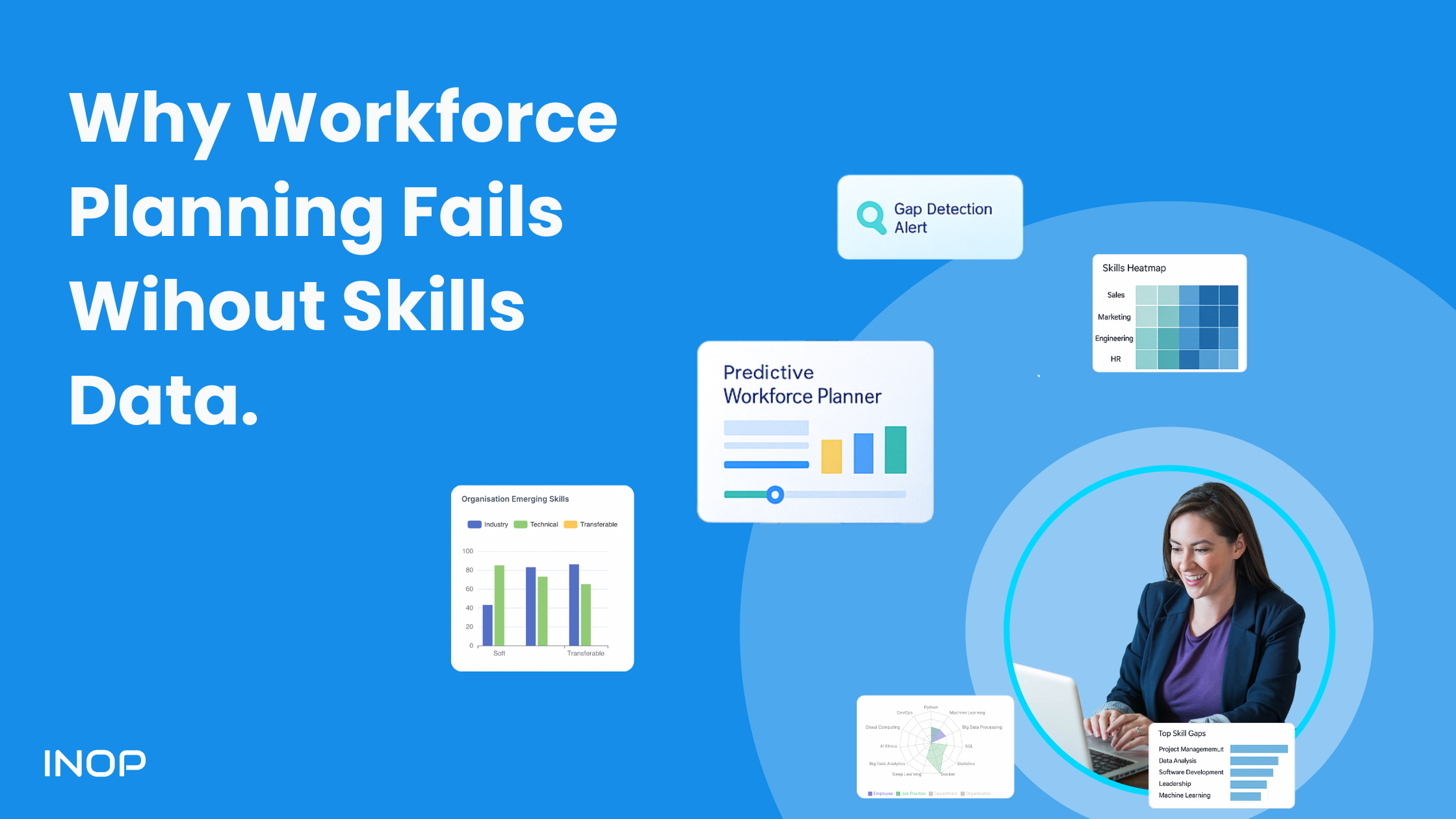
Research carried out by MuchSkills and referencing the World Economic Forum shows that just 8 per cent of organizations possess reliable data regarding the skills currently held by their workforce. This figure accounts for a large part of the problems facing workforce planning in 2026. Although companies are purchasing AI-powered workforce planning tools, developing complex scenario models, and investing in new HRIS platforms, they are feeding all of this with skills data that is inaccurate, incomplete, or more than 18 months old. The result is the creation of plans that look sophisticated but are based on a foundation which cannot support the decisions that those plans are meant to inform.
The 2025 Future of Jobs Report by the World Economic Forum shows that 39% of workers’ core skills are expected to change by 2030, and 63% of employers currently see skills gaps as the main obstacle to business transformation. According to Gartner’s 2025 HR Leaders survey, workforce planning is regarded as the second most important HR capability for 2026, with AI literacy being the only one ranked above it. The importance of the strategic issue has never been greater. The data foundation has never been in such a poor state.
The article explains why skills data is the most common failing point among workforce plans, the particular ways in which this failure is reflected in organizational and financial results, and what is in reality required to build a skills data foundation that can support workforce decisions.
Want to see how verified skills data connects to workforce decisions instead of sitting in a separate system? Book a 20-minute demo with INOP.
What Workforce Planning Without Skills Data Actually Produces
A workforce plan built on headcount and job titles answers the question: how many people do we have in each role? It does not answer the question that matters for execution: do those people have the capability the business plan requires?
Two employees with the same title, “Senior Data Analyst,” can have completely different capability profiles. One holds advanced Python, builds machine learning pipelines, and speaks to business stakeholders confidently. The other has strong SQL and Excel, performs historical reporting, and has never worked in a production ML environment. A headcount model treats them identically. A workforce plan built on their titles treats the function as fully staffed. A plan built on verified skills data shows a material gap between current capability and what the next 12 months of the business plan requires.
This is not a niche edge case. Only 55% of organizations regularly conduct skills assessments as part of their planning process, according to SHRM 2025. For the remaining 45%, workforce planning is producing headcount projections with no capability dimension. Finance approves the headcount. HR opens the requisitions. The hires arrive. And the capability gap that no model surfaced shows up in the first quarterly business review as a delivery problem, a project delay, or a budget overrun attributed to external consultants filling what internal capability should have covered.
Why Most Workforce Planning Frameworks Were Never Built for Skills Data
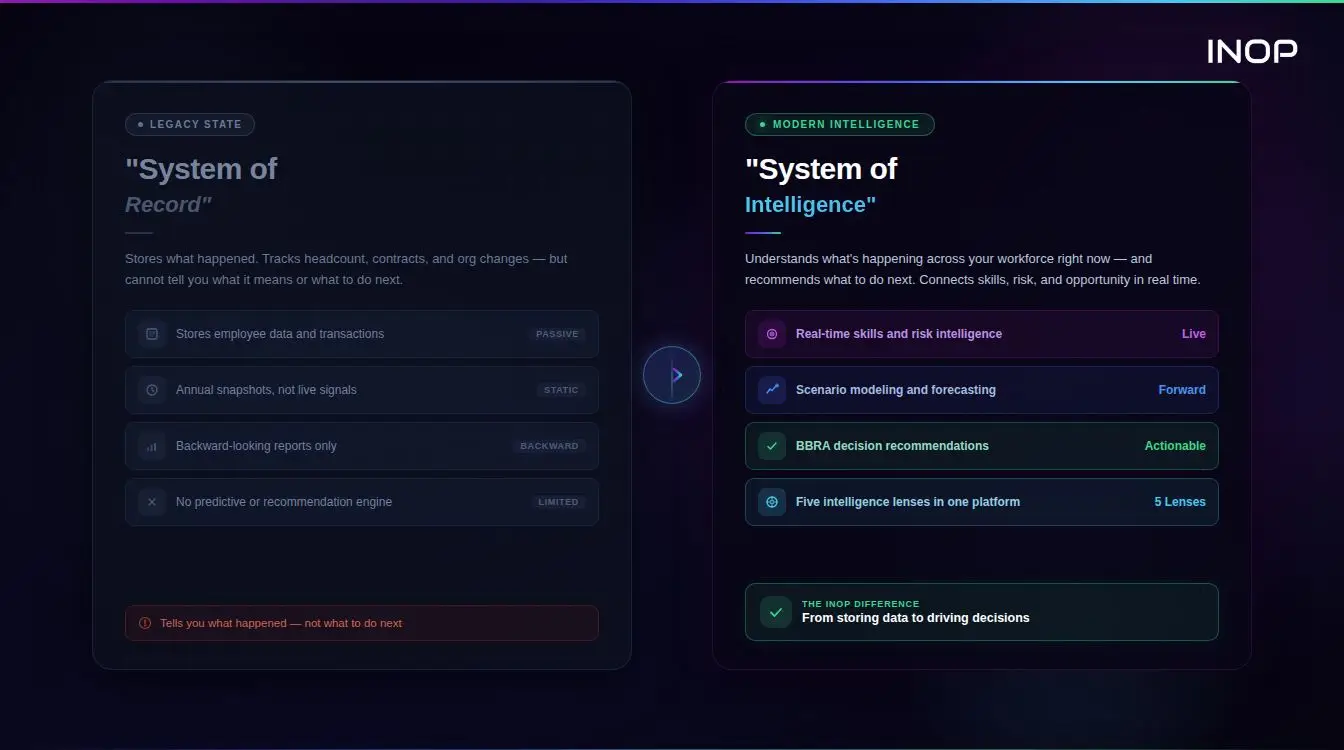
The failure is not primarily behavioral — it is structural. Most workforce planning frameworks in current use were designed before skills data was a tractable organizational input. They were built for headcount: how many people, at what cost, in which function, by when. Skills appeared in these frameworks as a qualitative layer — competency matrices built once and reviewed annually, described in aspirational language that did not connect to actual assessment data.
Only 12% of HR teams plan strategically beyond 12 months, according to McKinsey 2025. The same frameworks that produce short-horizon headcount plans were not redesigned when skills data became available. They absorbed skills vocabulary, adding skill-gap analysis sections and learning investment rows, without redesigning the underlying logic. Skills references in a headcount-based framework produce a more expensive version of the same plan. The inputs are different. The decisions are not.
A skills data infrastructure built on top of an unchanged planning framework is like installing a precision instrument in a vehicle that was never designed to use it. The reading is accurate. The vehicle does not respond to what it shows.
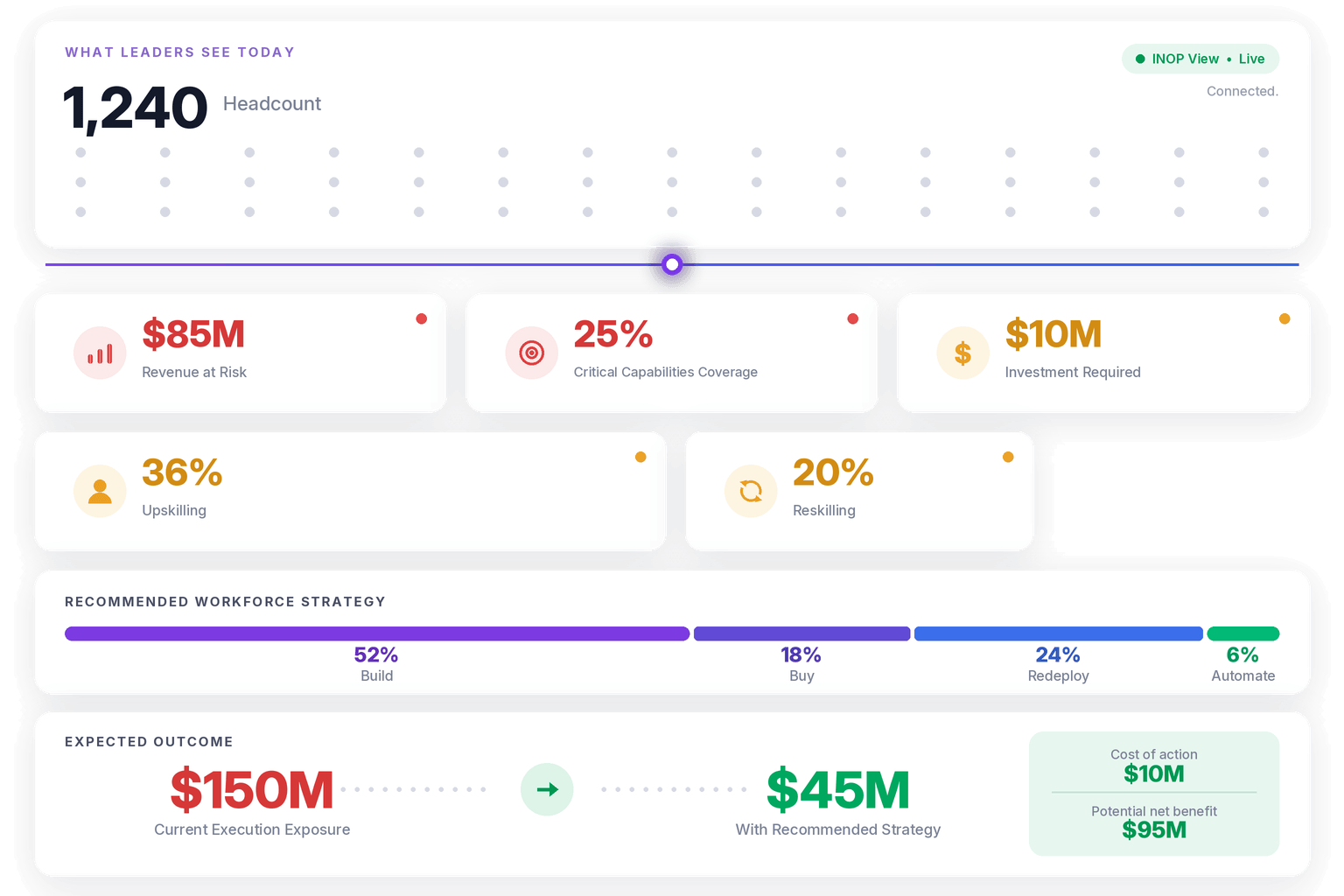
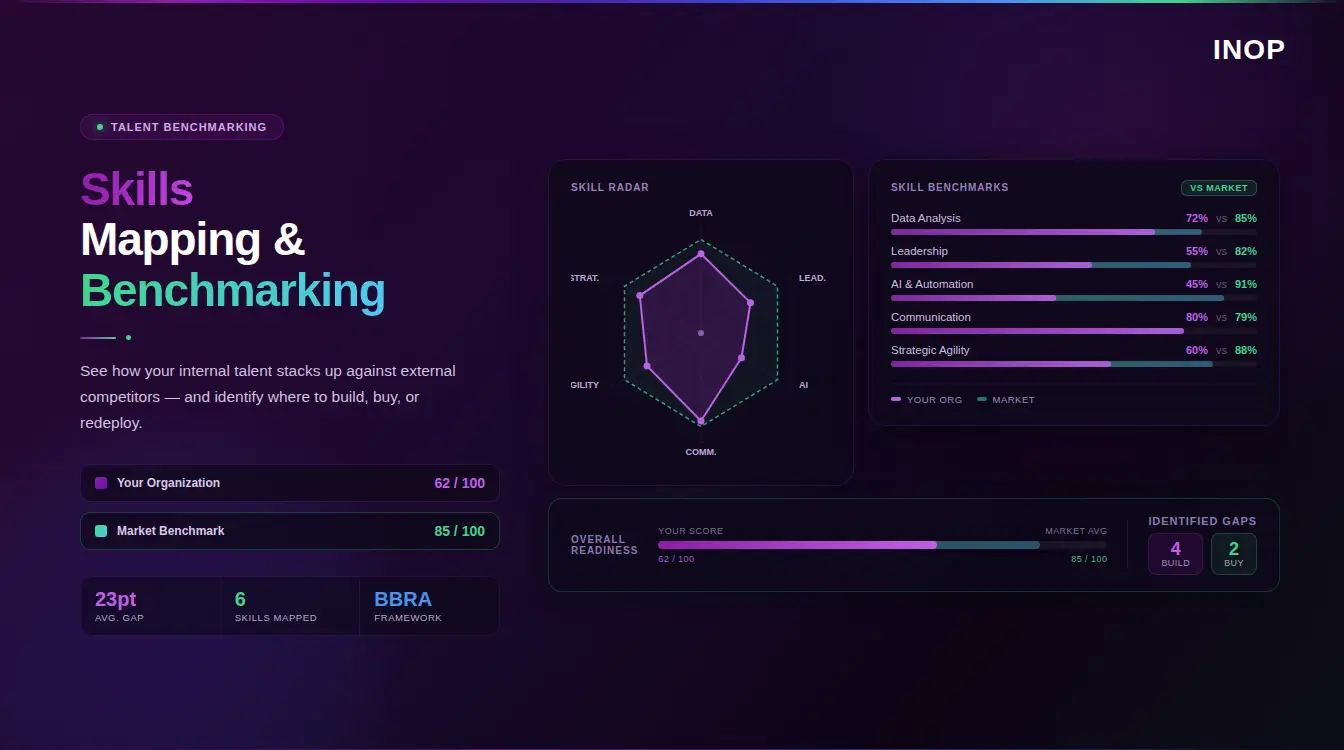
The redesign required is specific: demand forecasting needs to operate at the skills level rather than the role level, gap analysis needs to compare current verified capability against future strategic requirement rather than current titles against future titles, and the gap closure decision needs to evaluate Build, Buy, Redeploy, and Automate before defaulting to an open requisition. These are framework changes. A new data source fed into an old framework produces marginally better-informed versions of the same wrong decisions. For more on how modern workforce planning frameworks incorporate skills at the planning level rather than the reporting level, INOP’s guide on modern workforce forecasting covers the full structural shift.
The AI Workforce Planning Trap
AI workforce planning tools work by analysing patterns in workforce data to predict future needs, identify gaps, and model scenarios. Most organisations’ skills data is incomplete, outdated, or subjective. The tool is real. The data it is analyzing is not reliable.
The World Economic Forum’s Future of Jobs Survey 2025 found that 63% of employers consider skills gaps the single biggest barrier to business transformation. Organisations are deploying AI workforce planning technology without first fixing the data that would allow the AI to see their skills gaps clearly.
This produces a specific failure mode: organizations with AI-powered workforce planning tools that produce confident-looking outputs from low-quality inputs. The scenario model runs cleanly. The gap analysis chart renders beautifully. The underlying skills profiles it drew from are 14 months old, assembled from self-assessments that no manager validated, and missing entirely for the 30% of employees who did not complete the survey. The AI found patterns. The patterns are in the noise.
Fixing this requires addressing the data problem before the tool problem. An organization with clean, validated, continuously updated skills data can derive significant value from even a basic planning tool. An organization with a sophisticated AI platform running on unreliable skills data is producing sophisticated-looking guesses at significant cost.
How the Failure Shows Up in Practice
The Technology Firm: €650,000 and Six Months Lost
A mid-sized technology firm lacked visibility into its developers’ programming language proficiencies when it embarked on a large-scale software migration. Halfway through the project, the team discovered that only 30% of its developers had experience in the target language. The capability gap that a skills inventory would have surfaced in week one showed up in month four, when the project timeline had already been communicated to clients and the budget had been approved.
The consequences were direct and financial: project delays of over six months, additional training costs of €250,000, and vendor outsourcing fees of €400,000 to fill the gap that should not have existed. Total cost of missing skills data: €650,000, plus the client relationship cost of the delay that does not appear in any budget line.
The planning failure here was not that the organization hired wrong. It was that the workforce plan did not surface the gap between what the project required and what the workforce could actually do. A headcount plan that showed sufficient developer headcount looked complete. A skills-level plan would have shown it was not.
The Financial Services Firm: €1.2 Million Saved by Looking First
A global bank implemented a skills-mapping initiative before planning its project management capacity for the following year. The mapping revealed that 45% of its team leaders lacked formal project management training despite overseeing multi-million-euro initiatives. This gap had been invisible in the headcount model, which counted team leaders as fully capable because they held the right titles.
By targeting a tailored development programme to these specific individuals, the bank reduced project overruns by 25%, saved €1.2 million in corrective action costs, and improved employee satisfaction scores by 12%. The investment was in the skills assessment first, then in the targeted development. Without the assessment, the development spend would have been allocated generically, and the overruns would have continued.
The Finance-HR Disconnection
A failure mode that financial consequences make visible but that rarely gets attributed to its correct cause is budget misalignment between HR and Finance driven by disconnected planning data. HR builds a workforce plan from talent data. Finance builds a headcount budget from cost data. Neither plan contains skills data. Both plans are internally consistent. They are not consistent with each other or with the organization’s strategic capability requirements.
The reconciliation conversation that follows each planning cycle is not a data quality problem. It is an architectural problem: two functions building plans from different data with different logic and comparing outputs rather than building from shared inputs. Budget misalignment between HR and Finance, driven by disconnected planning tools, results in approved headcount plans that cannot actually be funded or workforce investments that miss business priorities. Skills data shared between both functions as the common input to a single planning process is the structural fix. Reconciliation after two separate plans are built is not.
The Four Planning Failures Skills Data Prevents
Failure 1: Headcount as a Proxy for Capability
Counting seats tells you how many people you have. It tells you nothing about what they can do. A customer success team of 12 with the right headcount but without the technical skills to support a newly launched enterprise product is not adequately staffed. A headcount plan says it is. A skills-level plan shows the gap specifically enough to address it before the product launches rather than after the first client escalation.
The specific planning error is treating roles within the same title as interchangeable. Workforce planning at the title level consistently overestimates capability supply, because it counts everyone in a role family as equivalent regardless of their actual proficiency distribution. Planning at the role-name level masks that shift entirely, because two employees with the same job title may have completely different skill profiles.
Failure 2: Relying on Outdated Job Descriptions
Job descriptions in most organizations were last reviewed when the role was last hired for, which in stable functions can mean the description is two to four years old. In fast-moving domains, a four-year-old job description describes a role that no longer exists in the form it was written. A cybersecurity analyst role from 2021 does not capture the cloud security, threat intelligence, and AI-assisted monitoring dimensions that the same role requires in 2026.
Workforce plans built on job descriptions inherit their staleness. The gap analysis compares current employees against a requirement that is itself out of date, producing gap findings that address yesterday’s problem rather than next year’s challenge. Real-time skills data, calibrated against external market demand signals rather than internal job descriptions, is what makes gap analysis forward-looking rather than retrospective.
Failure 3: Defaulting to External Hiring Before Evaluating Internal Options
Most workforce plans move from gap identification to requisition. The gap is identified, the headcount is requested, the job posting goes live. The Redeploy and Automate pathways that might close the same gap faster and at lower cost are not evaluated because the planning process has no mechanism to surface them.
Redeployment requires knowing which employees in other functions hold adjacent skills to the identified gap. Without a verified skills inventory, this knowledge does not exist in a searchable form. A skills database that shows a finance analyst holding intermediate Python skills, in a period where the data team needs Python capacity, converts an external hire decision into an internal redeployment decision. The same gap closes in weeks rather than months, at a fraction of the external hire cost, with higher retention probability because the redeployed employee already understands the organization.
Most workforce plans default to Build or Buy without evaluating Redeploy or Automate, which means they consistently overestimate headcount requirements and underestimate the potential of the existing workforce.
Failure 4: Reactive Hiring at a 19 to 30 Percent Premium
When workforce plans do not surface gaps far enough in advance to allow proactive sourcing, organizations fill roles under time pressure. Reactive hiring consistently runs 19% to 30% more expensive per hire than planned pipeline hiring in direct costs alone, before accounting for the productivity impact of extended vacancies and the quality impact of reduced selection rigor under deadline pressure.
For an organization making 200 professional hires annually at average salaries of $80,000, this premium represents $1.5 million to $2.4 million in avoidable annual spend. The premium is not a labor market problem. It is a planning horizon problem: skills gap identification that happens when a role becomes critical produces reactive hiring. Skills gap identification that happens 12 to 18 months before criticality produces proactive sourcing. The same talent market, different cost outcomes, driven entirely by how far in advance the gap was visible.
What Building a Skills Data Foundation Actually Requires
Step 1: Start With the Roles That Matter Most
Deloitte’s 2025 research identifies that 5% of roles in most organizations drive 95% of business impact. Start the skills inventory with those roles rather than attempting to map the entire organization simultaneously. A skills inventory that covers your 20 most strategically critical role families in depth is more useful for planning decisions than a shallow map of every role in the organization. It is also achievable in 90 days rather than 18 months, which means planning decisions can be made from real data before the first annual review cycle.
Step 2: Use Multiple Assessment Sources, Not Just Self-Report
Self-assessments reveal what employees believe about their skills. They do not reliably reveal what those employees can actually do under role-relevant conditions. Research consistently shows that self-reported proficiency overestimates actual capability in technical domains and underestimates it in behavioral ones. A skills inventory built on self-assessments alone produces exactly the kind of unreliable data that makes business leaders distrust workforce analytics.
Combining self-assessment with manager validation, structured technical assessments for critical skill domains, and learning platform completion data as a corroborating signal produces a profile that multiple data sources confirm. This multi-source approach typically reveals 15 to 20% more actual skill coverage than single-source assessment, because the combination catches both the employee who undersells their Python capability on a self-assessment and the one who oversells it. For a complete guide to how skills assessment methodology connects to workforce planning accuracy, INOP’s guide on skill gap analysis examples covers the assessment process in depth.
Step 3: Connect Internal Skills Data to External Market Signals
An internal skills inventory tells you what your workforce can do today. External market data tells you what that capability is worth, how scarce it is in the talent market, and whether it is growing or declining in demand. The two together answer the workforce planning questions that matter: which of our internal skills are becoming rare enough externally that losing them would be impossible to replace quickly? Which are in such high demand that employees who hold them face active external recruiting pressure? Which are declining in market relevance fast enough that investing in them is misdirected?
Without external calibration, skills data is a snapshot of current internal state. With it, skills data becomes a strategic planning input: it shows where the organization’s capability position is strong, where it is exposed, and where it is likely to face pressure before the next planning cycle surfaces it. INOP’s skills intelligence platform tracks external demand signal states for skills across four categories (Emerging, In Demand, Stable, and Declining) connecting internal inventory data to live market calibration rather than letting it drift against a static benchmark.
Step 4: Redesign Planning Workflows to Consume Skills Data
This is the step that most organizations omit, and that is the reason why investments in skills data usually fail to lead to improvements in outcomes even if the data itself is of a high quality. When skills data is fed into a planning workflow that has not been altered, it results in more informed headcount requests; it does not result in capability-based planning.
The changes needed in the workflow are particular. Demand planning should state future requirements in terms of skills rather than just in terms of job roles. Gap analysis should compare the skills currently verified with the future skills needed, not current job titles with future job titles. When making the gap closure decision, all four options (Build, Buy, Redeploy and Automate) should be evaluated before a requisition is opened. Also, budget scenarios should show the cost of each of the pathways so that Finance can treat workforce investment as a capital allocation decision, considering comparable alternatives rather than simply approving or denying headcount requests without any context.
Comparing Traditional and Skills-Driven Workforce Planning
| Dimension | Traditional Planning | Skills-Driven Planning |
|---|---|---|
| Primary input | Job titles and headcount | Verified skills profiles and capability levels |
| Gap identification | Role count vs. role requirement | Capability level vs. strategic requirement |
| Gap closure options evaluated | Hire or train | Build, Buy, Redeploy, or Automate |
| Planning horizon | 12 months (12% go beyond, per McKinsey 2025) | 18 to 36 months with quarterly refresh |
| Hiring approach | Reactive: 19-30% premium over planned hiring | Proactive pipeline: market-rate sourcing |
| Finance alignment | HR and Finance reconcile separate plans | Shared data layer; cost of each pathway modeled before budget decisions |
| Internal mobility rate | Low: redeployment option not visible without skills data | Target 30-40% of gaps closed internally |
| AI tool effectiveness | AI analyzes unreliable data; output quality limited | AI analyzes verified skills data; scenario modeling reliable |
Skills Data and DEI: A Structural Connection
Skills data plays a specific role in making workforce planning more equitable that extends beyond general DEI goals. By evaluating talent based on verified demonstrated capability rather than credentials, job title history, or institutional network, skills-based workforce planning reduces the structural advantage that traditional planning confers on employees who attended certain universities, worked at certain companies, or have managers who advocate vocally for them in talent reviews.
This matters particularly for internal mobility decisions. An employee whose verified skills profile shows genuine proximity to an open role’s requirements is surfaced by a skills-matching system regardless of whether their manager thought to nominate them. An employee whose credentials and title make them look qualified on paper is no longer automatically preferred over a non-traditional candidate whose skills are actually stronger. The planning process produces a more defensible, more equitable output when the input is capability evidence rather than credential and title proxy. For more on how skills-based approaches to internal talent identification connect to equity goals, INOP’s guide on spotting hidden talent inside your organization covers the identification methodology in detail.
Measuring the ROI of Skills-Driven Workforce Planning
Four metrics show whether skills data has improved workforce planning outcomes rather than simply added data infrastructure cost.
Forecast accuracy at six and twelve months measures whether the gap analysis the plan produced in January reflects what the organization actually needed by June and December. Organizations with mature skills-driven planning consistently report 20 to 35% improvement in forecast accuracy over headcount-based methods. Below 80% accuracy at six months signals that the gap between what the skills data shows and what the business actually needs is not being captured reliably.
Internal fill rate for planned gaps tracks what percentage of identified capability gaps were closed through internal redeployment rather than external hiring. An internal fill rate below 20% in an organization with a skills inventory suggests the data exists but the planning workflow is not using it to surface the redeployment option before requisitions open.
Reactive hiring ratio measures the percentage of filled roles that emerged as unplanned urgent requests versus roles that were in the workforce plan with adequate lead time for proactive sourcing. A ratio above 40% reactive indicates that the planning horizon is too short or that gaps are not being identified before they become critical.
Time to productivity for internal moves versus external hires tracks how much faster internally redeployed employees reach full effectiveness compared to external hires in equivalent gaps. Internally redeployed employees typically reach full productivity in 30 to 60 days versus 90 to 180 days for external hires. For roles where full productivity represents $200,000 in annual output, the 60-day productivity advantage on each internal move represents approximately $33,000 in value per placement.
Skills Data for Workforce Planning in PE Portfolio Companies
For operating partners in the private equity sector, the shortcomings resulting from skills-blind workforce planning are both concentrated and clearly evident in financial terms. When a portfolio company is acquired without having in place an infrastructure for skills data, there is an undetected risk relating to capability until the pressure of execution brings it to light.
It is during the 90-day period after the acquisition that this issue is most important. A workforce plan based on the historical headcount data of the acquired company informs the operating partner of the number of people in each department, but it does not indicate whether those people are able to carry out the value creation plan. Similarly, a digital transformation strategy that calls for 15 data engineers with production ML experience and that has been checked against an actual skills assessment of the engineering team will show whether that capability already exists within the company or whether it will be necessary to hire externally, a requirement that was not included in the original acquisition plan.
During the first 90 days, the operating partners who carry out a skills baseline always discover two things that lead to a change in the financial model. The first of these is that critical capability gaps become apparent only when execution fails—which the headcount plan wouldn’t have picked up until that point, and at that stage emergency hiring has to take place at premium rates. The second is hidden internal capability that is not detected by headcount planning: an employee in one department whose skills profile shows a real closeness to a gap in another department, enabling a redeployment within the company that cuts 90 to 120 days off the timeline and reduces external search costs per position by $50,000 to $150,000.
Across a portfolio, standardizing the skills data approach creates a comparative intelligence layer: operating partners can benchmark capability density across portfolio companies against the strategic requirements of each value creation plan, identify where the human capital risk is most concentrated, and allocate operating support accordingly. INOP’s strategic workforce planning platform supports this use case, providing rapid skills baseline assessment for portfolio companies connected to financial scenario modeling for gap closure decisions. For more on how workforce planning case studies document these outcomes across different industries, INOP’s guide on real-world skills-based workforce planning case studies covers verified outcomes in detail. Book a demo to see how INOP approaches skills-driven workforce planning for PE portfolio environments.
Ready to connect skills data to workforce decisions that Finance and the board can act on? See INOP’s workforce planning platform in a 20-minute demo.
Frequently Asked Questions
Why does workforce planning fail without skills data?
Workforce planning without skills data operates on job titles and headcount, inputs that show how many people you have in each role but say nothing about what those people can actually do. This produces four specific failures: treating employees in the same title as interchangeable when their capabilities differ significantly, missing internal redeployment opportunities because the data to surface them does not exist, defaulting to external hiring at a 19 to 30 percent premium over proactive sourcing, and building AI-powered planning tools on top of unreliable data that limits the quality of every output the tool produces. The planning looks complete. The capability gap it missed shows up in a project delay, a budget overrun, or an outsourcing cost that nobody can explain.
How many organizations actually have reliable skills data?
Only 8% of organizations have reliable data on the skills their workforce currently possesses, according to MuchSkills research citing World Economic Forum findings. A separate Mercer 2025 Skills Snapshot found that 38% of organizations now maintain an enterprise-wide skills library, up from 30% in 2023. The gap between maintaining a library and having reliable, validated, continuously updated data is significant: a library of self-reported proficiency scores that have never been validated against actual assessment and have not been updated in 14 months is not the same as reliable skills data for planning purposes.
What is the difference between a skills inventory and skills data for workforce planning?
A skills inventory lists the skills employees report holding. Skills data for workforce planning is validated against multiple sources, calibrated against external market demand signals, and connected to the planning workflows where decisions are actually made. A skills inventory in an HR system that no planner queries during demand forecasting has zero impact on workforce planning quality regardless of how comprehensive it is. Skills data for planning needs to be accurate enough for Finance to act on, current enough to reflect today’s capability rather than last year’s assessment, and accessible in the format that planning and scenario modeling tools consume.
What does skills-driven workforce planning actually change about the process?
Three things change structurally. Demand forecasting moves from role counts to capability requirements: the plan specifies not just how many people are needed but at what proficiency in which specific skills. Gap analysis compares verified current capability against those requirements rather than current title counts against future title counts. And the gap closure decision evaluates four pathways, Build internally through development, Buy externally through hiring, Redeploy internal talent with adjacent skills, or Automate the task, before opening a requisition. Each pathway has a different cost, timeline, and risk profile. The financial comparison of all four is what makes workforce planning a capital allocation decision rather than a staffing request.
How long does it take to build a skills data foundation that supports workforce planning?
Organizations that start with their 20 most strategically critical role families rather than attempting to map the entire organization can have a planning-grade skills baseline within 90 days. A full organizational skills inventory covering all role families takes six to eighteen months depending on organization size and data infrastructure. The phased approach delivers planning value faster: decisions about the roles that matter most for the next 12 months can be informed by skills data within 90 days while the broader inventory is built. The common failure is waiting for complete data before using any of it, the value of skills data in workforce planning is proportional to how much of it is being consumed by actual planning decisions, not to how comprehensive the inventory is.
How does skills data improve AI workforce planning tools?
AI workforce planning tools analyze patterns in data to predict future needs, identify gaps, and model scenarios. The quality of what they produce is bounded by the quality of what they analyze. An AI tool analyzing validated, multi-source, continuously updated skills data surfaces real capability gaps and generates reliable scenario comparisons. The same tool analyzing self-reported, 14-month-old, single-source skills profiles produces confident-looking outputs from unreliable inputs, a more expensive version of the same headcount guessing the tool was supposed to replace. Fixing the data foundation before investing in the tool produces better outcomes than investing in the tool and hoping it compensates for poor data quality.